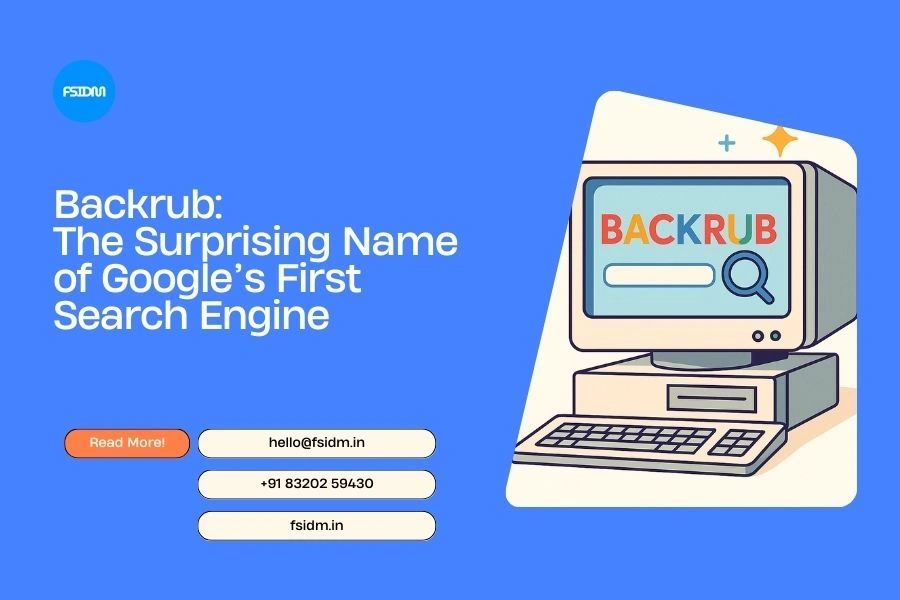
When we hear the word “Google” today, we instantly think of the most powerful search engine in the world — a verb synonymous with looking up anything online. But did you know that Google wasn’t always called Google? In fact, the first version of the world’s most popular search engine had a rather unexpected and quirky name: Backrub.
🧐 Why “Backrub”?
In 1996, two Stanford Ph.D. students — Larry Page and Sergey Brin — were working on a research project that analyzed the web’s linking structure. They believed that links between websites could be a valuable signal of a page’s authority and relevance.
The search engine they created worked by “crawling” the internet’s backlinks — the links pointing from one website to another — to determine how important a particular page was. Hence, they decided to call their project Backrub.
The idea was simple but brilliant: instead of ranking pages based only on content or keywords, Backrub ranked them based on how many other pages linked to them and the quality of those links — something now known as PageRank, a revolutionary algorithm named after Larry Page.
🤔 What Was Backrub Like?
Backrub lived on Stanford’s servers, and the homepage read:
“Backrub is written in Java and Python. It runs on several Sun Ultras and Intel Pentiums running Linux. The primary database is kept on a Sun Ultra II with 28GB of disk.”
It was a humble beginning for what would become a tech giant.
💡 When Did Backrub Become Google?
In 1997, Larry and Sergey decided that the name Backrub wasn’t quite right for a global product. They brainstormed for a new name that would reflect their mission to organize the world’s information.
They settled on the word “Googol”, which is a mathematical term for the number 1 followed by 100 zeros — symbolizing the massive scale of information they aimed to index.
Due to a happy accident (or typo), they registered the domain as Google.com, and the rest is history.
📈 Why This Origin Matters
Knowing the story behind Google’s name isn’t just trivia — it tells us a lot about:
- The evolution of internet search
- The importance of backlinks in SEO (even today!)
- How innovation often starts with simple, experimental ideas
Backrub laid the groundwork for modern search engines. It wasn’t flashy, but it was functional, data-driven, and user-focused — values that Google still follows today.
🔍 Final Thoughts
From Backrub to Google, this transformation reflects how a small idea — when paired with the right vision and execution — can truly change the world.
So the next time you Google something, just remember: you’re actually using a platform that once proudly went by the name Backrub. 😉
📌 Quick Facts:
- Year: 1996
- Created by: Larry Page & Sergey Brin
- Original name: Backrub
- Reason for name: Analyzed web “backlinks”
- Rebranded as: Google (in 1997)