


July 24, 2026
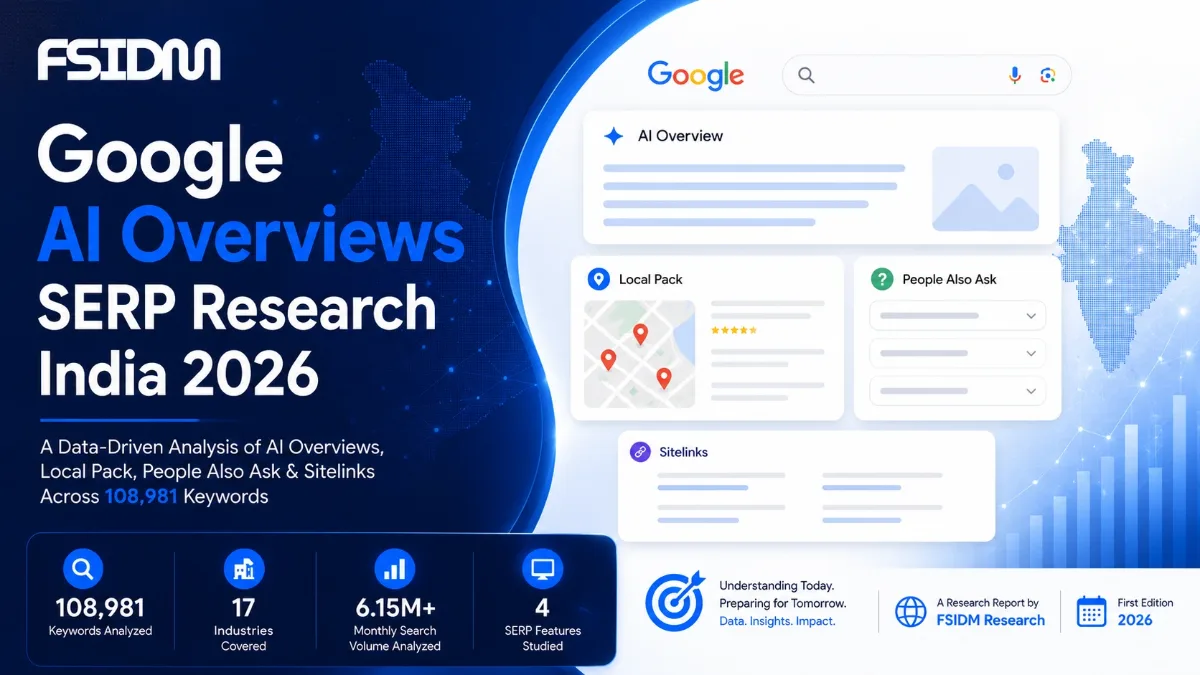
A Data-Driven Analysis of AI Overviews, Local Pack, People Also Ask & Sitelinks Across 108,981 Keywords India’s most comprehensive Google...
#1 Practical Digital Marketing Course
Enhance Your Digital Skills, Join AI-Powered Advanced Digital Marketing Course With Placements, Freelancing and Own Startup with Best Practice.
3-Month Course with Basic to Advanced Learning and 2 Month Internship

Learn future-ready marketing skills with AI-powered tools and automation. Master AI SEO, GEO, AEO, AI Overviews, ChatGPT, Claude, copilot marketing, AI social media strategies, AI Automation, AI agents and advanced AI workflows used by modern AI digital marketers.

Create high-converting content using AI tools and smart prompting techniques. Learn AI content writing, image prompting, video prompting, AI reels creation, ad copywriting, social media content, and prompt engineering practically.

Build professional websites, landing pages, funnels, and AI automation systems. Learn WordPress, Shopify, Elementor, AI chatbots, WhatsApp automation, lead automation, email workflows, and no-code automation tools.

Boost organic traffic with expert strategies in On-Page, Off-Page, Technical, and Local SEO.

Learn to manage and optimize paid search campaigns on platforms like Google Ads.

Utilize Performance Max, YouTube Ads, Search ad, Discovery Ads, and advanced targeting techniques.

Run high-converting ad campaigns across Google, Meta, and LinkedIn with tracking.

Build engaging brand presence through organic and paid strategies on all major social platforms.

Create powerful email workflows using Brevo, Mailchimp, and HubSpot Marketing to nurture leads.

Master storytelling, ad copy, blog writing, and strategic content planning.

Design stunning visuals using tools like Canva and Adobe Express for ads, posts, and brand creatives.

Build business websites and landing pages using WordPress and other beginner-friendly platforms.
Integrate AI tools like ChatGPT, Copilot, SEMrush, and more to enhance your digital marketing game.
Internship certificate, resume building, personal mentorship, and guidance for jobs, freelancing, or launching startup.
Learn how to scale your brand, generate leads, and manage your digital presence without depending on agencies.
Every module of our digital marketing course in Ahmedabad – 108 across 19 tracks, covering SEO, Google & Meta Ads, social media, AI SEO, GEO, prompt engineering, AI video and full marketing automation. Filter, search, and open any track to see exactly what you learn.
Showing all 108 modules
No module matches that search. Try SEO, ads, AI or automation.
Practical, Career-Driven Digital Marketing Training at an Honest Price
No hidden charges. No bloated packages. Just one powerful course designed to get you results — faster, smarter, and more affordably.

Your Guru
With over a decade of experience in the digital marketing industry, Pranav Veerani has a proven track record of driving online success through innovative strategies and hands-on training. Specializing in SEO, SEM, content marketing, social media marketing, paid marketing, performance marketing, and more, Pranav is dedicated to helping businesses master the skills needed to excel in the digital landscape. He has worked with clients across various industries, including IT, real estate, clothing, education, healthcare, e-commerce ,recruitment, and many others, delivering impactful results tailored to each niche.
Whether you’re looking to sharpen your skills or seek guidance for long-term digital growth, you’re in capable hands.
Master
Get hands-on training with the most in-demand digital and AI-powered tools used by top marketers — including Google Ads, Analytics, Search Console, Canva, SEMrush, Mailchimp, ChatGPT, Copy.ai, and more. Learn how to use these tools to plan campaigns, automate tasks, analyze performance, and drive real results.

Students Trained
Years Of Experience
Placement
Started Startup
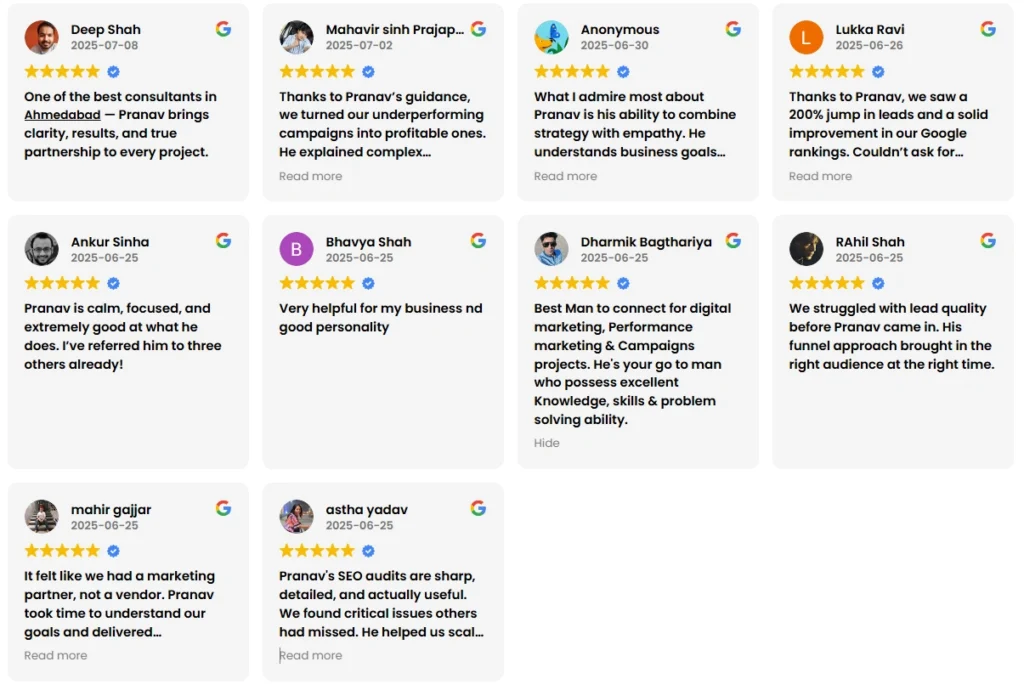
Testimonial

"This course gave me a clear understanding of SEO, PPC, and email marketing. The practical lessons helped me land my first freelance project. Highly recommend it!"

"I went from a beginner to confidently running SEO and social media ads. The feedback and practical approach made all the difference. A must-join course!"

"The course is well-structured and hands-on. I learned SEO, PPC, and tools like Google Ads and Canva—plus, I got an internship right after! Best decision ever."

"This course simplified digital marketing for me. I now run SEO and email campaigns for my online store. Perfect for anyone serious about marketing!"
Posted on Google
 Viraj Gajjar
Trustindex verifies that the original source of the review is Google.
I now freelance for 2 clients and actually earn while I study. BestttttPosted on Google Parth MehtaThe course helped me transition from a generalist to a digital-first thinker.Posted on Google
 Simran Lohar“Just finished my Digital Marketing course and I’m really happy with the experience. The mentor explained every topic clearly and provided excellent guidance throughout the course. Thankss for sharing your valuable knowledge with me...☺️🤟Load more
Everything a counsellor would walk you through about the digital marketing course in Ahmedabad – the full 108-module curriculum, the fee, batch timings, the tools you will work on and your certificates. Read it before you decide.
Learn from industry expert Pranav Veerani through a hands-on, AI-powered course covering SEO, SMM, Email Marketing, PPC, and more — with internship certification, placement support, and startup guidance to help you land a job, start freelancing, or build your own startup.
Anyone! Whether you're a student, working professional, entrepreneur, or business owner — our course is designed to suit all levels of experience.
Not at all. We start from the basics and gradually move to advanced strategies with full hands-on support.
All sessions are conducted online with live interactive training, allowing you to learn from anywhere with real-time guidance and personal mentorship.
Yes! We offer 100% placement assistance, interview prep, and resume building to help you land the right opportunity.
Absolutely. We guide you on how to build your freelancing profile, pitch clients, and manage projects independently.
You’ll learn how to grow your business online using performance marketing, SEO, content strategy, automation, and social media.
You’ll master industry tools like Google Ads, Meta Ads, Canva, SEMrush, ChatGPT, Brevo, Mailchimp, HubSpot, and more.
Yes. You’ll receive a Course Completion Certificate, Internship Letter, and optionally a Letter of Recommendation.
The course spans 3+ months, and includes additional mentorship support.
Yes! Our program includes startup guidance, business mentorship, and even support for building your first digital brand.
Definitely. We include live projects, case studies, and personalized assignments to give you real-world experience.
Yes, we offer continuous guidance, access to the community, and updated materials even after course completion.
Choosing the right place to learn digital marketing can completely transform your career — and that’s why FSIDM stands out as one of the most advanced, practical, and future-ready institutes in India.
At FSIDM, we don’t just teach digital marketing — we help you master it through real-time projects, hands-on assignments, and AI-powered tools. Every student learns how to combine creativity, analytics, and automation to deliver impactful digital campaigns that work in the real world.
FSIDM focuses on a practical, project-driven learning style.
Instead of boring theory, you’ll work on live SEO campaigns, social media ads, Google Ads, and content marketing strategies using the latest industry platforms.
Our curriculum covers every key aspect of modern marketing — SEO, SEM, Social Media, Email Marketing, Content Strategy, and Data Analytics — all powered by real industry tools.
What truly makes FSIDM different is our integration of AI tools that are shaping the future of digital marketing.
Students at FSIDM are trained to use ChatGPT for content ideation, ad copy creation, and keyword strategy.
You’ll also explore Google Gemini, Jasper AI, Canva Magic Write, and Notion AI to understand how artificial intelligence is transforming marketing creativity and efficiency.
By learning these tools inside FSIDM, students become future-ready marketers who can automate repetitive tasks, analyze large datasets, and generate high-quality creative content faster than ever.
In short, FSIDM helps you stay ahead of the curve in an AI-driven digital world.
Another powerful reason to choose FSIDM is the mentorship you receive. Each batch is led by experienced marketing professionals who have worked on national and international campaigns.
These mentors not only guide you through your course but also help you understand client psychology, analytics interpretation, and performance optimization.
FSIDM ensures that every learner receives one-on-one attention, career advice, and support to grow confidently.
The FSIDM ecosystem also connects you with a vibrant community of learners, alumni, and experts — creating collaboration opportunities, internships, and freelance projects.
You’ll learn to manage campaigns using tools like Google Analytics, Google Ads, Meta Business Suite, SEMrush, Ahrefs, Canva, ChatGPT, and Gemini — all under one program.
FSIDM constantly updates its syllabus to match the latest digital trends, Google algorithm updates, and AI innovations.
Whether it’s learning how to optimize ChatGPT prompts, automate content calendars using AI, or analyze SEO reports through data-driven dashboards, FSIDM ensures you gain the latest practical skills that employers value.
Finally, FSIDM isn’t just about learning; it’s about transformation.
With strong placement assistance, certification support, and a portfolio-based training model, FSIDM prepares you for real-world success.
You’ll graduate not just with knowledge but with confidence, practical skills, and a professional mindset that sets you apart.
FSIDM is where traditional marketing meets AI innovation.
If you’re ready to build a future-proof career in digital marketing, FSIDM is your launchpad — practical, AI-powered, and results-driven.
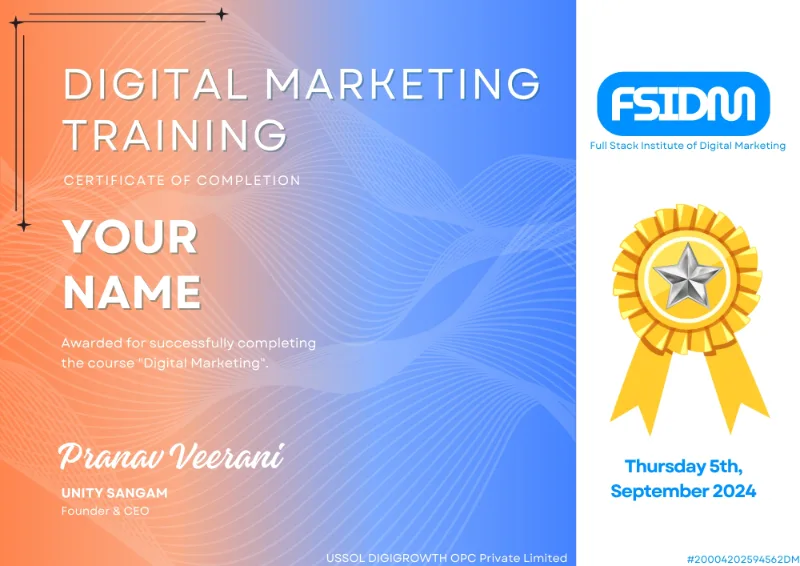
Digital Marketing Course Certificate
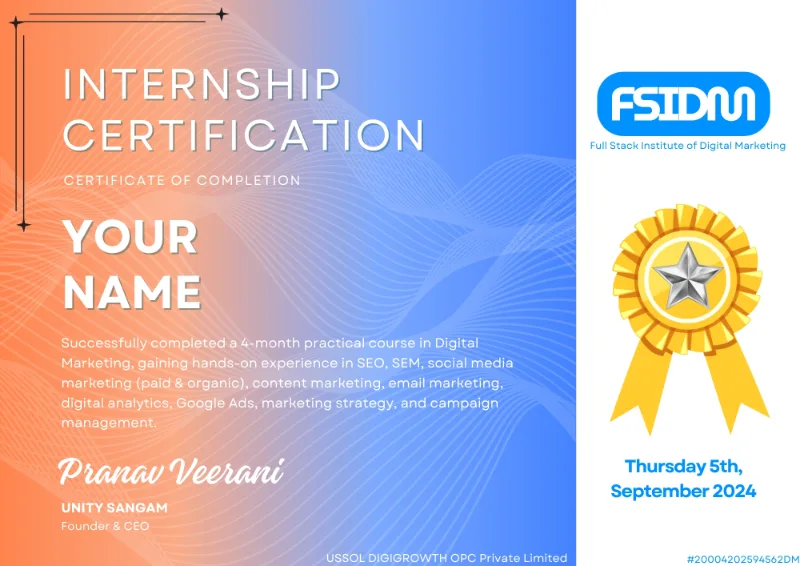
Internship Certificate
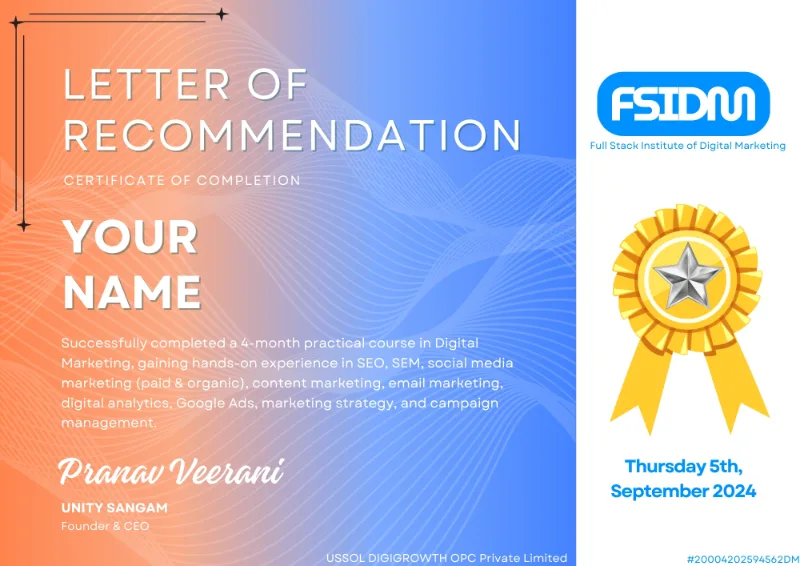
Letter of Recommendation
Whether you're a student, professional, entrepreneur, or career switcher – we have flexible weekday and weekend batches designed to match your lifestyle. Course Duration : 3 Month
Perfect for consistent daily learners, job seekers, or working professionals looking to upskill without disrupting their routine.
|
Batch Name
|
Timing
|
Duration
|
Perfect For
|
|---|---|---|---|
|
Sunrise Hustlers
|
6:00 AM – 7:00 AM
|
1 Hour
|
Early risers, students
|
|
Morning Motivators
|
7:00 AM – 8:00 AM
|
1 Hour
|
College students, freshers
|
|
Growth Kickstart
|
8:00 AM – 9:00 AM
|
1 Hour
|
Job seekers, freelancers
|
|
Power Hour
|
9:00 AM – 10:00 AM
|
1 Hour
|
WFH professionals
|
|
Brunch Brains
|
10:00 AM – 11:00 AM
|
1 Hour
|
Flexible learners, entrepreneurs
|
|
Digital Doers
|
11:00 AM – 12:00 PM
|
1 Hour
|
Hustlers & consultants
|
|
Noon Ninjas
|
12:00 PM – 1:00 PM
|
1 Hour
|
College-goers & remote workers
|
|
Lunch & Learn
|
1:00 PM – 2:00 PM
|
1 Hour
|
Busy professionals on lunch break
|
|
Skill Boosters
|
2:00 PM – 3:00 PM
|
1 Hour
|
Digital nomads, students
|
|
Afternoon Achievers
|
3:00 PM – 4:00 PM
|
1 Hour
|
Flexible jobholders
|
|
Coffee Coders
|
4:00 PM – 5:00 PM
|
1 Hour
|
Designers & marketers
|
|
Tea Time Trainers
|
5:00 PM – 6:00 PM
|
1 Hour
|
After-office learners
|
|
Evening Experts
|
6:00 PM – 7:00 PM
|
1 Hour
|
Beginners, returning professionals
|
|
Prime Time Players
|
7:00 PM – 8:00 PM
|
1 Hour
|
Entrepreneurs, job switchers
|
|
Night Ninjas
|
8:00 PM – 9:00 PM
|
1 Hour
|
Side hustlers, upskillers
|
|
Late Night Legends
|
9:00 PM – 10:00 PM
|
1 Hour
|
Full-timers, ambitious learners
|
Best for deep-dive learners, full-time professionals, or weekend warriors who prefer focused, high-intensity learning.
|
Batch Name
|
Timing
|
Duration
|
Perfect For
|
|---|---|---|---|
|
Weekend Warriors
|
6:00 AM – 8:00 AM
|
2 Hours
|
Early risers, go-getters
|
|
Sunshine Sprinters
|
7:00 AM – 9:00 AM
|
2 Hours
|
Students, side-hustlers
|
|
Focus Fuelers
|
9:00 AM – 11:00 AM
|
2 Hours
|
Working professionals & freelancers
|
|
Skill Surge
|
11:00 AM – 1:00 PM
|
2 Hours
|
Remote workers, digital nomads
|
|
Growth Gurus
|
1:00 PM – 3:00 PM
|
2 Hours
|
Post-lunch learners
|
|
Hustle Hub
|
3:00 PM – 5:00 PM
|
2 Hours
|
Entrepreneurs, consultants
|
|
Twilight Transformers
|
5:00 PM – 7:00 PM
|
2 Hours
|
Office-goers, creative professionals
|
|
Night Owls
|
7:00 PM – 9:00 PM
|
2 Hours
|
Late learners, weekend warriors
|
FSIDM Blog
A Data-Driven Analysis of AI Overviews, Local Pack, People Also Ask & Sitelinks Across 108,981 Keywords India’s most comprehensive Google...
Let’s be very honest. 👉 Most people are using AI like beginners.👉 Top 1% marketers are using AI like a...
Artificial intelligence is entering a new phase. After several years of experimentation with generative models and chat-based tools, 2026 is...
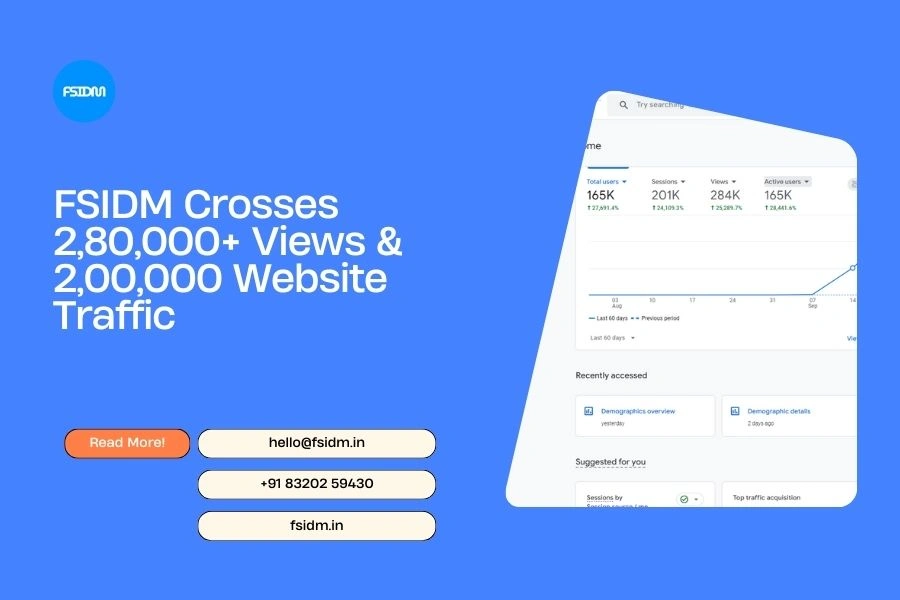
At FSIDM (Full Stack Institute of Digital Marketing), we believe in one golden rule: data never lies. And the latest...
The Work-Life-Upgrade Juggle According to LinkedIn’s Workforce Confidence Index, 74% of professionals in India are either considering a career shift...
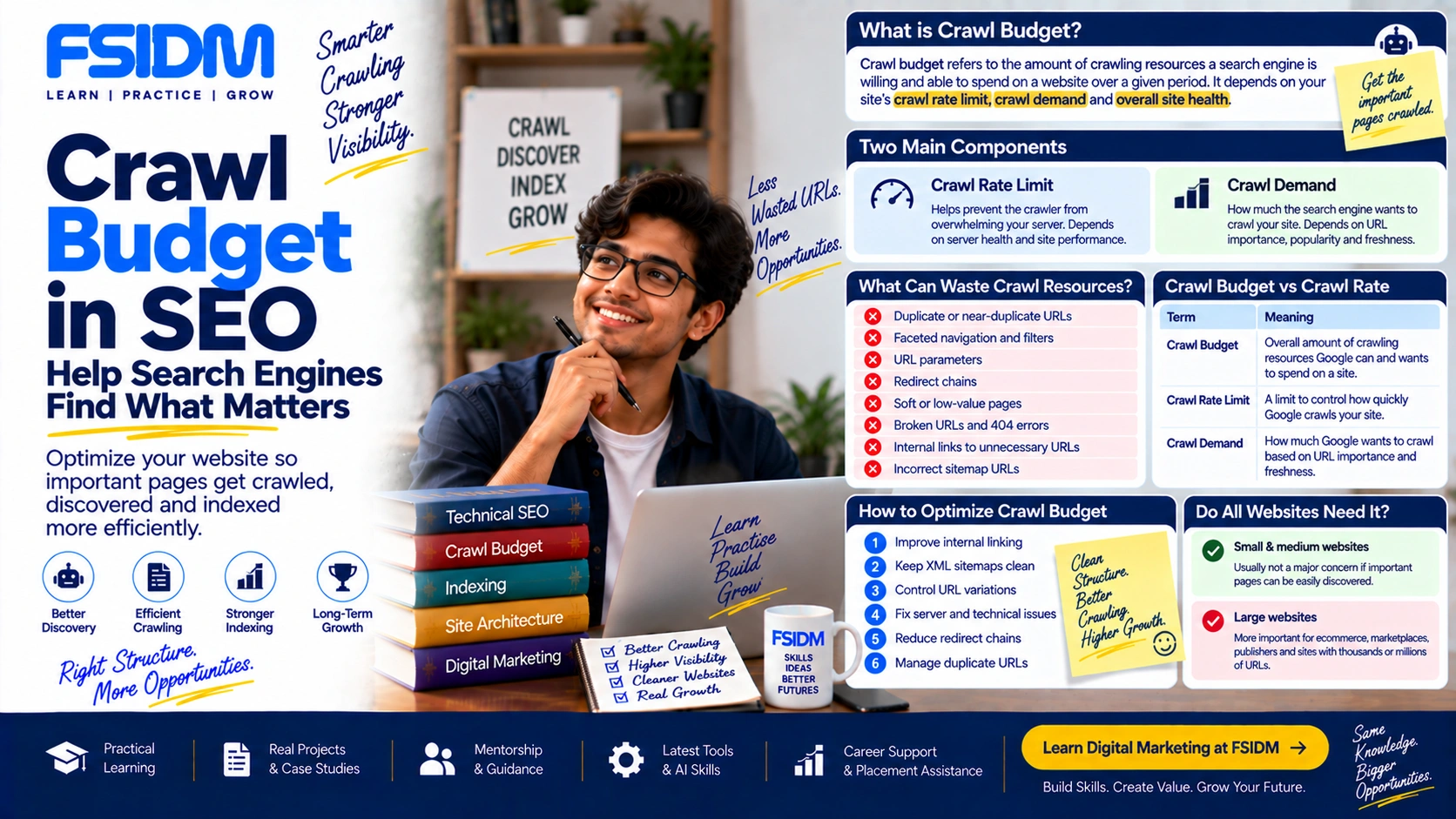
Crawl budget refers to the amount of crawling resources a search engine is willing and able to spend on a...
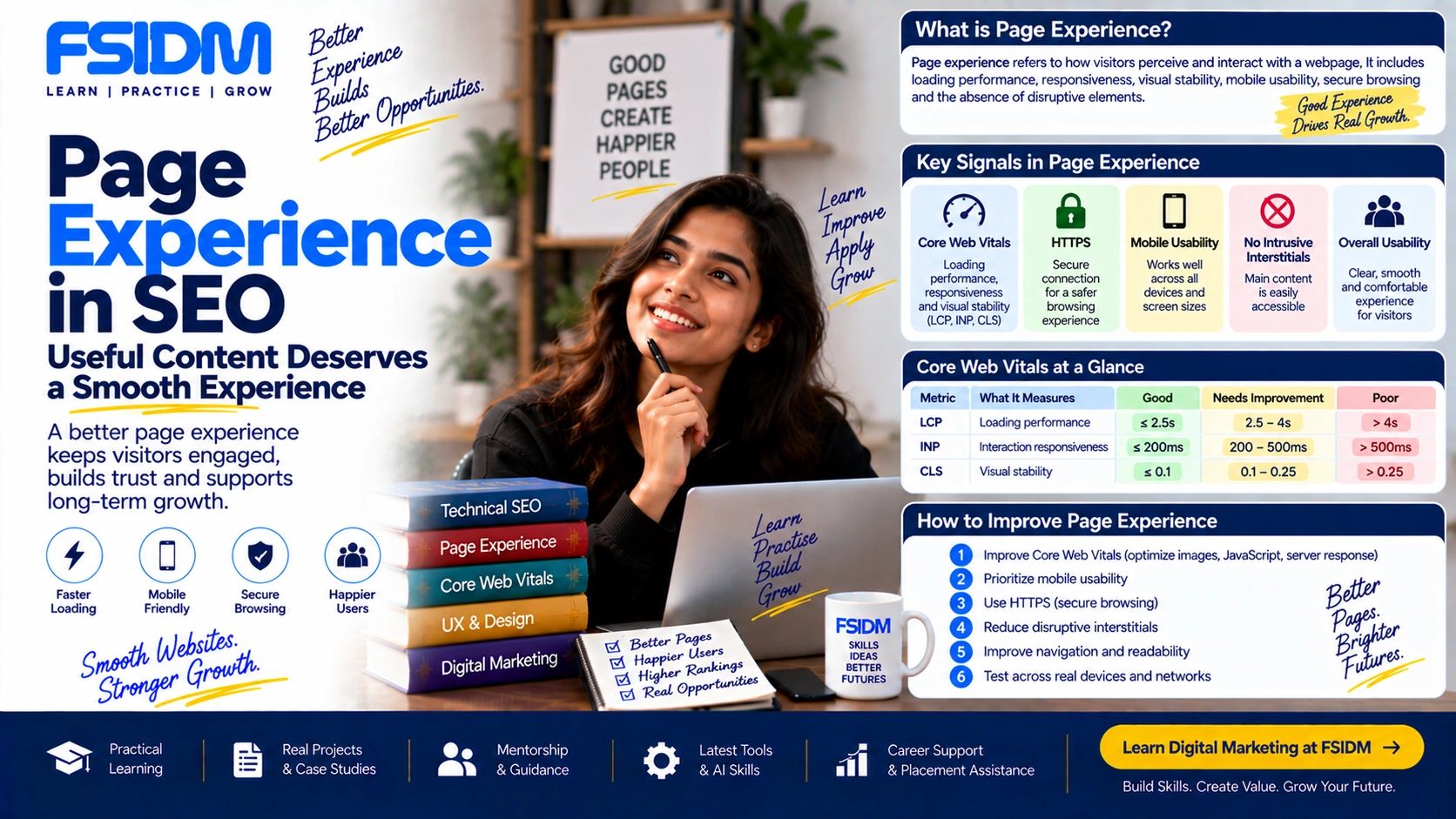
Page experience refers to how visitors perceive and interact with a webpage. In SEO, it describes a collection of signals...
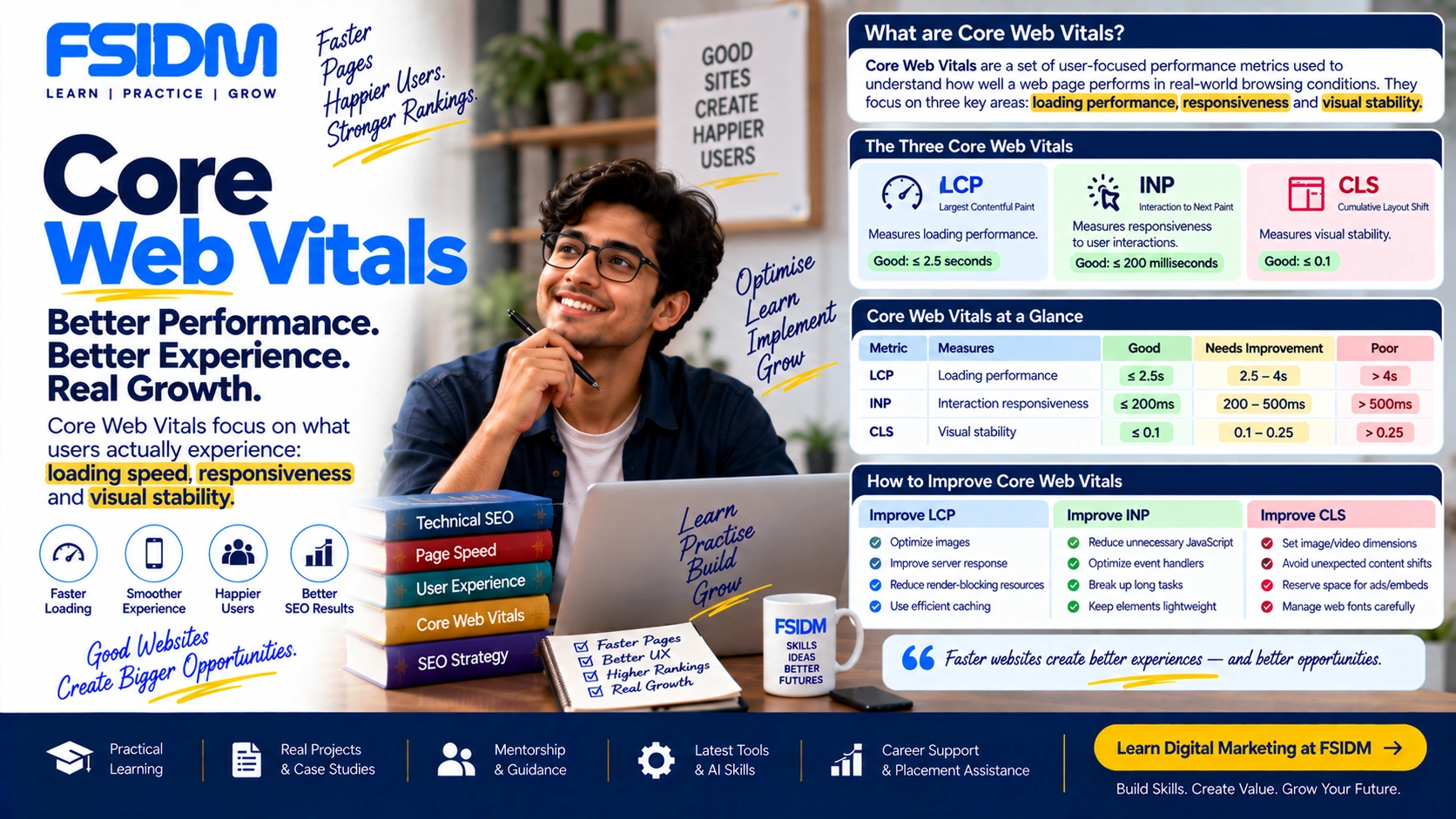
Core Web Vitals are a set of user-focused performance metrics used to understand how well a web page performs in...
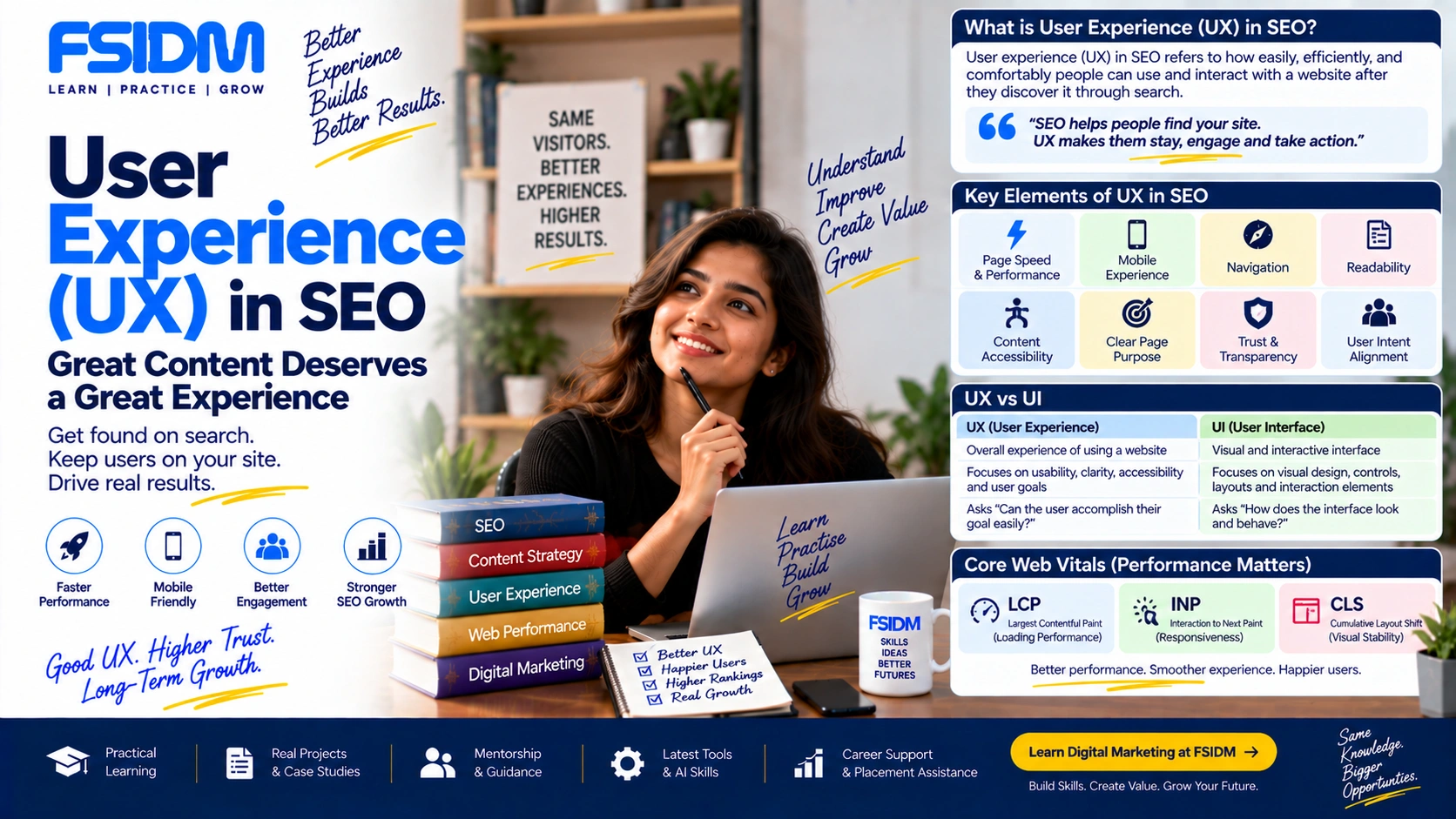
User experience (UX) in SEO refers to how easily, efficiently, and comfortably people can use and interact with a website...
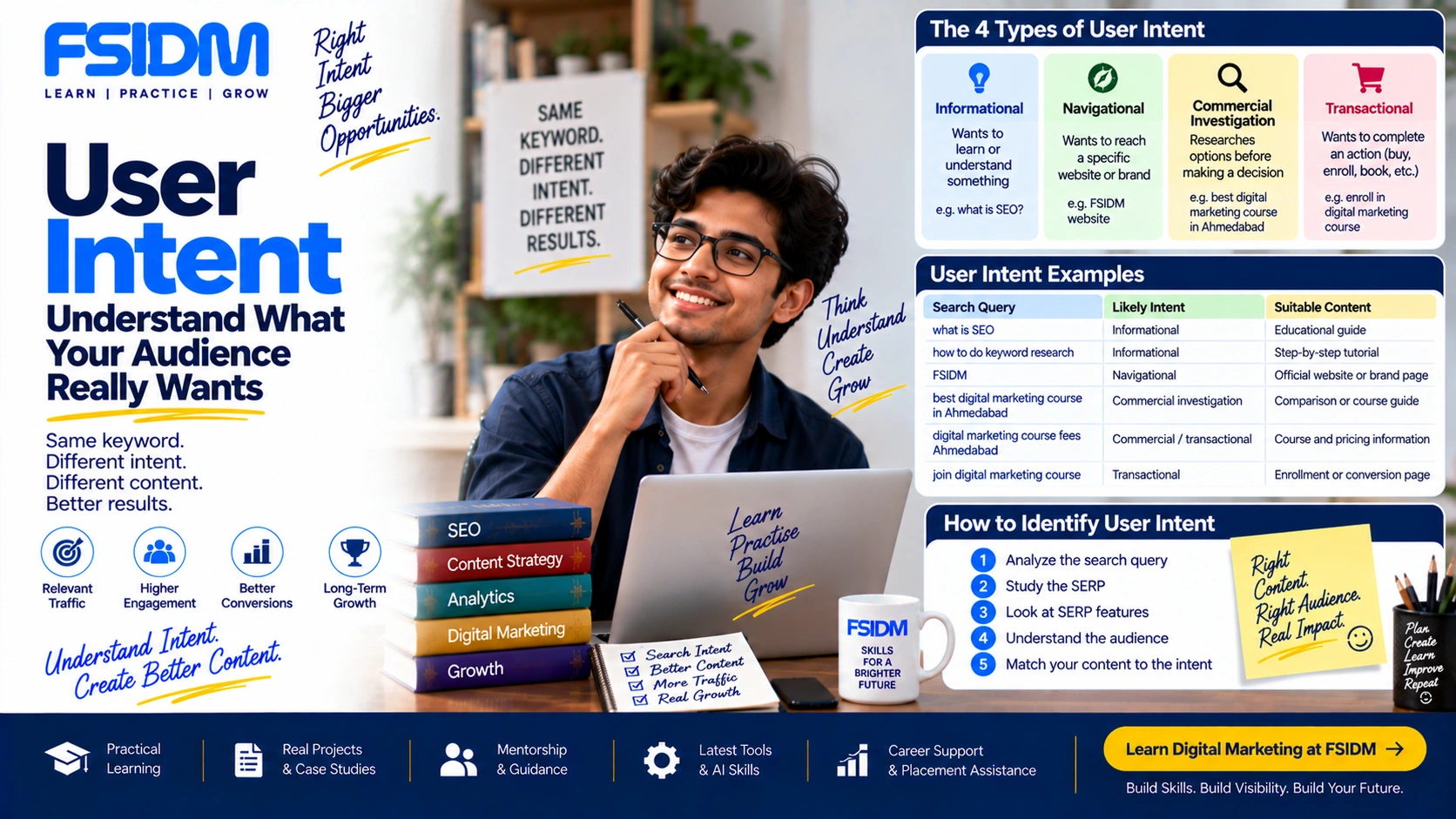
User intent, also called search intent, is the underlying goal or purpose a person has when they enter a search...
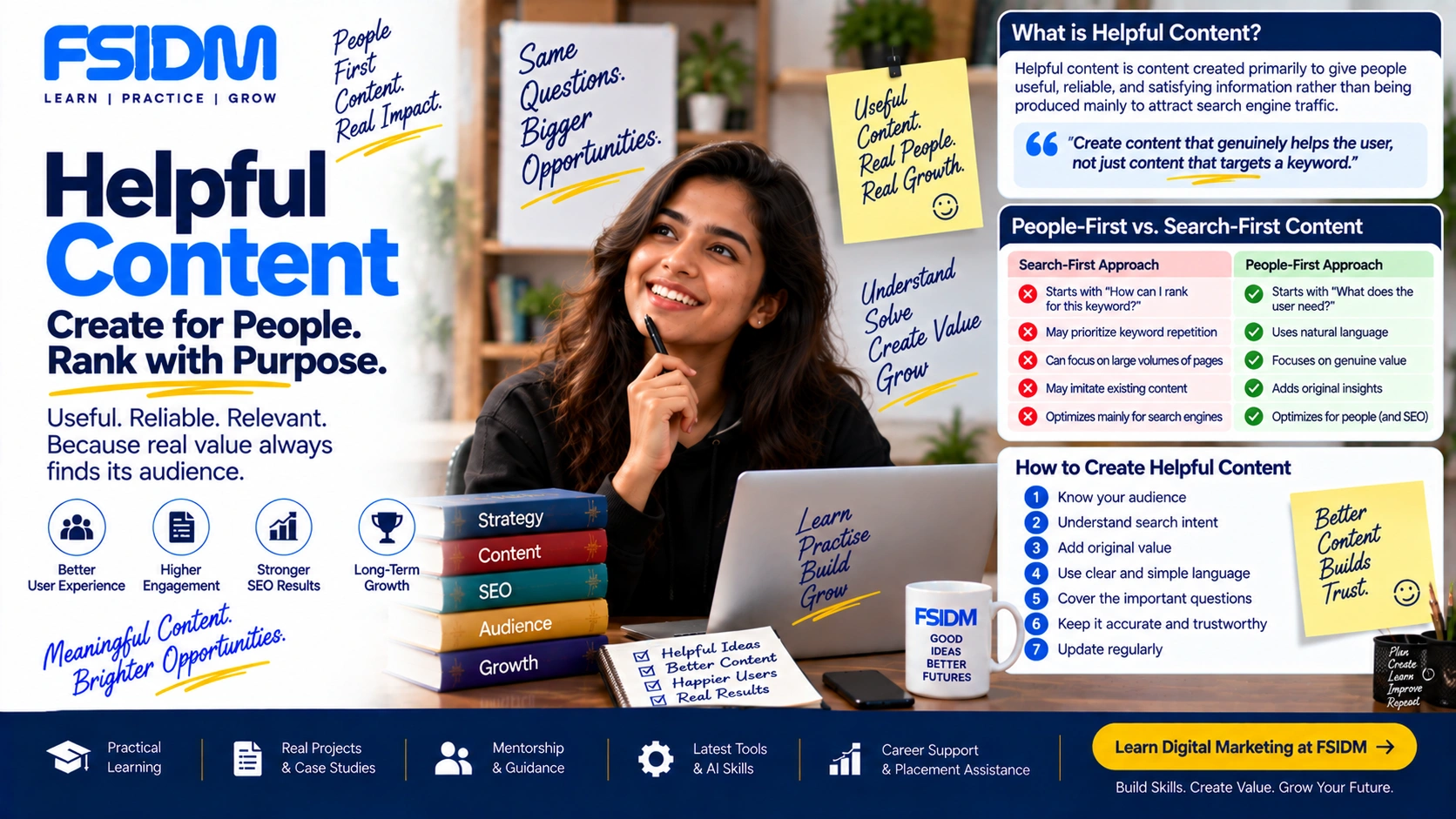
Helpful content is content created primarily to give people useful, reliable, and satisfying information rather than being produced mainly to...
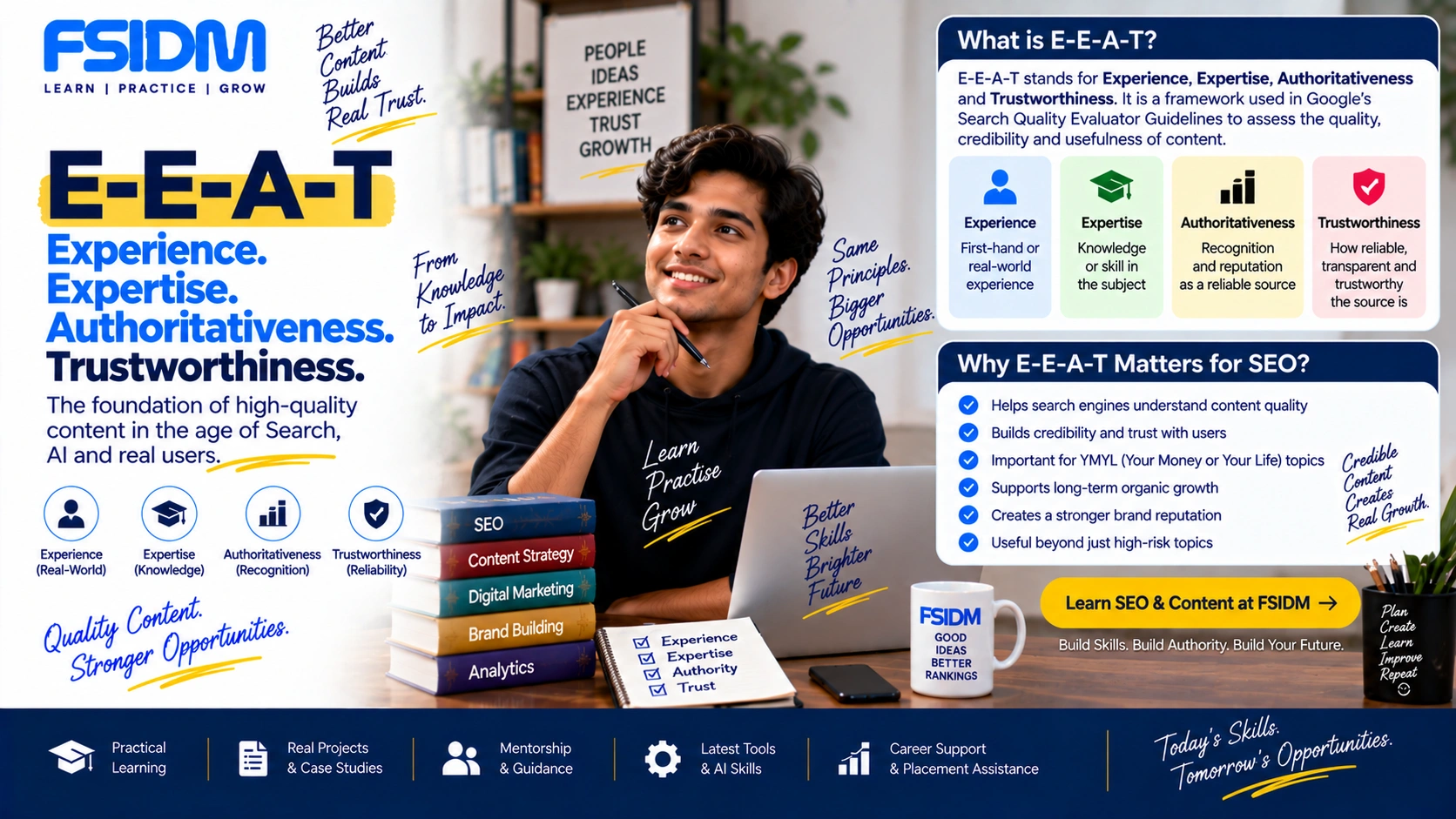
E-E-A-T stands for Experience, Expertise, Authoritativeness, and Trustworthiness. It is a framework used in Google’s Search Quality Evaluator Guidelines to...
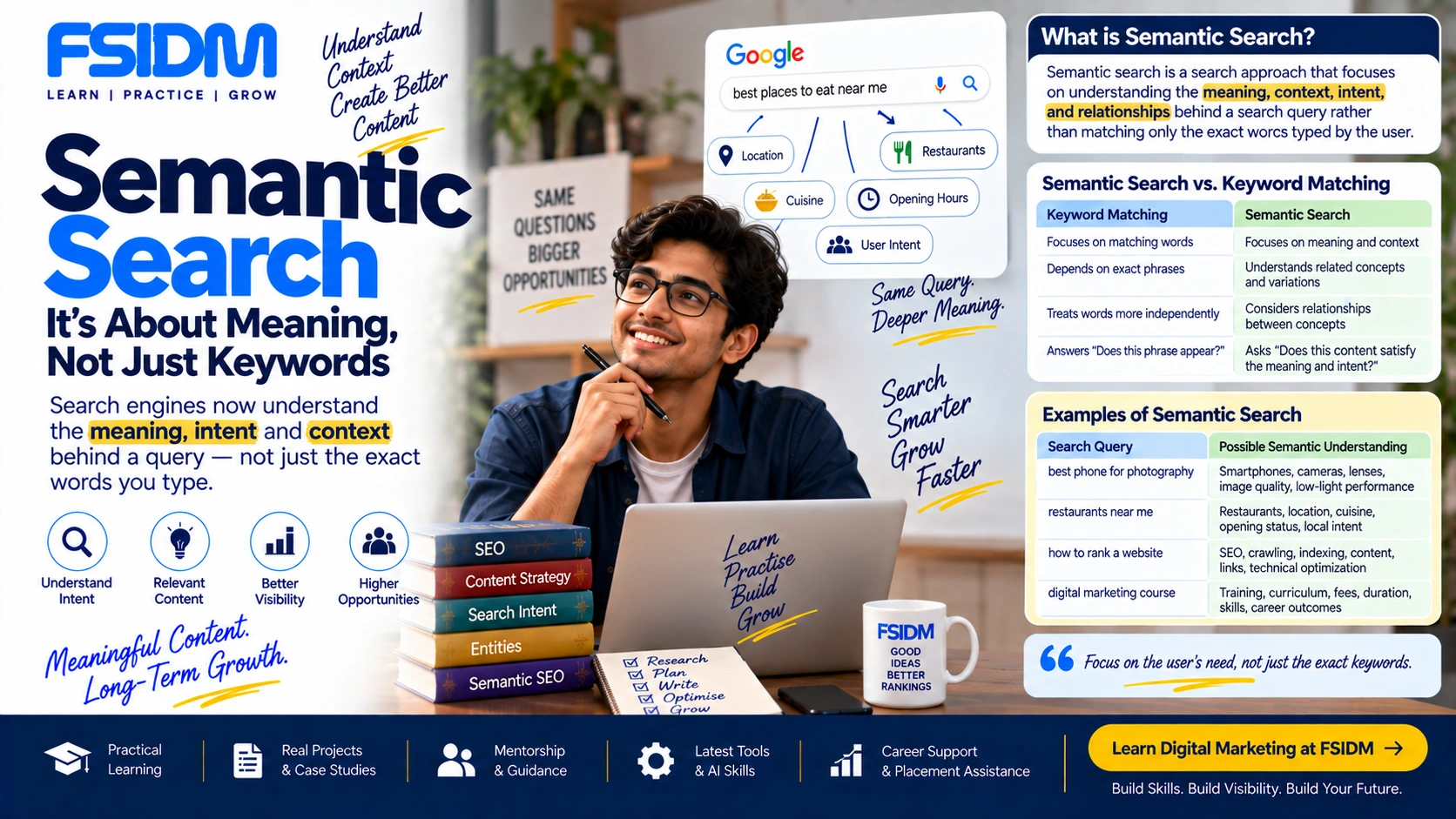
Semantic search is a search approach that focuses on understanding the meaning, context, intent, and relationships behind a search query...
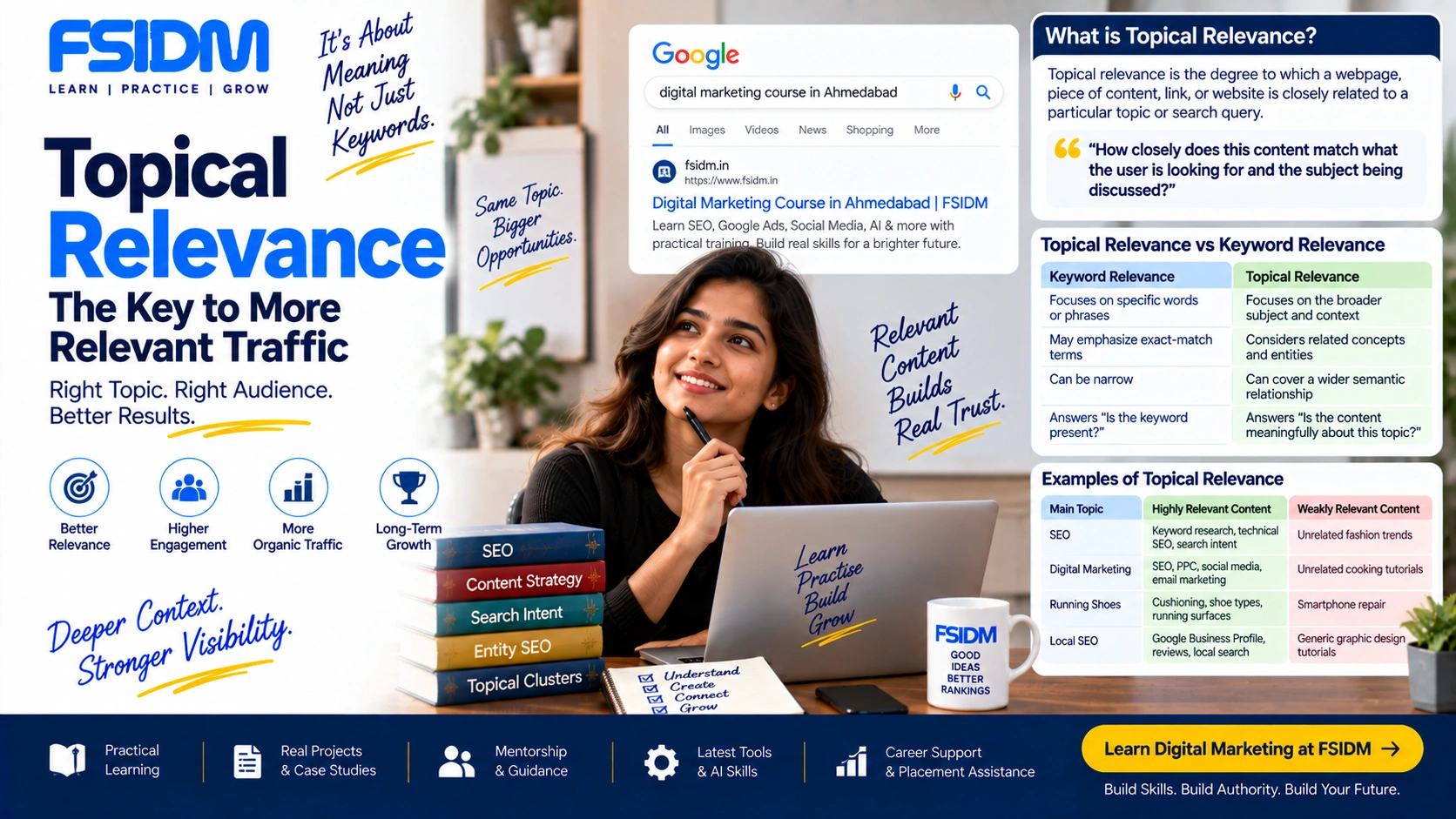
Topical relevance is the degree to which a webpage, piece of content, link, or website is closely related to a...
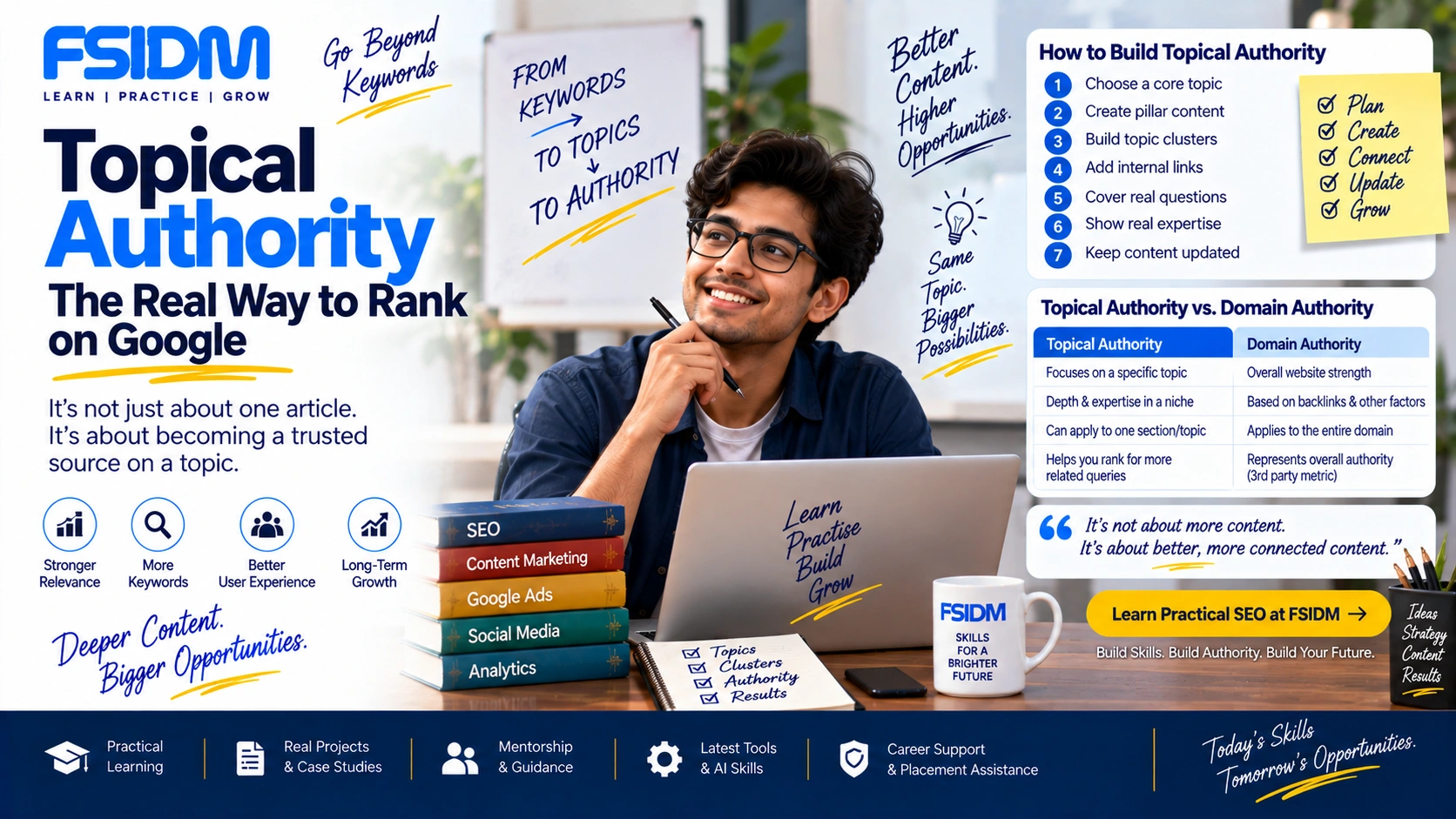
Ranking on Google is no longer just about targeting a keyword and publishing a single article. Search engines increasingly try...
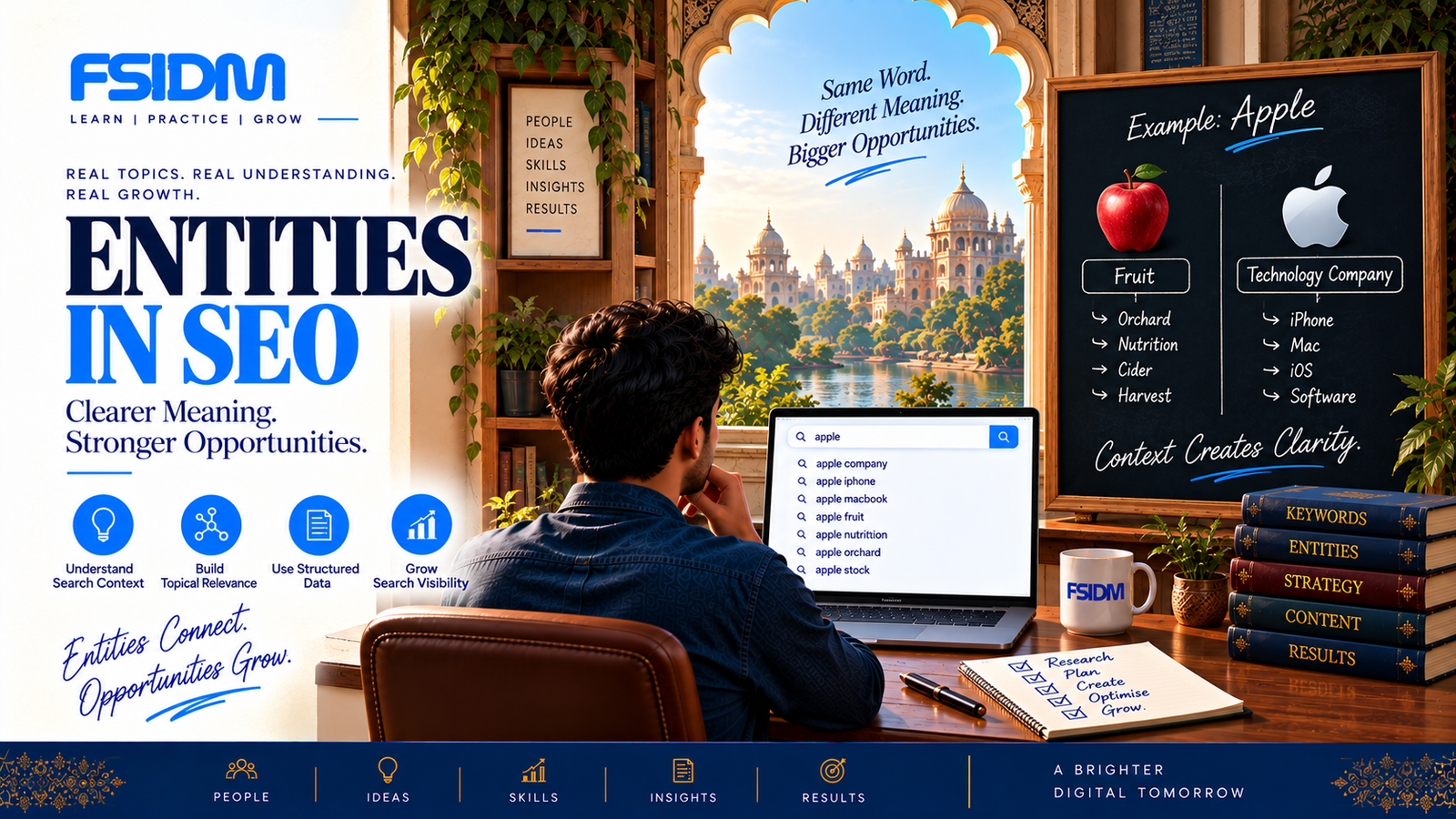
In SEO, an entity is a thing or concept that can be distinctly identified and understood, such as a person,...
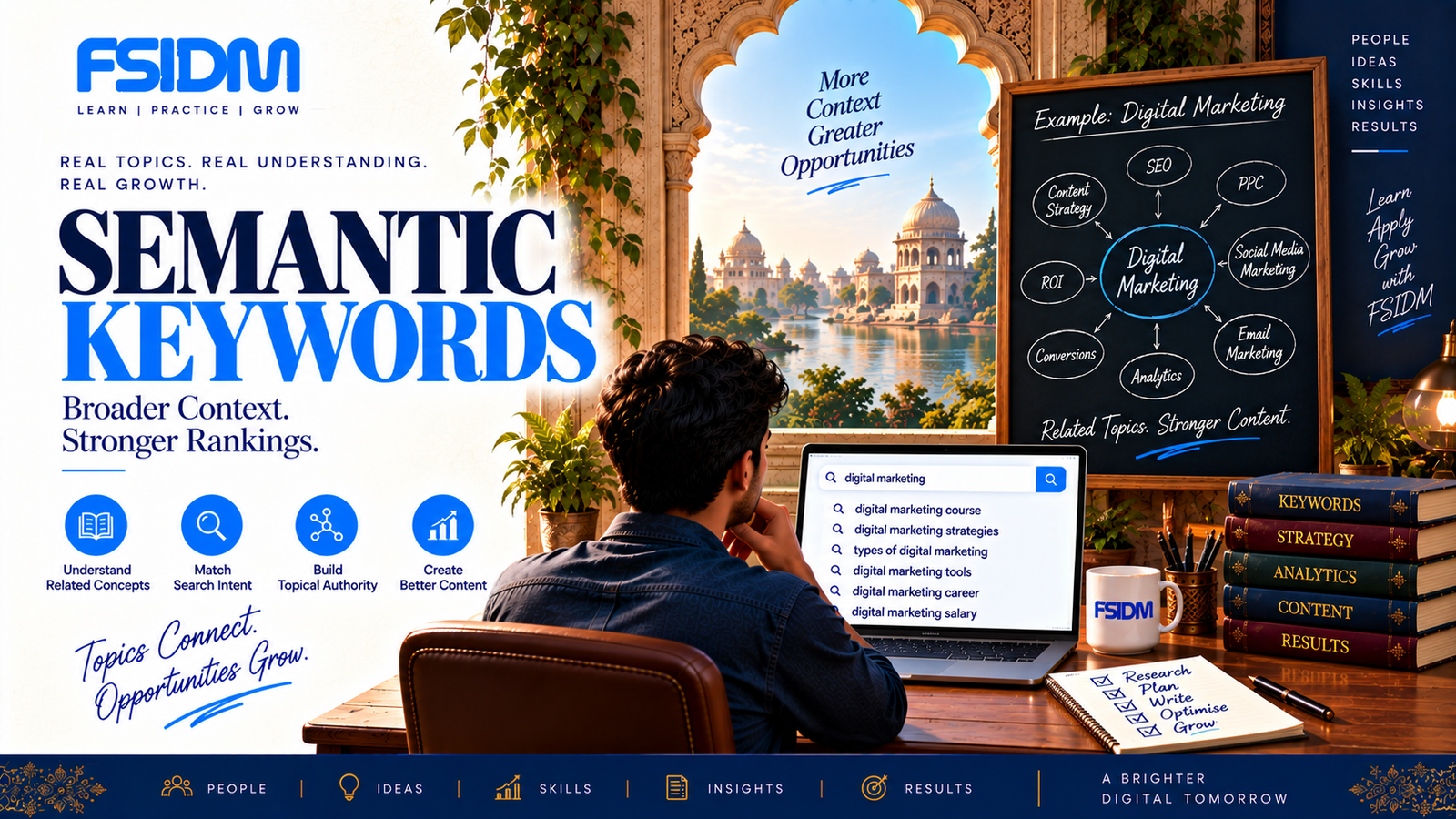
Semantic keywords are words, phrases, concepts, and entities that are contextually related to a primary topic or keyword. They help...
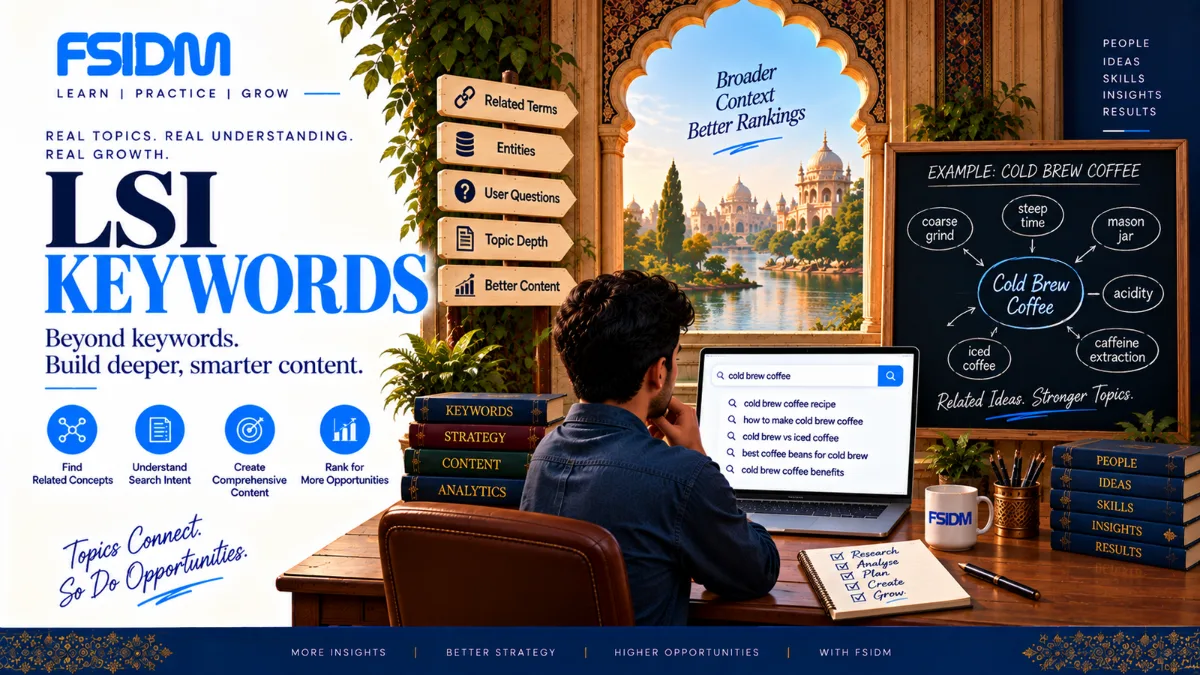
LSI keywords is an SEO industry term commonly used to describe words and phrases that are semantically or contextually related...
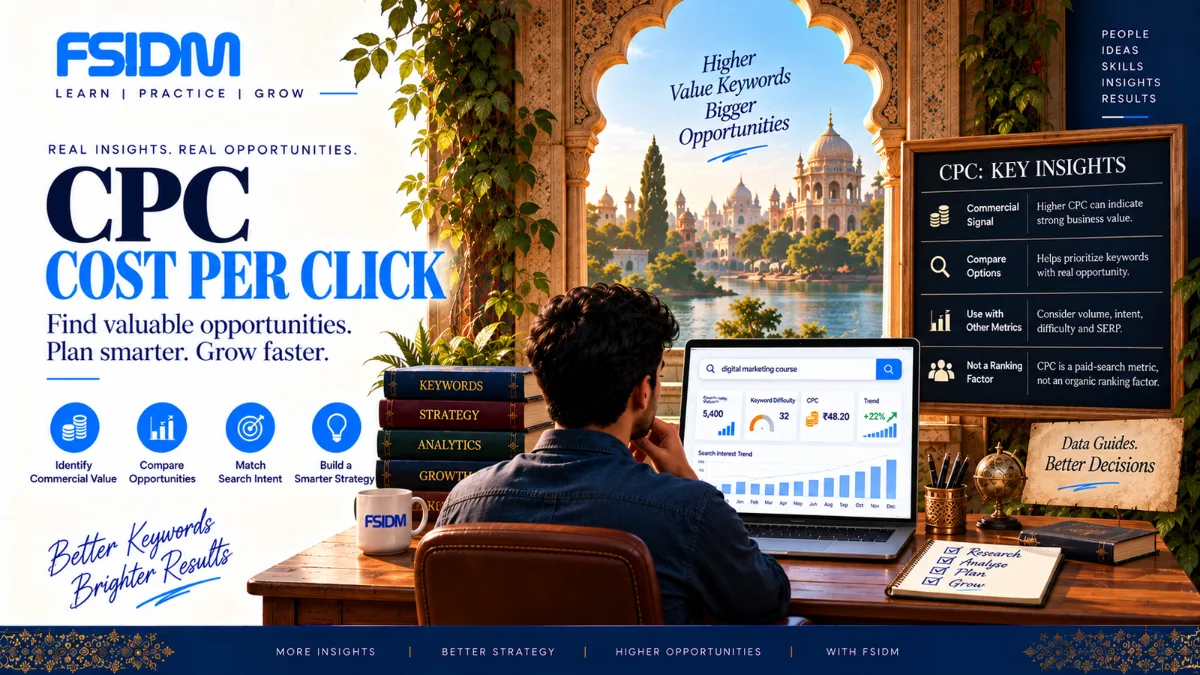
CPC (Cost Per Click) is a paid-search metric that represents the average amount advertisers pay for a click on an...
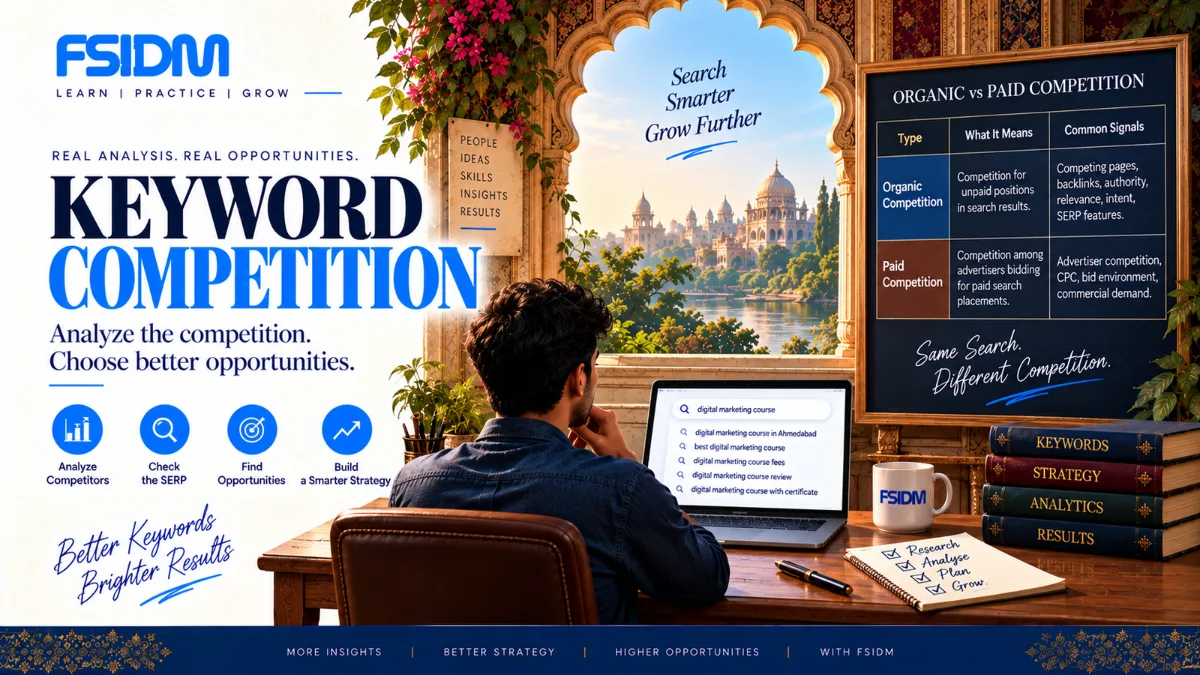
Keyword competition describes how competitive a search term is based on the number and strength of websites or advertisers targeting...
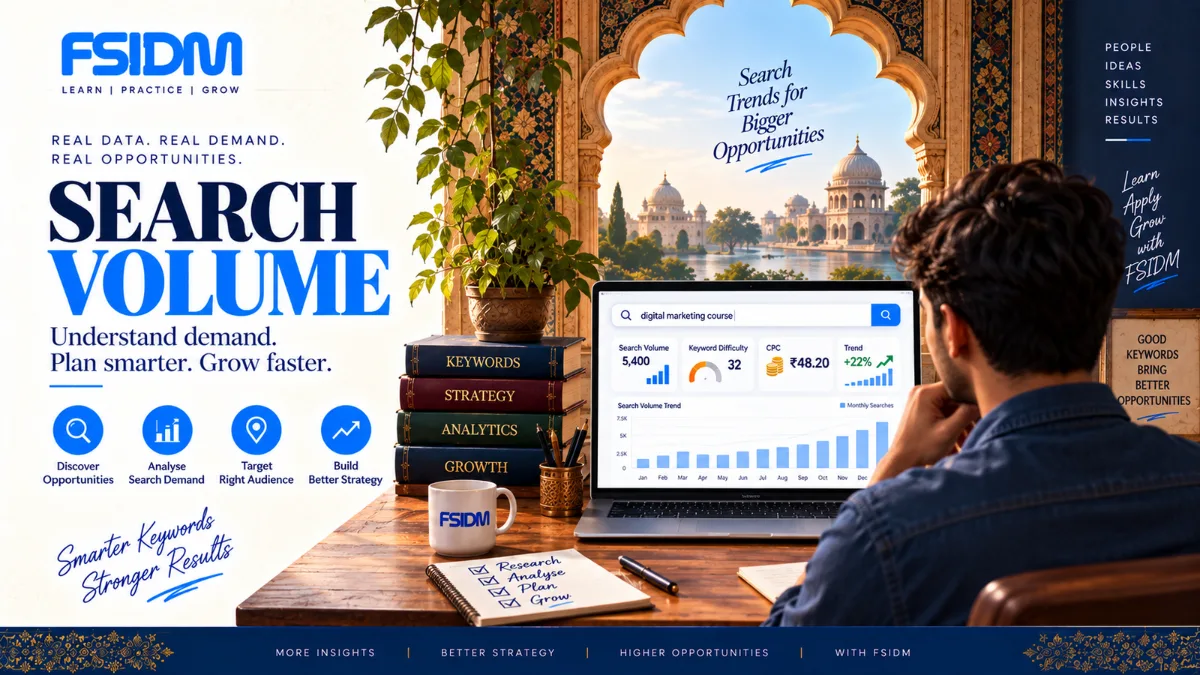
Search volume is an SEO metric that estimates how frequently a specific keyword or search query is searched within a...
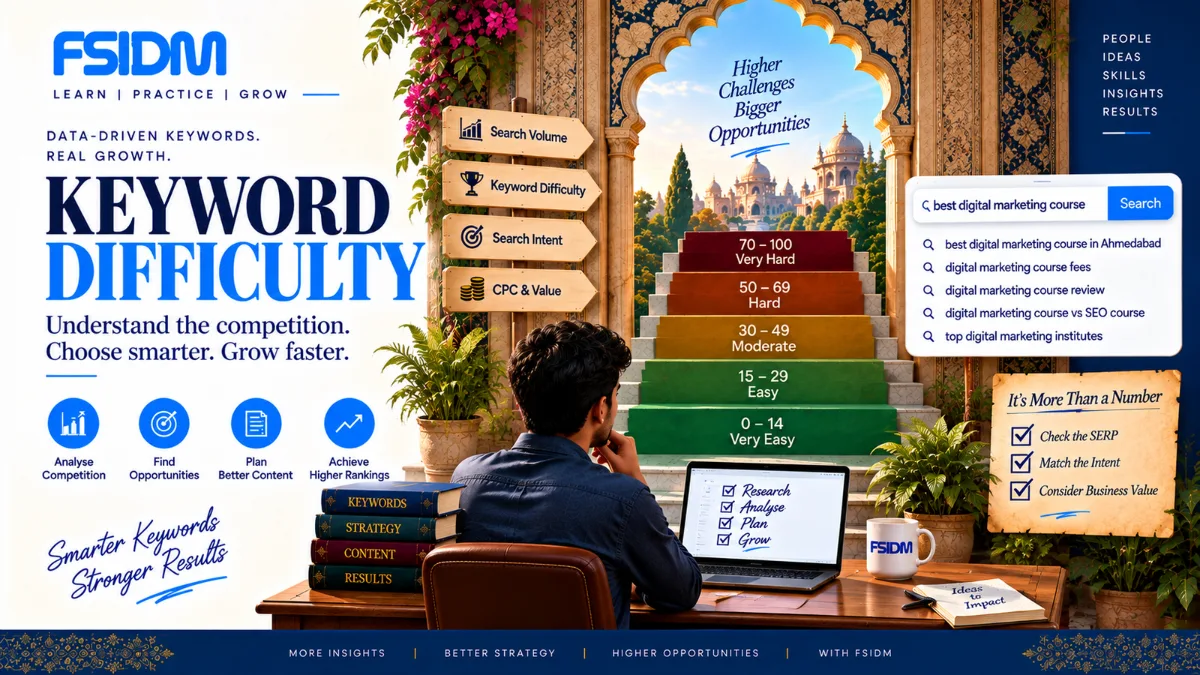
Keyword Difficulty (KD) is an SEO metric used by third-party keyword research tools to estimate how challenging it may be...
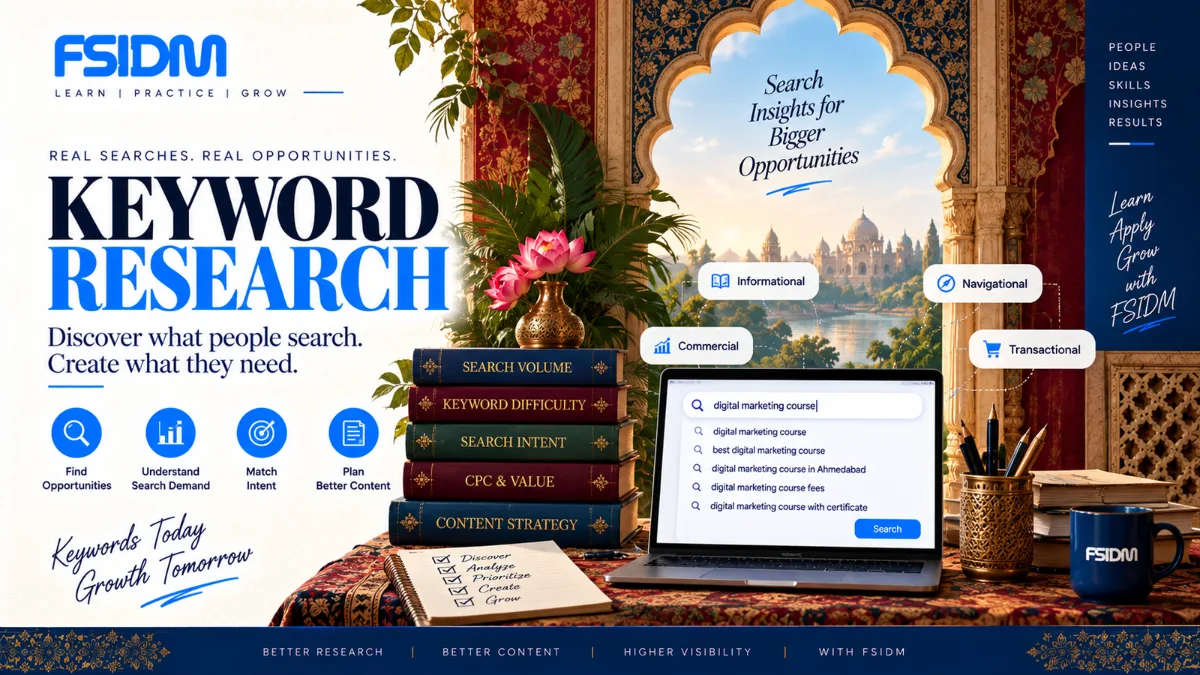
Keyword research is the process of discovering, analyzing, and selecting the search terms people use to find information, products, services,...



Let’s keep this simple.
Digital marketing means promoting products or services using the internet. Every time you search on Google, watch a YouTube video, scroll Instagram, or see an online ad — that’s digital marketing working in the background.
A Digital marketing course in Ahmedabad, India helps people understand how all of this actually works. It explains how brands reach people online and how digital platforms influence everyday decisions.
India is digital-first now. Smartphones are everywhere, internet is affordable, and people trust online information before buying anything.
That’s why learning digital skills has become important. A Digital marketing course in Ahmedabad, India helps learners understand how Indian audiences search, scroll, watch, and buy online.
From local businesses to growing startups, digital marketing is now part of daily business life.
Many people think digital marketing is only about social media. In reality, it’s much more than that.
A Digital marketing course in Ahmedabad, India introduces you to search engines, websites, ads, content, emails, and analytics — all explained step by step.
You learn how Google shows results, why some ads perform better, and how content builds trust over time.
You don’t need to be technical or from a marketing background.
A Digital marketing course in Ahmedabad, India usually starts from basics, using simple language and real-life examples. That’s why students, working professionals, business owners, and even freelancers can understand it easily.
Learning digital marketing is more about logic and understanding people than memorising tools.
AI is now part of everyday digital marketing — quietly working in the background.
A Digital marketing course in Ahmedabad, India today also explains how AI helps analyse data, suggest keywords, improve ads, and speed up content planning.
Think of AI as a helper. It saves time, reduces guesswork, and helps marketers make smarter decisions.
AI does not replace human thinking. It supports it.
A Digital marketing course in Ahmedabad, India helps learners understand how to use AI tools responsibly — without overdependence and without confusion.
The goal is clarity, not complexity.
Digital marketing skills are useful in many ways.
A Digital marketing course in Ahmedabad, India helps job seekers understand industry roles, helps business owners grow online, and helps freelancers offer services confidently.
Even if you don’t work in marketing, understanding digital platforms gives you an advantage in today’s world.
India’s digital audience is unique. Languages, platforms, buying behaviour, and trends are different from other countries.
A Digital marketing course in Ahmedabad, India focuses on this local context, making learning more practical and relatable.
This helps learners connect theory with real Indian examples.
Digital platforms change frequently. Algorithms update, tools improve, and AI keeps advancing.
A Digital marketing course in Ahmedabad, India also teaches learners how to adapt, learn continuously, and stay relevant instead of depending on shortcuts.
Strong basics make future learning easier.
Good marketing still needs human understanding — emotions, trust, creativity, and ethics.
A Digital marketing course in Ahmedabad, India helps learners balance human thinking with AI support, which is becoming an essential skill.
This balance is what modern digital marketing is all about.
Digital marketing is not just about jobs. It’s about understanding the digital world around us.
A Digital marketing course in Ahmedabad, India helps people make informed decisions online, whether they are building a career, a brand, or a business.
With AI becoming part of daily workflows, learning digital marketing is no longer optional. A Digital marketing course in Ahmedabad, India helps learners understand this space clearly, practically, and confidently — without unnecessary complexity.
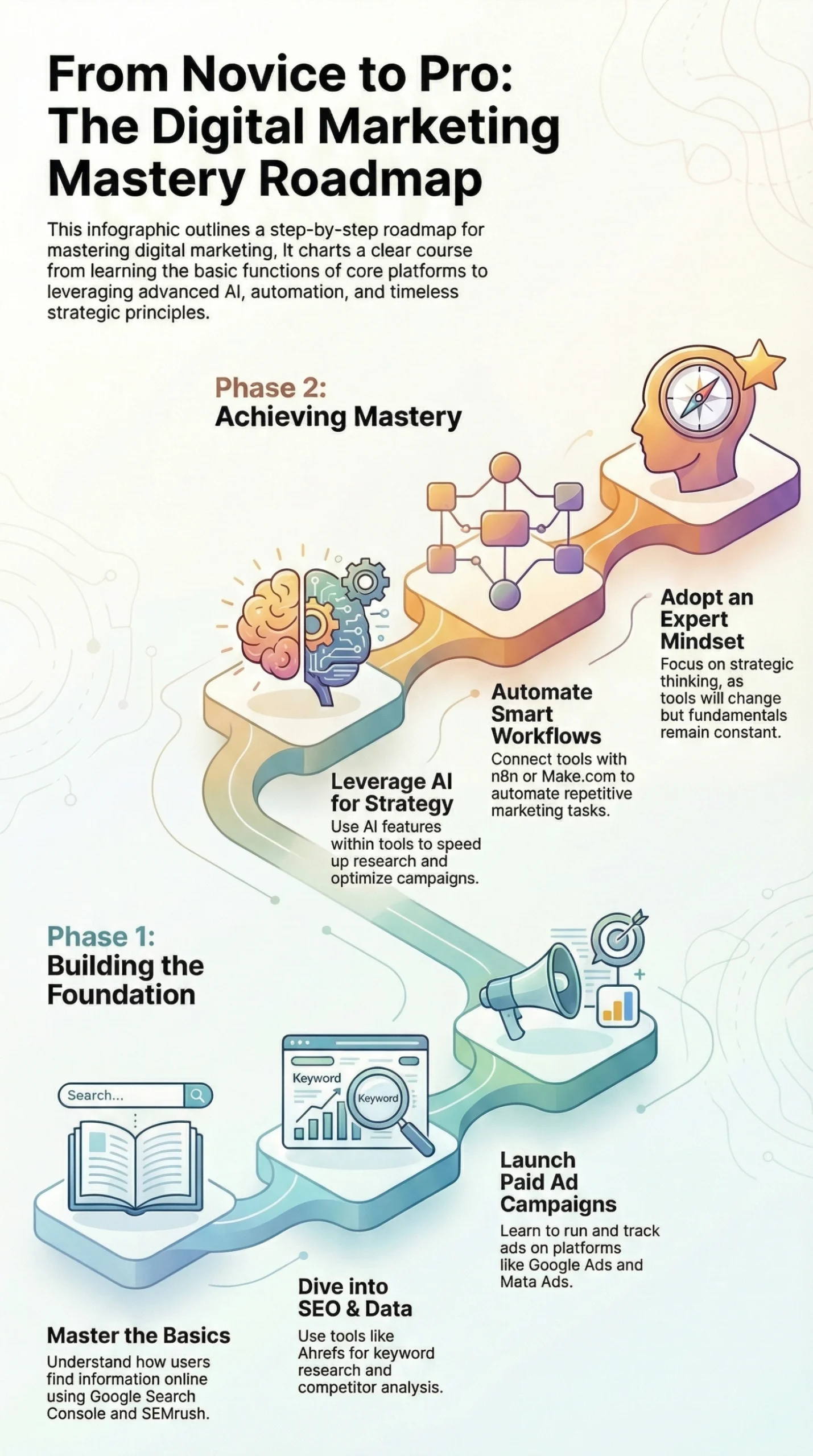
300 real questions about our digital marketing course in Ahmedabad – the ones we hear on calls, and the ones people type into Google, ChatGPT, Gemini, Claude and Google AI Mode. Search them, or jump to a topic. Answered straight, no sales fluff.
Showing all 300 questions
FSIDM (Full Stack Institute of Digital Marketing) is a practical AI, automation and digital marketing training institute based in Jivraj Park, Ahmedabad, with live online batches for students across India. It teaches a 108-module course built around real campaigns, real tools and real client-style projects rather than theory.
Our digital marketing course in Ahmedabad is built around practical training: 108 modules, live sessions on real ad and SEO accounts, client-style projects, a 2-month internship and placement assistance. It is run by Pranav Veerani, who has 10+ years in the industry. Batches stay small so every student’s work gets reviewed personally.
Pranav Veerani, founder of Unity Sangam, teaches the course. He has over a decade of hands-on experience in SEO, SEM, content, social media, paid and performance marketing, and has worked with clients in IT, real estate, education, healthcare, e-commerce, recruitment and more.
The digital marketing course in Ahmedabad runs from Jivraj Park, Gujarat 380051, India. Classroom batches are held there, and the same sessions are streamed live for online learners, so you can join from anywhere in India or abroad.
Call or WhatsApp +91 83202 59430, email hello@fsidm.in, or visit fsidm.in. A counselling call is free and includes a walkthrough of the syllabus and a career-path recommendation based on your background.
FSIDM has trained 107+ students so far, with 47+ placements and 25+ students who have started freelancing. The institute’s stated goal is to upskill 1,000+ individuals, which is why batch sizes are kept small enough for personal mentoring.
All three. The core course is the same, but there are specialised tracks for business owners, startups and working professionals, so the projects and examples match what you actually need – a job portfolio, freelance clients, or leads for your own business.
Three things: training runs on live accounts and real projects instead of demo dashboards; the AI and automation syllabus is unusually deep (AI SEO, GEO, AI agents, Make.com); and batches stay small so the trainer personally reviews your work rather than handing over pre-recorded videos.
Sessions are conducted in a mix of English and Hindi, with Gujarati explanation available since the institute is based in Ahmedabad. Course material, tools and assignments are in English, which is what you will use on the job.
Both. You can take the digital marketing course in Ahmedabad in the classroom, or join the same live batch online. Recordings, assignments, tool walkthroughs and mentor support are identical either way, so online learners are not getting a cut-down version.
The complete digital marketing course in Ahmedabad costs Rs. 15,000 as an offer price; the regular fee is Rs. 29,000. That one fee covers all 108 modules, 50+ tools, live training, real projects, the completion and internship certificates and a letter of recommendation.
No. The fee is a single, all-inclusive amount – there are no separate module packages, no tool charges and no certificate fees. Anything extra, such as your own ad spend when you run live campaigns, is clearly explained before you start.
Instalment options are available. Call or WhatsApp +91 83202 59430 to discuss a plan that works for you before the batch starts, since the arrangement is confirmed at enrolment.
A digital marketing course in Ahmedabad generally ranges from around Rs. 15,000 for practical short programmes to well over Rs. 1 lakh for long agency-style diplomas. FSIDM sits at the affordable end at Rs. 15,000 while still covering 108 modules, tools, projects and an internship.
It is worth it when the course gets you billable skills. Judge it by what you can do afterwards: run a Google or Meta ad campaign, audit a site’s SEO, build an automation, and show a portfolio. FSIDM is built around producing exactly that evidence.
The Rs. 15,000 price is already a discount on the Rs. 29,000 regular fee. For current batch offers, early-enrolment pricing or group discounts, call +91 83202 59430 – the available offer depends on the batch you join.
All 108 modules across 19 tracks, live training sessions, 50+ premium tools, real client-style projects, a 2-month internship, a course completion certificate, an internship certificate, a letter of recommendation, plus resume building and interview preparation.
No. You work on 50+ tools during the course using free tiers, trials and the institute’s access, and you are taught which ones are genuinely worth paying for later. You are never asked to buy software to complete the course.
For practice campaigns, a small budget helps you see real data, and you are guided on how to start with a minimal daily spend. It is optional – you also work on live accounts during the course and internship.
Fees can be paid at the institute or online. Confirm the current payment method when you book your seat by calling or messaging +91 83202 59430, or by emailing hello@fsidm.in.
The digital marketing course in Ahmedabad runs three months plus a 2-month internship, so five months end to end. The training covers all 108 modules; the internship is where you apply them to real projects and build a portfolio.
Weekday batches for the digital marketing course in Ahmedabad run 1 hour a day, Monday to Thursday or Tuesday to Friday. Weekend batches run 2 hours a day for people who work full time. You choose whichever fits your schedule when you enrol.
New batches for the digital marketing course in Ahmedabad start regularly through the year. Call or WhatsApp +91 83202 59430, or email hello@fsidm.in, for the next start date and to reserve a seat, since batch sizes are limited.
Missed sessions are supported with recordings and dedicated doubt-clearing time, so you can catch up without falling behind the batch. If you need to pause for a longer period, speak to the trainer about joining the equivalent sessions in a later batch.
Switching is usually possible depending on seat availability in the other batch. Raise it with the trainer as early as you can so your place can be arranged without breaking the flow of the syllabus.
Batches are deliberately kept small so the trainer can review each student’s campaigns, audits and assignments personally. Ask about the current batch size when you call, as it varies by batch.
Yes. Sessions are live, so learners anywhere in India or abroad attend the same batch as classroom students, with the same recordings, assignments, tool walkthroughs and mentor support.
Enquire about attending a session or a free counselling call before you enrol – call +91 83202 59430. The counselling call walks you through the full syllabus and recommends a path based on your background.
A laptop and a stable internet connection are enough. Tools are browser-based, so you do not need a high-end machine, and you are guided through setting up every account in the first modules.
Call or WhatsApp +91 83202 59430 or email hello@fsidm.in to check the next batch date for the digital marketing course in Ahmedabad and reserve a seat. You can also download the full brochure at fsidm.in/brochure to review the syllabus first.
Yes. The digital marketing course in Ahmedabad starts from fundamentals and basic website creation, so no prior marketing, coding or design experience is needed. Many students in every batch start from zero.
No. Digital marketing is not a coding job. You will build websites and landing pages using WordPress and AI website tools without writing code, and the technical SEO modules teach you to read and fix issues, not to program.
Yes. There is no degree requirement. Students join after 12th, during graduation or after it. What matters far more than qualification is a portfolio of real campaigns, which is what the course and internship are designed to give you.
Yes – the weekend batch (2 hours a day) and the 1-hour weekday batch exist for exactly this. There is also a specialised track for working professionals that focuses on skills you can apply in your current role or use to switch careers.
Yes, and many do. Digital marketing suits flexible or part-time work, especially freelancing in content, social media management and ads. The course covers freelancing, client handling and portfolio building alongside the technical skills.
Yes. Students from engineering, commerce, science, arts and completely unrelated jobs join every batch. The syllabus is sequenced from fundamentals upward, and small batch sizes mean you can ask questions until a concept actually lands.
No. Students range from fresh graduates to business owners in their forties and fifties. The skills are practical, and the only real requirement is consistent practice during and after the course.
Yes. The weekday batch is one hour a day and the weekend batch is two hours a day for this reason. Expect to spend extra time on assignments, since the learning comes from doing the campaigns, not from attending alone.
They answer different needs. An MBA is a long, expensive general management qualification; a practical digital marketing course gives you a specific, billable skill in months. Many people do a short practical course first, then decide whether an MBA adds anything.
The concepts are not hard; the discipline is. Most of digital marketing is testing, measuring and improving. The hard part is doing that consistently, which is why the course is built on real projects with feedback rather than passive video watching.
108 modules across 19 tracks – from SEO, Google Ads, Meta Ads and social media to AI SEO, GEO, prompt engineering, AI video creation, Make.com automation and AI agents. Every module is taught practically with live tool demonstrations.
The full range: digital marketing foundations, website and e-commerce creation, graphic and video content, SEO, social media marketing, paid advertising, analytics, email and WhatsApp marketing, AI SEO and GEO, prompt engineering, AI content and video, automation and AI agents, plus career and freelancing modules.
Yes – SEO is a full 10-module track covering search engine fundamentals, keyword research, on-page and off-page SEO, technical SEO, local SEO, Google algorithms, SEO audits, link building and competitor analysis, with a separate 6-module track for AI SEO and GEO.
Yes. The performance marketing track covers Search Engine Marketing with Google Ads, Meta Ads for Facebook and Instagram, display advertising, Discovery Ads, Performance Max, LinkedIn Ads and landing page optimisation – run on live accounts, not simulations.
Yes – a 9-module track covering Instagram, Facebook and LinkedIn optimisation, Facebook and Instagram marketing, LinkedIn marketing, influencer marketing, lead and traffic generation, social media automation, and re-marketing and conversion.
Yes. The design and content track covers copywriting and ad copy, content marketing, graphic creation, video creation, Reels and social media calendars, and there are separate AI content writing and AI copywriting modules.
Yes. You will build a business website, a blog and an e-commerce store in the foundations track, and there is a dedicated AI website development track covering AI-built websites, AI landing pages, AI chatbots and CRM setup.
Yes. Email marketing and WhatsApp marketing are in the advanced strategies track, and both have automation counterparts – email automation, WhatsApp automation and email marketing automation – in the automation tracks.
Yes. Assignments are built on live accounts and real client-style briefs throughout the course, and the 2-month internship is entirely project-based. The point is to leave with a portfolio you can show, not just notes.
Yes – there are dedicated tracks for business owners, startups and working professionals, so the same core skills are applied to the outcome you actually want: leads for your business, traction for your startup, or a role change.
Yes – a 10-module analytics track covering Google Analytics, Search Console, Tag Manager, Looker Studio, Microsoft Clarity, SEMrush or Ahrefs, plus reporting and dashboard automation in the AI marketing automation track.
Yes. Download the complete brochure at fsidm.in/brochure – it lists every module track by track along with the fee, batch timings, tools and certificates. You can also see all 108 modules on this page.
FSIDM builds AI and automation into the core syllabus rather than selling it as an add-on. Roughly half the curriculum is AI-focused: AI SEO, LLM SEO, GEO, AEO, prompt engineering, AI content and video creation, AI avatars, Make.com automation, AI chatbots, CRM automation and AI agent development.
GEO is the practice of making a brand visible inside AI-generated answers – ChatGPT, Gemini, Claude, Perplexity and Google AI Overviews – rather than only ranking on the classic results page. It focuses on clear, quotable, well-structured content and strong entity signals.
AEO is optimising content so it can be lifted directly as an answer. In practice that means answering a specific question in the first line, using plain language, structuring content in question-and-answer form, and backing it with schema markup.
LLM SEO is optimising for large language models – making your brand and facts easy for an AI to find, understand and cite. FSIDM teaches it alongside AI SEO, GEO, AEO, Google AI Overviews optimisation and Entity SEO as a dedicated six-module track.
SEO aims at a ranked list of blue links; GEO aims at being included in a synthesised AI answer. SEO rewards keywords, links and technical health. GEO additionally rewards clarity, structure, factual consistency and being cited across the web as a recognised entity.
No, but it changes it. Search is shifting toward AI answers, so the work moves from chasing rankings alone to making content that AI systems can quote confidently. The fundamentals – useful content, technical health, authority – still decide whether you are picked.
Answer real questions directly and early, keep facts consistent across your site and profiles, use clear headings and FAQ structure, add schema markup, and build mentions on sources AI tools already trust. FSIDM teaches this as GEO and implements it on live websites.
Entity SEO is about being understood as a definite thing – a named business, person or product – rather than a bag of keywords. It uses consistent naming, structured data and third-party mentions so search and AI systems can place you in their knowledge graph.
AI Overviews are the AI-generated summaries at the top of many Google results. To be included, answer the query plainly in the opening sentence, keep content well structured and factually consistent, and support it with schema. The course covers this directly.
Yes – a four-module track covering prompt engineering fundamentals, advanced prompt engineering, AI research and productivity workflows, and NotebookLM for research and learning. The focus is prompts that produce usable marketing output, not party tricks.
Yes. A five-module track covers AI image generation, AI graphic design, AI video generation, AI Reel creation and AI voice generation, plus a separate track on AI avatars, AI influencers and AI clone image and video creation for personal branding.
Yes – a six-module automation track covering marketing automation fundamentals, Make.com automation, email automation, WhatsApp automation, lead generation automation and AI agent development, followed by further tracks on social media and marketing workflow automation.
AI agents are systems that carry out multi-step marketing work on their own – qualifying a lead, drafting and scheduling a post, updating a CRM record, compiling a report. The course covers building them, including the automation plumbing that makes them reliable.
ChatGPT, Claude, Google Gemini and NotebookLM for research, writing and strategy; AI image, video and voice generation tools; AI website, landing page and chatbot builders; and Make.com for connecting them into working automations.
50+ tools, including Google Analytics 4, Search Console, Tag Manager, Looker Studio, Microsoft Clarity, SEMrush or Ahrefs, Google Ads, Meta Ads Manager, Canva, ChatGPT, Claude, Gemini, NotebookLM, AI video and voice tools, Make.com, Brevo or MailChimp, and CRM platforms.
Yes. Google Analytics 4 is taught alongside Search Console, Tag Manager, Looker Studio and Microsoft Clarity, so you can set up tracking, read what the data is telling you and build a reporting dashboard – not just open a report.
Yes. You will work with SEMrush or Ahrefs for keyword research, competitor analysis, backlink review and site audits, which are the same tasks agencies hire for.
Yes. Graphic creation, video creation and Reels are part of the content track using Canva and similar tools, backed by AI image and graphic generation modules for faster output.
Yes. You build a business website, a blog and an e-commerce store during the foundations track, and the AI website development track covers AI-assisted site and landing page creation.
You work on 50+ tools using a mix of free tiers, trials and institute access during training, and you are told honestly which ones are worth paying for once you are working. You are never required to buy software to finish the course.
Yes. CRM fundamentals and automation are covered in the AI website development and CRM track, and CRM automation appears again in the AI marketing automation track for lead nurturing and sales funnels.
Yes. Tag Manager is part of the analytics track, so you learn to set up conversion tracking properly – which is the difference between running ads and knowing whether they worked.
Roles such as digital marketing executive, SEO executive or specialist, performance marketer, PPC expert, social media executive or manager, content marketer, content writer, campaign manager and marketing manager. Many graduates also start freelancing or market their own business.
Entry-level roles typically start around Rs. 15,000 to Rs. 25,000 a month. With two to four years of proven results in paid ads or SEO, Rs. 40,000 to Rs. 80,000 is common, and specialists in performance marketing and automation go higher.
Most freshers in India start between Rs. 15,000 and Rs. 25,000 a month, with the upper end going to candidates who can show real campaigns, live dashboards and measurable results rather than only a certificate.
Yes. FSIDM provides placement assistance along with a 2-month internship on real projects, an internship certificate and a letter of recommendation. Resume building, LinkedIn optimisation and interview preparation are part of the syllabus.
FSIDM provides placement assistance and interview preparation rather than a blanket guarantee – any institute promising guaranteed jobs to everyone is worth questioning. What decides outcomes is your portfolio and interview performance, which the course and internship are designed to build.
Create the experience. Run real campaigns, audit real websites, manage a small business’s social media, and document results. The internship plus project work gives you exactly these case studies, which is what interviewers ask about.
Yes, provided you keep learning. Ad spend keeps shifting online and AI has raised the bar, so the people in demand are those who can direct AI, read data and own strategy. Routine, manual-only marketing work is the part being squeezed.
AI is absorbing the repetitive parts – first drafts, basic reporting, bulk edits – not the judgement. Marketers who use AI confidently are replacing those who do not. That is why AI, prompt engineering and automation sit inside this course rather than beside it.
Performance marketing and paid media tend to pay best, because results are measured in revenue. SEO leads, marketing automation specialists and analytics-strong marketers are close behind. All three are covered in the syllabus.
No. Most employers care about proof of work – campaigns you have run, results you can explain and tools you can use. A degree helps in some corporate roles, but a portfolio decides the majority of digital marketing hires.
Yes. Digital marketing skills transfer anywhere, and remote and hybrid roles are common. The resume, LinkedIn and interview modules prepare you to apply beyond Ahmedabad.
Day to day: planning and publishing content, running and optimising ad campaigns, improving site SEO, tracking performance in analytics, reporting on what worked, and testing improvements. Increasingly, it also means using AI tools to do all of this faster.
It depends on your portfolio, your city and how actively you apply. Students who complete the internship, build case studies and apply consistently move fastest. The course includes resume building and interview preparation to shorten that gap.
Yes. Resume building and interview preparation are modules in the monetisation and career track, so you practise presenting your projects and answering the technical questions interviewers actually ask.
Yes – 25+ FSIDM students have started freelancing. Freelancing is covered as a module, including how to find clients, price work and deliver it, and your course projects double as the portfolio you show prospects.
It varies with skill and client quality. Beginners often charge a few thousand rupees per small project or monthly retainer; experienced freelancers running ads and SEO for businesses charge far more. Earnings follow results you can prove, not years served.
You stop depending on agencies for basics. You will be able to run your own Google and Meta ads, fix your local SEO, build landing pages, set up WhatsApp and email automation, and judge whether any agency you hire is actually performing.
Yes. The specialised tracks cover business owners, startups and working professionals, focusing on lead generation, profitable ad spend, local SEO, automation and building an AI-assisted marketing system for your own business rather than job-oriented skills.
Yes. The startup track focuses on getting early traction cheaply: positioning, content, organic social, local and technical SEO, small-budget paid tests, and automations so a tiny team can operate like a bigger one.
Start with businesses you already know, offer a specific outcome rather than vague marketing, show one real case study, and ask for a referral when it works. The freelancing module covers outreach, pricing and scoping in detail.
A course completion certificate, an internship certificate after the 2-month internship, and a letter of recommendation. You are also guided to earn free official credentials such as Google Analytics, Google Ads and Meta Blueprint certifications.
The certificate confirms you completed the training, and the internship certificate and recommendation letter add weight. In practice, employers weigh your portfolio and campaign results most heavily – which is why the course is built to produce both.
Yes. A 2-month internship on real projects follows the three months of training, and you receive an internship certificate on completion. It exists so you finish with genuine work experience rather than only coursework.
Yes. Post-course support and mentorship are part of the offering, so you can come back with questions as you start working, freelancing or running campaigns for your own business.
You are guided through earning the free official certifications – Google Analytics, Google Ads and Meta Blueprint credentials – during the course, so you leave with recognised industry certificates alongside the FSIDM ones.
Speak to the trainer early rather than at the end – most issues are about pace or focus and can be fixed with extra doubt-clearing sessions. For any policy question before you enrol, call +91 83202 59430.
Start with one skill you can sell, not the whole field. Most homemakers begin with social media management or content, take on one small client, and build from there. The weekday batch is 1 hour a day, so it fits around the house, and the 2-month internship gives you real work to show before you apply anywhere.
A gap matters far less than proof of current skill. Employers and clients look at what you can run today – a live ad campaign, an SEO audit, a content calendar. Finish the course and internship with three real projects documented, and the conversation shifts from your gap to your portfolio.
No, and your experience is an asset here. Twenty years of knowing an industry, its customers and its language is exactly what most junior marketers lack. You are adding a skill layer on top of domain knowledge, which is a stronger position than a fresher starting from zero.
Do not resign first. Join the weekend batch, build skills for three months while earning, take freelance work during the internship, and move only once you have income or an offer. Most career changes that stick are made in parallel, not after a leap.
No. The batches are deliberately 1 to 2 hours a day so you can keep your job. Resigning first adds money pressure that makes people take the wrong first role. Build the skill and a portfolio alongside work, then switch when the numbers make sense.
Yes, and teachers do well on the digital marketing course in Ahmedabad. Teaching is explaining complex things simply, planning in sequence, and holding attention – that is content marketing, email sequences and ad copy. Many teachers move into content, social media and training roles, and some start teaching the skill themselves.
Strongly. Sales people already understand objections, buying intent and follow-up – which is most of what performance marketing and funnels are about. Adding paid ads, landing pages and CRM automation usually makes a salesperson more valuable rather than moving them sideways.
Yes, and you have an edge with data. Marketing runs on cost per lead, conversion rates, return on ad spend and attribution – numbers work that many marketers avoid. Performance marketing and analytics roles suit finance backgrounds particularly well.
Yes. You are already comfortable with tools, dashboards and troubleshooting, which shortens the technical SEO, Tag Manager and automation modules considerably. Many IT people move into technical SEO, marketing automation or AI agent work.
Yes – the weekend batch exists for exactly this. Just check your service rules before taking paid freelance work on the side, as many government roles restrict outside income. Learning the skill itself is not an issue.
Three months of training gets you usable skills; the 2-month internship gets you the proof. If you are job hunting urgently, focus on one high-demand area – Google Ads or SEO – and start applying during the internship rather than waiting for everything to finish.
Yes, and the business-owner track is built for this. Knowing how to generate your own leads removes the biggest dependency most small businesses have. Many people run freelance marketing for income while rebuilding their own venture in parallel.
Start part-time and remote-friendly: content writing, social media management or email marketing. These let you rebuild confidence and a portfolio on your own hours. The live sessions are 1 to 2 hours a day, and recordings cover you on the days that do not go to plan.
Learn the basics even if you eventually hire. Three months of practical training is enough to run your own local SEO, Google Business Profile and WhatsApp campaigns, and – just as valuable – to judge whether any agency you hire is actually performing or just sending reports.
Yes. There is no educational or background requirement, only a laptop, internet and consistent practice. The sessions are live and recorded, so irregular working hours are workable. Many students start with freelance social media work for local businesses they already know.
Yes. HR already does employer branding, LinkedIn content and internal communication – all transferable. Content marketing, LinkedIn marketing and social media roles are the most natural moves, and the LinkedIn optimisation modules apply directly to what you already do.
Easily, and it often pays better than switching outright. Existing clients who already trust you usually need marketing help too. Adding ads, SEO or automation to a design, writing or consulting practice raises your rate without starting from zero.
Begin with the foundations track and treat assignments as real work from week one. Experience is simply documented projects – a website you built, a campaign you ran, an audit you wrote. The internship exists to give you those before you apply anywhere.
Yes, and your background helps. Banking teaches compliance, trust and dealing with money-sensitive customers – useful in finance, insurance and real estate marketing, where most marketers lack domain credibility. Performance marketing and CRM automation are the most natural moves.
Well. You already generate leads and handle follow-ups manually; this teaches you to do it at scale with ads, landing pages, WhatsApp automation and a CRM. Many field-sales people use it to grow their own book rather than change jobs.
Yes. Discipline and process execution transfer strongly, and marketing is largely about running a plan consistently and measuring it. Start with one specialism, build a portfolio in the internship, and target roles where reliability matters more than years in the industry.
Yes. The digital marketing course in Ahmedabad is streamed live, so you can attend from any country, and recordings cover timezone clashes. Tools and platforms are global, so the skills apply wherever you work. Call or WhatsApp +91 83202 59430 to check batch timings against your timezone.
Yes – the business-owner track is designed for it. Learning it yourself means you can generate leads without depending on an agency, and you keep the knowledge inside the family business rather than paying to rent it indefinitely.
Yes, if you want a career path that does not depend on a lab or a masters. A science background brings analytical thinking that suits SEO, analytics and performance marketing. Learn it alongside your degree so you graduate with both a qualification and billable skills.
Very. BBA teaches marketing theory; this teaches execution – running the ads, building the funnel, reading the data. Doing both means you graduate able to do the job, not just describe it, which is the gap most BBA graduates hit in interviews.
Yes. BCom opens accounting and finance routes that are crowded and slow to start. Digital marketing adds a second route with faster entry and freelance potential, and your commerce background helps with budgets, ROI and client reporting.
An MBA gives you strategy and a network; it rarely gives you hands-on tool skill. Most MBA graduates have never run a live Google Ads campaign or fixed a technical SEO issue. Adding practical execution makes you considerably more hireable than classmates with theory alone.
Yes – arts backgrounds do well in content, copywriting, social media and brand work, which is a large share of the field. There is no technical prerequisite. What matters is whether you practise consistently and build a portfolio.
Not at all – it is a different lever. Technical SEO, marketing automation, AI agents and chatbot development all sit at the intersection of code and marketing, and people who can do both are rare. You can also keep development as your base and add marketing as a specialism.
It is a strong second skill. Engineering teaches structured problem-solving, which suits analytics and performance marketing. It also gives you a freelance income path during or after college that does not depend on campus placement outcomes.
Yes, in two ways: pharma and healthcare brands need marketers who understand the product, and many pharmacists start their own practice or store where local SEO and WhatsApp marketing bring in customers. Domain knowledge plus marketing is a strong combination.
It can be. Independent legal practice depends on visibility and referrals, and local SEO, content and a professional LinkedIn presence drive both. It is also a practical freelance income option while your practice builds.
Yes. There is no degree requirement to join or to work in this field. Clients and most employers hire on proof of work. Diploma students join every batch and compete on the same portfolio basis as graduates.
You can, and the skills compound early. Many students run freelance social media work through college and graduate with three years of experience. Just treat it as an addition to your education, not a replacement for it.
Yes, if you start now. Finishing the course and internship before placement season means you interview with live campaigns and real numbers while most classmates have only coursework. Resume building and interview preparation are part of the syllabus.
Yes. Commerce backgrounds suit the analytics, budgeting and reporting side of marketing, and e-commerce marketing in particular. The practical skills give you an alternative to the standard accounting route, which is slower to progress.
It complements it well. Mass comm covers messaging and media; this covers distribution, targeting and measurement. Together they make you employable in both content and performance roles rather than only one side.
Yes, and it changes your rate. Designers who understand conversion, ad formats and landing page performance stop being treated as decorators and start being hired for results. The AI design and video modules also speed up your output considerably.
No. Research skills transfer directly into keyword research, competitor analysis, data interpretation and content depth – areas where most marketers are weak. Plenty of academics move into content strategy, SEO or analytics roles.
Yes. This field hires on demonstrated ability more than certificates. If you can show campaigns you have run and results you can explain, a dropped degree rarely comes up. The internship and portfolio work exist precisely to create that evidence.
Yes – most students do. Weekday batches are 1 hour a day and weekend batches 2 hours, and sessions are recorded. Plan for extra time on assignments, since the learning comes from doing the campaigns rather than attending alone.
During, if you can manage the hours. Starting earlier means you graduate with both the degree and a portfolio, and you can freelance through your final years. Doing it after is fine too – it simply delays the earning start.
No. It is an independent professional certification from FSIDM, not a university-accredited programme. It carries weight with employers and clients through the portfolio and certificates, not through academic credit.
It does not have to be either-or. The weekday batch is an hour a day, so you can prepare for exams and build a backup skill at the same time. Many students use freelance marketing income to support themselves while attempting exams.
Yes – the tools and platforms are global, so Google Ads, Meta Ads, SEO and analytics work identically anywhere. Sessions are live online, so you can attend from another country, and the skills support remote freelance income while you study.
You do not have to choose immediately. Keep development as your base and add marketing as a second lever – technical SEO, marketing automation and AI agent development pay well precisely because few people can do both sides.
Yes. Hospitality lives on reviews, local search and Instagram – online reputation management, local SEO and social media are directly applicable. It is also a practical freelance income path if hotel hours do not suit you long term.
You can, though it is a genuine career change rather than an add-on. Where it fits naturally is healthcare marketing, where understanding clinical language is an advantage, or running marketing for a clinic or practice later.
Yes. There is no degree requirement, and trades people often do well marketing their own services – a workshop, electrical business or contracting firm – through local SEO and Google Business Profile. The skills apply to your own income directly.
Yes, more than people expect. Agri-businesses, equipment dealers and farm produce brands are poorly served by marketers who understand the sector. Domain knowledge plus marketing skill is a far stronger position than generic marketing.
No. Thirty is early in a working life, and maturity in client handling and judgement is genuinely valued here. What you need is current tool skill and a portfolio, both of which take months, not years.
Some will, but the better route at 40+ is often consulting, freelancing or a role in a company where your existing industry experience matters. You are usually competing on judgement and reliability rather than on being the cheapest hire.
It is realistic if your goal is specific – running marketing for your own business, consulting in an industry you already know, or a part-time income. Chasing an entry-level agency job at 50 is the harder path; applying marketing to existing expertise is the easier one.
Yes, commonly for consulting, running a small venture, or helping family businesses. The pace is yours to set, and the automation modules in particular let one person manage a lot without a team.
Focus on one platform and go deep before broadening. Learn to run Meta or Google ads properly, offer it to small local businesses, and build a track record early. Time is your biggest advantage – three years of real practice by 21 puts you ahead of most graduates.
No. Batches regularly include students in their late teens through business owners in their fifties. The only real requirement is consistent practice and a laptop with internet.
Many students are in exactly this position. The commitment is 1 hour a day on weekdays or 2 hours on weekends, plus assignment time. Sessions are recorded, so a missed evening does not derail you.
Learn it without leaving your income. The batch timings are built so you keep working, and the internship produces a portfolio before you need to make any decision. Treat the switch as something you do once freelance or offer income exists, not before.
Ask about instalment options on +91 83202 59430 before the batch starts. Beyond that, the fastest route is to begin freelancing during the course – even small social media work for a local shop – so the skill starts paying for itself.
Digital marketing is one of the more accessible careers – it is laptop-based, remote-friendly and output-measured. You can attend live online rather than travelling to the classroom. Tell the trainer what support you need when you enrol.
Yes – clients and employers are increasingly remote, and your local market is often underserved. Many students start by handling marketing for businesses in their own town, where almost no one is doing it well, then expand to remote clients.
Yes. The platforms are global and the work is remote-friendly, so experience in Google Ads, Meta Ads, SEO and analytics is recognised anywhere. Build a portfolio with measurable results and it travels with you.
No – 25 is early. Careers run for decades, and comparison against people on different tracks is a poor measure. Five focused months of skill building and a portfolio will change your position more than the time you have lost worrying about it.
The format is built for this: 1 hour a day on weekdays or 2 hours at weekends, so you keep your current income throughout. Ask about instalment options on +91 83202 59430, and aim to start small freelance work during the internship.
Realistically, small freelance income can start during the internship if you actively look for it – a local business social media handle or a website audit. Steady income usually follows a few months of consistent work. Anyone promising earnings in weeks is overselling.
Plan for the 1 to 2 hour session plus roughly the same again on practice. The class teaches the method; the skill comes from running the campaign yourself. Students who only attend and do not practise are the ones who struggle.
You can learn the concepts free – the information is genuinely available. What is missing is sequence, feedback on your actual work, live accounts to practise on, and someone to tell you why your campaign failed. That gap is what a structured course and internship close.
It is at the affordable end for 108 modules, 50+ tools, live training, a 2-month internship and three certificates – many Indian institutes charge upwards of Rs. 50,000. The fair way to judge it is whether you can earn it back with one or two freelance clients.
Tell the trainer early rather than at the end. Batches are small specifically so pace can be adjusted, and recordings plus doubt-clearing sessions exist for catching up. Most people who fall behind do so quietly, which is the avoidable part.
Yes, post-course support and mentorship are part of what is offered, so you can come back with questions once you are working on real client problems. That is usually when the most useful questions appear.
No. The tools are browser-based, so any laptop that runs Chrome smoothly with a stable internet connection is enough. You do not need a high-spec machine for ads, SEO, analytics or most AI tools.
Yes. Sessions are taught in a mix of English and Hindi with Gujarati explanation available, and the tools themselves are visual. Written English does matter for content roles, which is why copywriting and AI writing modules are included to help you improve.
No. Nothing in the course requires coding. You will build websites with WordPress and AI tools, and the technical SEO modules teach you to read and fix issues rather than program them. Comfort comes from repetition, not from a technical background.
Not necessarily. SEO, analytics, content, email marketing and automation are largely behind-the-scenes work. Client-facing skill helps if you freelance, but plenty of marketers build careers on execution rather than pitching.
Placement assistance, interview preparation and a recommendation letter are provided, but no honest institute can guarantee a job for everyone. What reliably moves the odds is the portfolio – students who finish the internship with documented projects and apply consistently do best.
Yes. Freelance social media management, content and small ad accounts are commonly run part-time alongside a job or home responsibilities. Automation modules help one person handle more clients without more hours.
Test it before committing emotionally: write a few posts, open a free Google Analytics demo account, try a small ad. If measuring, testing and improving appeals to you, the field fits. If you dislike data entirely, content or design sub-paths suit better.
Live batches with a fixed time, small groups, and a trainer who reviews your work – which is the accountability pre-recorded courses lack. The internship also gives a deadline and real projects, so there is something at stake beyond self-motivation.
AI will write and draft for you, but it cannot tell you whether the strategy is right, read your account data in context or take responsibility for spend. Clients pay for judgement. Using AI well still requires knowing what good looks like – which is the part you learn here.
They are replacing specific tasks – first drafts, routine reporting, bulk edits – not the role. Marketers who direct AI are replacing those who do not. That is exactly why prompt engineering, AI SEO and automation are built into this syllabus rather than taught separately.
For freelancers and consultants, it is often the single highest-return activity – it brings inbound clients without ad spend. For job seekers it shortens hiring conversations. LinkedIn optimisation and personal branding with AI are both covered in the course.
Use the structure rather than willpower: a fixed live batch time, a trainer reviewing your work, small-group visibility and internship deadlines. Most people who finish do so because something external held the schedule, not because they felt motivated every day.
Pick by temperament, not by salary tables. Coding suits people who enjoy building systems in depth; marketing suits people who like experiments, psychology and fast feedback. Marketing is quicker to first income; senior coding roles pay more at the top. Both are being reshaped by AI.
They overlap more than people think. Analytics pays well and is more technical; marketing is faster to enter and easier to freelance. Performance marketing sits between the two, which is why analytics tools are a full track in this course.
Different purposes. An MBA is a two-year, high-cost general management qualification; this is a five-month skill with a portfolio. If your goal is to be employable or to run your own marketing soon, start practical and decide on an MBA later if a role genuinely needs it.
A government job offers stability; digital marketing offers flexibility and faster income growth tied to proven results. They are not mutually exclusive – the weekday batch is an hour a day, so many people prepare for exams while building a fallback skill.
That is a false choice now. AI without a business use case is a hobby; marketing without AI is slower than competitors. This course deliberately teaches both together – prompt engineering, AI SEO, AI content and automation sit inside the marketing syllabus.
Choose by self-discipline, not content. Both are the same live sessions with the same recordings and support. Classroom helps if you need to be physically present to stay consistent; online is better if travel time would make you drop out.
Learn the whole picture first, then specialise. You cannot tell whether you prefer SEO, ads or automation until you have run all three. Once working, depth in one area pays considerably more than being shallow across all of them.
A job first, if you have the option. A year inside a company or agency teaches client standards, process and scale faster than learning alone. Freelancing suits people who need flexible hours immediately or already have access to potential clients.
Paid ads show results faster and are easier to prove to a client; SEO compounds and is cheaper long term. Most well-paid marketers understand both, which is why the course covers a 10-module SEO track and a 7-module paid track rather than making you choose.
Work for one first unless you already have clients. An agency teaches pricing, scope, reporting and the realities of client management – lessons that are expensive to learn on your own money. Many students freelance during the internship to test the water.
When comparing any digital marketing course in Ahmedabad, judge on three things regardless of the name: do you work on live accounts or demo dashboards, does the trainer review your individual work, and is AI genuinely built into the syllabus rather than added as one module. Ask to see a current student’s project work.
Warning signs: guaranteed job promises, pre-recorded videos sold as live training, no real ad spend or live accounts, a syllabus that stops at Facebook and Instagram basics, and trainers who have never run campaigns for paying clients.
Three months is enough to become competent and employable in the core skills, which is why the 2-month internship follows – competence turns into evidence there. Mastery of any one area takes a year or two of real client work, as with any craft.
Specific tools change constantly; the underlying work does not. Audience understanding, offer, measurement and iteration stay the same whichever tool you use. The course leans on that foundation and teaches current AI tools as instruments, not as the subject itself.
Bigger brands often mean large cohorts and pre-recorded content. FSIDM keeps batches small enough that the trainer reviews your individual campaigns, runs training on live accounts, and includes an unusually deep AI and automation syllabus. If you want personal feedback, size works against the big names.
Ask who teaches and what they have run recently; whether sessions are live; whether you work on real ad accounts; what exactly the internship involves; what the total fee covers; and to speak to a recent student. Any institute confident in its answers will arrange that.
Design pays for craft; marketing pays for results, which usually scales higher. If you enjoy visual work, the strongest position is both – a designer who understands conversion and ad performance charges considerably more than one who only delivers files.
If you can get a junior role that genuinely trains you, take it. In practice most entry-level jobs expect you to arrive already able to run campaigns. A course plus internship exists to create that starting proof when no one will hire you to learn.
Mostly four things: planning and publishing content, running and adjusting ad campaigns, checking analytics to see what moved, and reporting it. Add client calls if you freelance. It is less creative brainstorming and more steady testing and measuring than most people expect.
Start with businesses you already have a connection to – your family’s shop, a friend’s gym, a former employer. Offer one specific outcome, such as setting up their Google Business Profile or running one ad campaign, at a low or free rate in exchange for a testimonial and a case study.
Price the outcome, not your experience level. Beginners commonly start with small monthly retainers for social media management or one-off project fees for a website or audit. Raise rates once you have two or three documented results rather than once you feel ready.
Retainers for ongoing work like SEO, social media and ad management, since results compound over months. Project fees for one-time deliverables such as a website, an audit or a campaign setup. Most freelancers end up with a mix of both.
Prevent it with structure: take 50% upfront, keep a written scope, and never hand over final access or files before the balance clears. For ongoing work, bill monthly in advance. Most non-payment problems come from vague scope and no deposit, not from dishonest clients.
Define the number of revision rounds in writing before you start, and state what counts as a new request. When scope creeps, quote the extra as additional work rather than absorbing it. Clients respect a clear boundary far more than silent resentment.
Typically three to six small retainer clients working solo, depending on how much is automated and how demanding each one is. Automation of reporting, scheduling and lead nurturing is what lets one person handle the upper end without burning out.
Report in their language: leads, enquiries, calls, bookings and cost per lead – not impressions and reach. One simple monthly dashboard showing money in versus money out beats a 20-page report nobody reads. Dashboard automation is covered in the course.
Build projects on your own assets: a blog you rank, a small store you set up, a mock campaign with real ad spend of a few hundred rupees, a full SEO audit of a local business. Document the before, what you did, and the numbers after.
Not to start. Most freelancers begin as individuals and register a firm or company later when client size, invoicing or tax reasons require it. Check current GST thresholds with an accountant once your income grows.
Through LinkedIn content, a visible portfolio site, directories, and referrals from existing clients. Remote work is normal now – most clients care about results and responsiveness, not your location. LinkedIn optimisation is part of the syllabus for this reason.
It varies widely with effort and client quality, so treat any specific figure with suspicion. What is predictable is the pattern: slow first few months while you build proof, then income tied to how many clients you can find and keep. Results you can prove drive rates more than time served.
Start broad to get experience, then niche once you see which clients you enjoy and get results for. Niching – say, dentists or real estate – lets you reuse what works, charge more and get referrals, because you understand their customers already.
Lead with their problem in their words, state the specific outcome you will deliver, show one relevant result you have produced, then price and timeline. Keep it to one page. Long proposals full of your process rarely beat a short one about their problem.
Analytics and Search Console for measurement, Google Ads and Meta Ads Manager for campaigns, a keyword tool like SEMrush or Ahrefs, Canva for creative, a scheduler for social, and an AI assistant for drafting. Most have free tiers that are enough when starting.
Follow a small number of reliable sources rather than everything, and test changes on your own projects before applying them to client work. The fundamentals – audience, offer, measurement – change slowly; only the tools and interfaces churn.
It helps, and for freelancers it is close to essential – prospects check whether you practise what you sell. For in-house roles it matters less. A simple, active LinkedIn profile is the highest-value starting point.
Pause the worst-performing ad sets first, then check in order: is the targeting right, is the offer compelling, does the landing page match the ad, and is tracking even recording conversions correctly. Most losing campaigns fail at the landing page or the offer, not the ad.
Changing too many things at once, so you never learn what worked. The second most common is judging a campaign too early, before it has enough data. Both are habits the course drills out through live campaign work.
Learn to connect activity to revenue, run a budget, and explain decisions to non-marketers. Technical skill gets you hired; the ability to decide where money goes and defend it gets you promoted. Analytics and reporting skills matter more than extra tool knowledge here.
The path from stranger to customer, broken into stages: becoming aware of you, considering you, then buying. A funnel just means planning content and ads for each stage instead of asking strangers to buy immediately. Funnel building is covered in the automation track.
Retargeting shows ads to people who already visited your site or engaged with your content. It usually performs better than cold advertising because you are reaching people who showed interest. It is covered in the re-marketing and conversion module.
Click-through rate is the percentage of people who click after seeing your ad or listing. What counts as good varies by platform, placement and industry, so judge it against your own previous campaigns rather than a universal benchmark.
A landing page is a single page built for one action, with no menu or distractions. Homepages serve many purposes and so convert worse for campaigns. Sending ad traffic to a dedicated landing page is one of the cheapest ways to improve results.
Something useful given free in exchange for contact details – a checklist, template, guide or free audit. It works when it solves one specific, immediate problem for the exact person you want as a customer, not when it is a generic brochure.
A CRM stores your leads and tracks every interaction so nothing is forgotten. Even a small business benefits once enquiries exceed what memory and a notebook handle. CRM fundamentals and automation are a dedicated part of the syllabus.
SEO earns unpaid visibility in search results over time. SEM means paying for placement, usually through Google Ads, and works immediately while you pay. Most businesses need both – ads for now, SEO for later.
On-page is everything you control on your site: content, titles, structure, internal links and speed. Off-page is what happens elsewhere – mainly backlinks and mentions that signal credibility. Both are covered in the 10-module SEO track.
The plumbing: site speed, mobile usability, crawlability, indexing, structured data and site architecture. If technical SEO is broken, good content will not rank because search engines cannot properly access or understand the site.
Backlinks are links from other websites to yours, read as votes of credibility. They still matter, but quality and relevance now count far more than quantity. Buying bulk links is a reliable way to damage a site.
What the searcher actually wants: information, a specific site, comparison before buying, or to buy now. Matching your page to the intent matters more than matching the exact words – a sales page will not rank for a how-to question.
Optimising to appear when people nearby search – Google Business Profile, local keywords, reviews, and consistent name, address and phone details. For any business with a physical location or service area, it is usually the highest-return SEO work.
The free listing that shows your business in Google Maps and local results. For local businesses it often drives more calls and visits than the website itself, and it is one of the fastest things to fix. Covered in the local SEO module.
Improving the percentage of visitors who take the action you want, rather than buying more traffic. It is usually cheaper to double your conversion rate than to double your visitors, which is why landing page optimisation is its own module.
Running two versions of an ad, page or email against each other to see which performs better, changing one element at a time. It is how marketing decisions stop being opinions. The discipline is testing one variable, not five.
ROAS is return on ad spend – revenue divided by what you spent on ads. ROI accounts for all costs, including your time, tools and product costs. A campaign can show a healthy ROAS and still lose money overall.
What you pay in ads to generate one enquiry. A good number depends entirely on what a customer is worth to you – a cost per lead that is terrible for a small retailer can be excellent for a business selling high-value services.
Using tools to run repetitive marketing without manual work – welcome emails, lead follow-up, WhatsApp replies, CRM updates, scheduled posts and reports. It is the difference between one person handling three clients and handling eight.
Sending planned emails to people who gave you their address. It is not dead – it remains one of the most reliable channels because you own the list rather than renting attention from a platform algorithm.
Publishing genuinely useful content so people find and trust you before they buy. It is slower than ads but compounds, and it is what feeds SEO, email and social at the same time rather than being a separate activity.
Paying or partnering with people who already have your audience’s attention. Small budgets usually do better with micro-influencers, whose audiences are smaller but more engaged and considerably cheaper than large accounts.
Finding unconventional, low-cost ways to grow quickly, usually through experiments rather than big budgets. In practice it means rapid testing of channels and offers. It is a module in the advanced strategies track.
Monitoring and improving what people find when they search your name or brand – reviews, mentions and search results. For local businesses and professionals it directly affects whether someone calls you or your competitor.
It lets you add and manage tracking codes without editing website code each time. It is what makes proper conversion tracking practical, and it is why the analytics track covers it rather than just Analytics itself.
Attribution decides which touchpoint gets credit for a sale. It is confusing because customers see several ads, posts and searches before buying, and every platform claims the credit. The practical answer is to watch overall cost per sale, not platform-reported numbers alone.
Start with Google Business Profile, photos and reviews – most restaurant discovery happens in Maps, not on websites. Then local SEO, Instagram for food content, and WhatsApp for repeat orders. Paid ads work best for offers, not general awareness.
Google Business Profile and reviews first, then Instagram with real before-and-after work, and WhatsApp reminders for rebooking. Appointment-based businesses live on retention, so automated follow-up to past clients usually beats chasing new ones.
Local ads with a specific trial offer, strong Google Business Profile with reviews, and content showing real member results. The bigger win is usually retention – automated onboarding and check-in messages reduce dropouts more cheaply than new ads.
Local SEO and Google Business Profile, educational content answering patient questions, and genuine reviews. Keep claims factual and within medical advertising rules in your jurisdiction. Trust and visibility matter more than aggressive offers in healthcare.
Meta and Google lead ads with proper qualification, local SEO for area-specific searches, and fast follow-up – response speed matters more in real estate than almost any other sector. A CRM with automated follow-up is essential, not optional.
Yes, but start with Instagram and WhatsApp selling before building a full e-commerce site. Prove demand first. Once orders are steady, an online store and catalogue ads make sense. E-commerce creation is covered in the foundations track.
Local SEO, Google Business Profile, parent-focused content, and results-based social proof. Paid ads around admission season work well. WhatsApp automation for enquiry follow-up usually converts better than calling each parent manually.
LinkedIn content plus a clear positioning statement does most of the work for consultants, because buyers research people before they contact them. Add a simple site that states who you help and with what, and a way to book a call.
Yes, if you want margin. Marketplaces control the customer relationship and your competitors are one tap away. Your own store, email list and social audience give you repeat sales without paying marketplace fees on every order.
Yes, but differently. LinkedIn, content and email outperform Instagram for most B2B, and sales cycles are longer, so nurturing matters more than immediate conversion. Google Ads on high-intent keywords is usually the fastest B2B channel.
Your customers search before they visit, even for offline purchases. At minimum you need Google Business Profile, reviews and accurate contact details. Beyond that, local SEO and WhatsApp marketing are usually enough without a large online presence.
There is no universal percentage. Practically, start with a budget you can lose for 60 days while testing, measure cost per lead, then scale only what proves profitable. Scaling an unproven campaign is how small businesses waste money fastest.
Do it yourself first, at least at a basic level. Even three months of hands-on knowledge means you can brief an agency properly, read their reports critically, and recognise when you are paying for activity rather than results.
Usually because the reports measure reach, impressions and clicks rather than leads and revenue. Ask for cost per lead and cost per sale. If those cannot be produced, tracking was never set up properly – which is itself the problem.
Ask immediately after a good experience, make it one tap with a direct link, and ask in person or by WhatsApp rather than email. Never buy reviews – platforms detect and penalise it, and customers notice the pattern.
Effective, yes – open rates are far higher than email in India. Legality depends on consent: message people who opted in, use the official Business API for bulk sending, and avoid buying numbers. WhatsApp marketing and automation are both covered.
Do not fight them on broad terms. Win on local searches, specific niches, faster response and genuine relationship – areas where scale is a disadvantage. A small business that replies in five minutes beats a big one that replies in two days.
Start with a competitor analysis: what keywords they rank for, what content they have that you lack, and where their links come from. Then target the gaps rather than copying them. Competitor analysis is a dedicated SEO module.
Yes, eventually. Social accounts are rented ground – reach and rules change, and accounts get restricted. A website is the one asset you own, and it is where search traffic and conversions ultimately land.
Paid ads can show results within days once tracking is right. SEO and content typically take months before meaningful traffic. The usual mistake is judging SEO on an ad timeline and abandoning it just as it starts working.
Depends who buys from you. Instagram suits consumer, visual and local businesses; LinkedIn suits B2B, services and personal branding. Pick where your buyers already spend attention rather than where you personally enjoy posting.
Yes, particularly for local businesses, older demographics and ad reach. Organic Facebook posting has declined, but Meta Ads remains one of the most effective paid channels available. Judge the ad platform separately from the social feed.
It is the highest-effort, highest-durability channel. Videos keep bringing traffic for years, unlike posts that disappear in a day. Worth it if you can commit consistently; a poor fit if you want quick results.
Consistency beats frequency. Three good posts a week sustained for a year outperforms daily posting abandoned after a month. Pick a schedule you can keep with your actual workload, then automate scheduling.
Check whether your content shifted, since reach usually follows engagement in the first hour. Reels generally reach further than static posts, and saves and shares matter more than likes. Avoid engagement-bait tactics – they work briefly, then hurt.
They help categorisation more than they drive reach now. A small set of specific, relevant hashtags is fine; thirty generic ones is not a strategy. Content quality and watch time matter considerably more.
Organic proves whether your message resonates; ads scale what already works. Running ads to a weak offer just loses money faster. Test the message organically or with a small budget, then scale the winner.
Enough to gather data rather than a fixed figure – a small daily amount run consistently for a couple of weeks teaches more than a large one-day spend. Expect the first budget to buy learning, not profit.
Google Ads when people actively search for what you sell, since intent is already there. Meta Ads when you need to create demand or reach a demographic visually. Service businesses usually start with Google; consumer products with Meta.
For reach on social platforms, largely yes – short video gets distributed more aggressively than static content. You do not need production quality; clarity and a strong first three seconds matter more. Reels mastery is a dedicated module.
No. Two platforms done properly beat six done badly. Each platform needs its own format and consistency, and spreading thin is the most common reason small businesses see no results from social media.
It is more reliable, because you own the list and reach is not controlled by an algorithm. Social media is better for discovery. The standard approach is using social to find people and email to convert and retain them.
Only for specific niches – Pinterest for interiors, fashion, food and weddings; X for tech, media and public commentary. For most Indian small businesses, Google, Instagram, WhatsApp and YouTube deliver more for the same effort.
Very, for anything local. They influence both ranking in Maps and whether someone chooses you over the listing next to yours. A steady flow of recent, genuine reviews usually outperforms a higher rating that has gone stale.
As a drafting aid, yes; as the whole output, no. Audiences recognise generic AI text quickly, and search engines reward genuine usefulness. The practical approach taught here is AI for speed, human judgement for angle, accuracy and voice.
Pick one format, post consistently, and give away genuinely useful specifics rather than motivational filler. Engage in comments on larger accounts in your niche. Follower count matters far less than whether the right people see you.
No. Bought followers do not engage, which tells the algorithm your content is poor and suppresses future reach. They also fail the first check any serious client or brand partner makes.
Whatever your own analytics show for your audience, not what a generic blog says. Check your account insights after a few weeks of consistent posting. Consistency matters more than any particular hour.
Yes, arguably more. AI answers are assembled from content that exists somewhere, so publishing clear, factual answers is how you get quoted. The format shifts toward direct answers and structure rather than long keyword-stuffed articles.
Answer specific questions directly in the opening line, keep facts consistent across your site and profiles, structure content with clear headings and FAQs, and add schema markup. This is what GEO and AEO cover in the AI SEO track.
Almost always the landing page or the offer, not the ad. Check that the page delivers exactly what the ad promised, loads fast on mobile, and asks for as little information as possible. Then check that your form actually works.
Confirm it is indexed in Google Search Console first – many sites with no traffic are simply not indexed properly. Then check whether you have any content targeting what people actually search. Design is rarely the reason.
Tighten targeting and make the offer more specific, so unqualified people self-select out. Adding a qualifying question to the form helps. Counter-intuitively, fewer but better leads usually come from making it slightly harder to enquire.
Yes – slow sites lose visitors before they see anything and rank worse. The usual causes are oversized images, too many plugins and no caching. Image optimisation alone fixes most small-business sites.
Check in this order: a Google algorithm update, a technical problem such as accidental noindex or a site error, lost backlinks, or a competitor improving. Search Console usually shows whether it is technical before you assume an algorithm penalty.
Posting is visibility, not conversion. If there is no clear offer, no call to action and no way to capture contact details, attention leaks away. Add a next step to your content and somewhere for interested people to go.
Subject line and sender name drive opens more than content. Also check list quality – emailing people who never opted in kills deliverability. Send less often to people who actually want it rather than more often to everyone.
Read the specific policy cited rather than guessing, fix the offending ad or page, and appeal through the official process. Common causes are unsupported claims, restricted categories and landing pages that do not match the ad.
Usually not – more often tracking was never set up, the targeting was too broad, or the budget was spread so thin that nothing gathered data. Without conversion tracking you cannot tell what happened, which is the first thing to fix.
Get admin access and your domain and hosting logins in your own name – that is the real asset. Learning basic WordPress editing takes days, not months, and removes the dependency permanently. Website creation is part of the foundations track.
Stop competing on budget and compete on specificity – narrower audiences, local targeting, a sharper offer, faster response. Use Meta Ad Library to see what they run, then find the angle they are ignoring.
Google Business Profile kept current with reviews, and one consistent channel where your customers already are. That alone outperforms a scattered presence on five platforms. Automate reminders and scheduling so it survives busy weeks.
Secure access first – accounts, passwords and admin rights in your name. Then keep it simple: a posting schedule you can sustain and the one channel that drives enquiries. Learning the basics yourself prevents this from recurring.
Analytics, Search Console and one advertising platform. That is enough to run and measure real campaigns. Tools are added as specific problems appear, not collected in advance – which is how the course sequences them.
Pick one number that reflects money, such as cost per lead or cost per sale, and track it monthly. If you cannot state that number, tracking is the gap. Impressions, likes and reach are activity, not results.
No question matches that search. Try fee, job, AI or certificate – or just call +91 83202 59430.
FSIDM is India’s most practical digital marketing institute focused on full-stack training — from SEO, PPC, and SMM to freelancing, startup support, and AI-powered tools — all guided by industry experts.
Resource
© 2025 Powered by USSOL DIGIGROWTH (OPC) PRIVATE LIMITED & Partner with Unity Sangam
