A clear, realistic guide for marketing leaders
Why This Decision Feels Harder Than It Should
Deciding how to split your budget between SEO and PPC looks simple at first.
In reality, it’s one of the most stressful choices marketing leaders face in 2026.
- Leadership wants predictable results
- Finance wants accountability
- Marketing teams want flexibility
- And the market keeps changing
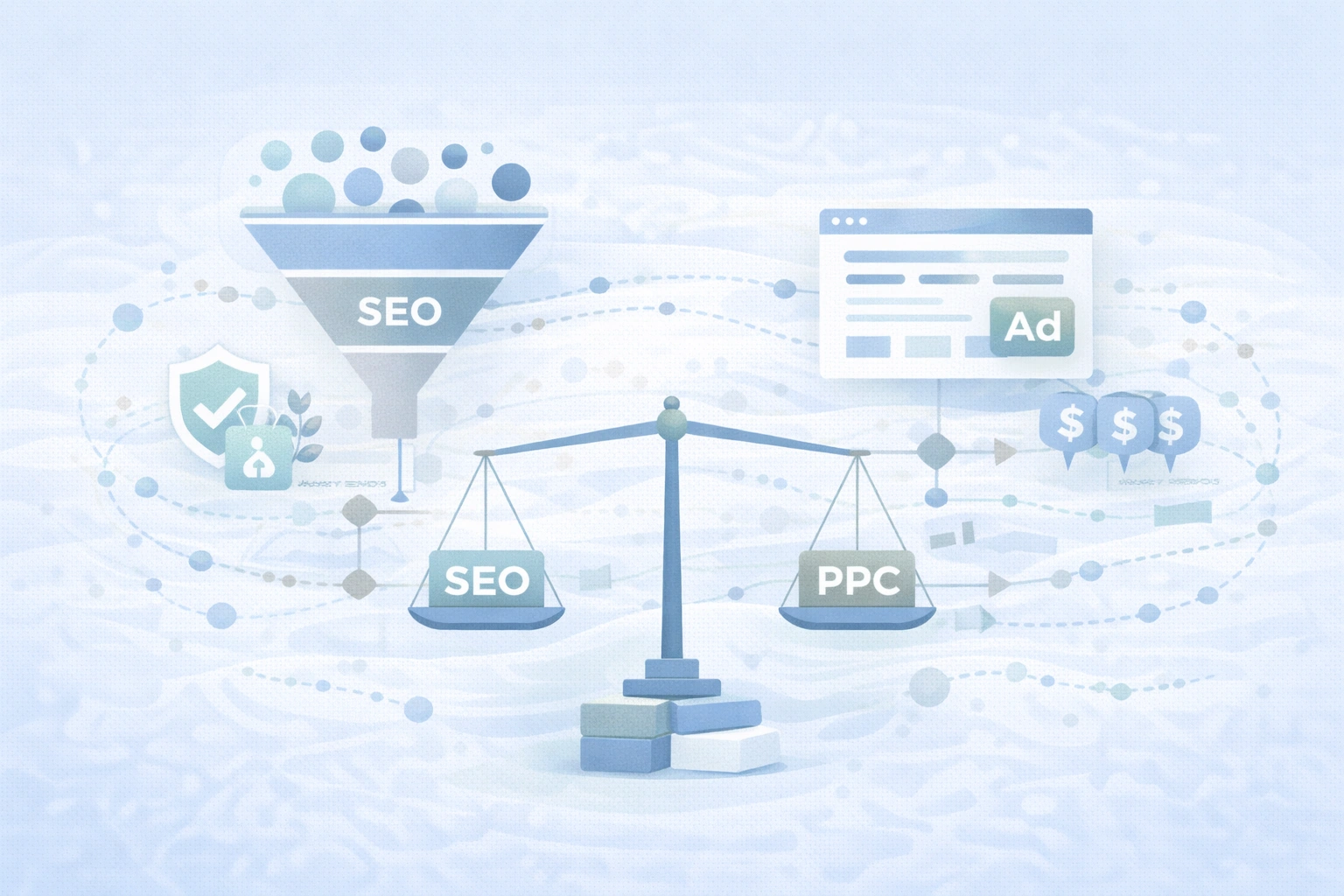
SEO and PPC don’t compete—but they behave very differently. When teams don’t fully understand those differences, budgets get misallocated, expectations break, and results disappoint.
The goal of this guide is simple:
Help you build a budget mix that works together, not against itself.
What You’re Actually Paying For (SEO vs PPC)
Before deciding how to split budget, you need to understand what you’re buying.
What PPC Really Buys You
When you invest in PPC, you’re paying for immediate visibility.
You get:
- Clicks
- Impressions
- Leads
- Conversions (now)
The math is predictable.
If your average CPC is $3 and you spend $10,000, you’ll get roughly 3,300 clicks.
That predictability is why PPC is often favored for:
- Quarterly targets
- Lead generation
- Revenue accountability
But there’s a tradeoff:
👉 The moment you stop paying, traffic stops.
What SEO Actually Buys You
SEO is not about buying clicks. It’s about building assets.
Your spend goes toward:
- Content creation
- Technical improvements
- Site structure
- Authority building
Once SEO gains traction, traffic keeps coming without paying per click.
The upside:
- Compounding growth
- Lower cost per lead over time
- Long-term defensibility
The downside:
- Slower ramp-up
- Less predictable short-term output
- Requires patience and consistency
Think of it this way:
- PPC = renting traffic
- SEO = owning traffic
How Urgency And Goals Shape Your Budget Mix
Your budget split should reflect how fast you need results.
When PPC Deserves More Budget
PPC should dominate when:
- You need leads now
- You’re launching a new product
- You’re under quarterly revenue pressure
- You’re entering a new market
In these cases, speed matters more than efficiency.
Many brands start with:
- 70/30 PPC/SEO, or
- 60/40 PPC/SEO
This gives immediate traction while SEO quietly builds underneath.
When SEO Should Take A Bigger Share
SEO deserves more investment when:
- You want to lower long-term CAC
- You’re focused on brand visibility
- Your sales cycle is longer (common in B2B)
- You already have organic traction
SEO doesn’t just support demand—it creates it.
Brands with strong foundations can gradually rebalance toward SEO without sacrificing performance.
Why Organic Traffic Is Harder To Defend in 2026
SEO has changed—and budgets must reflect that.
The Impact of AI-Powered Search
AI-generated answers now appear directly on search results.
This means:
- Fewer clicks
- More zero-click searches
- Organic rankings alone are not enough
Even sites that rank well may see traffic decline.
SEO today must earn visibility in:
- AI summaries
- Featured answers
- Enhanced SERP elements
What Modern SEO Budgets Must Include
In 2026, SEO budgets should cover more than content.
Key investment areas:
- Structured, entity-based content
- Schema and technical optimization
- Page speed and performance
- Multimedia (images, videos)
- Ongoing content refreshes
SEO is still valuable—but only when it evolves.
Budget Planning Based On Realistic Outcomes
Let’s look at a simple example.
Example: $100,000 Annual Budget
Option A: PPC-Heavy Approach
- $80,000 PPC
- $20,000 SEO
Possible outcome:
- ~25,000 paid clicks
- ~500 conversions (example rates)
- Traffic stops when spend stops
SEO may start showing traction after 3–6 months.
Option B: More Balanced Approach
- $60,000 PPC
- $40,000 SEO
Possible outcome:
- Strong paid pipeline
- Faster organic momentum
- Reduced reliance on paid over time
The key isn’t the exact ratio.
It’s whether the expected output matches reality.
PPC And SEO Both Need Ongoing Investment
A common mistake is treating one channel as “set and forget.”
PPC Requires:
- Ongoing bid optimization
- Creative testing
- Audience refinement
- Retargeting strategy
SEO Requires:
- Fresh content
- Technical maintenance
- Internal linking updates
- SERP adaptation
Neither channel works well without maintenance.
How To Explain The Budget Mix To Leadership
Leadership usually asks two questions:
- How much are we spending?
- What are we getting back?
Use simple analogies:
- PPC is a faucet – instant but paid
- SEO is a well – slower but sustainable
Both are necessary.
What helps most:
- Clear timelines
- Expected ramp-up periods
- Scenario modeling (50/50 vs 70/30)
- Visual forecasts
Clarity reduces friction.
Choosing The Right Metrics For Each Channel
Not all KPIs belong to both channels.
PPC KPIs
- CPA
- ROAS
- Conversion rate
- Impression share
SEO KPIs
- Organic traffic growth
- Engagement metrics
- Assisted conversions
- Ranking trends (contextual, not absolute)
Show how PPC fuels demand now and SEO reduces cost later.
When To Adjust The Budget Mix
Your first split is not final.
Rebalance when:
- PPC costs rise without conversion growth
- Organic rankings improve but engagement drops
- Market conditions change
- Seasonality shifts demand
Quarterly reviews keep strategy flexible and credible.
Common Budget Mistakes To Avoid
Avoid these traps:
- Expecting SEO to deliver immediate ROI
- Spending heavily on PPC without conversion optimization
- Treating SEO as a one-time project
- Ignoring post-click experience
Traffic without conversion is wasted spend.
Balancing Short-Term Wins With Long-Term Growth
There is no universal “perfect” split.
The right mix depends on:
- Business maturity
- Revenue pressure
- Market competition
- Internal capabilities
The smartest strategies blend speed and sustainability.
The goal is not to choose SEO or PPC.
The goal is to make them work together.
Final Takeaway
In 2026, the best-performing marketing budgets are not extreme.
They:
- Use PPC for speed and certainty
- Use SEO for durability and efficiency
- Adjust based on real performance
- Set realistic expectations early
A good budget mix reflects where your business is today, while preparing it for where it needs to go next.