Introduction: Why SEO vs PPC Is the Wrong Question
Most marketing leaders don’t struggle because they don’t know SEO or PPC.
They struggle because they’re asked to:
- Deliver results now
- Prove ROI clearly
- Build sustainable growth
- Defend budgets to leadership
SEO and PPC are often framed as competitors for budget.
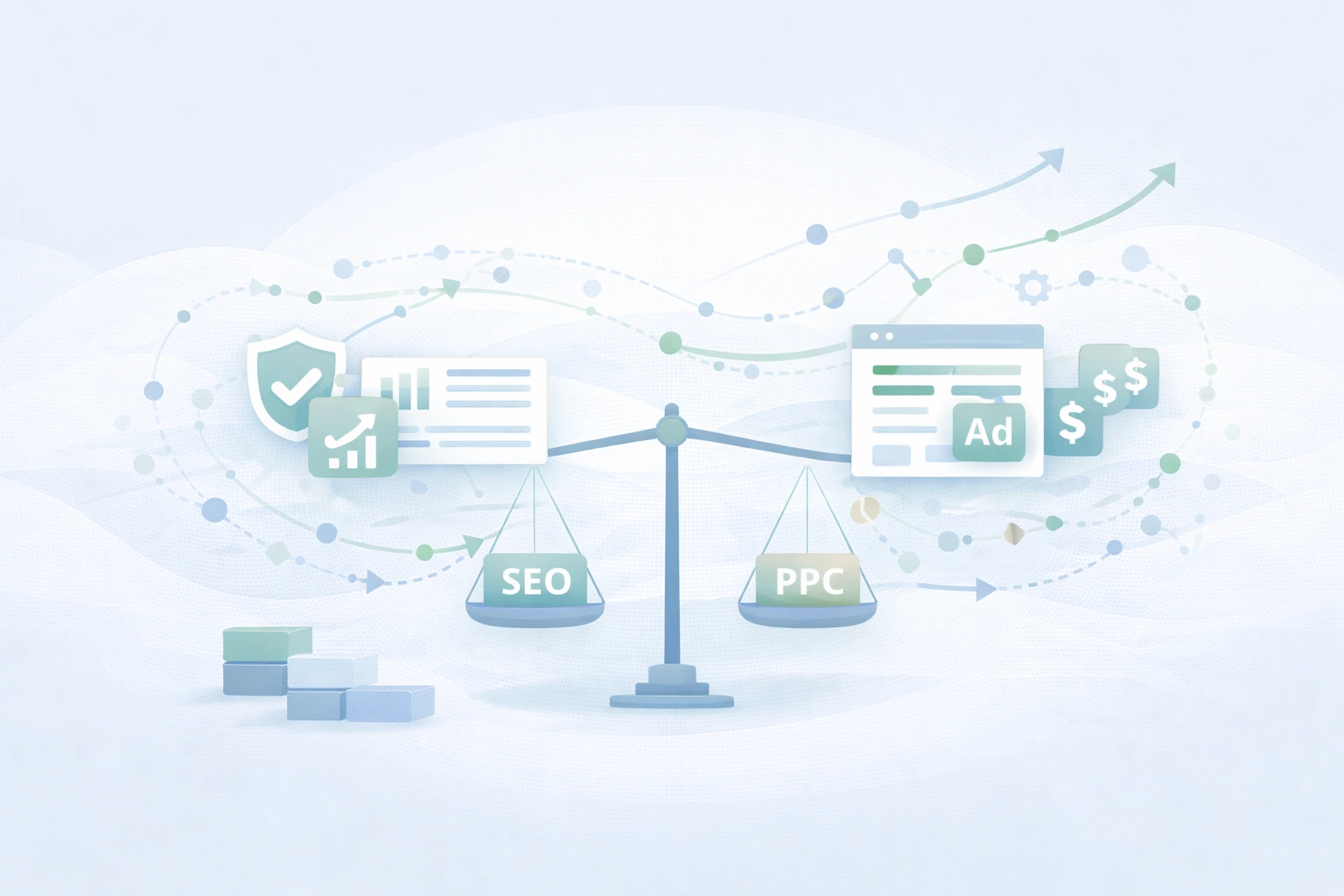
In reality, they are complementary systems with different timelines, risks, and payback curves.
The goal isn’t to choose one.
The goal is to allocate budget based on urgency, maturity, and realistic outcomes.
1. What You’re Actually Paying For in Each Channel
PPC: Buying Immediate Visibility
When you invest in PPC, you’re paying for:
- Clicks
- Impressions
- Leads or conversions right now
PPC is predictable:
- You can estimate traffic from CPC
- You can forecast leads from conversion rates
- You can turn it on or off instantly
That makes PPC attractive for:
- Short-term goals
- Revenue targets
- Product launches
- Demand generation under pressure
But the moment you stop spending, results stop.
SEO: Building an Asset, Not Renting Traffic
SEO investment goes into:
- Content creation
- Technical improvements
- Site structure
- Authority building
You don’t pay per click — you pay to earn visibility over time.
SEO’s strengths:
- Compounding returns
- Lower cost per lead long term
- Brand credibility and trust
SEO’s challenges:
- Slower ramp-up
- Harder to forecast precisely
- Requires patience and consistency
In short:
- PPC = faucet
- SEO = well
2. How Urgency and Business Goals Should Shape the Mix
Your budget split should start with one question:
How fast do we need results?
When PPC Should Get More Budget
- You need leads this quarter
- You’re launching something new
- You’re entering a new market
- You’re behind revenue targets
In these cases, PPC often carries 60–70% of the budget initially.
When SEO Deserves More Investment
- You want to lower CAC over time
- You already have baseline organic traction
- You’re focused on brand visibility
- Your sales cycle is long
As SEO gains traction, many teams shift toward a 50/50 or 60/40 split favoring SEO.
The key is expectation-setting:
SEO is not a short-term rescue plan.
3. Why Organic Traffic Is Harder to Defend in 2026
Organic search is changing.
AI-driven search features now:
- Answer questions directly
- Reduce traditional click-through rates
- Push organic listings lower on the page
This doesn’t kill SEO — it changes what SEO investment must include.
Modern SEO budgets should cover:
- Structured, entity-focused content
- Schema and technical enhancements
- FAQ and answer-oriented formatting
- Images and videos used in AI results
- Continuous content refresh
If your SEO plan hasn’t adapted, organic performance will erode even if rankings look “fine.”
4. Budget Planning Based on Realistic Outputs
Let’s simplify with an example.
Scenario: $100,000 Annual Budget
Option A: PPC-Heavy
- $80,000 PPC
- $20,000 SEO
PPC may deliver:
- Immediate traffic
- Predictable conversions
SEO may:
- Start contributing in 3–6 months
- Build a foundation for future cost reduction
Option B: Balanced Growth
- $60,000 PPC
- $40,000 SEO
This approach:
- Maintains short-term pipeline
- Accelerates long-term organic returns
- Reduces reliance on paid clicks over time
The right answer depends on:
- Sales cycle length
- Competition
- Current organic baseline
Model outcomes, not hope.
5. PPC and SEO Need Internal Budget Balance Too
Not all spend inside each channel is equal.
PPC Budget Should Be Split Across:
- Brand vs non-brand
- Prospecting vs retargeting
- Search vs display/video
Over-investing in branded search may look efficient, but it doesn’t scale demand.
SEO Budget Should Cover:
- New content
- Technical maintenance
- Content refreshes
- Authority development
SEO is not a one-time project.
Starving it after a sprint kills momentum.
6. What Leadership Actually Needs to Hear
Executives care about:
- Cost
- Return
- Risk
- Timeline
Explain SEO and PPC like this:
- PPC delivers short-term certainty
- SEO delivers long-term efficiency
- Together, they stabilize growth
Use scenarios:
- “Here’s what happens with a 70/30 split”
- “Here’s what changes if we rebalance to 50/50”
- “Here’s when SEO starts offsetting paid spend”
Visual models beat opinions.
7. Choosing the Right Metrics for Each Channel
PPC Metrics That Matter:
- CPA
- ROAS
- Conversion rate
- Impression share
SEO Metrics That Matter:
- Organic traffic growth over time
- Engagement quality
- Assisted conversions
- Visibility in AI-driven results
SEO rarely gets full credit if you only look at last-click attribution.
8. When to Adjust Your Budget Mix
Your budget split is not permanent.
Rebalance when:
- PPC costs rise but efficiency drops
- SEO traffic grows but conversions lag
- Seasonality changes demand
- Business priorities shift
Quarterly reviews are essential.
Agility builds trust with leadership.
9. Common Budget Mistakes to Avoid
- Expecting SEO to deliver instant results
- Burning PPC budget without fixing landing pages
- Treating SEO as a one-time expense
- Ignoring CRO and post-click experience
Traffic without conversion is waste — paid or organic.
Final Takeaway: Balance Beats Extremes
There is no universal “perfect” SEO vs PPC ratio.
The right mix depends on:
- Your urgency
- Your maturity
- Your competitive landscape
- Your ability to sustain investment
The strongest strategies in 2026:
- Use PPC to drive immediate momentum
- Use SEO to reduce dependency over time
- Adjust continuously as conditions evolve
The goal isn’t to pick a winner.
The goal is to fund growth intelligently — now and later.