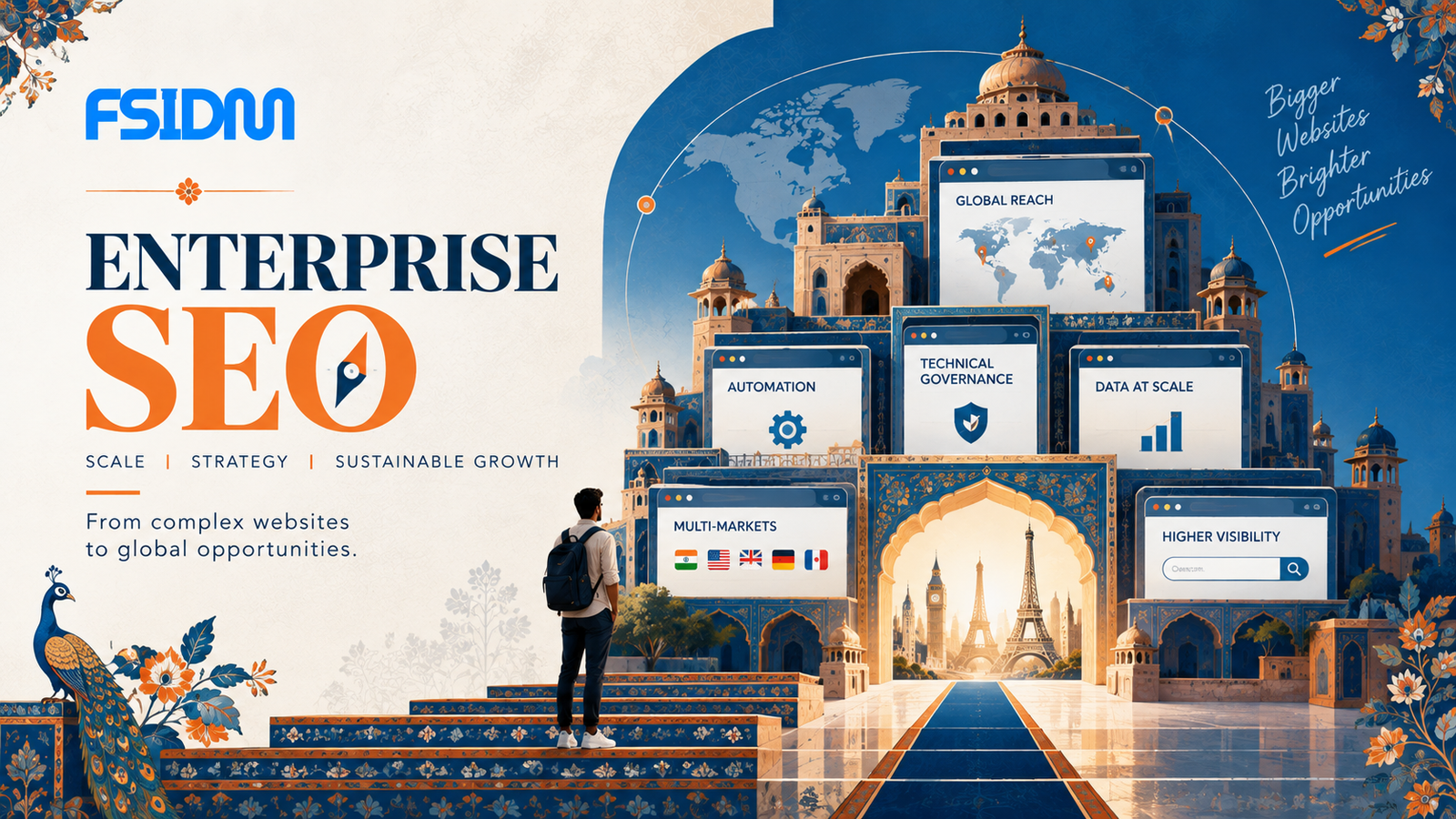
Enterprise SEO is the practice of improving organic search visibility for large-scale websites and organizations where the size, technical complexity, number of stakeholders, or global footprint makes traditional SEO workflows difficult to manage manually.
Instead of focusing only on individual keywords and articles, Enterprise SEO emphasizes scalability, automation, technical governance, data analysis, and cross-functional collaboration.
What Makes a Website Enterprise Scale?
Enterprise SEO is generally relevant when a website has a very large number of pages or operates across multiple markets, teams, languages, or technical environments.
- Massive page volume: Large e-commerce websites, media platforms, hotel networks, and directories can contain thousands or millions of URLs.
- Complex organizations: SEO changes may require coordination between SEO, engineering, product, content, legal, branding, and other teams.
- Global presence: International organizations may manage multiple languages, country-specific websites, subdomains, or localized content.
- Large business impact: At enterprise scale, relatively small technical or visibility improvements can affect significant amounts of organic traffic and revenue.
Core Pillars of Enterprise SEO
1. Automation and Data at Scale
Managing thousands of pages manually is difficult. Enterprise SEO therefore uses automation and scalable data workflows to identify opportunities and problems efficiently.
Programmatic SEO
Programmatic SEO uses standardized templates and structured data to create or optimize large numbers of landing pages. The approach can help websites target large sets of relevant search queries while maintaining consistent page structures.
Enterprise SEO Platforms
Large organizations may use specialized SEO platforms to monitor rankings, technical issues, search visibility, and website performance across extensive websites.
Log File Analysis
Server log analysis can provide insight into how search-engine crawlers interact with a website. For large sites, this can help identify inefficient crawling patterns, problematic URL groups, and areas requiring technical attention.
2. Advanced Technical Governance
Large websites can develop technical problems quickly when many teams publish or modify content. Enterprise SEO therefore requires processes that reduce the risk of accidental SEO issues.
CMS Guardrails
CMS permissions, templates, validation rules, and publishing controls can help prevent accidental changes to important SEO elements such as indexability, canonicalization, metadata, and URL structures.
Staging and Deployment Audits
Testing website changes before production deployment helps teams identify potential indexing, rendering, URL, and technical problems before they affect the live website.
3. Stakeholder Management and SEO Evangelism
Enterprise SEO is not only a technical discipline. Much of the work involves coordinating teams and connecting SEO recommendations with business priorities.
- Cross-department collaboration: SEO teams may work with developers, product managers, content teams, PR, legal, and branding teams.
- Prioritization: Large organizations often have more SEO opportunities than development resources, making prioritization essential.
- ROI measurement: SEO performance can be connected to business outcomes such as qualified leads, conversions, customer acquisition, and revenue rather than relying only on rankings or impressions.
Standard SEO vs. Enterprise SEO
| Feature | Standard SEO | Enterprise SEO |
|---|---|---|
| Website scale | Usually small to medium websites | Large, complex websites with extensive URL inventories |
| Primary focus | Content, keywords, on-page and technical optimization | Scalable optimization, automation, technical systems, and governance |
| Common challenge | Building visibility and authority | Complex architecture, technical debt, workflows, approvals, and development resources |
| Workflow | Often manageable by a small SEO team | Usually requires multiple teams and structured processes |
| Business focus | Organic traffic, rankings, leads, and conversions | Organic growth at scale, market visibility, brand protection, and revenue impact |
Why Enterprise SEO Requires a Different Approach
The biggest difference is scale. A process that works for 100 pages may become inefficient when applied to 100,000 pages.
For example, manually reviewing metadata across a very large website is unlikely to be practical. A scalable approach could involve templates, structured data, automated quality checks, prioritization systems, and engineering support.
Similarly, a technical change that affects one page on a small website can potentially affect thousands of URLs on a large platform. Enterprise SEO therefore places greater emphasis on governance, testing, monitoring, and controlled deployment.
Common Enterprise SEO Challenges
- Large and complex site architecture
- Duplicate, near-duplicate, or low-value URL sets
- Indexation and crawl-management issues
- Legacy technical infrastructure
- Limited engineering resources
- Multiple CMS or technology stacks
- International and multilingual SEO requirements
- Slow approval and implementation processes
- Coordination between multiple internal teams
- Difficulty connecting SEO performance to business revenue
Enterprise SEO Checklist
- Audit the website architecture and major URL groups.
- Identify scalable technical and content opportunities.
- Review indexability and crawl behavior.
- Establish CMS and publishing guardrails.
- Build automated monitoring where appropriate.
- Prioritize SEO recommendations according to business impact and implementation effort.
- Coordinate SEO requirements with engineering, product, content, and other relevant teams.
- Test major technical changes before production deployment.
- Track SEO outcomes against meaningful business KPIs.
Frequently Asked Questions
Is Enterprise SEO only for websites with millions of pages?
No. Page count is only one factor. A website can require enterprise-style SEO processes because of organizational complexity, multiple markets, multiple technology platforms, or the number of teams involved in implementing changes.
What is the biggest difference between SEO and Enterprise SEO?
The fundamental difference is the level of scale and operational complexity. Enterprise SEO requires SEO strategies that can be implemented, monitored, and governed across large websites and organizations.
Does Enterprise SEO require automation?
Automation is often valuable because large websites contain too many pages and data points for many repetitive tasks to be handled manually. However, automation should be combined with quality controls and human oversight.
What skills are important for Enterprise SEO?
Enterprise SEO can require a combination of technical SEO, data analysis, automation, content strategy, project management, communication, and stakeholder-management skills.
Interview Question
What is Enterprise SEO, and how is it different from traditional SEO?
Interview Tip: Focus your answer on scalability. Explain how automation, technical governance, data analysis, and cross-functional collaboration become increasingly important as website and organizational complexity grows.
Learn Enterprise SEO with FSIDM
At FSIDM, digital marketing and SEO are approached from a practical, industry-focused perspective. Understanding how SEO works at different scales can help marketers build stronger strategies for real-world businesses.
Explore FSIDM to build practical digital marketing and SEO skills.