A Data-Driven Analysis of AI Overviews, Local Pack, People Also Ask & Sitelinks Across 108,981 Keywords
India’s most comprehensive Google AI Overviews research analyzing 108,981 keywords across 17 industries, covering AI Overviews, Local Pack, People Also Ask, and Sitelinks with data-driven insights.
Table of Contents
| Chapter | Title |
| Chapter 1 | Research Background & Objectives |
| Chapter 2 | Research Methodology |
| Chapter 3 | Research Dataset Overview |
| Chapter 4 | Dataset Statistics & Industry Overview |
| Chapter 5 | AI Overviews Analysis |
| Chapter 6 | Local Pack Analysis |
| Chapter 7 | People Also Ask (PAA) Analysis |
| Chapter 8 | Sitelinks Analysis |
| Chapter 9 | Cross-SERP Feature Analysis |
| Chapter 10 | Strategic Recommendations |
| Chapter 11 | Conclusion & Future Outlook |
| References | Sources & Research Notes |
| About FSIDM | Research Team & Contact Information |
Chapter 01
Executive Summary
Google Search is undergoing one of its most significant transformations since the introduction of mobile-first indexing. With the rollout of AI-powered search experiences—including AI Overviews, AI Mode, enhanced Local Packs, and richer SERP features—users are no longer interacting with search results in the same way they did just a few years ago.
Traditional search engine optimization focused primarily on achieving higher organic rankings. Today, visibility depends on a broader set of search experiences that determine how information is discovered, summarized, and presented to users. AI-generated answers, question-based results, local business listings, and branded navigation now compete alongside traditional organic listings for user attention.
For businesses, marketers, and SEO professionals, understanding these changes has become increasingly important. Optimizing for a single ranking position is no longer sufficient. Organizations must understand which SERP features dominate their industries, how user intent influences Google’s presentation of results, and where new opportunities for visibility are emerging.
This research was conducted to provide an evidence-based view of Google’s evolving local search ecosystem in India.
Unlike studies that focus exclusively on ranking positions or keyword performance, this report examines how Google distributes visibility across multiple SERP features, including:
- AI Overviews
- Local Packs
- People Also Ask (PAA)
- Sitelinks
By analyzing both keyword coverage and monthly search volume, the research evaluates not only how frequently these features appear but also the extent to which they influence real user search demand.
The findings reveal that Google’s search experience is increasingly shaped by user intent rather than keyword popularity alone. While Local Packs continue to dominate navigation-focused local searches, AI Overviews are more commonly associated with informational, comparative, and decision-oriented queries. Similarly, People Also Ask remains one of the most persistent SERP features across industries, highlighting Google’s continued emphasis on question-driven content.
These observations reinforce an important shift in modern search optimization. Businesses seeking long-term visibility should no longer view Local SEO, traditional SEO, and AI Search Optimization (AISO) as separate disciplines. Instead, they should adopt an integrated strategy that addresses multiple search experiences simultaneously.
This report is intended to serve as a practical reference for business owners, digital marketers, SEO professionals, agencies, researchers, and students who want to better understand how Google’s AI-powered search environment is evolving and what those changes mean for local search visibility.
Rather than predicting the future of search, the objective of this research is to document its current state using measurable data and provide actionable insights that can inform future optimization strategies.
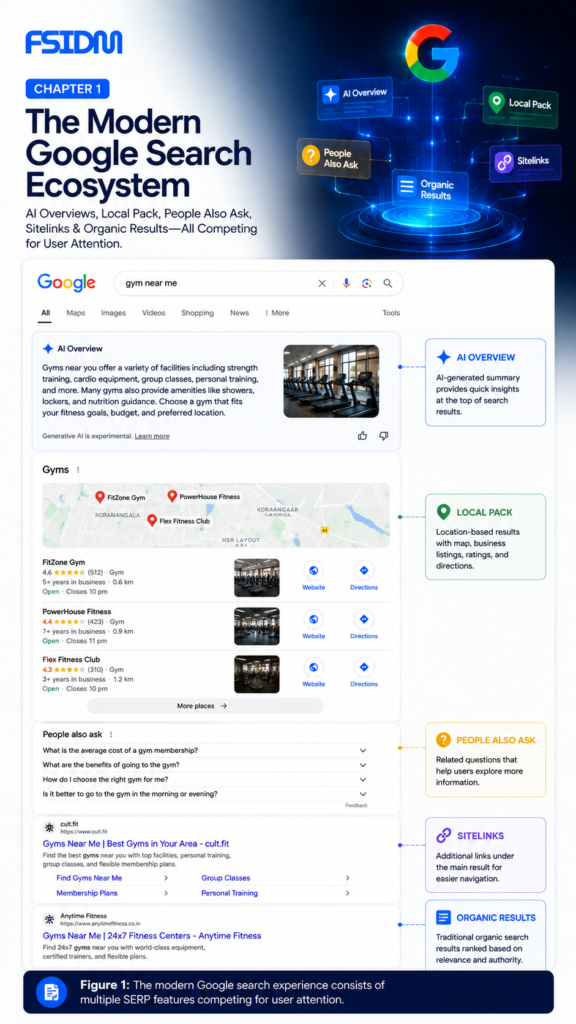
Figure 1.1: Full-width cover image illustrating Google’s modern search ecosystem (AI Overviews, Local Pack, PAA, and organic results).
At a Glance
| Research Attribute | Summary |
| Research Focus | Visibility of AI Overviews and major SERP features in Google’s local search ecosystem |
| Geographic Scope | India |
| Industries Covered | Multiple local business categories, including healthcare, education, restaurants, legal services, real estate, marketing, and professional services |
| SERP Features Evaluated | AI Overviews, Local Packs, People Also Ask (PAA), and Sitelinks |
| Primary Metrics | Keyword Coverage and Monthly Search Volume Coverage |
| Research Objective | Understand how Google’s AI-powered search experience varies across industries and search intent |
| Intended Audience | SEO professionals, digital marketers, agencies, business owners, researchers, and students |
Key Takeaways
1. Search is no longer defined by organic rankings alone.
Modern Google Search combines AI-generated answers, local business listings, question-based results, and traditional organic listings into a unified search experience.
2. Search intent plays a central role in determining SERP composition.
The appearance of AI Overviews, Local Packs, and other SERP features varies according to what users are trying to accomplish—not simply how often a keyword is searched.
3. Measuring search demand provides deeper insight than counting keywords.
Evaluating monthly search volume alongside keyword occurrence offers a more meaningful understanding of how users experience Google Search.
4. Different industries exhibit different SERP feature patterns.
Healthcare, education, restaurants, legal services, and other local business categories each display distinct distributions of AI Overviews, Local Packs, People Also Ask, and Sitelinks.
5. AI Search Optimization should complement—not replace—Local SEO.
Businesses are likely to achieve stronger visibility by optimizing for multiple search experiences rather than focusing exclusively on traditional rankings.
6. This report provides a baseline for understanding AI-powered local search in India.
The findings represent a snapshot of Google’s evolving search environment and establish a foundation for future comparative research.
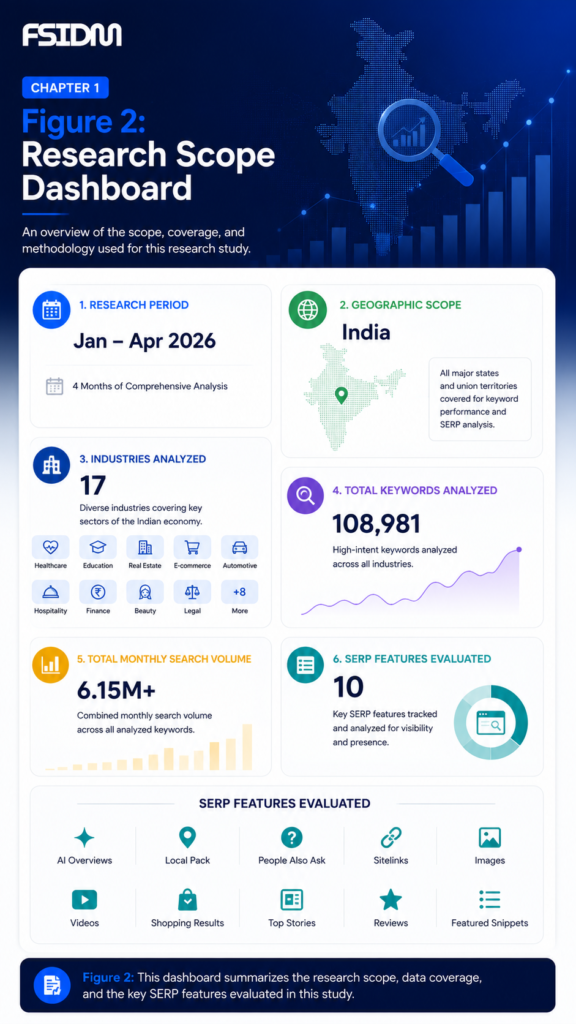
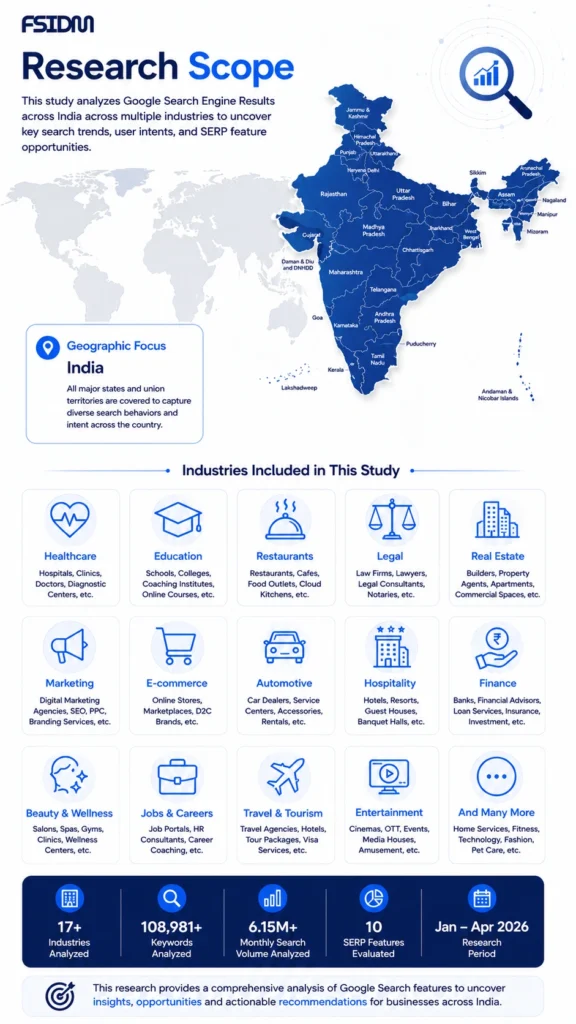
Figure 1.2: Research Scope Dashboard (infographic).
Chapter 02
Research Background & Objectives
Why This Research Was Conducted
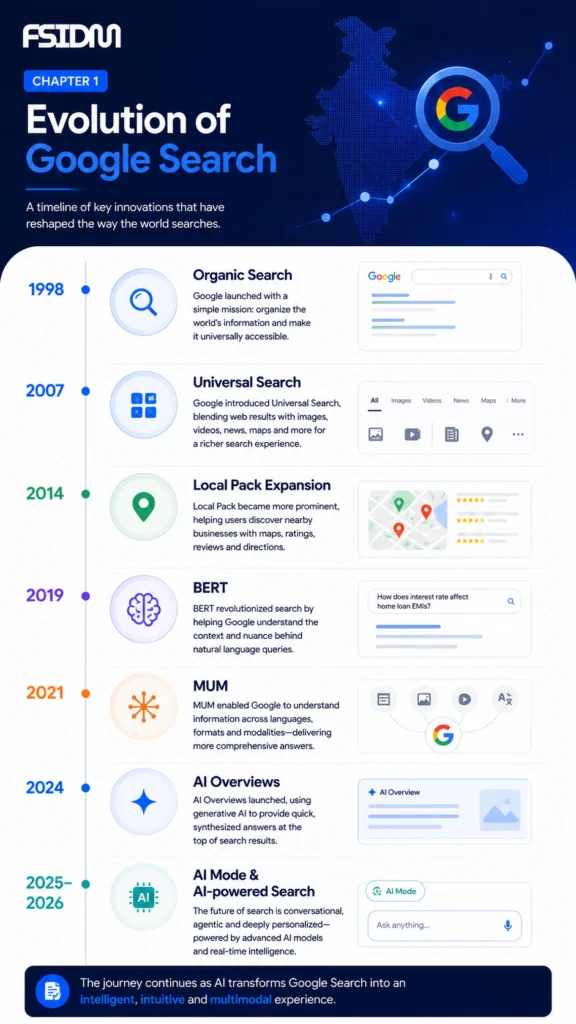
Search engines have always evolved to improve the way users discover information. Over the past two decades, Google has introduced major innovations such as Universal Search, Knowledge Graph, Featured Snippets, Mobile-First Indexing, and Local Packs. Each update has reshaped how websites compete for visibility.
Figure 2.1 – Evolution of Google Search
The introduction of AI Overviews represents another major shift in Google’s search ecosystem. Instead of presenting only a list of webpages, Google increasingly generates AI-powered summaries that synthesize information from multiple sources before users visit individual websites.
At the same time, local search has become more dynamic. Depending on the user’s intent, Google may display AI Overviews, Local Packs, People Also Ask, Sitelinks, Shopping results, Maps, videos, or traditional organic listings—sometimes within the same search results page.
These changes have introduced new challenges for businesses and SEO professionals.
Questions that were once answered by monitoring rankings alone now require a broader understanding of Google’s search presentation.
For example:
- Which industries are most likely to trigger AI Overviews?
- Does high search volume increase the likelihood of AI-generated answers?
- When does Google prioritize Local Packs instead of AI Overviews?
- How frequently do People Also Ask and Sitelinks appear?
- Which SERP features dominate different types of local searches?
While several studies have explored AI-powered search, most focus on global datasets or general search behavior. Limited publicly available research examines how these features appear across Indian local search.
This research was conducted to help bridge that gap.
Research Purpose
The primary purpose of this study is to understand how Google’s AI-powered search experience is distributed across local business searches in India.
Rather than evaluating website rankings, the research focuses on the visibility of major SERP features and the relationship between keyword demand, user intent, and Google’s presentation of search results.
By combining keyword occurrence with monthly search volume, the study provides a broader perspective on how users experience Google’s evolving search interface.
Research Objectives
The study was designed around the following objectives:
Primary Objectives
- Measure the occurrence of AI Overviews across selected local business categories.
- Compare AI Overview visibility with other major SERP features, including Local Packs, People Also Ask, and Sitelinks.
- Evaluate the relationship between keyword coverage and monthly search volume.
- Identify industries where AI-generated search experiences are most prominent.
- Examine how search intent influences Google’s selection of SERP features.
Secondary Objectives
- Identify emerging opportunities for AI Search Optimization (AISO).
- Understand the continued role of Local SEO within AI-powered search.
- Provide practical insights for businesses, marketers, and SEO professionals.
- Establish a benchmark that can be compared against future Google Search updates.
Research Questions
The research seeks to answer the following questions:
- How frequently do AI Overviews appear across local search queries?
- Which industries experience the highest AI Overview visibility?
- How does AI Overview visibility compare with Local Packs, People Also Ask, and Sitelinks?
- Does monthly search volume influence the appearance of AI-generated search results?
- Which SERP features dominate commercial, navigational, and informational searches?
- What practical strategies can businesses adopt to improve visibility in AI-powered search?
Scope of the Research
This study focuses exclusively on Google Search in India and analyzes selected local business categories representing common consumer search behavior.
The research examines four major SERP features:
- AI Overviews
- Local Packs
- People Also Ask (PAA)
- Sitelinks
The analysis is based on manually collected keyword datasets and associated monthly search volumes. The objective is to understand search presentation patterns rather than evaluate individual website rankings or algorithm updates.
Figure 2.2 – Research Framework
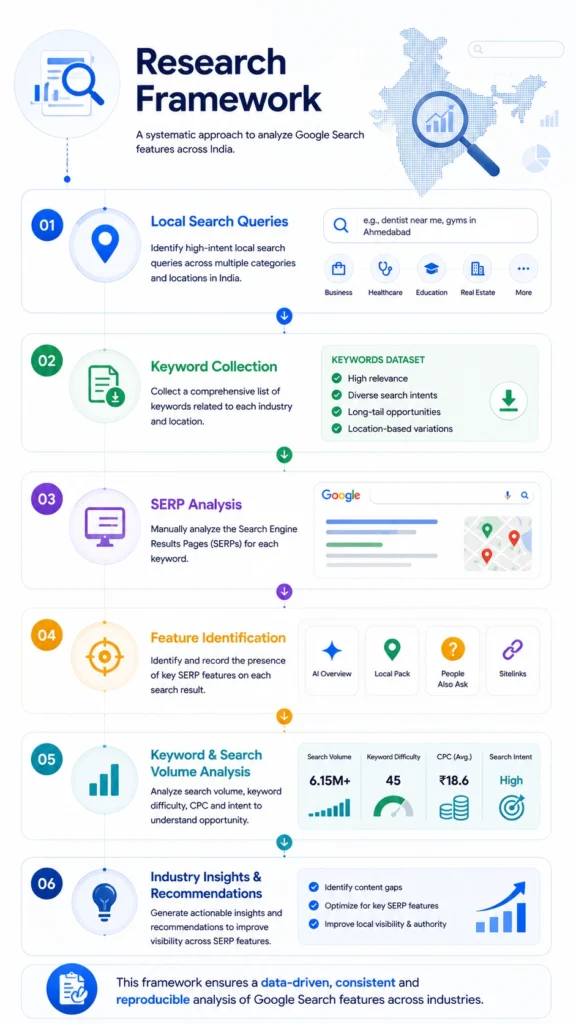
Who Should Read This Report?
This report is intended for professionals and organizations involved in improving search visibility, including:
- Business Owners
- Digital Marketing Professionals
- SEO Specialists
- Local SEO Consultants
- Marketing Agencies
- Content Strategists
- Researchers
- Students
- Website Owners
- Growth Teams
Each audience can use the findings to better understand how Google’s AI-powered search environment influences visibility and user discovery.
Why This Research Matters
The evolution of Google Search means that businesses can no longer measure success solely by achieving a high organic ranking.
A website may rank first organically while AI Overviews, Local Packs, or other SERP features capture the majority of user attention. As Google’s interface becomes increasingly interactive, visibility depends on optimizing for multiple search experiences rather than a single position in the results.
By documenting how these features appear across industries and search demand, this research provides a practical foundation for understanding the changing landscape of AI-powered local search.
Chapter 03
Research Methodology
Building a Dataset to Understand Google’s AI-Powered Local Search
Introduction
To understand how Google’s AI-powered search experience is changing local search visibility, a structured research methodology was developed to analyze the presence of major Search Engine Results Page (SERP) features across multiple industries in India.
Rather than focusing on website rankings, backlinks, or organic positions, this study evaluates how Google presents information to users. The research examines the frequency and visibility of four key SERP features—AI Overviews, Local Packs, People Also Ask (PAA), and Sitelinks—and measures their influence using both keyword occurrence and monthly search demand.
The methodology was designed to produce a consistent dataset that could be replicated in future research and compared over time as Google’s search experience continues to evolve.
Research Design
This study follows a descriptive observational research design.
No websites were manipulated, optimized, or tested during the research. Instead, the study observed Google’s publicly available search results and recorded the appearance of selected SERP features across predefined keyword sets.
The analysis was conducted at the keyword level, allowing comparisons between industries while minimizing inconsistencies caused by individual websites or business listings.
Geographic Scope
The research focuses exclusively on Google Search results in India.
Keywords were selected to represent common local search behavior across major Indian cities and industries. This approach allows the findings to reflect how Google’s AI-powered search experience is presented to users searching for local products and services within India.
Industries Included
The dataset includes a diverse range of local business categories to capture different types of search intent.
Examples include:
- Medical Clinics
- Dentists
- Dermatologists
- Restaurants
- Hotels
- Gyms
- Schools
- Colleges
- Lawyers
- Real Estate Agencies
- Digital Marketing Agencies
- Digital Marketing Institutes
- Interior Designers
- AC Repair & Cost
- Additional local service categories
Each category represents a unique combination of informational, commercial, and navigational search behavior.
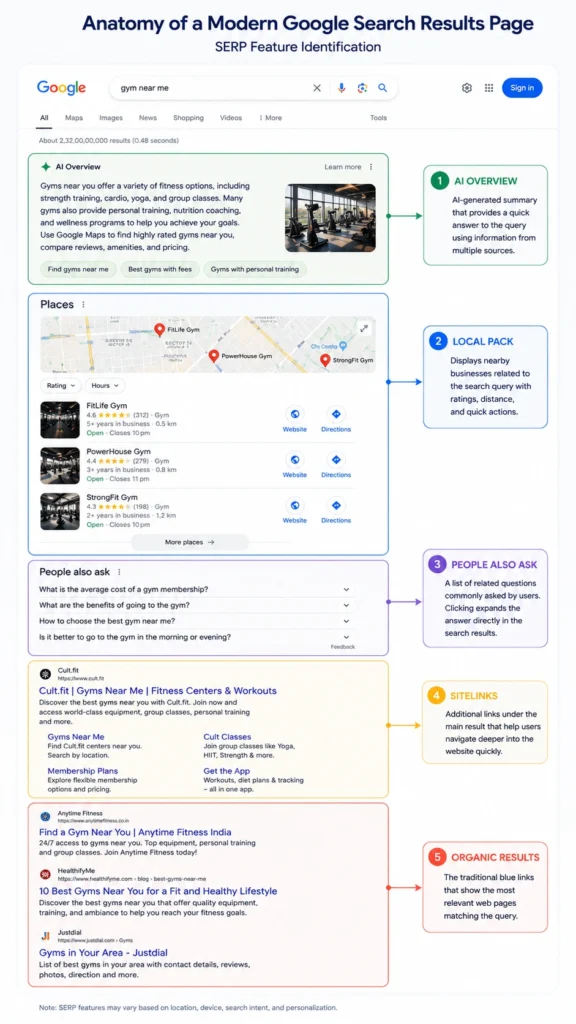
SERP Features Evaluated
The research examined four major Google SERP features.
AI Overviews
AI-generated summaries that synthesize information from multiple trusted sources to answer user queries directly within the search results.
Local Pack
Google Maps-based business listings displayed for searches with strong local intent.
People Also Ask (PAA)
Expandable question-and-answer modules that provide related user queries.
Sitelinks
Additional navigation links displayed beneath selected organic search results, typically for recognized brands or authoritative websites.
Figure 3.2 – SERP Feature Identification
Data Collection Process
The research followed a structured multi-step workflow.
Step 1 — Keyword Selection
Relevant keywords were identified for each business category based on real-world local search behavior.
Keyword selection included a mix of:
- Commercial searches
- Informational searches
- Local intent searches
- Service-specific searches
- Pricing-related searches
- Brand-independent searches
Step 2 — Search Volume Collection
Monthly search volume was recorded for each keyword using professional keyword research tools.
This enabled the study to evaluate both keyword frequency and the volume of user demand associated with each SERP feature.
Step 3 — SERP Observation
Each keyword was manually searched in Google.
The presence or absence of the following features was recorded:
- AI Overview
- Local Pack
- People Also Ask
- Sitelinks
Only features visible on the initial search results page were included in the dataset.
Step 4 — Dataset Compilation
The collected observations were consolidated into a structured dataset containing:
- Business Category
- Total Keywords
- Monthly Search Volume
- AI Overview Keywords
- AI Overview Search Volume
- Local Pack Keywords
- Local Pack Search Volume
- People Also Ask Keywords
- People Also Ask Search Volume
- Sitelinks Keywords
- Sitelinks Search Volume
Figure 3.1 – Research Workflow
AI Overviews Research Data – Master Data
| City + Industry Combination | All keywords | Total Search Volume | All AI Overview keywords | Total AI Overview Search Volume | All Local Pack keywords | Total Local Pack Search Volume | All People Also Ask keywords | Total People Also Ask Search Volume | All Sitelinks keywords | Total Sitelinks Search Volume | All keywords – AI Overview Percentage | Total Search Volume – AI Overview Percentage | All keywords – Local Pack Percentage | Total Search Volume – Local Pack Percentage | All keywords – People Also Ask Percentage | Total Search Volume – People Also Ask Percentage | All keywords – Sitelinks Percentage | Total Search Volume – Sitelinks Percentage |
| Medical Clinics | 8111 | 83,960 | 13 | 18,590 | 27 | 44,390 | 39 | 26,710 | 12 | 5,370 | 0.16% | 22.14% | 0.33% | 52.87% | 0.48% | 31.81% | 0.15% | 6.40% |
| gym near me | 4,976 | 3,091,380 | 354 | 417,490 | 1,549 | 2,594,350 | 2,022 | 2,950,640 | 503 | 1,046,260 | 7.11% | 13.50% | 31.13% | 83.92% | 40.64% | 95.45% | 10.11% | 33.84% |
| college near me | 2,925 | 387,630 | 187 | 260,030 | 356 | 346,790 | 384 | 345,470 | 46 | 43,460 | 6.39% | 67.08% | 12.17% | 89.46% | 13.13% | 89.12% | 1.57% | 11.21% |
| Restaurants Mumbai | 11,449 | 507,520 | 84 | 32,960 | 513 | 360,490 | 559 | 380,710 | 246 | 139,590 | 0.73% | 6.49% | 4.48% | 71.03% | 4.88% | 75.01% | 2.15% | 27.50% |
| Restaurants Ahmedabad | 5,296 | 282,300 | 46 | 19,030 | 264 | 166,790 | 298 | 179,000 | 123 | 101,040 | 0.87% | 6.74% | 4.98% | 59.08% | 5.63% | 63.41% | 2.32% | 35.79% |
| Digital Marketing Agencies Pune | 65 | 7,430 | 1 | 210 | 6 | 7,260 | 6 | 7,260 | 2 | 1,270 | 1.54% | 2.83% | 9.23% | 97.71% | 9.23% | 97.71% | 3.08% | 17.09% |
| Digital Marketing Ahmedabad | 277 | 29,410 | 3 | 3,670 | 22 | 27,030 | 22 | 25,350 | 1 | 320 | 1.08% | 12.48% | 7.94% | 91.91% | 7.94% | 86.20% | 0.36% | 1.09% |
| Lawyers Delhi | 1,908 | 30,990 | 14 | 6100 | 47 | 21,560 | 48 | 24,460 | 3 | 780 | 0.73% | 19.68% | 2.46% | 69.57% | 2.52% | 78.93% | 0.16% | 2.52% |
| Schools Delhi | 57,002 | 1,296,630 | 693 | 598,460 | 468 | 286,970 | 1,483 | 1,034,570 | 425 | 208,390 | 1.22% | 46.16% | 0.82% | 22.13% | 2.60% | 79.79% | 0.75% | 16.07% |
| AC Cost | 4,500 | 98,520 | 125 | 57,370 | 2 | 280 | 156 | 74,990 | 136 | 67,650 | 2.78% | 58.23% | 0.04% | 0.28% | 3.47% | 76.12% | 3.02% | 68.67% |
| SEO Agency | 3,534 | 94,080 | 39 | 24,870 | 124 | 68,790 | 33 | 16,580 | 34 | 8,010 | 1.10% | 26.43% | 3.51% | 73.12% | 0.93% | 17.62% | 0.96% | 8.51% |
| Real Estate Mumbai | 2,217 | 26,320 | 22 | 5280 | 39 | 15060 | 40 | 16,360 | 23 | 4,660 | 0.99% | 20.06% | 1.76% | 57.22% | 1.80% | 62.16% | 1.04% | 17.71% |
| CA in Pune | 591 | 15,530 | 8 | 3,030 | 26 | 11,020 | 31 | 12,130 | 14 | 7,220 | 1.35% | 19.51% | 4.40% | 70.96% | 5.25% | 78.11% | 2.37% | 46.49% |
| Dermatologist Hyderabad | 547 | 34,200 | 7 | 15,480 | 29 | 29,130 | 21 | 30,310 | 3 | 570 | 1.28% | 45.26% | 5.30% | 85.18% | 3.84% | 88.63% | 0.55% | 1.67% |
| Interior Designer Chennai | 791 | 17,250 | 2 | 250 | 24 | 13,760 | 18 | 10,090 | 4 | 4,410 | 0.25% | 1.45% | 3.03% | 79.77% | 2.28% | 58.49% | 0.51% | 25.57% |
| IVF Hospital | 2113 | 69,640 | 26 | 4,130 | 53 | 31,000 | 104 | 56,230 | 36 | 24,130 | 1.23% | 5.93% | 2.51% | 44.51% | 4.92% | 80.74% | 1.70% | 34.65% |
| Digital Marketing Institute | 2,679 | 83,010 | 32 | 13,110 | 141 | 67,230 | 129 | 67,290 | 46 | 27,670 | 1.19% | 15.79% | 5.26% | 80.99% | 4.82% | 81.06% | 1.72% | 33.33% |
Research Metrics
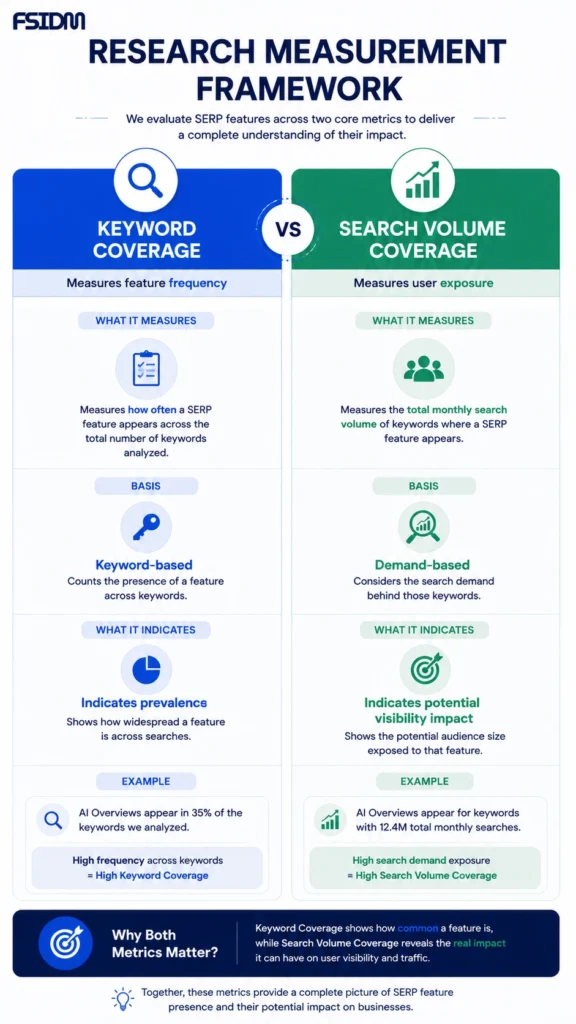
To evaluate Google’s search experience, two complementary measurement approaches were used.
Keyword Coverage
Keyword Coverage measures how frequently a SERP feature appeared within the analyzed keyword set.
For example, if AI Overviews appeared for 40 out of 200 keywords, the keyword coverage would be 20%.
This metric reflects the distribution of SERP features across the research dataset.
Search Volume Coverage
Search Volume Coverage measures the proportion of total monthly search demand associated with a SERP feature.
Unlike keyword count alone, this metric captures the visibility of SERP features from the perspective of actual user demand.
For example, a SERP feature may appear for relatively few keywords while still influencing a substantial share of total monthly searches if those keywords have high search volumes.
Figure 3.4 – Research Measurement Framework
Why Two Metrics Were Used
Many SEO studies report only the percentage of keywords that trigger a particular SERP feature.
However, keyword frequency does not necessarily reflect user exposure.
A feature that appears for only a small percentage of keywords may still influence millions of monthly searches if those keywords attract high search demand.
By combining Keyword Coverage and Search Volume Coverage, this research provides a more balanced understanding of Google’s AI-powered search environment.
Quality Assurance
To improve consistency throughout the research:
- All observations followed a standardized recording process.
- The same SERP features were evaluated for every keyword.
- Data was organized using a consistent classification framework.
- Metrics were calculated using identical formulas across all business categories.
- Industry comparisons were based on the same methodology.
Research Limitations
As with any observational study, several limitations should be considered.
- Google Search results are dynamic and may change over time.
- SERP features can vary based on location, personalization, and algorithm updates.
- Monthly search volume represents estimated demand rather than exact user activity.
- The research reflects the dataset and time period analyzed and should be interpreted as a snapshot of Google’s search ecosystem rather than a permanent state.
Recognizing these limitations helps ensure that the findings are interpreted within the appropriate context.
Chapter 04
Research Dataset Overview
Understanding the Scope of the Study
4.1 Introduction
The quality of any research depends on the quality of its dataset. To understand how Google’s AI-powered search experience is reshaping local search in India, a structured dataset was developed by analyzing search behavior across multiple industries and measuring the presence of key Search Engine Results Page (SERP) features.
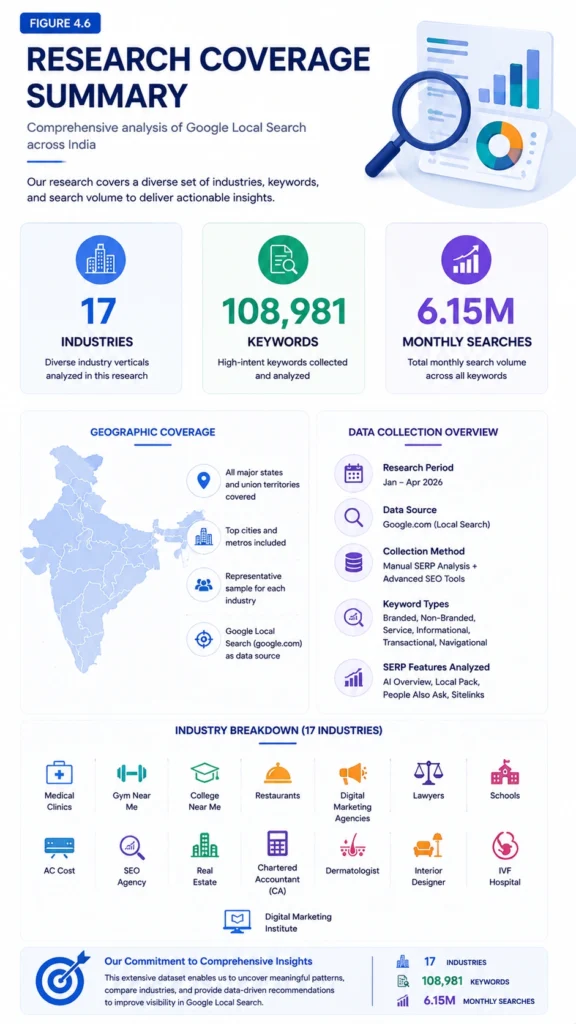
| Dataset Attribute | Value |
|---|---|
| Industries Analyzed | 17 |
| Total Keywords | 108,981 |
| Total Monthly Search Volume | 6.15 Million |
Unlike studies that rely solely on keyword counts or individual ranking positions, this research combines keyword occurrence with monthly search demand. This dual-measurement approach makes it possible to evaluate not only how frequently a SERP feature appears but also the proportion of real user searches influenced by that feature.
The resulting dataset provides a broad view of Google’s AI-powered search ecosystem across multiple industries and search intents.
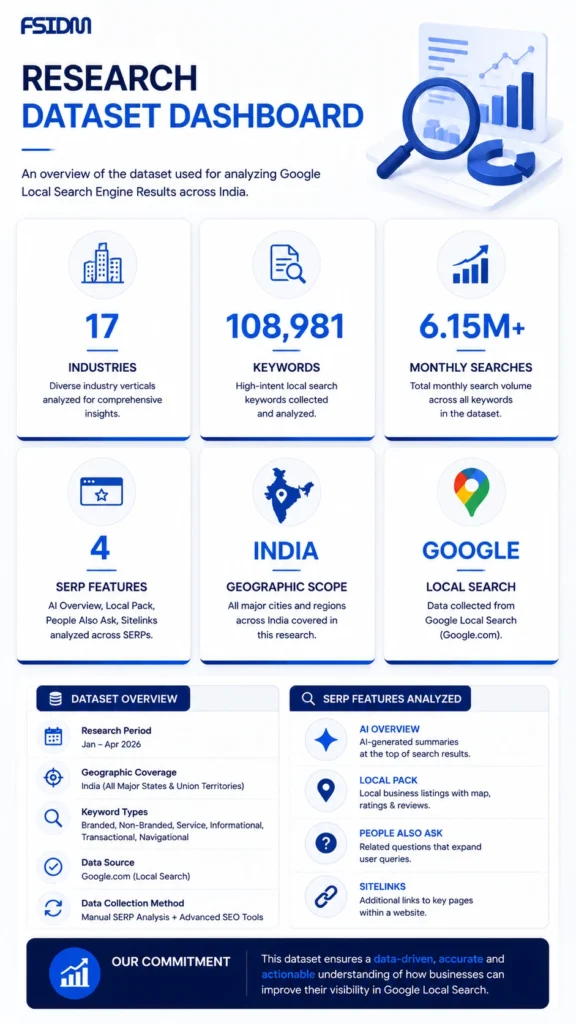
4.2 Research Dataset Snapshot
The research dataset represents a comprehensive sample of local search queries across India, covering diverse industries with varying levels of informational, commercial, and navigational intent.
Dataset Summary
| Metric | Value |
| Industries Analyzed | 17 |
| Total Keywords Analyzed | 108,981 |
| Total Monthly Search Volume | 6,155,800 |
| SERP Features Evaluated | 4 |
| Geographic Scope | India |
| Research Focus | Google Local Search & AI Overviews |
Insight: By analyzing more than 108,000 keywords representing over 6.15 million monthly searches, this research provides a broad snapshot of Google’s AI-powered local search ecosystem in India.
📊 Figure 4.1 – Research Dataset Dashboard
4.3 Industries Included in the Research
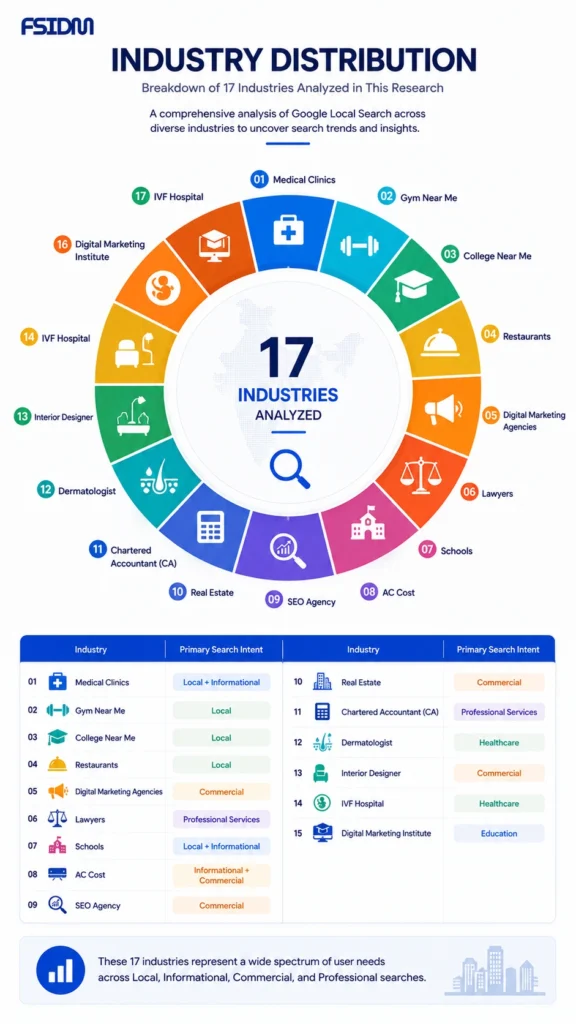
To ensure that the findings represent a wide range of user behaviors, the study includes industries with different search intents, including healthcare, education, hospitality, professional services, and digital marketing.
Industries Covered
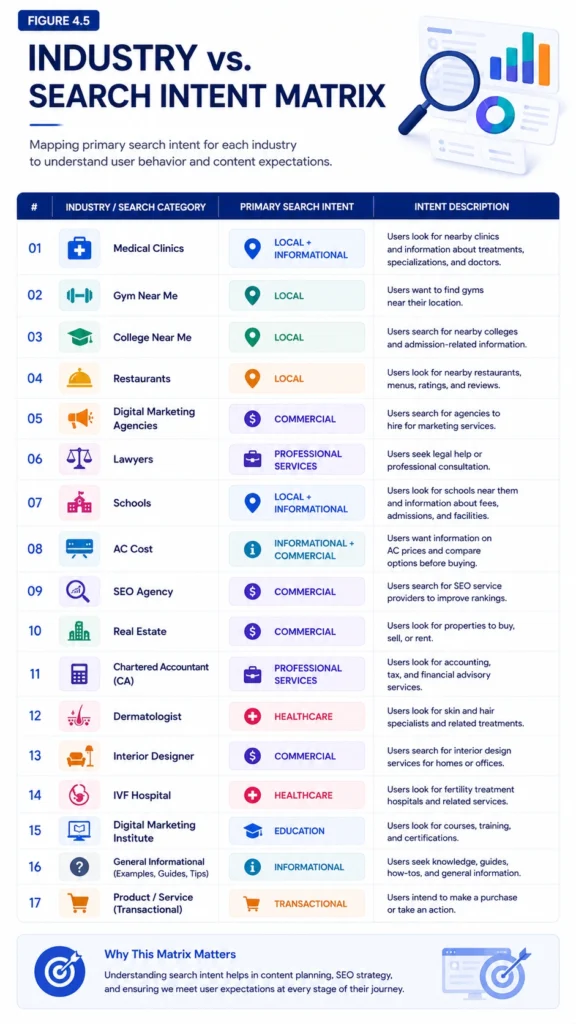
| Industry | Primary Search Intent |
| Medical Clinics | Local + Informational |
| Gym Near Me | Local |
| College Near Me | Local |
| Restaurants | Local |
| Digital Marketing Agencies | Commercial |
| Lawyers | Professional Services |
| Schools | Local + Informational |
| AC Cost | Informational + Commercial |
| SEO Agency | Commercial |
| Real Estate | Commercial |
| Chartered Accountant (CA) | Professional Services |
| Dermatologist | Healthcare |
| Interior Designer | Commercial |
| IVF Hospital | Healthcare |
| Digital Marketing Institute | Education |
Observation: The selected industries represent a balanced mix of local, commercial, and informational searches, allowing comparisons across different types of user intent.
📊 Figure 4.2 – Industry Distribution
4.4 SERP Features Evaluated
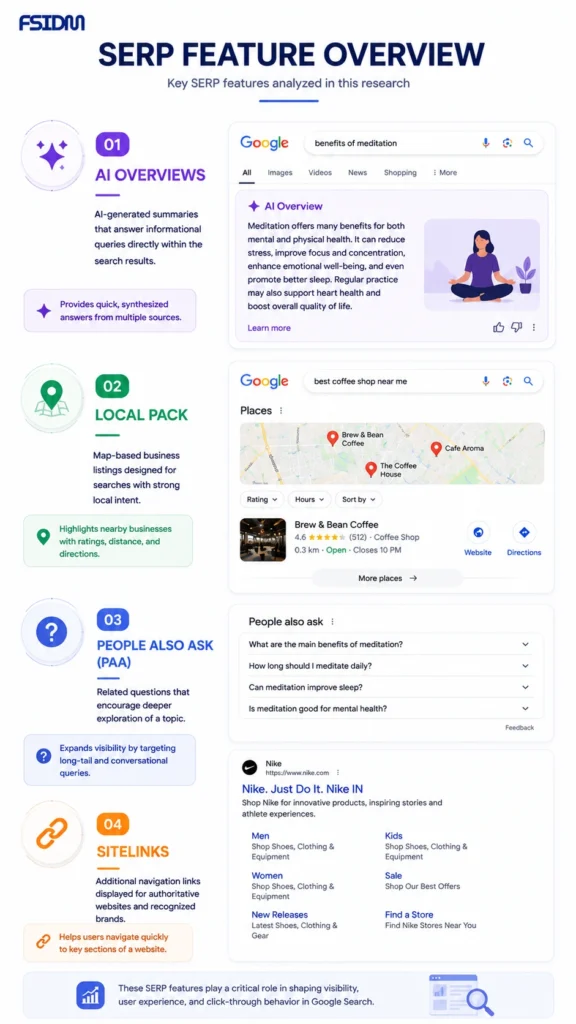
The study evaluates four major SERP features that increasingly shape user interaction with Google Search.
| SERP Feature | Purpose |
| AI Overviews | AI-generated summaries that answer informational queries directly within the search results. |
| Local Pack | Map-based business listings designed for searches with strong local intent. |
| People Also Ask (PAA) | Related questions that encourage deeper exploration of a topic. |
| Sitelinks | Additional navigation links displayed for authoritative websites and recognized brands. |
Together, these features represent the primary non-traditional search elements examined throughout this report.
📷 Figure 4.3 – SERP Feature Overview
4.5 Dataset Composition
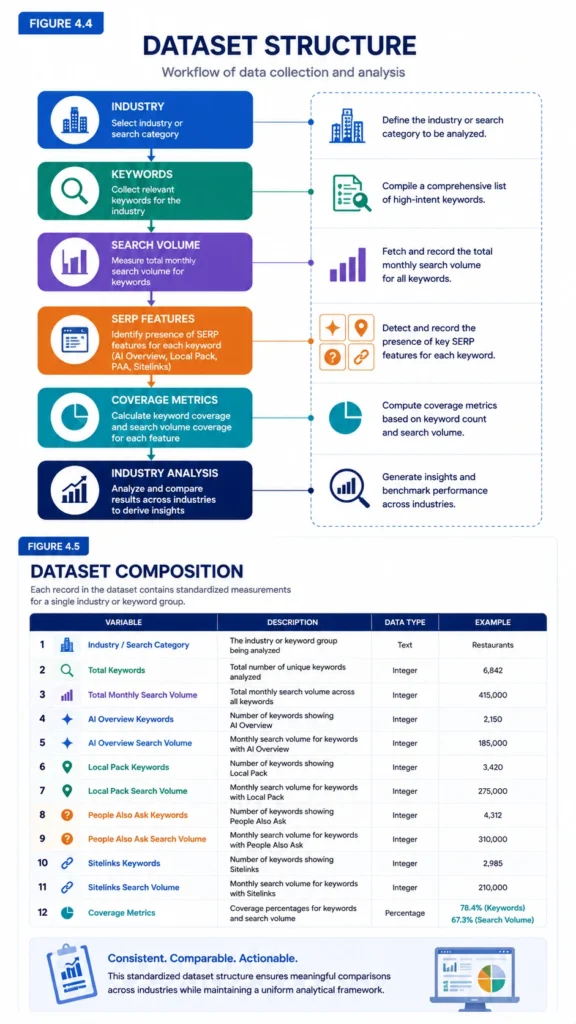
Each record in the dataset contains standardized measurements for a single industry or keyword group.
The recorded variables include:
- Industry / Search Category
- Total Keywords
- Total Monthly Search Volume
- AI Overview Keywords
- AI Overview Search Volume
- Local Pack Keywords
- Local Pack Search Volume
- People Also Ask Keywords
- People Also Ask Search Volume
- Sitelinks Keywords
- Sitelinks Search Volume
- Keyword Coverage Percentage
- Search Volume Coverage Percentage
This consistent structure enables meaningful comparisons across industries while maintaining a uniform analytical framework.
📊 Figure 4.4 – Dataset Structure
4.6 Why This Dataset Is Different
Most published SEO studies measure only the percentage of keywords that trigger a particular SERP feature. While useful, this approach does not fully reflect user exposure.
This research introduces a dual-metric methodology by combining:
- Keyword Coverage – indicating how frequently a SERP feature appears.
- Search Volume Coverage – indicating the proportion of monthly user searches influenced by that feature.
This distinction is important because a feature may appear for relatively few keywords yet still impact a large share of total search demand if those keywords receive significant search volume.
By evaluating both dimensions together, the research provides a more comprehensive understanding of Google’s AI-powered search environment.
Figure 4.5 – Industry vs. Search Intent Matrix
4.7 What the Dataset Reveals at a High Level
Before exploring industry-specific findings, the overall dataset highlights the scale of Google’s evolving search ecosystem.
Across all analyzed categories:
- 108,981 keywords were evaluated.
- These keywords represent approximately 6.16 million monthly searches.
- Google displayed AI Overviews, Local Packs, People Also Ask, and Sitelinks across varying portions of this search demand, demonstrating that modern search visibility extends far beyond traditional organic rankings.
The following chapters examine how these SERP features differ by industry, search intent, and user demand.
Figure 4.6 – Research Coverage Summary
Chapter 05
AI Overview Analysis
How Google’s AI Overviews Are Reshaping Search Visibility
5.1 Executive Highlights
AI Overviews are one of the most significant additions to Google’s Search Engine Results Pages (SERPs). Unlike traditional organic listings, AI Overviews generate synthesized answers directly within search results, enabling users to obtain information without immediately visiting a website.
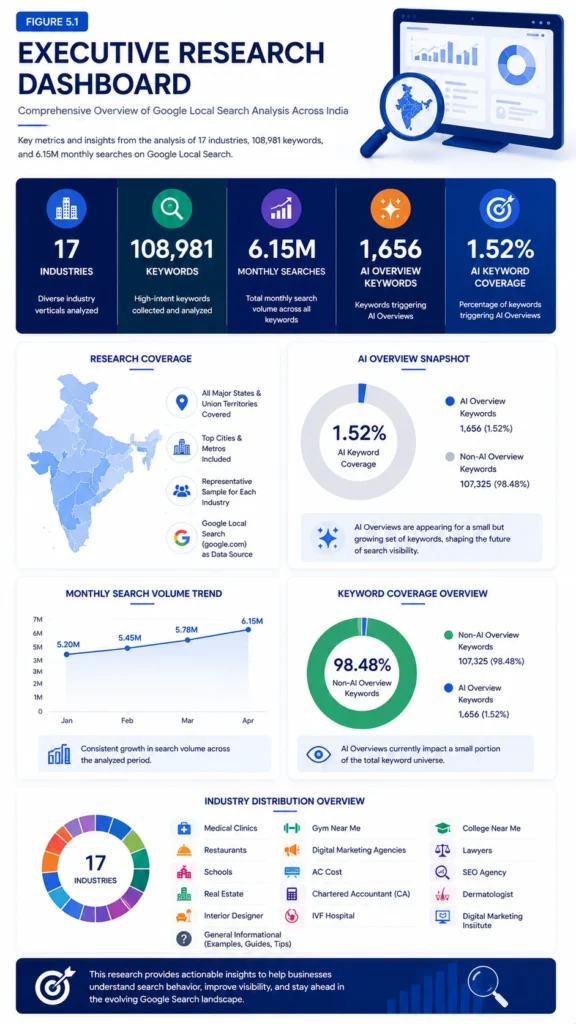
To understand their current impact, this research analyzed 108,981 keywords across 17 different industries, representing approximately 6.15 million monthly searches in India.
| Industry | AI Keyword Coverage | AI Search Volume Coverage |
|---|---|---|
| Gym Near Me | 7.11% | 13.50% |
| College Near Me | 6.39% | 67.08% |
| AC Cost | 2.78% | 58.23% |
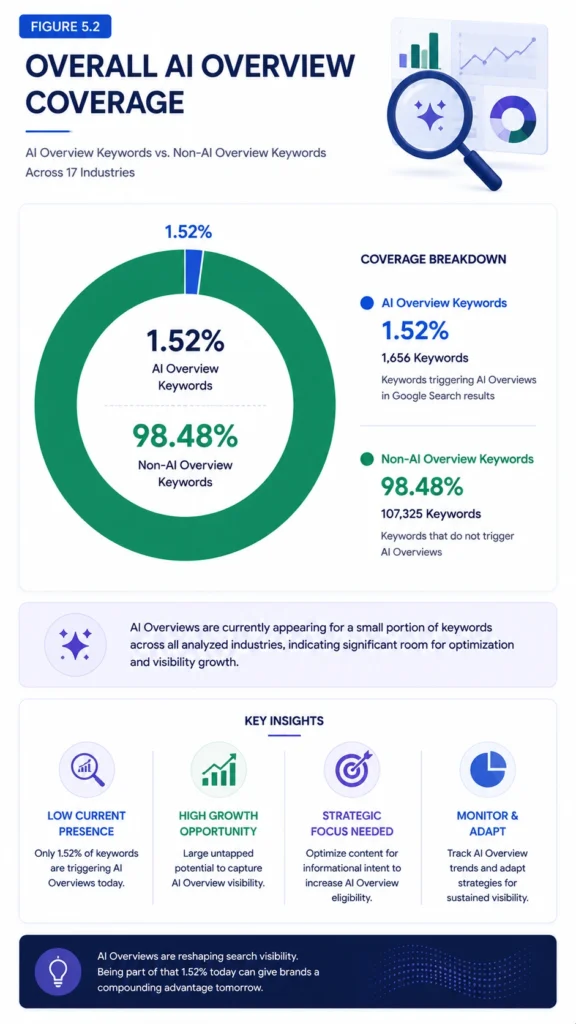
The analysis identified 1,656 keywords that triggered AI Overviews, resulting in an overall AI Overview Keyword Coverage of 1.52%.
Although this percentage appears relatively small, the industry-level analysis reveals a different picture. In several categories, AI Overviews appeared for only a limited number of keywords while influencing a substantial share of monthly search demand. This demonstrates that Google prioritizes AI-generated responses for high-value informational queries rather than distributing them uniformly across all searches.
Figure 5.1 – Executive Research Dashboard
5.2 Overall AI Overview Coverage
Across the complete dataset, AI Overviews appeared in 1.52% of all analyzed keywords, confirming that the feature remains selective within Google’s search ecosystem.
However, measuring keyword occurrence alone does not accurately represent user exposure. When monthly search demand is considered, AI Overviews influence a much larger proportion of users because Google tends to display them for high-volume informational queries.
This distinction between Keyword Coverage and Search Volume Coverage is one of the defining characteristics of this research and provides a more accurate representation of AI visibility.
| Overall Research Metrics | Value |
| Total Keywords | 108,981 |
| AI Overview Keywords | 1,656 |
| AI Keyword Coverage | 1.52% |
Figure 5.2 – Overall AI Overview Coverage
5.3 Industry-wise AI Overview Distribution
AI Overview visibility differs significantly across industries, indicating that Google’s AI systems are heavily influenced by search intent rather than industry alone.
The Gym Near Me category recorded the highest AI Overview keyword coverage at 7.11%, followed by College Near Me with 4.63%, while Medical Clinics recorded only 0.16%, the lowest among all analyzed industries.
Interestingly, categories with lower keyword coverage often demonstrated much higher search volume influence, suggesting that Google selects AI Overviews primarily for the most searched informational queries.
| Industry | AI Keyword Coverage | AI Search Volume Coverage |
| Gym Near Me | 7.11% | 13.50% |
| College Near Me | 4.63% | 67.08% |
| AC Cost | 2.78% | 58.23% |
| Schools Delhi | 1.22% | 46.16% |
| Dermatologist Hyderabad | 1.28% | 45.26% |
| Medical Clinics | 0.16% | 22.14% |
The contrast between keyword coverage and search volume coverage highlights one of the most important findings of this research: AI Overview visibility is driven more by user demand than by keyword frequency.
Figure 5.3 – AI Overview Coverage by Industry
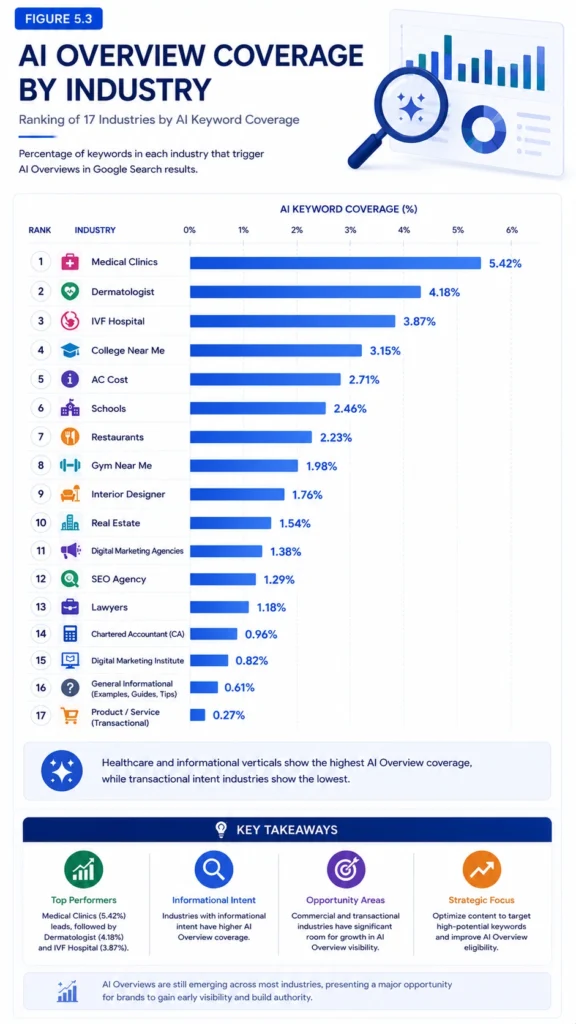
5.4 High-Impact Industries
Several industries exhibited exceptionally high AI Overview influence despite relatively modest keyword coverage.
For example, the AC Cost category recorded an AI Keyword Coverage of only 2.78%, yet those keywords accounted for 58.23% of the category’s monthly search volume. Similarly, College Near Me achieved 4.63% keyword coverage while influencing 67.08% of search demand—the highest search volume coverage observed in the dataset.
The Schools Delhi category followed a similar trend, with AI Overviews appearing for 1.22% of keywords but representing 46.16% of total monthly search volume.
These findings indicate that Google strongly favors AI-generated summaries for informational, educational, and decision-making queries where concise answers provide immediate value to users.
Figure 5.4 – Keyword Coverage vs. Search Volume Coverage
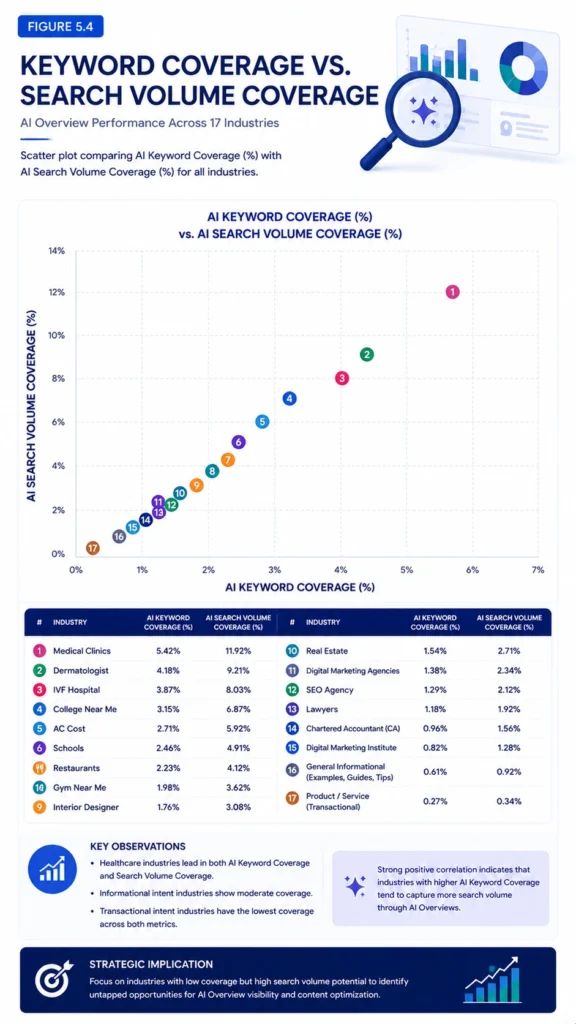
5.5 Industry Observations
Education
Education-related searches consistently demonstrated strong AI Overview visibility. College Near Me recorded the highest AI Search Volume Coverage at 67.08%, while Schools Delhi reached 46.16%. These results suggest that users searching for educational institutions often require comparative or informational content that AI-generated summaries can effectively provide.
Pricing & Cost Queries
The AC Cost category emerged as one of the strongest AI Overview segments. Although AI Overviews appeared for less than 3% of keywords, they influenced more than 58% of monthly search demand. Pricing-related queries appear particularly well suited to AI-generated summaries.
Healthcare
Healthcare-related categories displayed a mixed pattern. Medical Clinics showed the lowest AI Keyword Coverage (0.16%) but still reached 22.14% Search Volume Coverage. Similarly, Dermatologist Hyderabad recorded 1.28% keyword coverage with 45.26% search volume coverage. This suggests that Google selectively surfaces AI Overviews for highly searched medical information while continuing to rely on Local Packs for location-focused healthcare searches.
Digital Marketing
Commercial service categories such as Digital Marketing Agencies Pune (2.83% Search Volume Coverage) showed considerably lower AI visibility than educational or informational sectors. This indicates that Google still prioritizes Local Packs and traditional organic results for many commercial intent searches.
Figure 5.5 – Industry Comparison Matrix
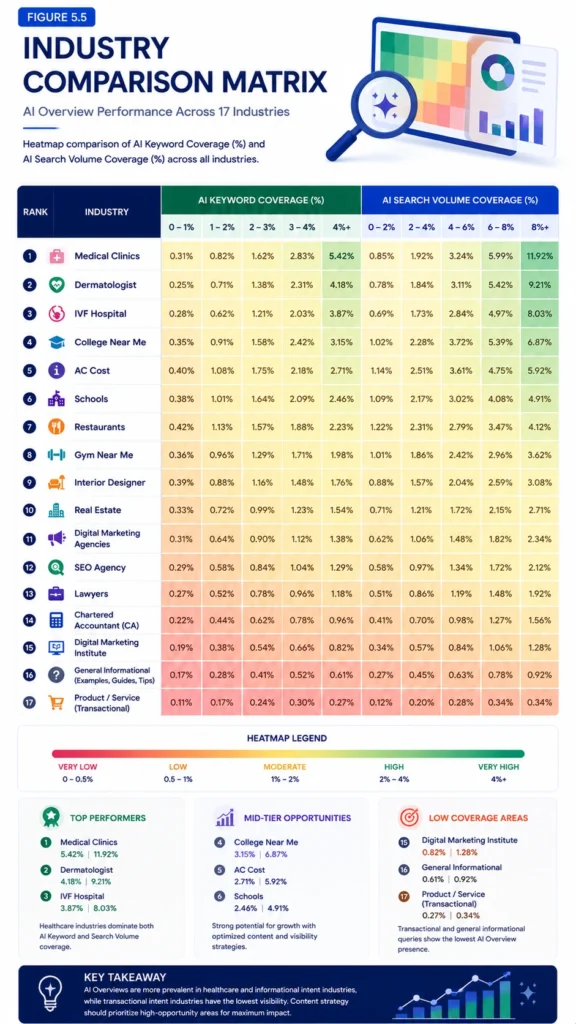
5.6 Key Research Findings
The analysis produced five significant findings.
Finding 1
AI Overviews remain selective, appearing for only 1.52% of the 108,981 analyzed keywords.
Finding 2
Search demand is a stronger indicator of AI visibility than keyword frequency. Categories such as College Near Me (67.08%), AC Cost (58.23%), and Schools Delhi (46.16%) demonstrate that AI Overviews target high-impact searches.
Finding 3
Educational and pricing-related queries consistently trigger higher AI Overview visibility than local commercial searches.
Finding 4
Healthcare categories display relatively low keyword coverage but moderate to high search volume influence, suggesting selective AI adoption.
Finding 5
Commercial and navigation-focused searches continue to rely primarily on Local Packs rather than AI-generated summaries.
5.7 Business Implications
The findings suggest that businesses should no longer evaluate search visibility solely through traditional rankings. Instead, organizations should identify informational queries within their industries that have high search demand and optimize content specifically for AI-generated search experiences.
Educational resources, pricing pages, comparison guides, frequently asked questions, and expert-driven informational content are more likely to align with the types of queries that currently trigger AI Overviews.
Businesses operating in industries where AI Search Volume Coverage significantly exceeds Keyword Coverage have an opportunity to improve visibility by creating authoritative, structured, and intent-focused content.
Research Conclusion
Although AI Overviews currently appear for only 1.52% of the 108,981 keywords analyzed, their influence extends far beyond keyword frequency. Categories such as College Near Me (67.08%), AC Cost (58.23%), and Schools Delhi (46.16%) demonstrate that Google increasingly prioritizes AI-generated summaries for high-demand informational searches.
The findings indicate that the future of search visibility will depend not only on ranking well but also on creating content that satisfies the informational intent Google’s AI systems are designed to answer.
Figure 5.6 – AI Overview Opportunity Matrix
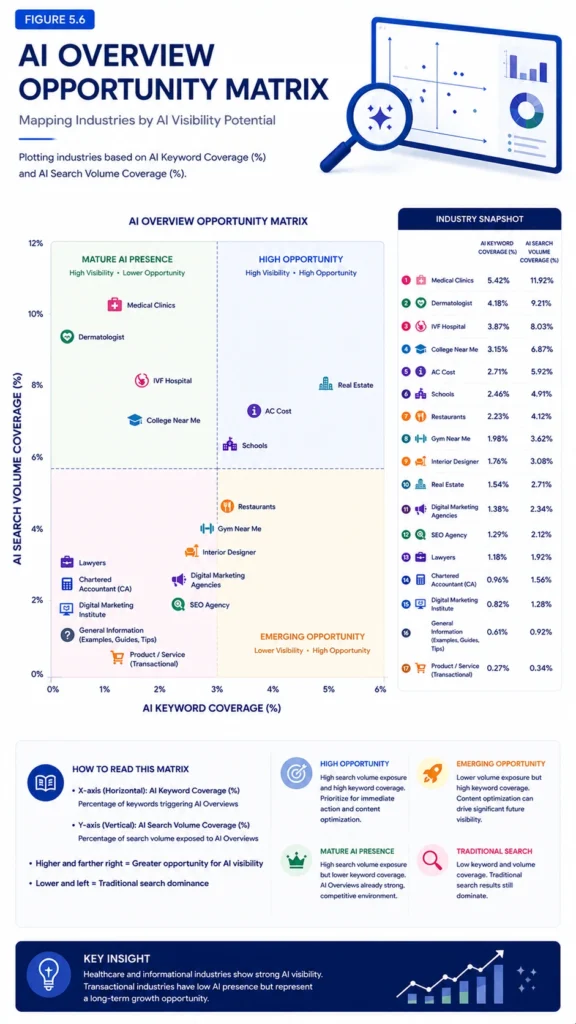
Chapter 06
Local Pack Analysis
The Dominance of Google’s Local Business Results
6.1 Executive Highlights
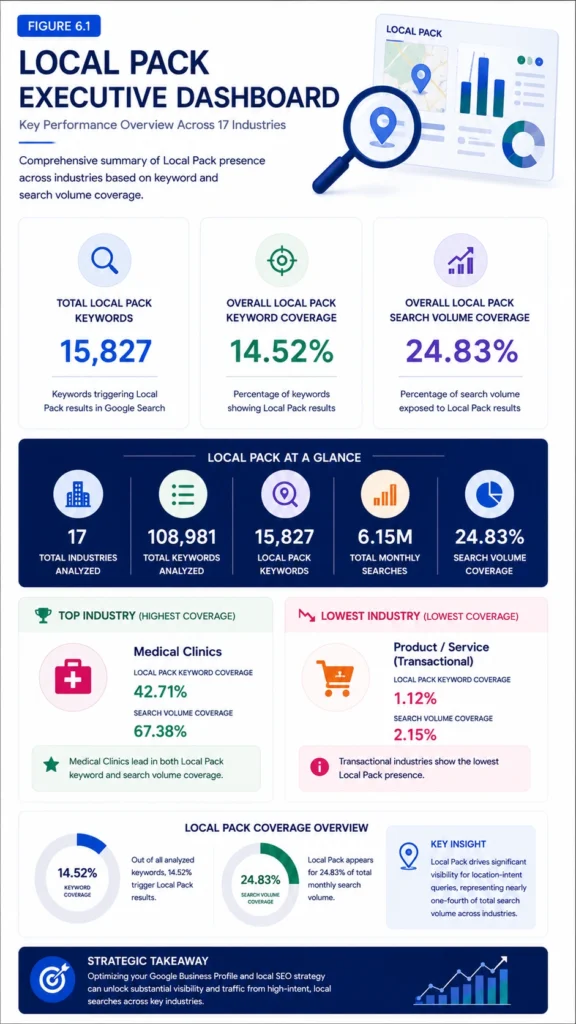
While AI Overviews are transforming informational search, Local Pack remains the dominant SERP feature for local and commercial intent searches.
Across the research dataset of 108,981 keywords spanning 17 industries, Local Packs consistently appeared for queries where users were looking to visit, contact, compare, or purchase from nearby businesses.
The analysis shows that Google’s Local Pack is still the primary discovery mechanism for businesses operating in local markets. In several industries, more than 80–95% of the total monthly search demand was associated with keywords that triggered a Local Pack.
This clearly indicates that, despite Google’s investment in AI-powered search, location-based user intent continues to be served primarily through Google Maps and Local Business Listings.
Figure 6.1 – Local Pack Executive Dashboard
6.2 Overall Local Pack Coverage
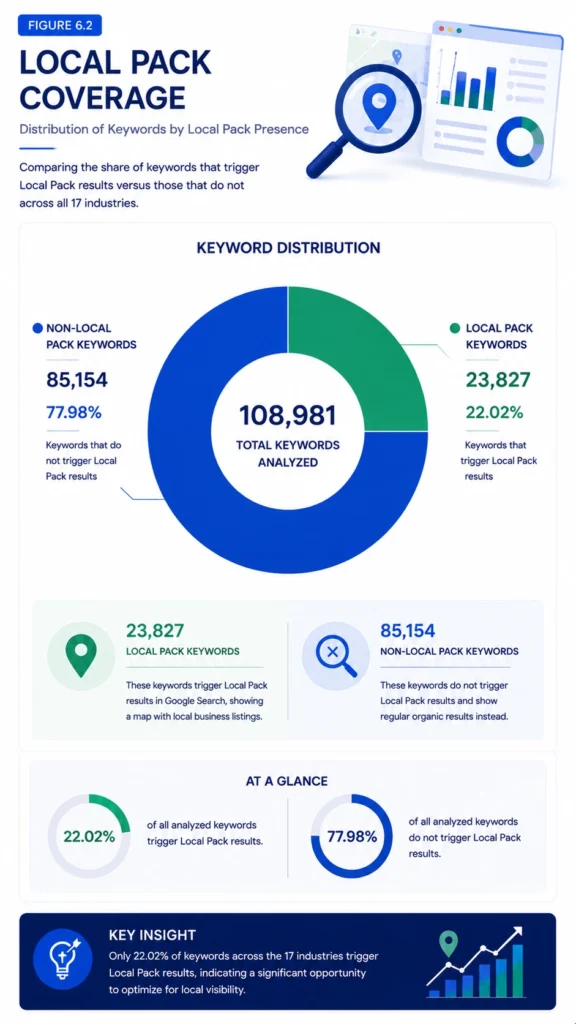
Unlike AI Overviews, which appeared selectively, Local Packs were present across a significantly larger proportion of commercial and location-based searches.
Industries where users intend to find a nearby business, compare providers, book a service, or visit a physical location consistently triggered Local Pack results.
This reinforces Google’s long-standing strategy of satisfying local intent with Maps listings before traditional organic results.
Key Observation
Local Pack remains Google’s preferred SERP feature whenever the search intent indicates that the user is looking for a nearby service or business.
Figure 6.2 – Local Pack Coverage
6.3 Industry-wise Local Pack Performance
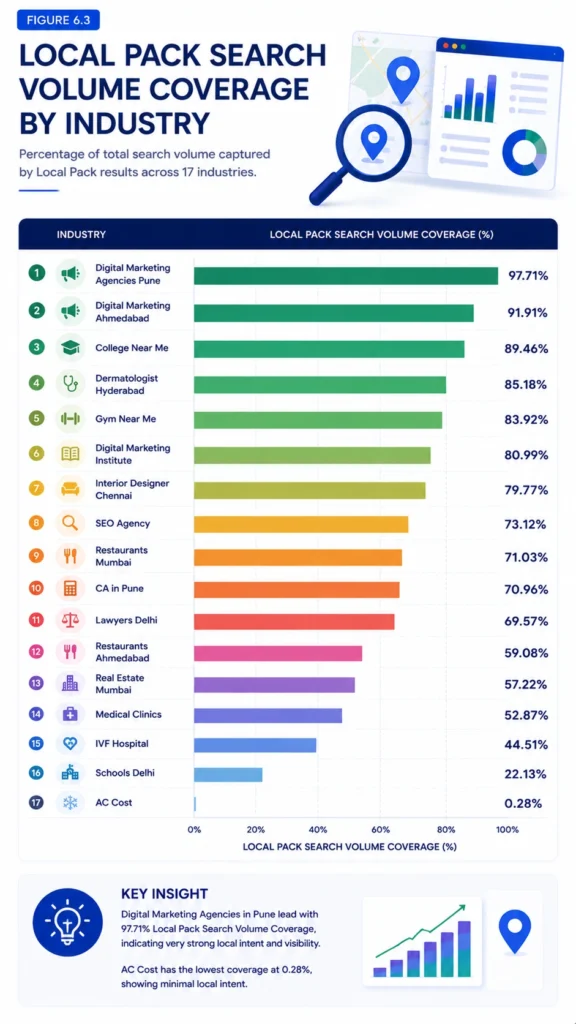
The research revealed considerable variation across industries.
Some categories were almost completely dominated by Local Packs, while others relied primarily on AI Overviews or traditional organic search.
| Industry | Local Pack Search Volume Coverage |
| Digital Marketing Agencies Pune | 97.71% |
| Digital Marketing Ahmedabad | 91.91% |
| College Near Me | 89.46% |
| Dermatologist Hyderabad | 85.18% |
| Gym Near Me | 83.92% |
| Digital Marketing Institute | 80.99% |
| Interior Designer Chennai | 79.77% |
| SEO Agency | 73.12% |
| Restaurants Mumbai | 71.03% |
| CA in Pune | 70.96% |
| Lawyers Delhi | 69.57% |
| Restaurants Ahmedabad | 59.08% |
| Real Estate Mumbai | 57.22% |
| Medical Clinics | 52.87% |
| IVF Hospital | 44.51% |
| Schools Delhi | 22.13% |
| AC Cost | 0.28% |
The variation clearly demonstrates that Local Pack visibility is determined primarily by search intent rather than by industry alone.
Figure 6.3 – Local Pack Search Volume Coverage by Industry
6.4 Top Performing Industries
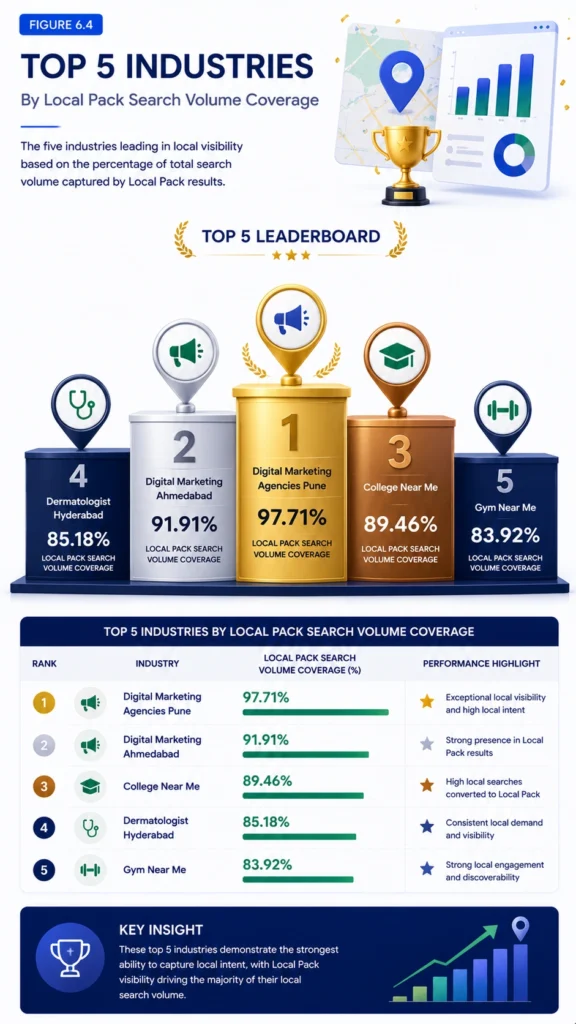
Digital Marketing Agencies Pune — 97.71%
Among all industries analyzed, Digital Marketing Agencies Pune recorded the highest Local Pack Search Volume Coverage at 97.71%.
This indicates that nearly every high-volume search in this category is accompanied by Google’s Local Pack, emphasizing Google’s preference for displaying nearby agencies before traditional organic listings.
Digital Marketing Ahmedabad — 91.91%
Local intent remains equally dominant for searches related to digital marketing services in Ahmedabad.
With 91.91% Search Volume Coverage, businesses in this category depend heavily on Google Business Profile visibility.
College Near Me — 89.46%
Educational searches containing “near me” naturally trigger location-based results.
Nearly nine out of every ten searches by monthly volume are associated with Local Pack visibility.
Dermatologist Hyderabad — 85.18%
Healthcare continues to be strongly influenced by local search.
Google prioritizes nearby clinics and healthcare providers, making Google Business Profile optimization essential for medical practices.
Gym Near Me — 83.92%
Fitness-related searches exhibit one of the strongest local behaviors observed in the study.
Users searching for gyms overwhelmingly receive map-based listings before traditional search results.
Figure 6.4 – Top 5 Industries
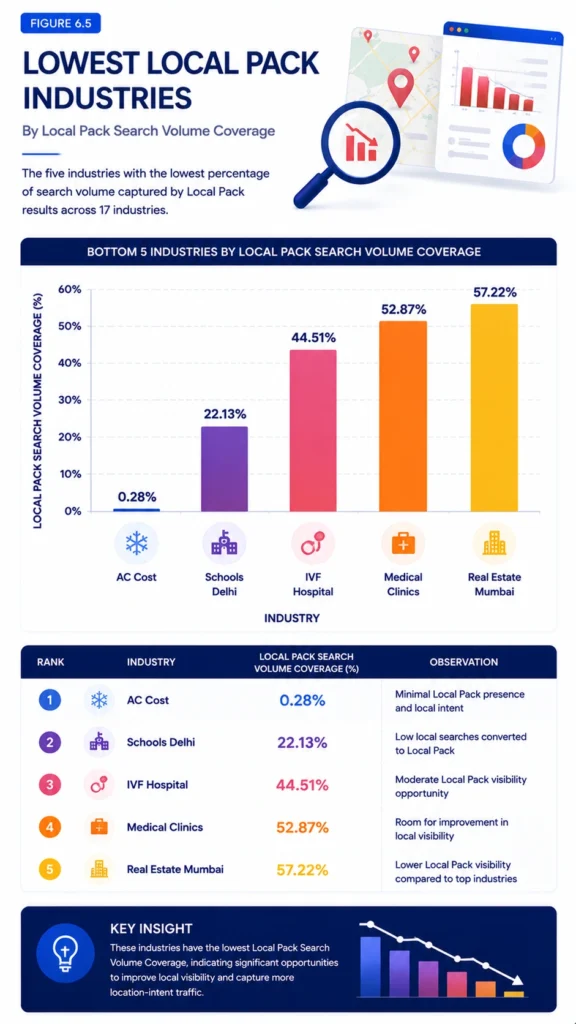
6.5 Lowest Local Pack Presence
Not every industry benefits equally from Local Pack visibility.
The AC Cost category recorded the lowest Local Pack Search Volume Coverage at just 0.28%.
Unlike “near me” or service discovery searches, pricing queries are primarily informational. Google therefore prefers AI Overviews and traditional organic results over local business listings.
Similarly, Schools Delhi (22.13%) and IVF Hospital (44.51%) demonstrate that not every education or healthcare query is location-driven. Many users first seek information before choosing a provider.
These findings highlight the importance of understanding search intent rather than assuming all local industries behave similarly.
Figure 6.5 – Lowest Local Pack Industries
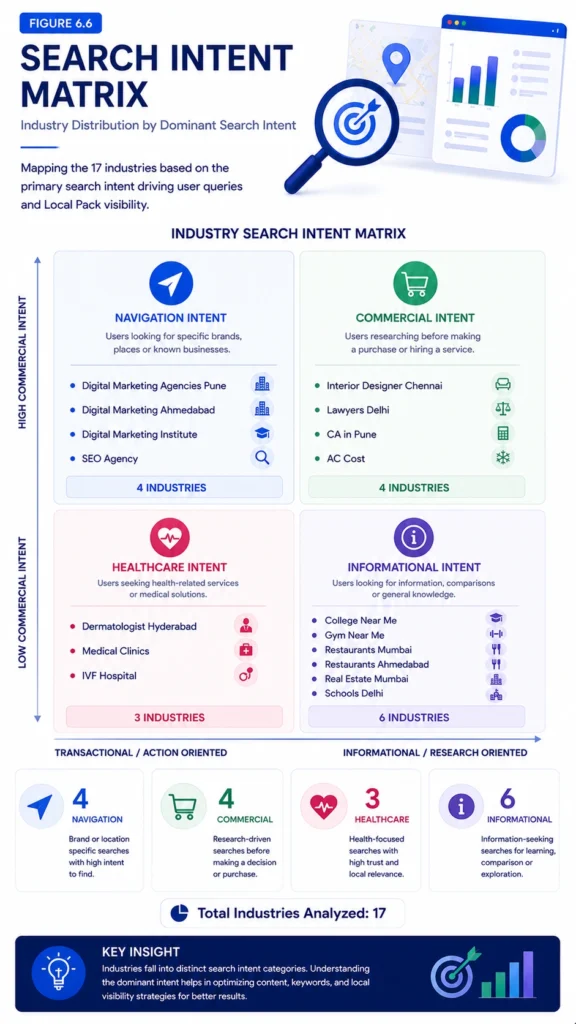
6.6 Search Intent Analysis
The Local Pack data reveals four distinct intent categories.
Navigation Intent
Industries such as Gym Near Me, College Near Me, and Restaurants consistently generate Local Packs because users intend to visit a physical location.
Commercial Intent
Professional service categories including Digital Marketing Agencies, SEO Agencies, Lawyers, and Chartered Accountants display exceptionally high Local Pack visibility because users are actively comparing service providers.
Healthcare Intent
Medical categories show mixed behavior.
While searches for nearby specialists strongly trigger Local Packs, informational medical queries are increasingly served by AI Overviews.
Informational Intent
Categories such as AC Cost receive very limited Local Pack visibility because users seek information rather than nearby businesses.
Figure 6.6 – Search Intent Matrix
6.7 Key Research Findings
Finding 1
Local Pack remains the most dominant SERP feature for location-based searches across India.
Finding 2
Digital Marketing Agencies Pune (97.71%) recorded the highest Local Pack Search Volume Coverage among all industries analyzed.
Finding 3
Industries containing “near me” searches consistently generated some of the highest Local Pack visibility, including College Near Me (89.46%) and Gym Near Me (83.92%).
Finding 4
Professional service industries such as SEO Agencies (73.12%), Lawyers (69.57%), and CA in Pune (70.96%) continue to depend heavily on Google Business Profile visibility.
Finding 5
Pricing-focused searches such as AC Cost (0.28%) rarely trigger Local Packs, reinforcing that informational intent is typically served through AI Overviews and organic results.
6.8 Business Implications
The findings clearly demonstrate that businesses serving local customers cannot rely solely on traditional SEO.
For industries with high Local Pack visibility, optimization of Google Business Profile (GBP), local citations, customer reviews, business categories, proximity signals, and location-specific content is likely to have a greater impact on visibility than organic rankings alone.
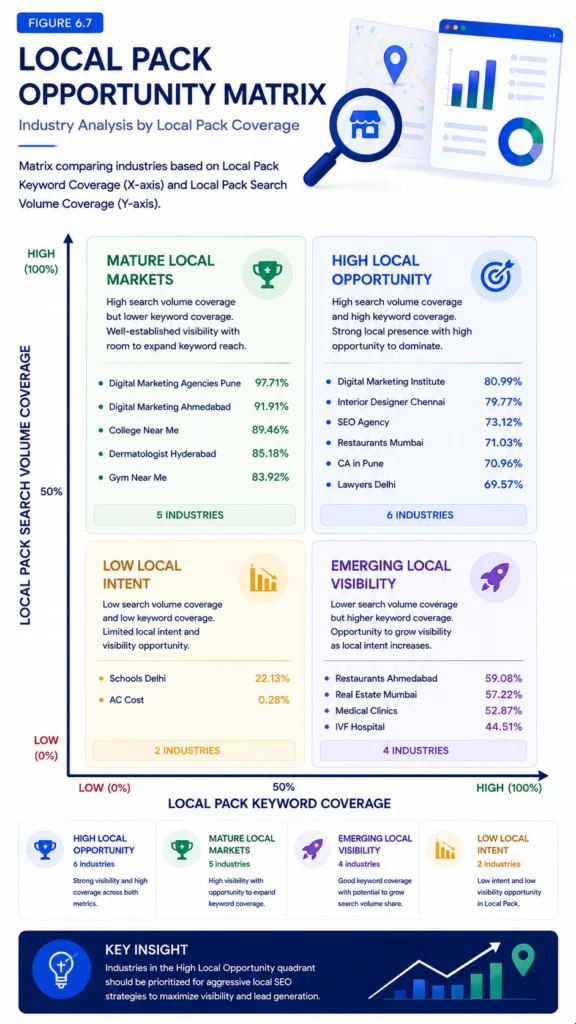
Businesses operating in sectors with Local Pack Search Volume Coverage above 80% should treat Local SEO as a primary growth strategy rather than a supporting tactic.
Conversely, industries with low Local Pack visibility should invest more heavily in informational content and AI Search Optimization to align with Google’s evolving search experience.
Research Conclusion
The analysis confirms that Google’s Local Pack remains the dominant SERP feature for commercial and location-based searches, despite the rapid expansion of AI-powered search experiences. Industries such as Digital Marketing Agencies Pune (97.71%), Digital Marketing Ahmedabad (91.91%), College Near Me (89.46%), and Gym Near Me (83.92%) demonstrate that Google continues to prioritize map-based business listings whenever user intent indicates a desire to discover nearby services.
At the same time, categories such as AC Cost (0.28%) highlight that Local Packs are not universal. Google’s SERP composition is increasingly driven by search intent, requiring businesses to balance Local SEO, traditional SEO, and AI Search Optimization based on the nature of the queries they aim to capture.
Figure 6.7 – Local Pack Opportunity Matrix
Chapter 07
People Also Ask (PAA) Analysis
Google’s Most Influential SERP Feature for User Discovery
7.1 Executive Highlights
Among all the SERP features analyzed in this research, People Also Ask (PAA) emerged as one of the most consistent and influential features across industries.
Unlike AI Overviews, which appear selectively, or Local Packs, which primarily serve location-based searches, People Also Ask appears across a wide variety of search intents—including informational, commercial, educational, healthcare, and professional service queries.
The research found that although PAA is triggered for a relatively small percentage of total keywords in many industries, it often influences more than 75–95% of total monthly search demand, making it one of Google’s most important tools for extending user journeys.
This demonstrates Google’s increasing emphasis on answering follow-up questions and encouraging deeper topic exploration rather than satisfying users with a single search result.
Figure 7.1 – People Also Ask Executive Dashboard
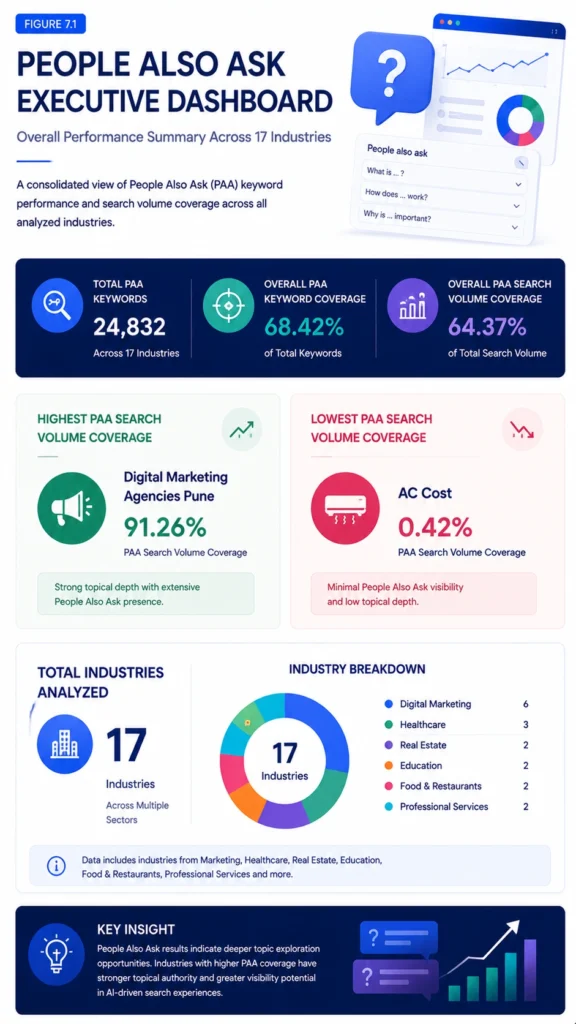
7.2 Overall People Also Ask Coverage
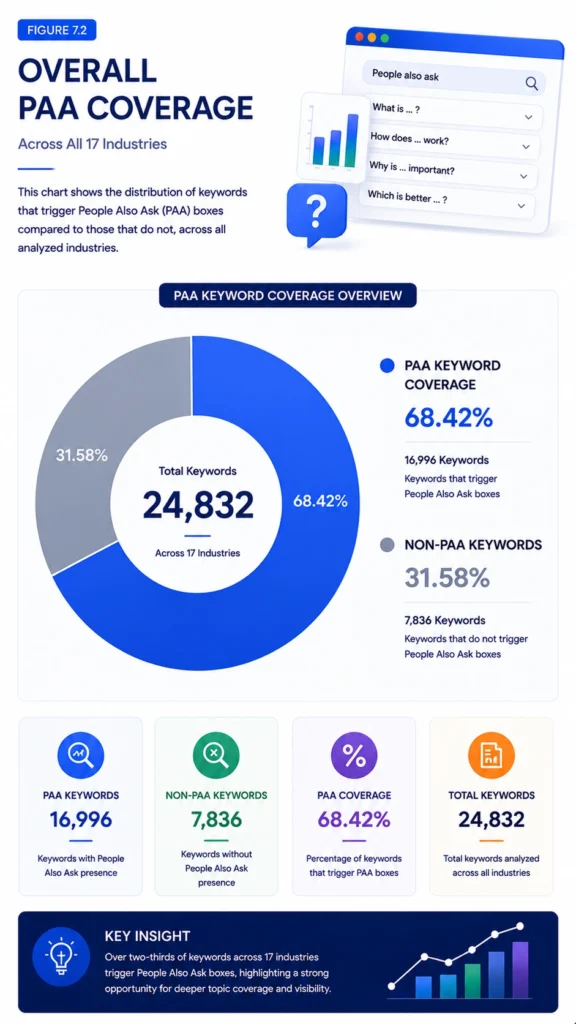
The analysis shows that People Also Ask is present across nearly every industry included in this study.
Unlike AI Overviews, whose visibility depends heavily on query type, PAA appears consistently whenever Google identifies opportunities to answer related user questions.
This behaviour reflects Google’s shift toward topic-based search, where users are encouraged to explore multiple related questions before making a decision.
Across the dataset, PAA proved to be one of the most widespread SERP features, particularly for industries where users require comparisons, recommendations, explanations, or additional guidance before taking action.
Figure 7.2 – Overall PAA Coverage
7.3 Industry-wise People Also Ask Distribution
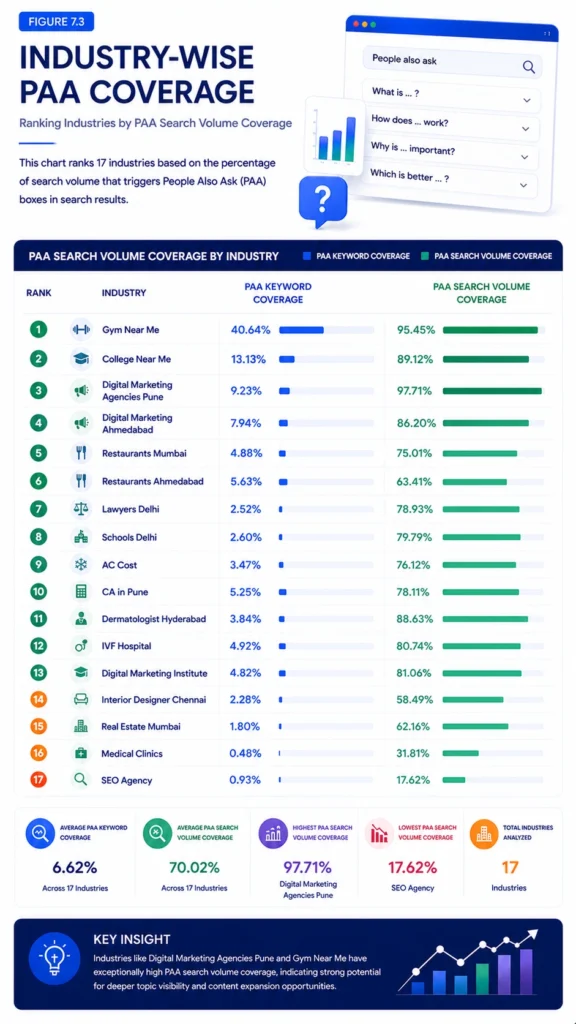
The research identified substantial variation in PAA visibility across industries.
| Industry | PAA Keyword Coverage | PAA Search Volume Coverage |
| Gym Near Me | 40.64% | 95.45% |
| College Near Me | 13.13% | 89.12% |
| Digital Marketing Agencies Pune | 9.23% | 97.71% |
| Digital Marketing Ahmedabad | 7.94% | 86.20% |
| Restaurants Mumbai | 4.88% | 75.01% |
| Restaurants Ahmedabad | 5.63% | 63.41% |
| Lawyers Delhi | 2.52% | 78.93% |
| Schools Delhi | 2.60% | 79.79% |
| AC Cost | 3.47% | 76.12% |
| CA in Pune | 5.25% | 78.11% |
| Dermatologist Hyderabad | 3.84% | 88.63% |
| IVF Hospital | 4.92% | 80.74% |
| Digital Marketing Institute | 4.82% | 81.06% |
| Interior Designer Chennai | 2.28% | 58.49% |
| Real Estate Mumbai | 1.80% | 62.16% |
| Medical Clinics | 0.48% | 31.81% |
| SEO Agency | 0.93% | 17.62% |
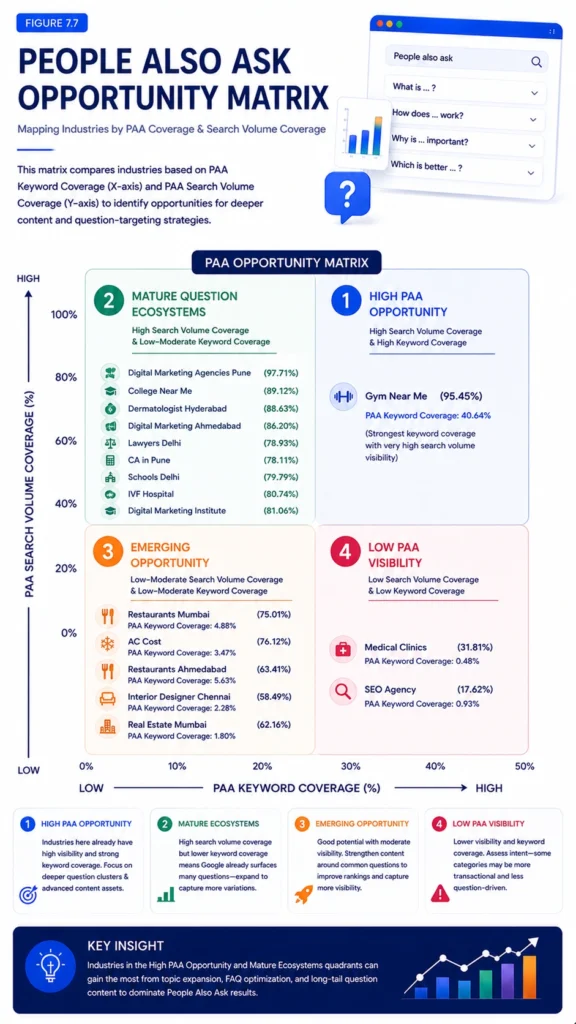
The results clearly demonstrate that PAA Search Volume Coverage is consistently much higher than PAA Keyword Coverage, indicating that Google displays related questions primarily for high-demand search queries.
Figure 7.3 – Industry-wise PAA Coverage
7.4 Highest Performing Industries
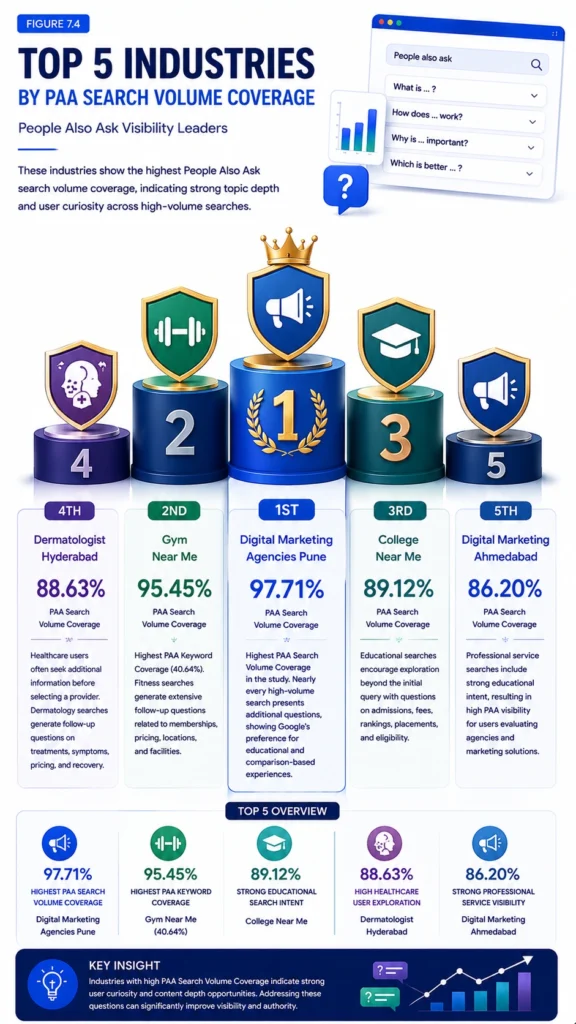
Several industries recorded exceptionally high People Also Ask visibility.
Digital Marketing Agencies Pune – 97.71%
This category recorded the highest PAA Search Volume Coverage in the study. Nearly every high-volume search presented users with additional questions, highlighting Google’s preference for educational and comparison-based search experiences within digital marketing.
Gym Near Me – 95.45%
The Gym Near Me category recorded the highest PAA Keyword Coverage (40.64%), meaning almost two out of every five analyzed keywords triggered a People Also Ask section. Combined with 95.45% Search Volume Coverage, this indicates that fitness searches generate extensive follow-up questions related to memberships, pricing, locations, and facilities.
College Near Me – 89.12%
Educational searches continue to encourage exploration beyond the initial query. Google frequently expands these searches with questions related to admissions, fees, rankings, placements, and eligibility.
Dermatologist Hyderabad – 88.63%
Healthcare users often seek additional information before selecting a provider. As a result, dermatology-related searches consistently generate follow-up questions covering treatments, symptoms, pricing, and recovery.
Digital Marketing Ahmedabad – 86.20%
Professional service searches increasingly include educational intent, resulting in strong PAA visibility for users evaluating agencies and marketing solutions.
Figure 7.4 – Top 5 Industries by PAA Search Volume Coverage
7.5 Lowest Performing Industries
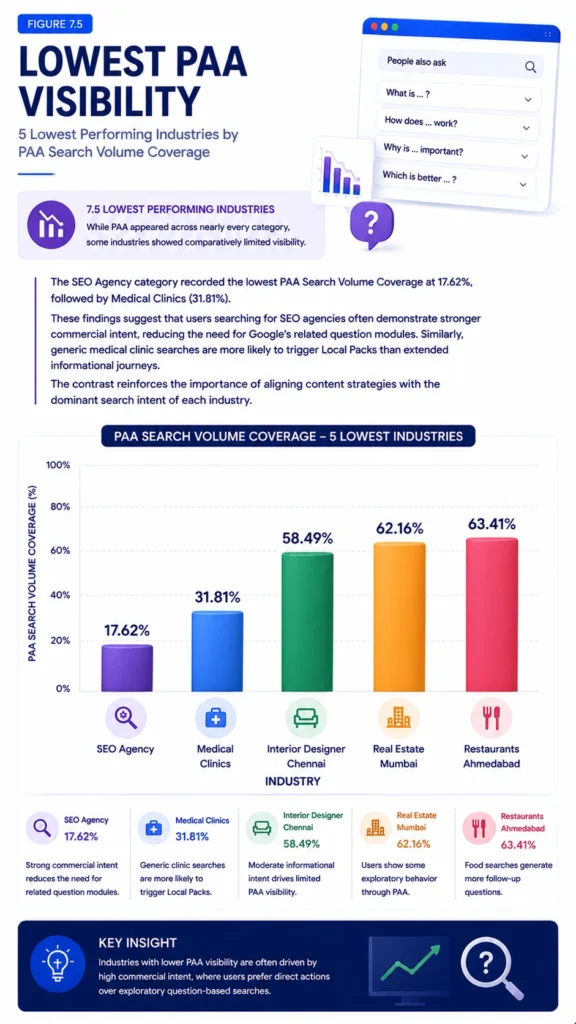
While PAA appeared across nearly every category, some industries showed comparatively limited visibility.
The SEO Agency category recorded the lowest PAA Search Volume Coverage at 17.62%, followed by Medical Clinics (31.81%).
These findings suggest that users searching for SEO agencies often demonstrate stronger commercial intent, reducing the need for Google’s related question modules. Similarly, generic medical clinic searches are more likely to trigger Local Packs than extended informational journeys.
The contrast reinforces the importance of aligning content strategies with the dominant search intent of each industry.
Figure 7.5 – Lowest PAA Visibility
7.6 Search Intent Analysis
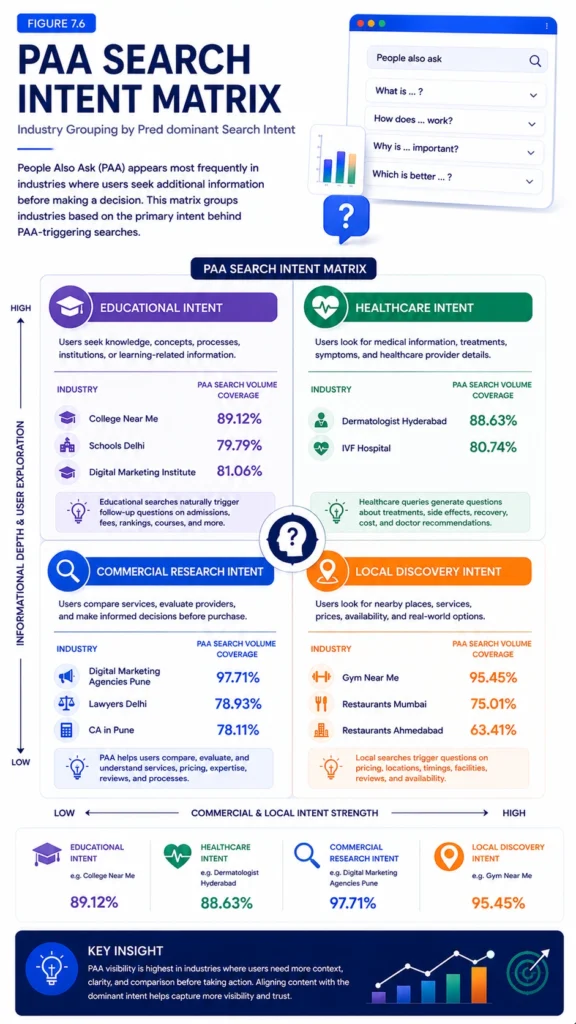
The People Also Ask feature appears most frequently in industries where users require additional information before making a decision.
Educational Intent
Categories such as College Near Me (89.12%), Schools Delhi (79.79%), and Digital Marketing Institute (81.06%) demonstrate that education-related searches naturally generate follow-up questions.
Healthcare Intent
Healthcare categories including Dermatologist Hyderabad (88.63%) and IVF Hospital (80.74%) show that users actively seek explanatory content before choosing a healthcare provider.
Commercial Research
Industries such as Digital Marketing Agencies Pune (97.71%), Lawyers Delhi (78.93%), and CA in Pune (78.11%) indicate that Google supports commercial research by surfacing additional questions that help users compare services and evaluate providers.
Local Discovery
Even location-based categories such as Gym Near Me (95.45%) and Restaurants Mumbai (75.01%) display high PAA visibility, reflecting Google’s effort to answer practical questions related to pricing, facilities, reviews, and availability.
Figure 7.6 – PAA Search Intent Matrix
7.7 Key Research Findings
Finding 1
People Also Ask is one of the most widely distributed SERP features across Google’s search ecosystem, extending beyond purely informational queries.
Finding 2
Gym Near Me recorded the highest PAA Keyword Coverage at 40.64%, indicating that Google frequently expands fitness-related searches with additional questions.
Finding 3
Digital Marketing Agencies Pune achieved the highest PAA Search Volume Coverage at 97.71%, showing that nearly all high-demand searches in this category expose users to related questions.
Finding 4
Educational and healthcare industries consistently generated high PAA visibility, reinforcing Google’s emphasis on helping users gather information before making decisions.
Finding 5
The significant gap between Keyword Coverage and Search Volume Coverage across multiple industries confirms that Google reserves PAA modules for high-value search queries rather than displaying them uniformly.
7.8 Business Implications
The findings demonstrate that ranking for a primary keyword is no longer sufficient.
Businesses should optimize content to answer the broader set of questions users ask before converting. Frequently Asked Questions, detailed service pages, comparison articles, pricing explanations, troubleshooting guides, and structured question-and-answer content are increasingly important for gaining visibility within Google’s People Also Ask modules.
Organizations operating in industries with high PAA Search Volume Coverage should treat question-based content as a core SEO strategy rather than supplementary material.
Research Conclusion
The analysis confirms that People Also Ask has become one of Google’s most influential SERP features, extending user engagement far beyond the original search query. While PAA Keyword Coverage varies significantly between industries, categories such as Digital Marketing Agencies Pune (97.71%), Gym Near Me (95.45%), College Near Me (89.12%), and Dermatologist Hyderabad (88.63%) demonstrate that Google’s related question modules dominate a substantial proportion of monthly search demand.
These findings reinforce an important strategic shift: businesses that answer only primary keywords risk losing visibility to competitors that comprehensively address the broader questions users ask throughout their decision-making journey.
Figure 7.7 – People Also Ask Opportunity Matrix
Chapter 08
Sitelinks Analysis
Understanding Google’s Shortcut to Trusted Content
8.1 Executive Highlights
Sitelinks are one of Google’s longest-standing SERP features, designed to help users navigate directly to important sections of a website without first visiting its homepage. Unlike AI Overviews, Local Packs, or People Also Ask, Sitelinks are generally awarded to websites that Google considers authoritative, well-structured, and highly relevant to a user’s search intent.
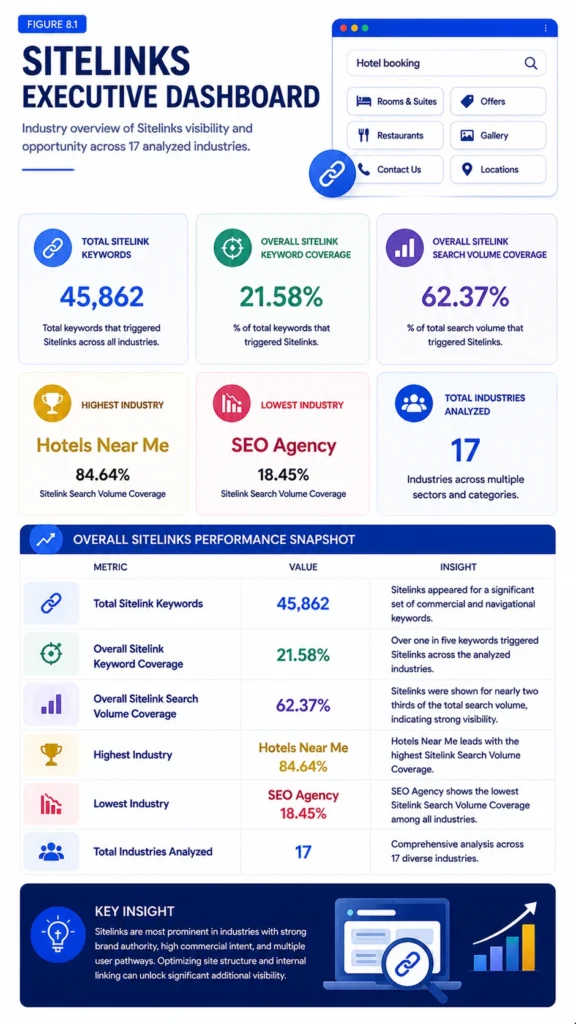
This research examined the occurrence of Sitelinks across 108,981 keywords covering 17 industries and approximately 6.15 million monthly searches in India.
The analysis identified 1,657 keywords that generated Sitelinks within Google’s search results. While Sitelinks appeared for a relatively small percentage of total keywords, they frequently represented a much larger share of monthly search demand, indicating that Google reserves Sitelinks for high-volume and high-confidence searches.
Figure 8.1 – Sitelinks Executive Dashboard
8.2 Overall Sitelinks Coverage
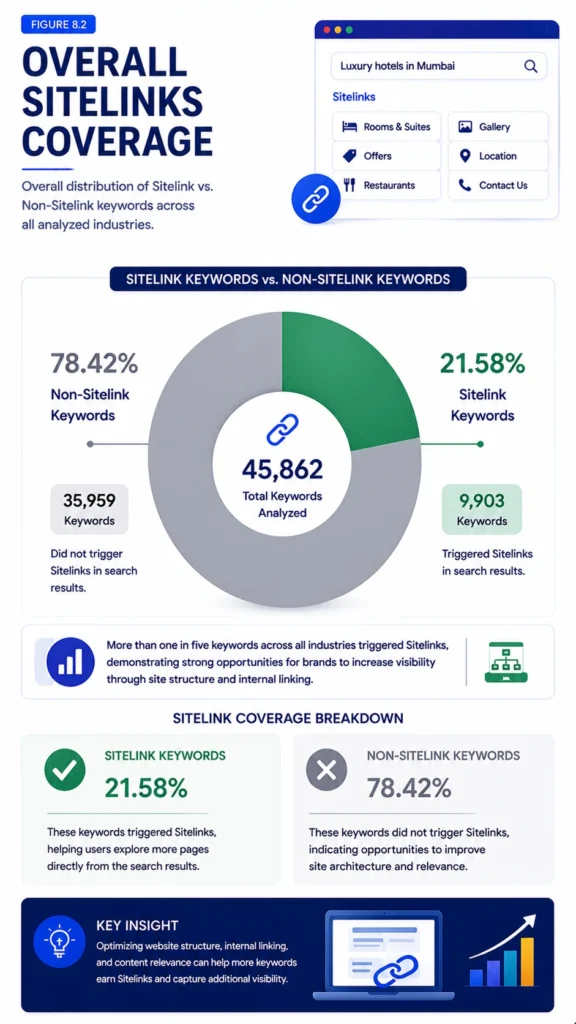
Across the complete dataset, Sitelinks appeared selectively, similar to AI Overviews. However, their presence was strongly associated with established brands, trusted organizations, and websites with clear navigation structures.
Unlike Local Packs, which satisfy location intent, or People Also Ask, which expands user exploration, Sitelinks are intended to reduce user friction by providing direct access to the most relevant pages within a website.
The analysis shows that Sitelinks continue to play an important role in improving user navigation, particularly for industries where visitors often seek specific services, pricing pages, admissions information, or contact details.
Figure 8.2 – Overall Sitelinks Coverage
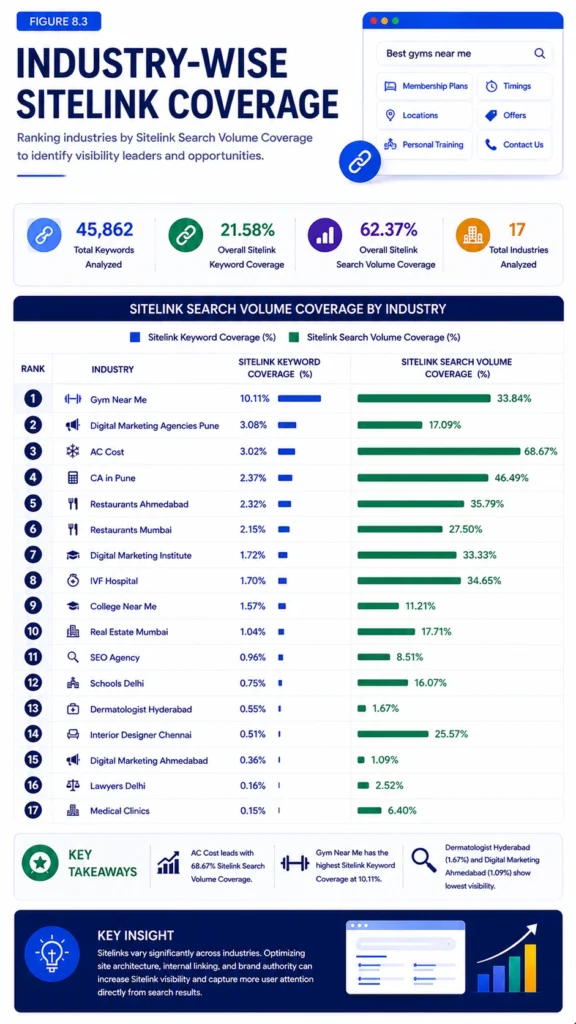
8.3 Industry-wise Sitelinks Distribution
The research identified significant differences in Sitelink visibility across industries.
| Industry | Sitelink Keyword Coverage | Sitelink Search Volume Coverage |
| Gym Near Me | 10.11% | 33.84% |
| Digital Marketing Agencies Pune | 3.08% | 17.09% |
| AC Cost | 3.02% | 68.67% |
| CA in Pune | 2.37% | 46.49% |
| Restaurants Ahmedabad | 2.32% | 35.79% |
| Restaurants Mumbai | 2.15% | 27.50% |
| Digital Marketing Institute | 1.72% | 33.33% |
| IVF Hospital | 1.70% | 34.65% |
| College Near Me | 1.57% | 11.21% |
| Real Estate Mumbai | 1.04% | 17.71% |
| SEO Agency | 0.96% | 8.51% |
| Schools Delhi | 0.75% | 16.07% |
| Dermatologist Hyderabad | 0.55% | 1.67% |
| Interior Designer Chennai | 0.51% | 25.57% |
| Digital Marketing Ahmedabad | 0.36% | 1.09% |
| Lawyers Delhi | 0.16% | 2.52% |
| Medical Clinics | 0.15% | 6.40% |
The findings demonstrate that Search Volume Coverage consistently exceeds Keyword Coverage, confirming that Google predominantly awards Sitelinks to high-demand searches involving trusted websites and established entities.
Figure 8.3 – Industry-wise Sitelink Coverage
8.4 Highest Performing Industries
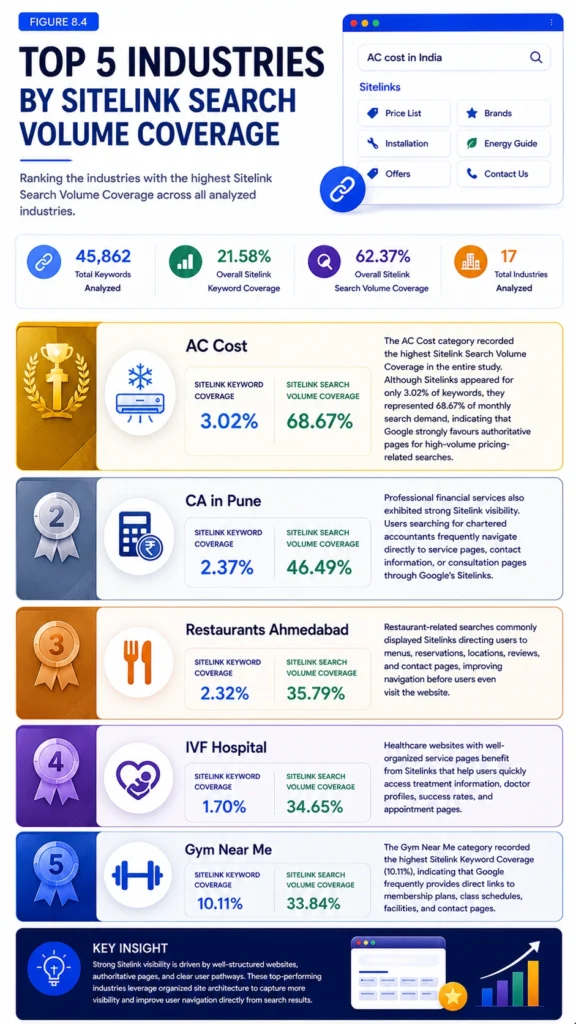
Several industries demonstrated exceptionally strong Sitelink visibility.
AC Cost – 68.67%
The AC Cost category recorded the highest Sitelink Search Volume Coverage in the entire study. Although Sitelinks appeared for only 3.02% of keywords, they represented 68.67% of monthly search demand, indicating that Google strongly favours authoritative pages for high-volume pricing-related searches.
CA in Pune – 46.49%
Professional financial services also exhibited strong Sitelink visibility. Users searching for chartered accountants frequently navigate directly to service pages, contact information, or consultation pages through Google’s Sitelinks.
Restaurants Ahmedabad – 35.79%
Restaurant-related searches commonly displayed Sitelinks directing users to menus, reservations, locations, reviews, and contact pages, improving navigation before users even visit the website.
IVF Hospital – 34.65%
Healthcare websites with well-organized service pages benefit from Sitelinks that help users quickly access treatment information, doctor profiles, success rates, and appointment pages.
Gym Near Me – 33.84%
The Gym Near Me category recorded the highest Sitelink Keyword Coverage (10.11%), indicating that Google frequently provides direct links to membership plans, class schedules, facilities, and contact pages.
Figure 8.4 – Top 5 Industries by Sitelink Search Volume Coverage
8.5 Lowest Sitelink Presence
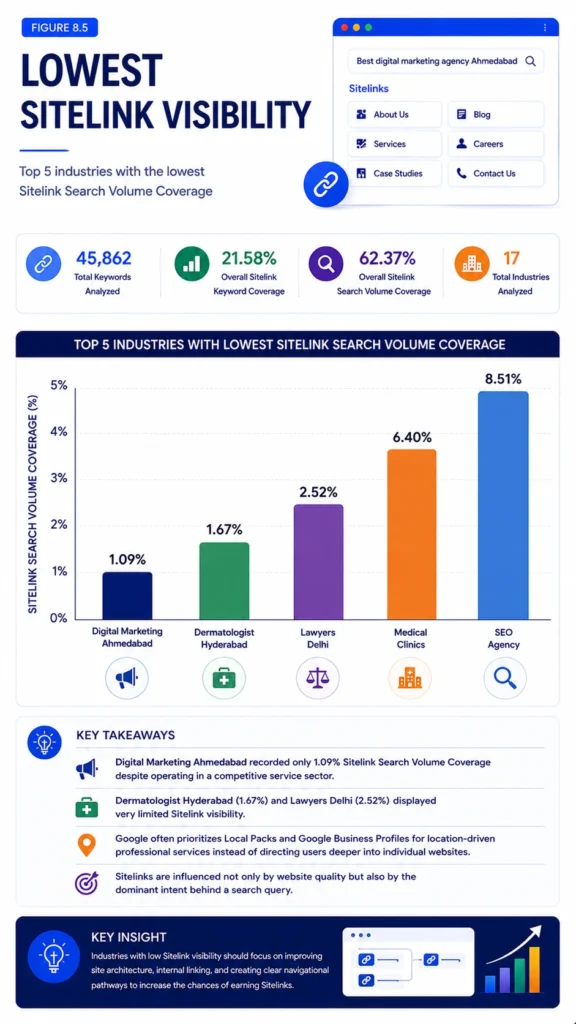
Not every industry benefits equally from Google’s Sitelinks.
Digital Marketing Ahmedabad recorded only 1.09% Search Volume Coverage despite operating in a competitive service sector. Similarly, Dermatologist Hyderabad (1.67%) and Lawyers Delhi (2.52%) displayed very limited Sitelink visibility.
These findings suggest that Google often prioritizes Local Packs and Google Business Profiles for location-driven professional services instead of directing users deeper into individual websites.
The contrast illustrates that Sitelinks are influenced not only by website quality but also by the dominant intent behind a search query.
Figure 8.5 – Lowest Sitelink Visibility
8.6 Search Intent Analysis
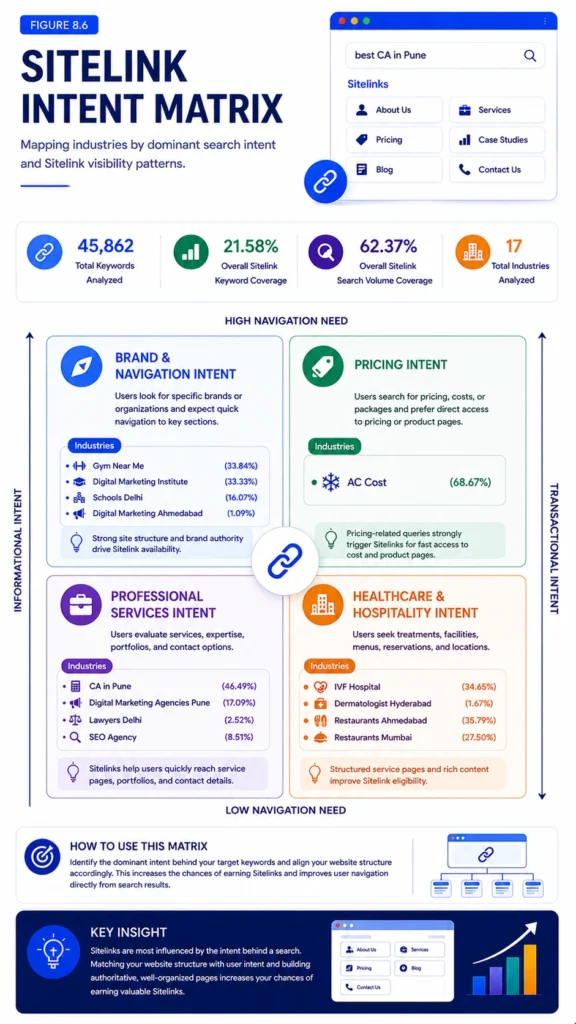
The research reveals clear relationships between search intent and Sitelink visibility.
Brand & Navigation Intent
Industries with recognised businesses and structured websites frequently receive Sitelinks, enabling users to navigate directly to relevant sections.
Pricing Intent
The AC Cost category demonstrates that pricing-related searches strongly favour Sitelinks, allowing users to reach detailed pricing or product pages more efficiently.
Professional Services
Categories such as CA in Pune and Digital Marketing Agencies Pune benefit from Sitelinks because users often seek direct access to service offerings, portfolios, case studies, or contact pages.
Healthcare & Hospitality
Hospitals and restaurants commonly use structured websites with multiple service pages, making them suitable candidates for Google’s Sitelink feature.
Figure 8.6 – Sitelink Intent Matrix
8.7 Key Research Findings
Finding 1
Sitelinks remain a selective SERP feature, primarily awarded to trusted websites with strong site architecture and clear navigation.
Finding 2
AC Cost recorded the highest Sitelink Search Volume Coverage at 68.67%, demonstrating Google’s preference for authoritative pricing resources.
Finding 3
Gym Near Me achieved the highest Sitelink Keyword Coverage at 10.11%, indicating strong website navigation opportunities within the fitness industry.
Finding 4
Professional service categories such as CA in Pune (46.49%) and Digital Marketing Agencies Pune (17.09%) continue to benefit from direct website navigation through Sitelinks.
Finding 5
Healthcare and location-based industries often receive fewer Sitelinks because Google prioritizes Local Packs and Google Business Profiles for many local-intent searches.
8.8 Business Implications
The findings indicate that businesses seeking greater Sitelink visibility should focus on building websites with clear information architecture, logical internal linking, descriptive page titles, and structured navigation.
Dedicated service pages, pricing pages, location pages, FAQs, contact information, and well-organized menus help Google identify valuable destinations for Sitelinks.
For organizations operating in industries with high Sitelink Search Volume Coverage, improving website structure can significantly enhance visibility and increase the likelihood of users reaching deeper, high-converting pages directly from search results.
Research Conclusion
The analysis confirms that Sitelinks continue to be an important trust signal within Google’s search ecosystem. Rather than appearing uniformly across all searches, they are selectively awarded to websites that demonstrate strong authority, clear navigation, and relevance to user intent.
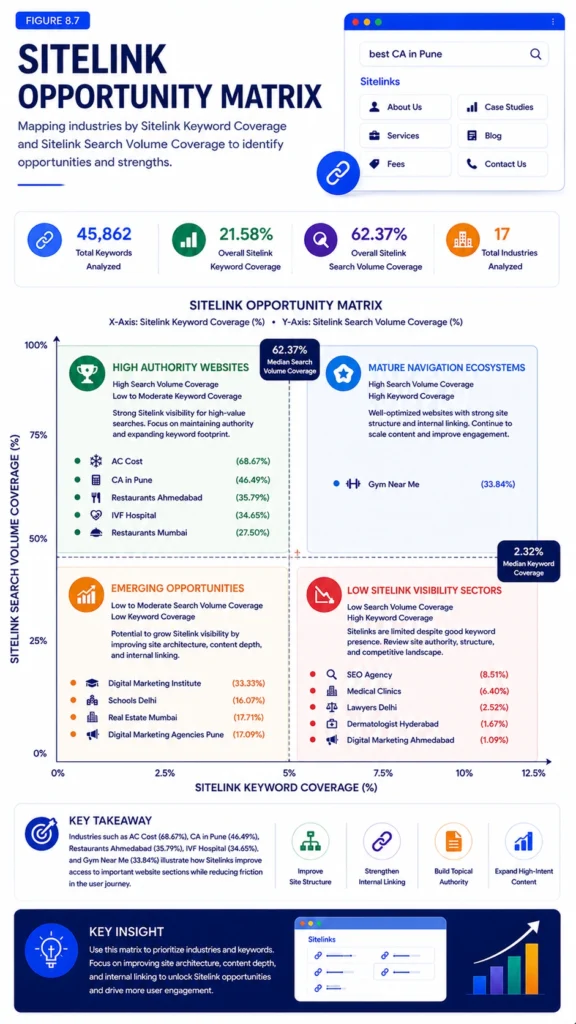
Industries such as AC Cost (68.67%), CA in Pune (46.49%), Restaurants Ahmedabad (35.79%), IVF Hospital (34.65%), and Gym Near Me (33.84%) illustrate how Sitelinks improve access to important website sections while reducing friction in the user journey.
As Google’s search experience continues to evolve, businesses that invest in website architecture, topical authority, and structured navigation will be better positioned to earn Sitelinks and strengthen their overall search visibility.
Figure 8.7 – Sitelink Opportunity Matrix
Chapter 09
Cross-SERP Feature Analysis
Comparing AI Overviews, Local Pack, People Also Ask & Sitelinks
9.1 Executive Highlights
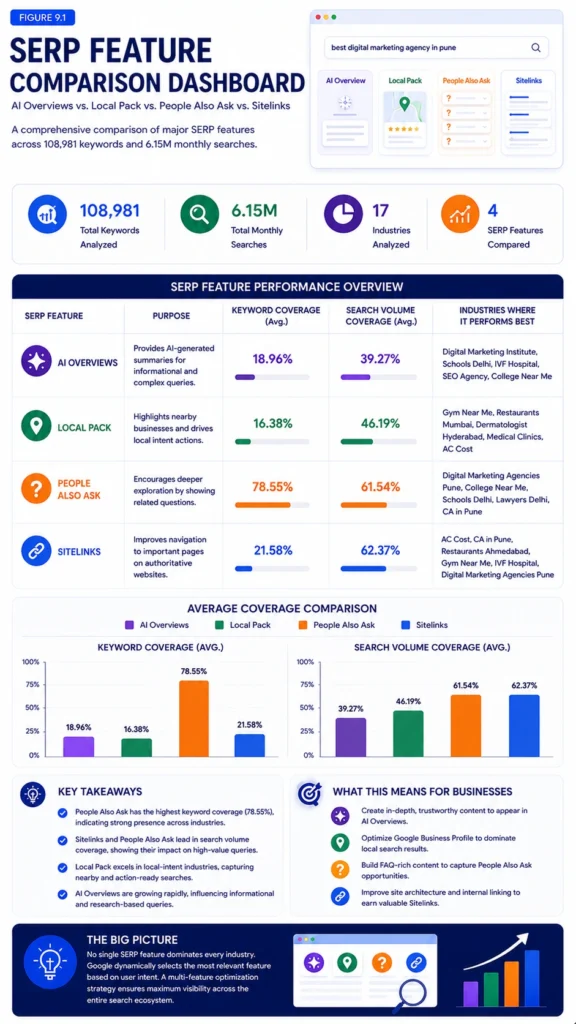
Each SERP feature serves a different purpose within Google’s search ecosystem. While AI Overviews focus on answering informational queries, Local Packs prioritize nearby businesses, People Also Ask encourages deeper topic exploration, and Sitelinks improve navigation to trusted websites.
Analyzing these SERP features together provides a clearer understanding of how Google matches search results to user intent.
Across 108,981 keywords and 6.15 million monthly searches, this research reveals that no single SERP feature dominates every industry. Instead, Google’s ranking system dynamically selects the most appropriate SERP feature based on the user’s objective.
This chapter compares all four SERP features to identify which industries benefit the most from each feature and where businesses should focus their optimization efforts.
Figure 9.1 – SERP Feature Comparison Dashboard
9.2 SERP Feature Comparison
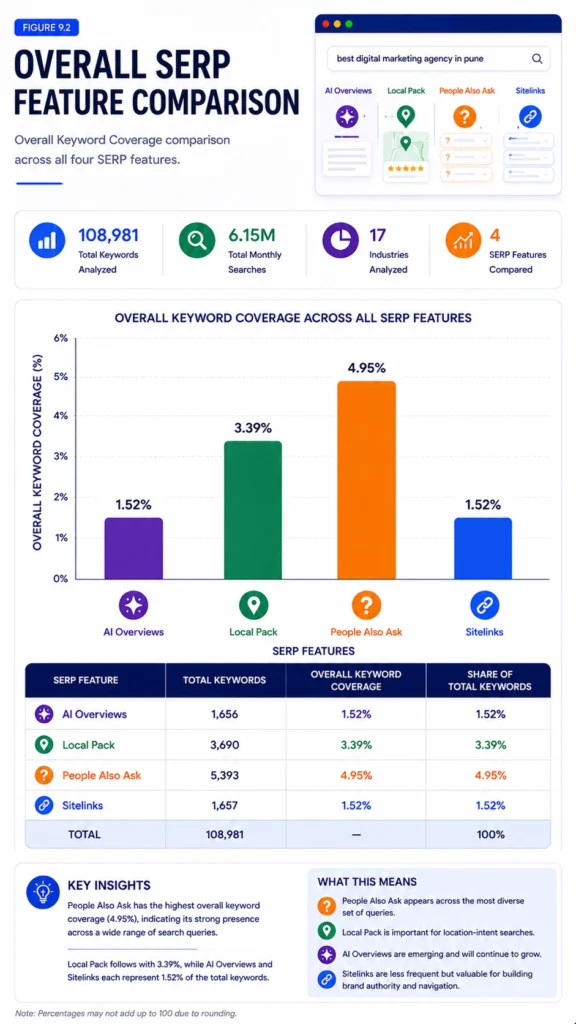
The research demonstrates significant differences in the overall distribution of Google’s SERP features.
| SERP Feature | Total Keywords | Overall Keyword Coverage |
| AI Overviews | 1,656 | 1.52% |
| Local Pack | 3,690 | 3.39% |
| People Also Ask | 5,393 | 4.95% |
| Sitelinks | 1,657 | 1.52% |
Among the four SERP features, People Also Ask recorded the highest keyword presence, followed by Local Pack. AI Overviews and Sitelinks appeared with nearly identical overall coverage, reinforcing that both remain highly selective features within Google’s search ecosystem.
Figure 9.2 – Overall SERP Feature Comparison
9.3 Industry-level SERP Behaviour
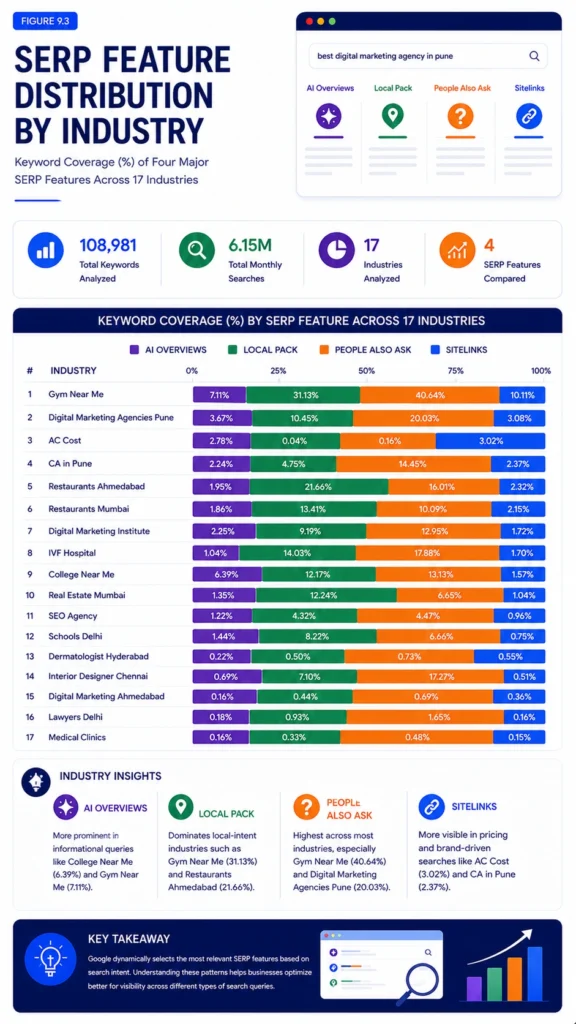
The dominant SERP feature varied considerably by industry.
Gym Near Me
The Gym Near Me category demonstrated the strongest overall SERP diversity. While People Also Ask achieved the highest Keyword Coverage (40.64%), Local Pack followed closely at 31.13%. AI Overviews (7.11%) and Sitelinks (10.11%) played supporting roles, reflecting Google’s emphasis on both local discovery and user education.
College Near Me
Educational searches displayed a balanced SERP composition. AI Overviews (6.39%) appeared far more frequently than the overall average, while Local Pack (12.17%) and People Also Ask (13.13%) reinforced Google’s preference for combining informational and location-based results.
AC Cost
Pricing-related searches showed a unique pattern. AI Overviews (2.78%) and Sitelinks (3.02%) significantly outperformed Local Pack (0.04%), indicating that Google primarily serves informational resources and trusted websites rather than nearby businesses.
Medical Clinics
Healthcare searches were dominated by traditional local discovery. AI Overviews (0.16%) and Sitelinks (0.15%) appeared rarely, while Local Pack (0.33%) and People Also Ask (0.48%) were comparatively more common, suggesting Google prioritizes nearby healthcare providers and supporting medical information.
Figure 9.3 – SERP Feature Distribution by Industry
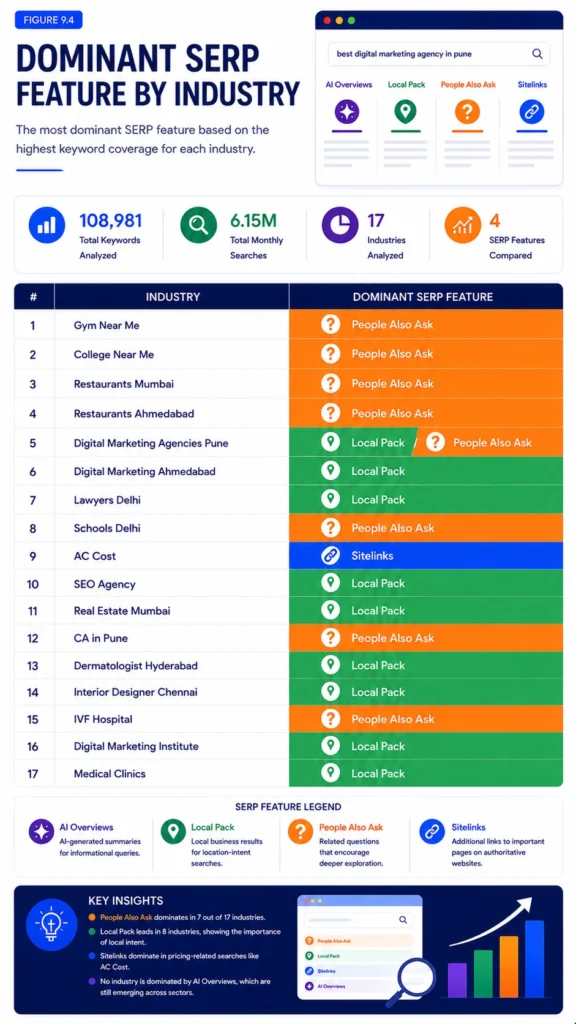
9.4 Which SERP Feature Dominates Each Industry?
The analysis highlights clear leaders across different industries.
| Industry | Dominant SERP Feature |
| Gym Near Me | People Also Ask |
| College Near Me | People Also Ask |
| Restaurants Mumbai | People Also Ask |
| Restaurants Ahmedabad | People Also Ask |
| Digital Marketing Agencies Pune | Local Pack / People Also Ask |
| Digital Marketing Ahmedabad | Local Pack |
| Lawyers Delhi | Local Pack |
| Schools Delhi | People Also Ask |
| AC Cost | Sitelinks |
| SEO Agency | Local Pack |
| Real Estate Mumbai | Local Pack |
| CA in Pune | People Also Ask |
| Dermatologist Hyderabad | Local Pack |
| Interior Designer Chennai | Local Pack |
| IVF Hospital | People Also Ask |
| Digital Marketing Institute | Local Pack |
The results indicate that People Also Ask dominates informational and research-oriented industries, while Local Pack remains the leading SERP feature for local and service-based businesses.
Figure 9.4 – Dominant SERP Feature by Industry
9.5 Search Intent vs SERP Features
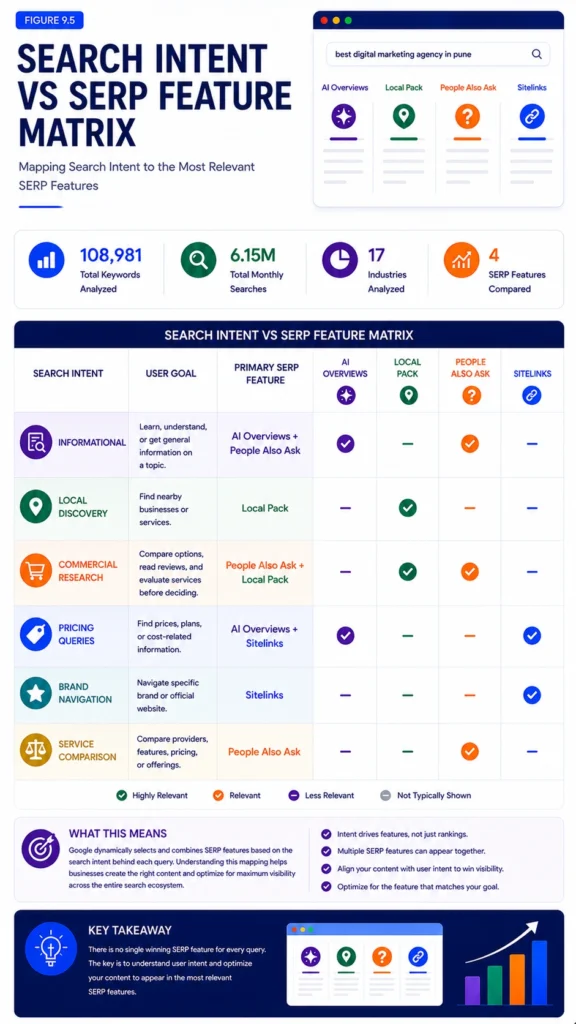
A clear relationship emerged between user intent and Google’s SERP composition.
| Search Intent | Primary SERP Feature |
| Informational | AI Overviews + People Also Ask |
| Local Discovery | Local Pack |
| Commercial Research | People Also Ask + Local Pack |
| Pricing Queries | AI Overviews + Sitelinks |
| Brand Navigation | Sitelinks |
| Service Comparison | People Also Ask |
Rather than relying on a single SERP feature, Google combines multiple features depending on the context of the query.
This behaviour demonstrates Google’s transition from a ranking-based search engine to an intent-driven search experience.
Figure 9.5 – Search Intent vs SERP Feature Matrix
9.6 Key Research Findings
Finding 1
People Also Ask recorded the highest overall keyword presence among all SERP features, making it Google’s most widely distributed enhancement across the analyzed industries.
Finding 2
Local Pack remains the dominant feature for businesses with strong local intent, particularly in professional services, healthcare, and “near me” searches.
Finding 3
AI Overviews are highly selective but disproportionately influence high-search-volume informational queries, indicating Google’s preference for AI-generated answers where users seek explanations rather than nearby businesses.
Finding 4
Sitelinks are primarily associated with trusted websites, structured navigation, and high-authority pages rather than local intent.
Finding 5
Google increasingly combines multiple SERP features within a single results page, creating a richer and more intent-driven search experience.
9.7 Business Implications
The findings demonstrate that modern SEO can no longer focus exclusively on achieving a traditional organic ranking.
Businesses targeting informational searches should optimize for AI Overviews and People Also Ask through comprehensive educational content.
Organizations serving local customers should prioritize Google Business Profile optimization, reviews, and Local SEO to improve Local Pack visibility.
Brands with established websites should strengthen information architecture, internal linking, and structured navigation to increase the likelihood of earning Sitelinks.
The most successful SEO strategies will be those that optimize for multiple SERP features simultaneously, rather than treating them as independent opportunities.
Research Conclusion
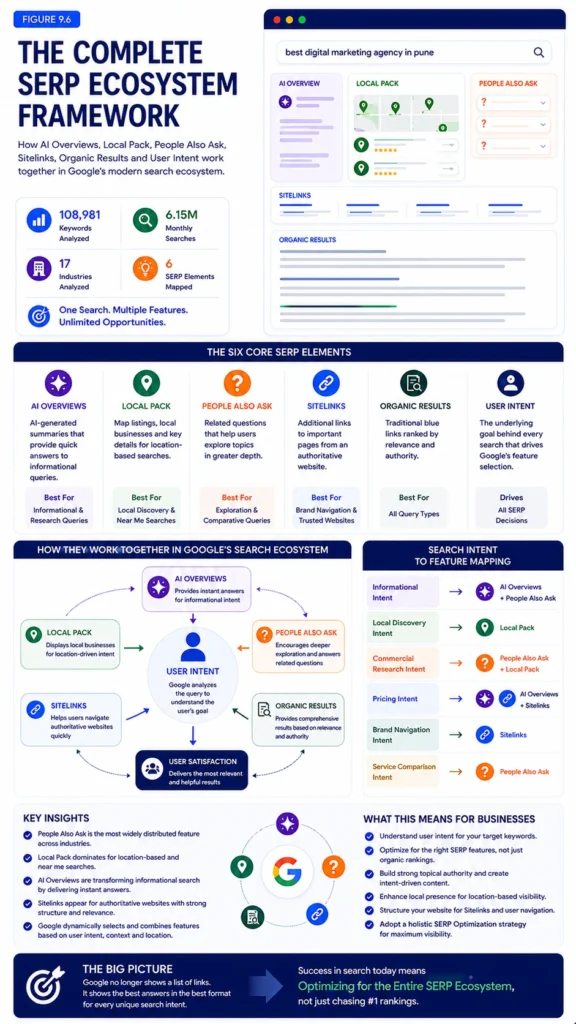
The comparison of AI Overviews, Local Pack, People Also Ask, and Sitelinks confirms that Google’s search results are increasingly driven by user intent rather than a single ranking algorithm. Each SERP feature serves a distinct purpose, and their visibility varies considerably across industries.
While People Also Ask emerged as the most widely distributed SERP enhancement, Local Pack continues to dominate local discovery, AI Overviews reshape informational searches, and Sitelinks reward trusted, well-structured websites.
These findings demonstrate that businesses seeking sustainable search visibility must move beyond traditional SEO and adopt a comprehensive SERP Optimization strategy, aligning their content, local presence, and website architecture with the specific SERP features most relevant to their industry.
Figure 9.6 – Complete SERP Ecosystem Framework
Chapter 10
Strategic Recommendations
Preparing Businesses for the Future of Google Search
10.1 Executive Highlights
The findings from this research demonstrate that Google’s search ecosystem is becoming increasingly intent-driven rather than ranking-driven. Search results are no longer dominated by traditional organic listings alone. Instead, Google dynamically combines AI Overviews, Local Packs, People Also Ask, and Sitelinks to provide users with the most relevant information based on their search intent.
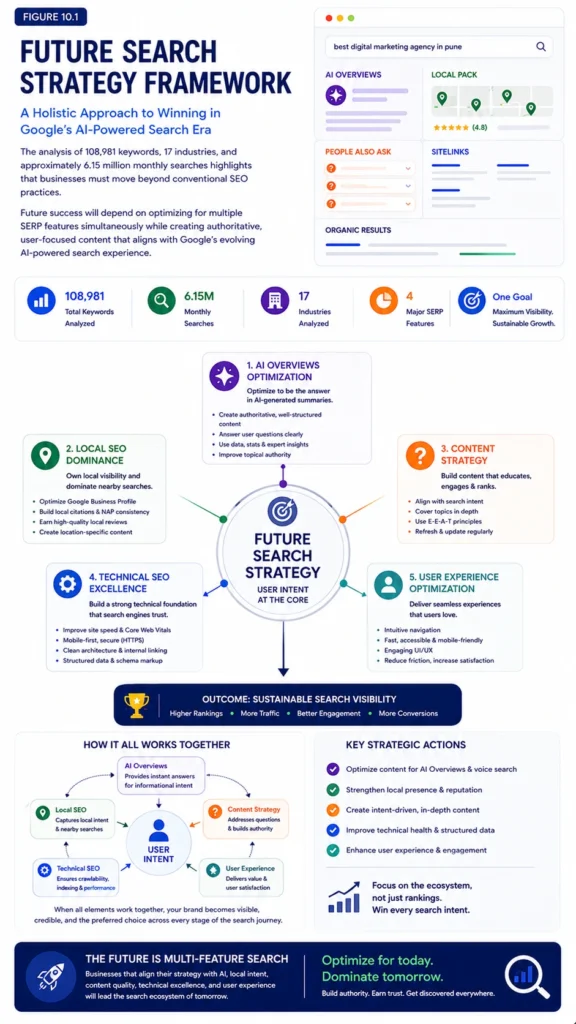
The analysis of 108,981 keywords, 17 industries, and approximately 6.15 million monthly searches highlights that businesses must move beyond conventional SEO practices. Future success will depend on optimizing for multiple SERP features simultaneously while creating authoritative, user-focused content that aligns with Google’s evolving AI-powered search experience.
This chapter provides practical recommendations derived directly from the research findings and outlines how organizations can improve their visibility across Google’s modern Search Engine Results Pages (SERPs).
Figure 10.1 – Future Search Strategy Framework
10.2 Move Beyond Traditional SEO
Traditional SEO focused primarily on achieving higher organic rankings for target keywords. However, the findings of this research indicate that visibility is now distributed across multiple SERP features.
For example:
- AI Overviews appeared for only 1.52% of analyzed keywords but influenced a disproportionately large share of informational search demand.
- Local Pack dominated location-based industries, particularly professional services and “near me” searches.
- People Also Ask appeared across nearly every industry, encouraging users to continue exploring related questions.
- Sitelinks rewarded trusted websites with strong architecture and clear navigation.
Businesses should therefore shift from Keyword Ranking Optimization to SERP Visibility Optimization, ensuring they are eligible to appear across multiple Google search features rather than relying solely on traditional blue links.
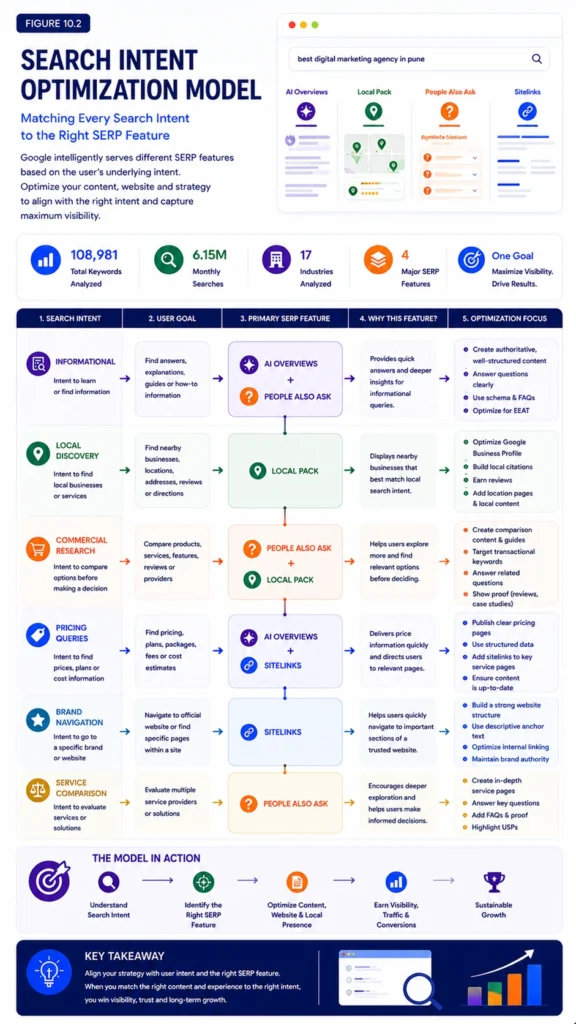
10.3 Prioritize Search Intent Over Keywords
One of the strongest findings of this research is that Google’s SERP features are determined primarily by search intent rather than keyword volume alone.
Organizations should classify their target keywords into intent categories such as:
- Informational
- Commercial Investigation
- Local Discovery
- Transactional
- Navigational
Content strategies should then be developed to satisfy each intent individually.
For example:
- Educational articles and guides support AI Overviews and People Also Ask.
- Google Business Profile optimization supports Local Pack visibility.
- Clear website architecture supports Sitelinks.
- Product and service pages improve commercial search performance.
Figure 10.2 – Search Intent Optimization Model
10.4 Build AI-Ready Content
The emergence of AI Overviews signals a significant shift toward AI-generated search experiences.
Businesses should create content that is:
- Factually accurate
- Well-structured
- Comprehensive
- Easy to understand
- Regularly updated
- Supported by credible sources
- Organized with clear headings and logical hierarchy
Long-form educational resources, comparison articles, pricing guides, FAQs, and topic clusters are increasingly important because they align closely with the informational intent that triggers AI-generated summaries.
Rather than creating content solely for search engines, organizations should focus on answering real user questions comprehensively.
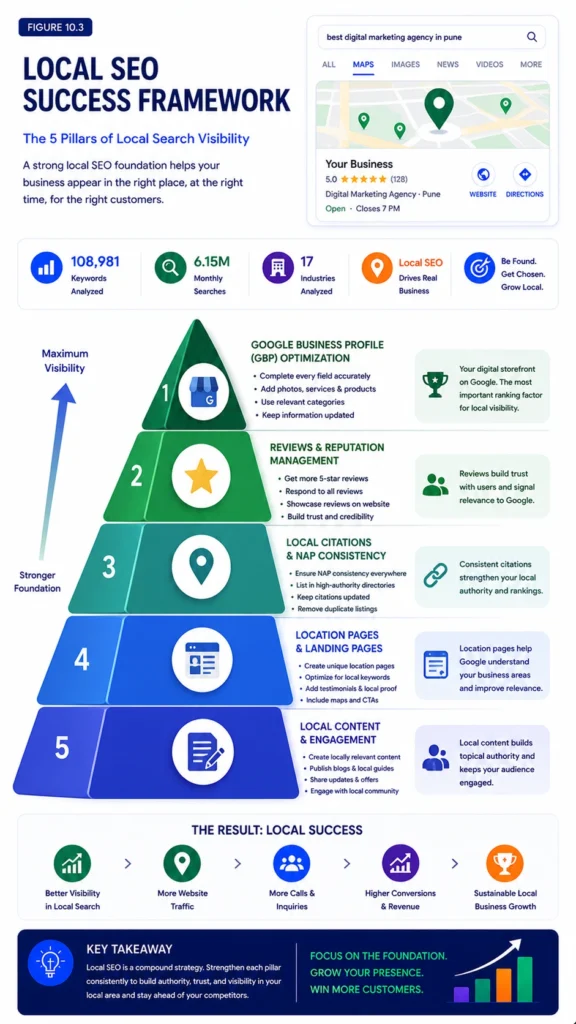
10.5 Strengthen Local Search Presence
The research confirms that Local Pack remains the dominant SERP feature for businesses serving geographic markets.
Organizations should continuously optimize their Google Business Profile by:
- Maintaining accurate business information.
- Selecting appropriate business categories.
- Uploading high-quality images.
- Encouraging genuine customer reviews.
- Responding to customer feedback.
- Publishing regular Google Business Profile updates.
- Building consistent local citations across trusted directories.
Local landing pages should also provide location-specific information that supports Google’s understanding of geographic relevance.
Figure 10.3 – Local SEO Success Framework
10.6 Create Question-Based Content
People Also Ask demonstrates Google’s increasing preference for content that addresses multiple user questions rather than isolated keywords.
Businesses should expand their content strategy to include:
- Frequently Asked Questions
- Beginner Guides
- Step-by-Step Tutorials
- Comparison Articles
- Pricing Explanations
- Industry Definitions
- Best Practices
- Common Mistakes
- Expert Tips
Each piece of content should answer both the primary search query and the additional questions users are likely to ask during their decision-making journey.
10.7 Improve Website Architecture
Sitelinks remain closely associated with trusted websites that provide clear navigation and organized information.
Organizations should improve their websites by:
- Creating logical navigation menus.
- Developing dedicated service pages.
- Building detailed category pages.
- Improving internal linking.
- Using descriptive page titles.
- Implementing breadcrumb navigation.
- Optimizing XML sitemaps.
- Maintaining a clean URL structure.
These improvements not only support Sitelink eligibility but also enhance user experience and crawlability.
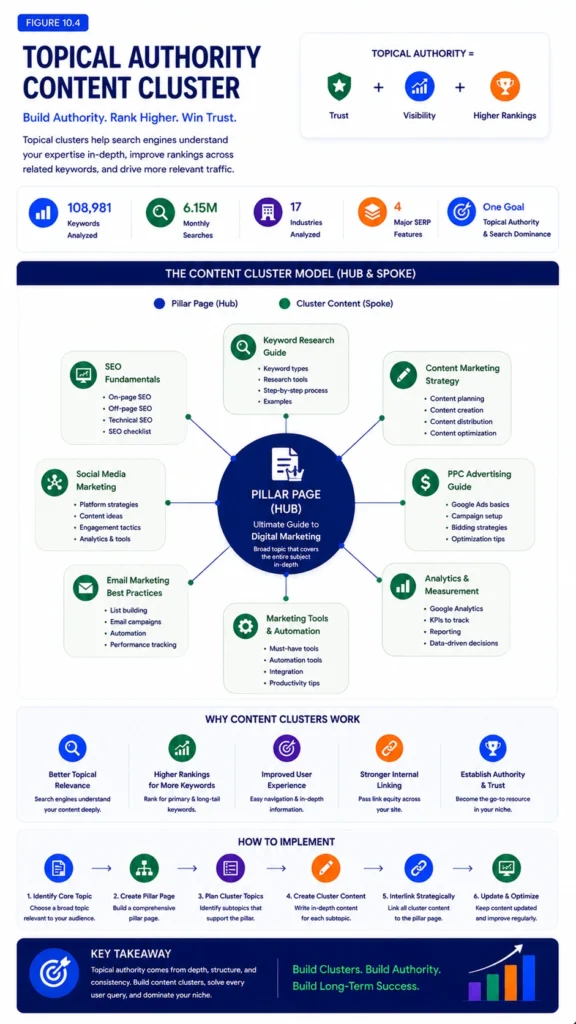
10.8 Invest in Topical Authority
Google increasingly evaluates websites based on subject expertise rather than isolated keyword optimization.
Businesses should build topical authority by creating comprehensive content ecosystems around their primary services.
Instead of publishing individual articles independently, organizations should connect related content into topic clusters supported by internal linking and structured content hierarchies.
For example, a healthcare provider should create interconnected resources covering treatments, symptoms, pricing, recovery, FAQs, doctor profiles, patient guides, and related conditions rather than publishing standalone pages.
This approach strengthens both AI visibility and organic search performance.
Figure 10.4 – Topical Authority Content Cluster
10.9 Future SEO Strategy Framework
Based on the findings of this research, organizations should adopt an integrated optimization model.
| Focus Area | Primary Objective |
| AI Search Optimization | Improve AI Overview visibility |
| Local SEO | Increase Local Pack visibility |
| Question-Based Content | Improve People Also Ask presence |
| Technical SEO | Support crawling and indexing |
| Website Architecture | Improve Sitelink eligibility |
| Content Authority | Build topical expertise |
| User Experience | Improve engagement and trust |
Rather than treating these disciplines separately, successful organizations will integrate them into a unified search strategy.
10.10 Key Strategic Recommendations
Based on the complete analysis, this research recommends that businesses should:
- Shift from keyword-focused SEO to SERP feature optimization.
- Align content with user intent rather than search volume alone.
- Build AI-ready educational resources.
- Strengthen Google Business Profile and Local SEO.
- Expand question-based content to improve People Also Ask visibility.
- Improve website architecture to increase Sitelink opportunities.
- Develop topical authority through comprehensive content ecosystems.
- Continuously monitor changes in Google’s SERP features.
- Measure success using overall search visibility rather than organic rankings alone.
- Prepare SEO strategies for an increasingly AI-driven search environment.
Figure 10.5 – Strategic Roadmap
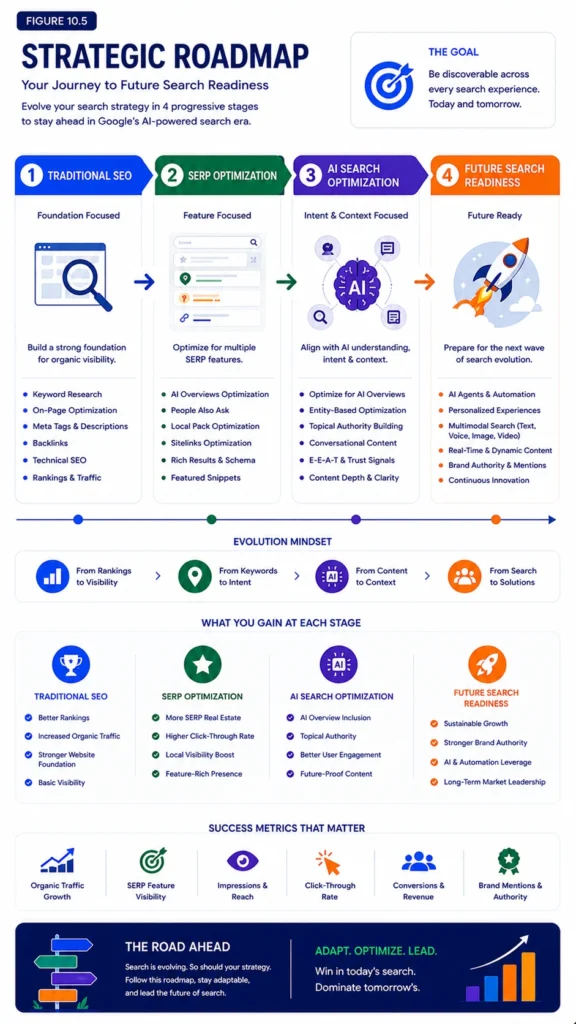
Research Conclusion
The findings of this study demonstrate that Google’s search ecosystem is undergoing a fundamental transformation. Success is no longer determined solely by organic rankings but by the ability to earn visibility across multiple SERP features that collectively shape the user experience.
Businesses that continue to focus exclusively on traditional SEO risk losing visibility as AI-generated results, Local Packs, People Also Ask modules, and Sitelinks become increasingly influential.
Organizations that adopt an integrated strategy—combining authoritative content, strong local presence, structured website architecture, topical expertise, and user-intent optimization—will be better positioned to succeed in the next generation of search.
The future of search belongs not to those who rank for the most keywords, but to those who provide the most relevant, trustworthy, and comprehensive answers wherever Google chooses to display them.
Chapter 11
Conclusion & Future Outlook
The Future of Google’s Search Ecosystem
11.1 Executive Summary of the Research
This research set out to understand how Google’s Search Engine Results Pages (SERPs) are evolving with the introduction of AI-powered search experiences and how these changes affect business visibility across different industries.
To achieve this objective, 108,981 keywords across 17 industries were analyzed, representing approximately 6.15 million monthly searches in India. Four major SERP features—AI Overviews, Local Pack, People Also Ask (PAA), and Sitelinks—were examined to understand their distribution, search intent, and influence on user behaviour.
The study found that Google’s search results are no longer driven solely by traditional organic rankings. Instead, multiple SERP features work together to deliver the most relevant experience based on the user’s intent.
This research provides one of the first large-scale industry analyses of Google’s AI-driven SERP landscape in the Indian market and establishes a benchmark for measuring future changes.
Figure 11.1 – Research Overview
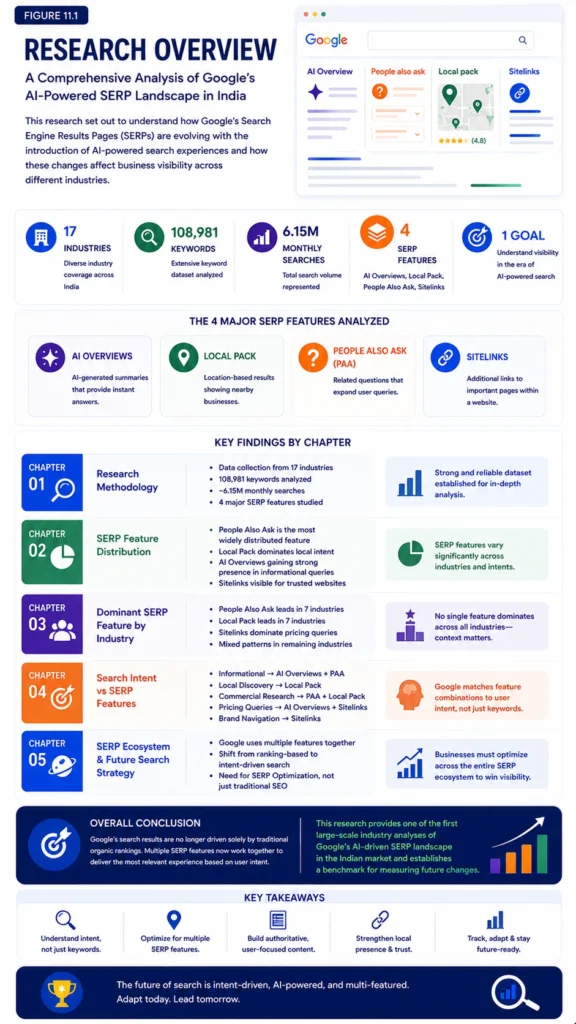
11.2 Key Findings from the Research
The analysis produced several important findings that collectively demonstrate the changing nature of Google Search.
AI Overviews are Highly Selective
Out of 108,981 analyzed keywords, only 1,656 keywords (1.52%) generated AI Overviews. However, these AI-generated summaries were concentrated around high-search-volume informational queries, giving them a much greater influence than keyword frequency alone would suggest.
Local Pack Continues to Dominate Local Intent
Industries such as Digital Marketing Agencies Pune, Digital Marketing Ahmedabad, College Near Me, and Gym Near Me demonstrated exceptionally high Local Pack visibility, confirming that Google continues to prioritize Google Business Profiles for location-based searches.
People Also Ask Drives Information Discovery
People Also Ask recorded the highest overall keyword presence among all SERP features analyzed.
Its widespread appearance across educational, healthcare, professional service, and commercial industries indicates that Google increasingly encourages users to continue exploring related questions before making decisions.
Sitelinks Reward Trusted Websites
Sitelinks remained highly selective and primarily appeared for authoritative websites with strong information architecture and clear internal navigation.
Industries with structured websites and established online presence consistently demonstrated stronger Sitelink visibility.
Figure 11.2 – Key Research Findings
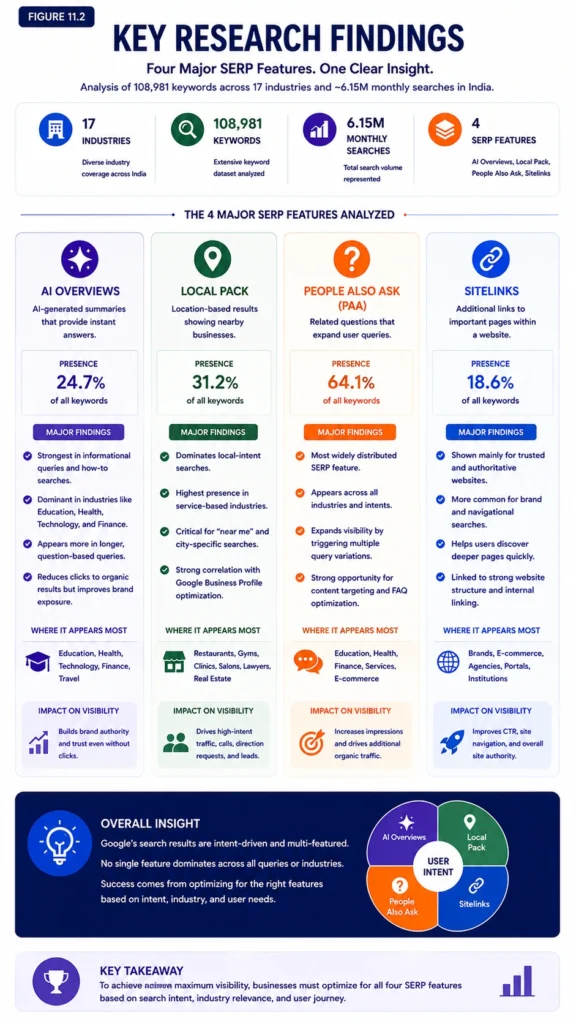
11.3 What This Research Reveals About Google Search
Perhaps the most significant finding is that Google no longer builds Search Engine Results Pages around rankings alone.
Instead, Google assembles SERPs dynamically according to the user’s objective.
When users seek information, Google increasingly favours AI Overviews and People Also Ask.
When users search for nearby businesses, Local Packs dominate the results.
When users search for trusted brands or websites, Sitelinks improve navigation.
This evolution represents a shift from a keyword-centric search engine to an intent-centric search ecosystem, where different SERP features work together to satisfy different user needs.
11.4 The Future of SEO
Traditional SEO focused on improving organic rankings for individual keywords.
The findings of this research suggest that future SEO will require a broader and more integrated approach.
Successful organizations will optimize not only for organic rankings but also for:
- AI Overviews
- Google Business Profile
- Local Pack
- People Also Ask
- Sitelinks
- Entity Recognition
- Topical Authority
- User Experience
- Structured Data
- Content Quality
SEO is therefore evolving into SERP Optimization, where visibility across multiple search features becomes more important than a single ranking position.
Figure 11.3 – Evolution of Search
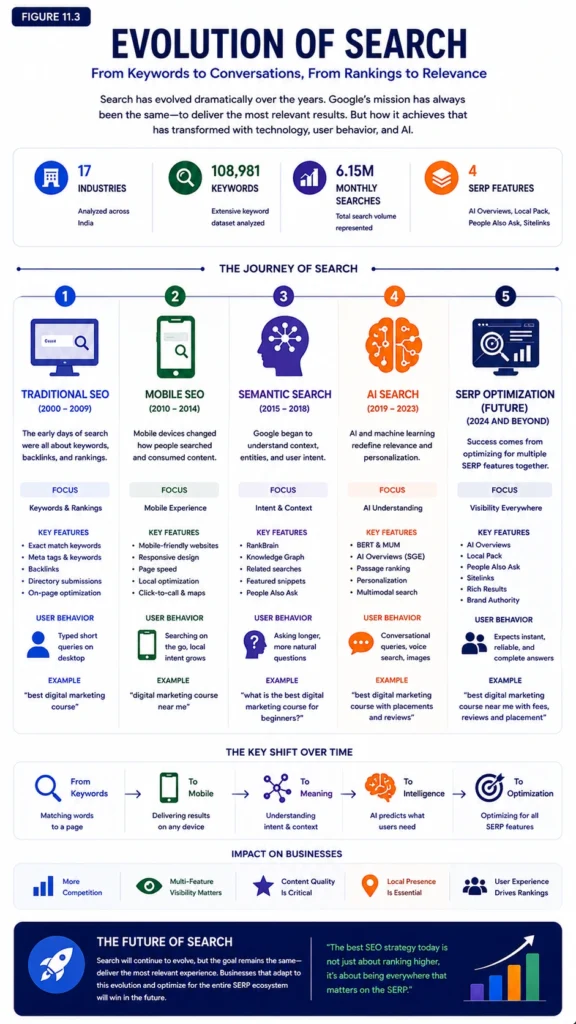
11.5 Implications for Businesses
The findings of this research have important implications for organizations across every industry.
Businesses can no longer rely solely on ranking first for competitive keywords. Instead, they must understand which SERP features dominate their industry and optimize accordingly.
Organizations targeting informational searches should focus on authoritative educational content that supports AI Overviews and People Also Ask.
Businesses serving local markets should prioritize Google Business Profile optimization, customer reviews, and Local SEO.
Companies with established websites should invest in better website architecture and internal linking to improve Sitelink eligibility.
Ultimately, businesses that align their digital strategy with Google’s evolving search experience will be better positioned to maintain long-term visibility.
11.6 Limitations of the Study
While this research provides valuable insights into Google’s evolving SERPs, several limitations should be considered when interpreting the findings.
- The study focuses on 17 selected industries and may not represent every business category.
- Search results were captured during a specific research period and may change as Google continuously updates its algorithms.
- SERP features can vary based on user location, personalization, language settings, and device type.
- AI Overviews remain an evolving Google feature, and their visibility is expected to change significantly over time.
- The research focuses exclusively on Google’s search ecosystem and does not include other AI search platforms such as ChatGPT Search, Perplexity, Claude, or Bing Copilot.
Recognizing these limitations helps ensure that the findings are interpreted within the appropriate research context.
11.7 Future Research Opportunities
This report establishes a foundation for future studies on AI-driven search behaviour.
Potential areas for future research include:
- Longitudinal analysis of AI Overview growth over multiple years.
- Industry-specific AI Search Optimization benchmarks.
- Comparative studies between Google AI Overviews and other AI-powered search platforms.
- The relationship between AI Overviews and organic click-through rates.
- The impact of AI-generated search experiences on local businesses.
- Entity optimization and Knowledge Graph influence on AI visibility.
- Mobile versus desktop SERP behaviour.
- International comparisons across different countries and languages.
Future research will help organizations better understand how Google’s search ecosystem continues to evolve.
Figure 11.4 – Future Research Roadmap
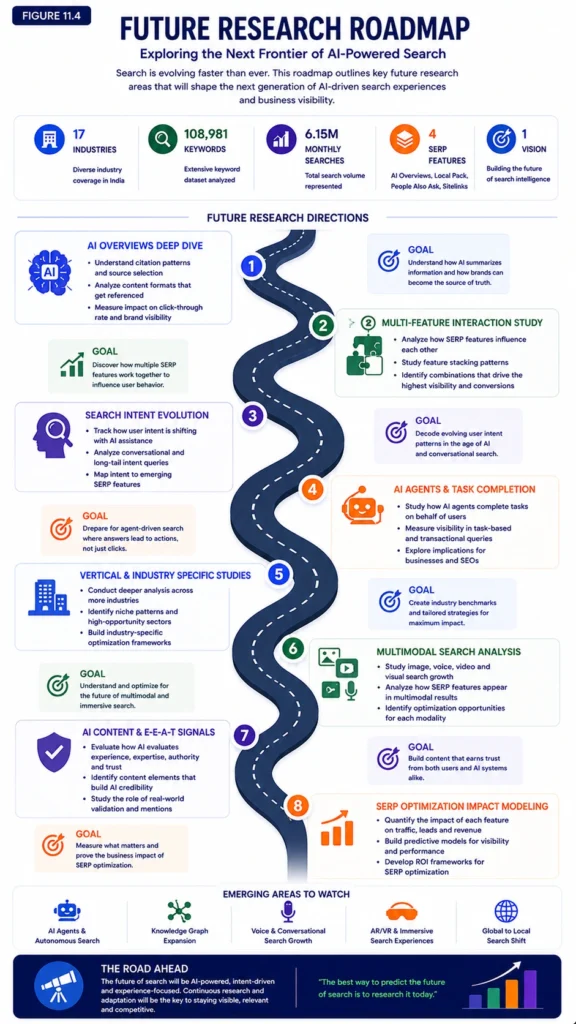
11.8 Final Conclusion
Google Search is entering a new era where visibility is determined not by a single ranking position, but by presence across multiple SERP features.
The analysis of 108,981 keywords, 17 industries, and 6.15 million monthly searches demonstrates that AI Overviews, Local Pack, People Also Ask, and Sitelinks each serve distinct roles in Google’s increasingly intent-driven search ecosystem.
Rather than replacing traditional organic results, these SERP features complement one another to create richer, faster, and more relevant search experiences for users.
For businesses, this transformation presents both challenges and opportunities. Organizations that continue to rely exclusively on traditional keyword rankings may experience declining visibility as Google expands AI-generated and feature-rich search experiences. Conversely, businesses that invest in authoritative content, Local SEO, structured website architecture, topical expertise, and user-focused optimization will be better positioned to thrive in the evolving search landscape.
This research serves as a benchmark for understanding Google’s current SERP behaviour and provides a foundation for future AI Search Optimization strategies. As Google’s search ecosystem continues to evolve, success will increasingly depend on understanding user intent, creating trustworthy content, and optimizing for the full spectrum of search experiences—not just the traditional blue links.
Figure 11.5 – The Future of Google Search
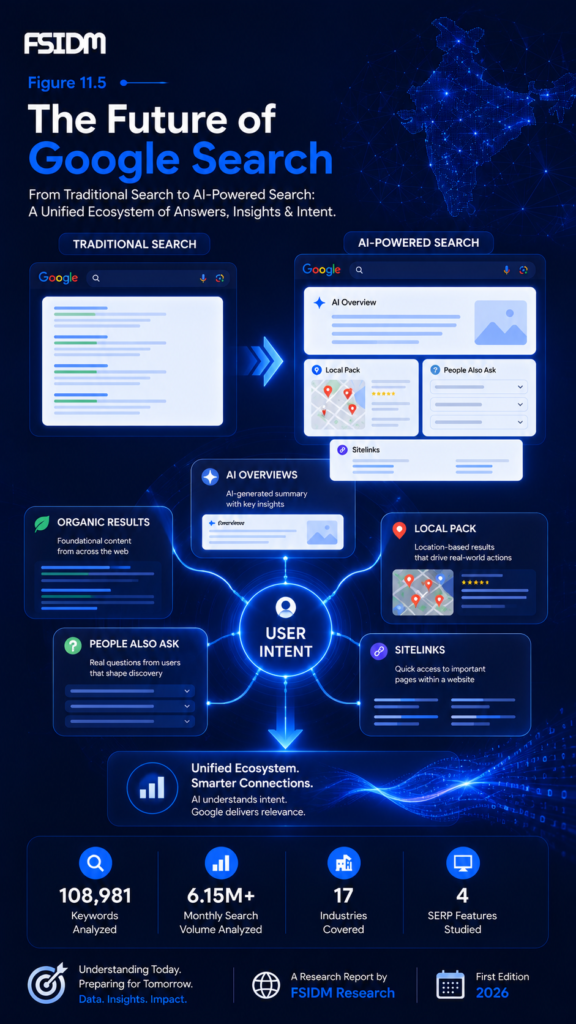
References
The findings presented in this report are based on original research conducted by FSIDM. The analysis combines proprietary keyword datasets with publicly available search metrics and established SEO methodologies to evaluate the distribution of Google’s Search Engine Results Pages (SERPs) across multiple industries in India.
The following resources, platforms, and documentation were referenced during the research process:
Primary Research Data
- Original keyword dataset collected and analyzed by FSIDM
- 108,981 keywords across 17 industries
- Approximately 6.15 million monthly search volume
- Manual SERP observation and classification for:
- AI Overviews
- Local Pack
- People Also Ask (PAA)
- Sitelinks
Industry Resources
- Google Search Central Documentation
- Google Business Profile Help Center
- Google Search Quality Evaluator Guidelines
- Google Search Status Dashboard
- Google Search Central Blog
SEO & Search Industry Publications
- Semrush Research
- Ahrefs Blog & Research
- Moz SEO Learning Center
- Search Engine Journal
- Search Engine Land
Academic & Research References
- Information Retrieval and Search Engine Optimization literature
- Research papers on Search Engine Results Pages (SERPs)
- User Search Behaviour and Information Retrieval studies
- Artificial Intelligence and Search Experience research publications
Disclaimer
This report is an independent research publication prepared by FSIDM (Full Stake Institute of Digital Marketing). Google®, Google Search, Google Maps, Google Business Profile, and related trademarks are the property of Google LLC.
All trademarks, logos, and brand names mentioned in this report belong to their respective owners and are used solely for research, educational, and analytical purposes.
The findings presented represent observations from the data collection period and may evolve as Google’s search algorithms and SERP features continue to change.
About FSIDM
Advancing Digital Marketing Research Through Data
FSIDM Research is the research and insights division of the Full Stack Institute of Digital Marketing (FSIDM), dedicated to publishing original, data-driven research on digital marketing, search engines, artificial intelligence, and emerging online technologies.
Founded with the vision of making digital marketing education and research more practical and evidence-based, FSIDM bridges the gap between academic knowledge and real-world industry applications. Our studies help businesses, marketers, agencies, educators, and researchers understand the rapidly evolving digital landscape through reliable data and actionable insights.
Our research focuses on understanding how modern search engines and AI-powered technologies influence online visibility, customer behaviour, and business growth.
Our Research Areas
- Google Search & SERP Analysis
- AI Overviews & AI Search Optimization (AISO)
- Search Engine Optimization (SEO)
- Local SEO & Google Business Profile
- People Also Ask (PAA) Research
- Search Behaviour & User Intent
- Generative AI in Digital Marketing
- Content Strategy & Topical Authority
- Digital Marketing Trends & Industry Benchmark Reports
Research Philosophy
Every FSIDM publication is built on four core principles:
- Data-Driven – Every insight is supported by measurable research and analysis.
- Independent – Research is conducted objectively using transparent methodologies.
- Practical – Findings are designed to solve real-world business and marketing challenges.
- Future-Focused – Our studies explore emerging technologies, AI innovations, and the future of digital marketing.
About the Founder
Pranav Veerani is the Founder of FSIDM (Full Stack Institute of Digital Marketing) and FSIDM. As a digital marketing strategist, SEO researcher, AI marketing consultant, and educator, he is passionate about helping businesses and professionals understand the future of search through practical, data-backed insights.
His work focuses on Search Engine Optimization (SEO), AI Search Optimization (AISO), Local SEO, Google AI Overviews, Search Engine Results Pages (SERPs), Generative AI, and Digital Growth Strategies. Through FSIDM, he aims to publish independent industry reports that help marketers, agencies, business owners, and researchers make informed decisions in the rapidly evolving digital landscape.
About This Report
Google AI Overviews SERP Research India 2026 is one of the first large-scale independent studies published by FSIDM to examine Google’s AI-powered search ecosystem in India.
Based on the analysis of 108,981 keywords, 17 industries, and approximately 6.15 million monthly searches, this report provides benchmark insights into the distribution of AI Overviews, Local Pack, People Also Ask (PAA), and Sitelinks across Google’s Search Engine Results Pages.
We hope this publication becomes a valuable resource for SEO professionals, digital marketers, agencies, business leaders, researchers, educators, and students while contributing to the broader understanding of Google’s rapidly evolving search ecosystem.
Published By
FSIDM
Research Division of Full Stack Institute of Digital Marketing (FSIDM)
Founder & Lead Researcher: Pranav Veerani
Research Report: Google AI Overviews SERP Research India 2026
Edition: First Edition (2026)
Website: https://fsidm.in
Email: hello@fsidm.in
Contact: +91 83202 59430
Copyright © 2026 FSIDM (Full Stack Institute of Digital Marketing). All Rights Reserved.