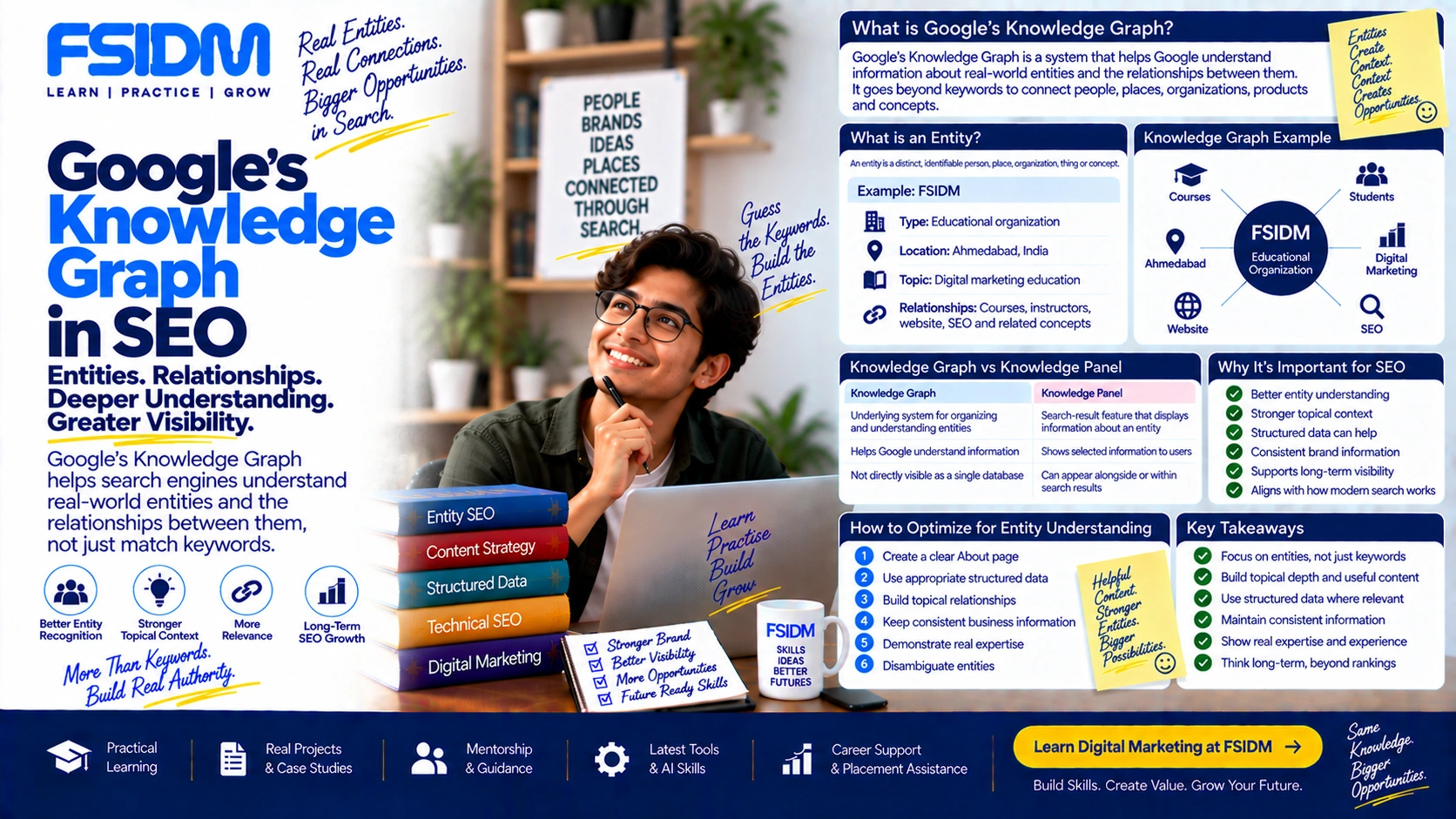
Google’s Knowledge Graph is a system Google uses to understand information about real-world entities and the relationships between them. Instead of treating every search as a simple collection of keywords, it helps Google understand that a person, company, place, product or concept is a distinct entity with related attributes and connections.
For example, a search for a university is not just a phrase containing words such as “university” and “Ahmedabad.” Google may understand the institution as an entity and associate it with information such as its location, courses, organization, website and other relevant relationships.
What Is an Entity in the Knowledge Graph?
An entity is a distinct, identifiable person, place, organization, thing or concept. Knowledge Graph systems are designed to connect information about these entities and their relationships.
Consider a simple example:
- Entity: FSIDM
- Type: Educational organization
- Location: Ahmedabad, India
- Topic: Digital marketing education
- Relationships: Courses, instructors, website, digital marketing, SEO and related concepts
The important idea is that Google can move beyond matching the exact words on a webpage and build a broader understanding of what those words refer to.
How Does the Knowledge Graph Work?
Google’s systems gather and organize information from multiple sources to understand entities and their relationships. The Knowledge Graph is not simply one database that website owners directly submit information to for guaranteed inclusion.
Google can use information from publicly available sources, licensed data and other sources to build and improve its understanding of entities. Structured data on websites can also help communicate what a page or organization represents, although using structured data does not guarantee that an entity will appear in a Knowledge Panel or receive a particular search feature.
Knowledge Graph Example
Imagine someone searches for a well-known company. A traditional keyword-based system might primarily identify webpages containing that company’s name. An entity-oriented system can understand the company as a specific organization and connect it with related facts, people, products, locations and topics.
This allows search engines to answer questions that depend on relationships rather than just matching individual words.
Knowledge Graph vs Knowledge Panel
| Knowledge Graph | Knowledge Panel |
|---|---|
| An underlying system for organizing and understanding entities and relationships | A search-result feature that can display information about an entity |
| Helps Google understand information | Shows selected information to users |
| Not directly visible as a single webpage or database | Can appear alongside or within search results |
A Knowledge Panel can therefore be thought of as one visible search experience that may be supported by Google’s broader understanding of entities. They are related, but they are not the same thing.
Why Is the Knowledge Graph Important for SEO?
The Knowledge Graph is important because modern search increasingly involves entities, relationships and context, not just exact-match keywords.
For SEO professionals, this changes how content should be planned. Instead of creating dozens of disconnected pages around slightly different keyword variations, a stronger strategy can build comprehensive topical coverage and clearly explain how related concepts connect.
1. Better Entity Understanding
Clear information about an organization, product, person or location can make it easier for search engines to interpret what the website represents.
2. Stronger Topical Context
Publishing useful content around related concepts helps establish the context of a website. The goal is not to repeat keywords, but to demonstrate genuine topical depth.
3. Structured Data Can Help
Relevant Schema.org structured data can provide machine-readable context about entities such as organizations, products, articles, courses and local businesses. It is a communication aid, not a guarantee of Knowledge Graph inclusion.
4. Consistent Brand Information
Businesses should maintain accurate and consistent information across their website and other reputable online sources. Consistency can help reduce ambiguity when search engines interpret an organization or brand.
How to Optimize for Entity Understanding
- Create a clear About page: Explain who the organization is, what it does, where it operates and what it is known for.
- Use appropriate structured data: Implement relevant Schema.org types where they accurately represent the page.
- Build topical relationships: Connect related content through useful internal links and comprehensive topic coverage.
- Use consistent business information: Keep important organization, location and contact information accurate across relevant properties.
- Demonstrate real expertise: Include original insights, examples, case studies and first-hand experience where appropriate.
- Disambiguate entities: Make it clear which person, organization, product or place your content refers to when names could be confused with other entities.
Is Schema Markup the Same as the Knowledge Graph?
No. Schema.org is a vocabulary for describing entities and other information in structured form. Schema markup is a common way websites implement that vocabulary. The Knowledge Graph is Google’s broader system for understanding entities and relationships.
Adding Organization or Person schema does not automatically create a Knowledge Graph entity, Knowledge Panel or ranking advantage.
Knowledge Graph and Semantic SEO
The Knowledge Graph is closely related to the broader shift toward semantic search. Semantic search attempts to understand the meaning and relationships behind a query rather than relying only on exact keyword matching.
This is why an SEO strategy should consider related entities, concepts, attributes and user questions. For example, a page about “digital marketing courses” may naturally need to discuss SEO, paid advertising, social media marketing, analytics, AI tools, career paths and practical training depending on the user’s intent.
Knowledge Graph and AI Search
Entity understanding also matters in the era of AI-powered search. AI search experiences need to identify people, organizations, products, places and concepts before they can reliably connect information about them.
However, it would be inaccurate to claim that optimizing a website for the Knowledge Graph guarantees visibility in AI Overviews, AI Mode or other AI-generated search experiences. These systems use multiple signals and their behavior can change over time.
Common Knowledge Graph SEO Mistakes
- Assuming adding schema automatically creates a Knowledge Panel.
- Treating entity SEO as simply adding more keywords.
- Creating generic content solely to mention related entities.
- Using inaccurate or misleading structured data.
- Ignoring consistency in important organization and business information.
- Assuming Knowledge Graph visibility directly guarantees higher rankings.
Frequently Asked Questions
What is Google’s Knowledge Graph?
Google’s Knowledge Graph is a system that helps Google organize and understand information about real-world entities and the relationships between them.
Is the Knowledge Graph a ranking factor?
It is better understood as part of Google’s information-understanding systems rather than a simple ranking factor with a score that SEO professionals can optimize directly.
What is the difference between an entity and a keyword?
A keyword is a word or phrase people use in search. An entity represents a distinct thing or concept that a search engine can understand and relate to other information.
Can I submit my company directly to Google’s Knowledge Graph?
There is no general form that guarantees direct Knowledge Graph inclusion. Businesses should focus on establishing accurate, consistent and well-supported information about their organization across their website and relevant reputable sources.
Does Schema Markup create a Knowledge Panel?
No. Structured data can help search engines understand information, but it does not guarantee a Knowledge Panel or Knowledge Graph inclusion.
Interview Question
Q: What is the Knowledge Graph, and why is it important for SEO?
Answer: Google’s Knowledge Graph is a system that helps Google understand entities and relationships between them. It is important for SEO because search is increasingly based on meaning, context and entities rather than only exact keyword matching. Clear entity information, topical coverage and accurate structured data can help search engines better interpret a website.
Interview Tip
Don’t say “Knowledge Graph is Google’s database of every website.” A better answer is: “It is a system Google uses to understand real-world entities and the relationships between them.”
Learn Modern SEO with FSIDM
Modern SEO goes beyond keywords. Understanding entities, semantic search, structured data, topical authority and AI-powered search helps marketers build websites that are easier for both people and search engines to understand.
FSIDM focuses on practical, industry-oriented digital marketing and SEO learning, helping students and professionals understand modern search and apply SEO concepts to real-world projects.