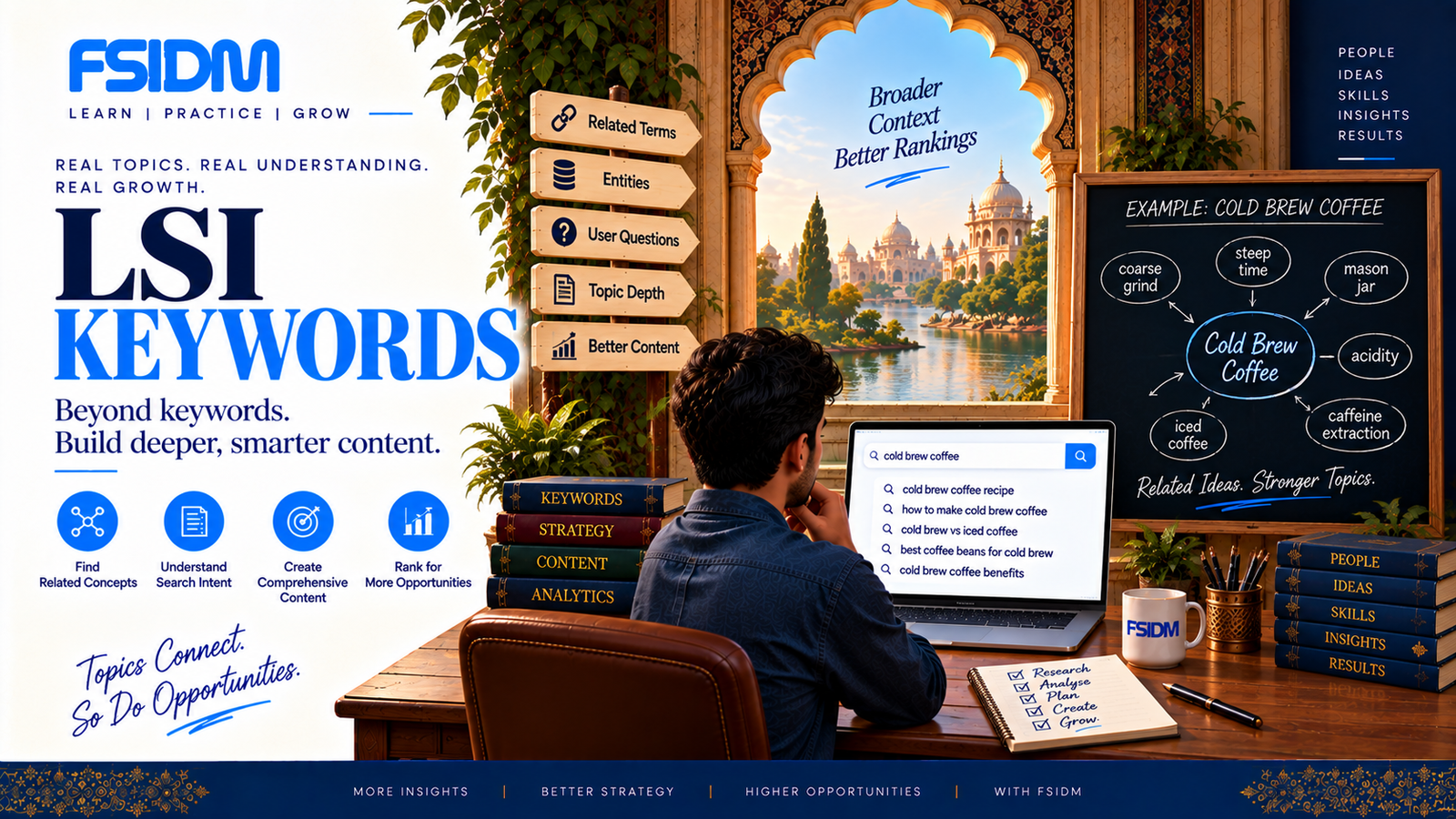
LSI keywords is an SEO industry term commonly used to describe words and phrases that are semantically or contextually related to a primary keyword. However, the term is technically misleading: Google does not use “LSI keywords” as a specific SEO ranking concept.
Latent Semantic Indexing (LSI) is an older information-retrieval technique, while modern search engines use much more sophisticated language-understanding systems. For SEO practitioners, the more useful concept is semantic relevance—covering related concepts, entities, terminology, and questions naturally within content.
Are LSI Keywords a Google Ranking Factor?
No. There is no Google-published “LSI keyword” ranking factor or requirement that websites include a specific set of LSI terms.
The phrase became popular in the SEO industry as a way to describe words that frequently occur around a topic. In modern SEO, it is more accurate to discuss related terms, entities, concepts, and semantic relationships rather than treating them as a special category of keywords that Google requires.
What Is Latent Semantic Indexing?
Latent Semantic Indexing is an information-retrieval technique developed to identify relationships between terms and documents based on patterns of word usage. It predates modern search engines and should not be confused with the advanced language-understanding systems used by contemporary search engines.
Therefore, using related terminology in an SEO article does not mean that Google is applying an LSI keyword checklist to the page.
Why Semantic Relevance Still Matters
Although “LSI keywords” is an inaccurate label, the underlying SEO practice of writing comprehensively about a topic remains useful.
When a page discusses the relevant concepts, terminology, entities, attributes, and questions surrounding a subject, it can provide clearer context for both users and search systems.
For example, a page about Apple could mean different things depending on its surrounding context:
| Primary Term | Related Concepts | Likely Topic Context |
|---|---|---|
| Apple | iPhone, MacBook, iOS, Silicon Valley | Technology company |
| Apple | Orchard, fruit, pie, cider, harvest | Fruit / agriculture |
| Golf | Club, ball, swing, green, PGA, caddie | Sport |
| Golf | Volkswagen, engine, mileage, hatchback, turbo | Automobile |
The important SEO principle is not to insert these words mechanically. It is to create content that makes the topic and its intended context clear.
Examples of Semantic Keywords
Example 1: Cold Brew Coffee
If the primary topic is cold brew coffee, naturally relevant concepts could include:
- coarse grind
- steep time
- mason jar
- acidity
- iced coffee
- caffeine extraction
A useful article may discuss these concepts because they help explain how cold brew works—not because they represent a required list of “LSI keywords.”
Example 2: On-Page SEO
A comprehensive page about on-page SEO may naturally cover concepts such as:
- title tags
- meta descriptions
- internal linking
- image alt text
- search intent
- content structure
- keyword usage
These terms help establish topical context when they are genuinely relevant to the subject.
LSI Keywords vs Semantic Keywords
| Term | Meaning | Modern SEO Perspective |
|---|---|---|
| LSI Keywords | Industry term for words thought to be semantically related to a target keyword. | Technically misleading when presented as a Google ranking mechanism. |
| Semantic Keywords | Related words and phrases that help communicate a topic and its context. | Useful as a content-planning concept. |
| Entities | Distinct people, places, organizations, objects, concepts, or other identifiable subjects. | Important to modern search understanding, but not equivalent to an “LSI keyword list.” |
| Related Questions | Questions users commonly ask around a topic. | Useful for understanding search needs and building comprehensive content. |
How to Find Semantic Keywords
You do not need an “LSI keyword generator” to build a semantically relevant article. Useful discovery methods include:
1. Google Autocomplete
Start typing the primary topic into Google and examine the suggestions. These can reveal variations and related search formulations.
2. People Also Ask
Review People Also Ask (PAA) questions for the topic. These questions can reveal related information users may want to understand.
3. Related Searches
The related-search section can provide additional query variations and adjacent topics that may be useful during content research.
4. Competitor SERPs
Review high-quality pages ranking for the topic and identify concepts they cover that are genuinely relevant to the user’s needs.
5. Subject-Matter Research
Use your own expertise, customer questions, product documentation, industry terminology, and reliable research to identify concepts that deserve coverage.
Do Not Stuff Semantic Keywords
One of the biggest mistakes associated with the LSI concept is treating related terms as a checklist.
Adding a keyword repeatedly simply because an SEO tool suggests it can make content unnatural and reduce its usefulness. The objective should be topical completeness and clarity, not achieving an arbitrary keyword density.
Use related terminology when it genuinely helps explain the topic, answer a question, clarify an entity, or satisfy user intent.
Semantic SEO and Topical Coverage
Semantic SEO focuses on communicating the meaning and relationships within a topic rather than repeatedly matching one exact phrase.
For example, a strong article about keyword research may naturally discuss search volume, Keyword Difficulty, search intent, CPC, SERPs, keyword mapping, long-tail queries, and content strategy. These concepts make the article more complete because they are genuinely connected to the subject.
Common LSI Keyword Mistakes
- Calling related terms a Google ranking factor: Google does not publish an LSI-keyword requirement.
- Using an LSI generator as a keyword checklist: Related terms should support useful content rather than dictate it.
- Keyword stuffing: Repeating semantic terms unnaturally does not make content better.
- Confusing synonyms with entities: Related concepts are not necessarily synonyms of the primary keyword.
- Ignoring user intent: Semantic relevance should ultimately help answer what the user is trying to accomplish.
- Focusing on terminology instead of topic depth: A comprehensive, useful page is more important than hitting a predetermined list of related words.
FAQs About LSI Keywords
What are LSI keywords?
LSI keywords is an SEO industry term for words and phrases considered contextually related to a main keyword. The term is technically misleading when used to describe a specific Google ranking mechanism.
Does Google use LSI keywords?
Google does not publish “LSI keywords” as a ranking factor. Modern search systems use more advanced methods of understanding language, meaning, entities, and context.
Are LSI keywords useful for SEO?
The label itself is not particularly useful, but researching related concepts and terminology can help you create clearer and more comprehensive content.
What should I use instead of LSI keywords?
Terms such as semantic keywords, related concepts, related entities, topical terms, and search-intent questions are generally more accurate ways to describe the underlying practice.
How can I find semantic keywords?
You can use Google Autocomplete, People Also Ask, related searches, competitor SERPs, customer questions, subject-matter research, and keyword-research tools to identify relevant concepts.
Should I add every related keyword to my article?
No. Include terminology when it naturally contributes to the topic and helps users understand or accomplish what they came to the page to do.
Interview Question
What are LSI keywords, and are they actually used by Google?
LSI keywords is an SEO industry term used to describe contextually related words and phrases. However, it is not an official Google ranking factor. A more accurate modern SEO approach is to focus on semantic relevance, related concepts, entities, and comprehensive coverage of search intent.
Interview Tip
This is a common SEO interview trick. Do not confidently say that “Google ranks pages using LSI keywords.” Explain the distinction between the outdated LSI terminology and the modern practice of creating semantically relevant, comprehensive content.
Learn Practical SEO with FSIDM
At FSIDM, SEO is approached from a practical, industry-focused perspective. Understanding semantic relevance helps marketers move beyond mechanical keyword placement and create content that communicates topics clearly, naturally, and comprehensively.