Imagine you are looking for a digital marketing expert.
One person has been working with hundreds of businesses for years and has plenty of useful work to show.
Another person has just started yesterday.
Both may give you the same advice, but you will probably feel more confident about the first person.
That is roughly the idea behind authority on the web.
But when SEO professionals talk about Domain Authority, there is an important detail that often gets missed:
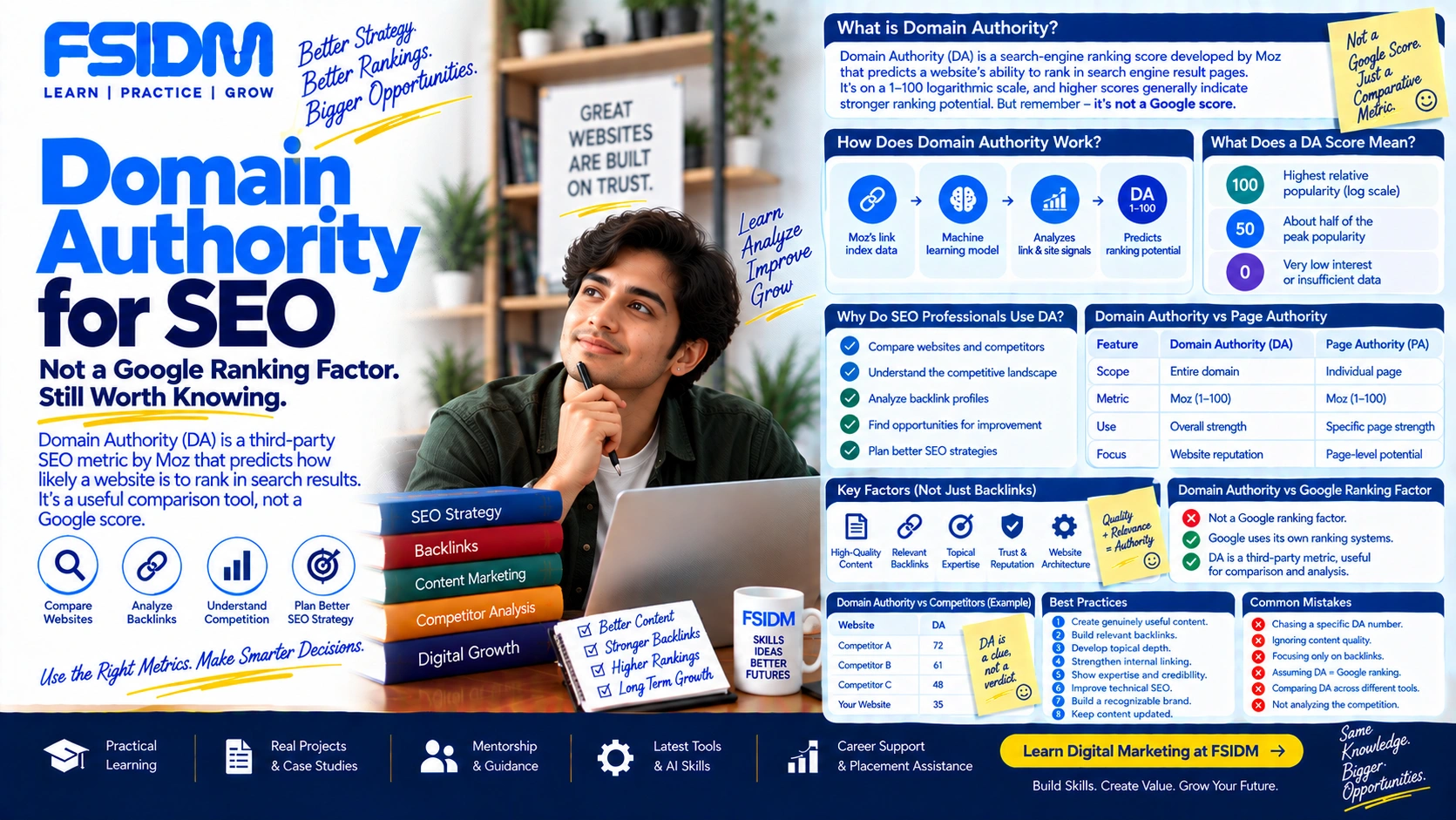
Domain Authority is not a Google ranking factor.
It is a third-party SEO metric created by Moz to estimate how likely a website may be to rank in search results compared with other websites.
What Is Domain Authority?
Domain Authority (DA) is a search-engine ranking score developed by Moz that predicts a website’s ability to rank in search engine result pages.
Moz calculates DA on a 1–100 logarithmic scale. Higher scores generally indicate a stronger ability to rank compared with lower-scoring domains.
But there is a catch.
Google does not use Moz’s Domain Authority score as a ranking factor.
So if your website has a DA of 50 and your competitor has a DA of 70, it does not mean Google automatically considers your competitor “better” or will always rank them above you.
DA is best used as a comparative SEO metric, not as a Google score.
Who Created Domain Authority?
Domain Authority was created by Moz, an SEO software company.
Moz developed DA as a way to estimate the ranking strength of an entire domain based on link-related and other signals used in its own predictive model.
This distinction matters because you may see DA mentioned alongside Google’s own SEO documentation.
They are not the same thing.
Google ranking systems ≠ Moz Domain Authority.
How Does Domain Authority Work?
Domain Authority is a predictive metric.
Moz uses its own link index and machine-learning model to calculate the score.
The exact calculation can change as Moz updates its model and link data.
One of the major ideas behind DA is the strength and quality of a website’s backlink profile.
In simple terms:
Other websites linking to your website can contribute to the signals Moz uses to estimate your domain’s authority.
But it is not as simple as collecting as many backlinks as possible.
A website with thousands of low-quality or irrelevant links is not automatically stronger than a website with fewer, more relevant and authoritative links.
What Does a Domain Authority Score Mean?
DA ranges from 1 to 100.
The scale is logarithmic, which means moving from one score to another does not represent an equal amount of improvement.
For example, increasing from DA 20 to DA 30 is not necessarily the same level of improvement as increasing from DA 70 to DA 80.
This is why chasing a specific number can become misleading.
Instead of thinking:
“I need DA 60.”
Think:
“How does my website compare with the websites competing for the searches I care about?”
Is Domain Authority a Google Ranking Factor?
No.
This is probably the most important sentence in this entire article.
Google does not use Moz’s Domain Authority score as a ranking factor.
Google has its own ranking systems and does not publish a single website-wide “authority score” that corresponds to Moz DA.
So statements such as:
“Google increased my website’s DA.”
or
“Google requires DA 50 to rank.”
are misleading.
DA can still be useful for SEO professionals because it provides a third-party way to compare websites, particularly when researching competitors and backlink profiles.
Why Do SEO Professionals Use Domain Authority?
If DA is not a Google ranking factor, why does anyone care about it?
Because third-party metrics can still be useful for comparison and analysis.
For example, suppose you are researching five competitors.
| Website | DA |
|---|---|
| Competitor A | 72 |
| Competitor B | 61 |
| Competitor C | 48 |
| Your website | 35 |
This does not prove that Competitor A will outrank everyone.
But it may give you a useful starting point for understanding the competitive landscape.
You can then investigate their backlinks, content, topical coverage, search intent, internal linking and other factors.
DA is a clue, not a verdict.
Domain Authority vs Page Authority
This is another important distinction.
Domain Authority estimates the ranking strength of an entire domain.
Page Authority (PA) is a Moz metric designed to predict the ranking ability of an individual webpage.
For example:
- Domain Authority: How strong does the overall domain appear in Moz’s predictive model?
- Page Authority: How strong does this particular page appear?
A website can have a relatively modest DA while one particular page has accumulated strong backlinks and performs well.
What Is a Good Domain Authority Score?
There is no universal “good DA” number.
A DA of 30 might be competitive in one niche and relatively weak in another.
It depends heavily on the websites you are competing against.
For example, competing against massive websites with extremely strong backlink profiles is very different from competing against small local businesses.
Instead of asking:
“Is DA 40 good?”
Ask:
“How does DA 40 compare with the sites I actually compete with?”
What Can Increase Domain Authority?
Because DA is primarily a predictive link-based metric, improving your website’s backlink profile can influence the score.
But the goal should not be to manipulate DA simply for the sake of increasing the number.
Focus on building a website that naturally earns valuable links.
That can include:
- Publishing genuinely useful content
- Creating original research or data
- Producing useful resources that others want to reference
- Building relationships within your industry
- Digital PR and legitimate outreach
- Earning relevant editorial backlinks
- Creating content worth citing
The important word here is relevant.
One strong, relevant backlink can be much more meaningful than a pile of random links.
Do More Backlinks Always Mean Higher DA?
No.
This is another common SEO misunderstanding.
Imagine you receive 1,000 backlinks from websites nobody trusts, websites unrelated to your industry or pages created purely for links.
That does not automatically make your website authoritative.
Now imagine another website earns 20 strong, relevant editorial links from respected websites in its industry.
The second backlink profile could be much more valuable.
Link quality, relevance and the overall backlink profile matter far more than simply counting links.
Domain Authority and Link Building
DA is often used during link-building campaigns.
For example, an SEO professional may evaluate a potential backlink opportunity using several factors, including:
- Domain Authority
- Relevance to the industry
- Actual organic traffic
- Content quality
- Editorial standards
- Backlink profile
- Audience relevance
- Spam signals
This is much better than saying:
“This website has DA 60, so let’s get a link.”
A high DA website can still be irrelevant to your audience.
Can a Low-DA Website Outrank a High-DA Website?
Yes.
This is important.
Imagine a small local website publishing an excellent article that perfectly answers a specific local question.
A huge website might have a much higher DA, but if its page does not satisfy the searcher’s intent as well, the smaller website can still compete.
SEO is not simply a competition to see who has the highest third-party metric.
Google evaluates individual pages and many other signals when determining search results.
So never assume:
High DA = automatic #1 ranking.
Domain Authority vs Domain Rating
Another common source of confusion is Domain Rating (DR).
DA and DR are not the same metric.
DA is a Moz metric.
DR is an Ahrefs metric.
Both are third-party metrics designed to help SEO professionals evaluate websites, but they use different methodologies and should not be treated as interchangeable.
| Metric | Company | What it represents |
|---|---|---|
| Domain Authority (DA) | Moz | Predictive domain ranking strength |
| Domain Rating (DR) | Ahrefs | Strength of a website’s backlink profile |
If one tool says your website has DA 45 and another says DR 52, there is no contradiction.
They are measuring different things using different systems.
Domain Authority vs Google PageRank
DA is also sometimes confused with PageRank.
PageRank is Google’s historical link-analysis algorithm based on the web’s link structure.
Google no longer provides a public PageRank score in the way SEO tools provide DA or DR.
So you should not treat DA as a replacement for some publicly visible Google PageRank score.
Should You Track Domain Authority?
You can.
But track it for the right reason.
DA can be useful when you want to:
- Compare your website with competitors
- Monitor changes in your backlink profile
- Evaluate potential link-building opportunities
- Understand the relative strength of domains in a niche
- Track broad SEO progress alongside other metrics
But don’t make DA your primary SEO KPI.
Business outcomes are more important.
Look at things such as:
- Organic traffic
- Relevant rankings
- Organic clicks
- Qualified leads
- Sales
- Conversions
- Revenue
A Simple FSIDM Example
Imagine FSIDM is comparing its website with three other digital marketing institutes.
One competitor has a DA of 55.
Another has a DA of 42.
FSIDM has a DA of 35.
It would be tempting to say:
“We need to increase our DA to 55 before we can rank.”
That would be the wrong conclusion.
Instead, the SEO team could investigate:
- Which pages are ranking?
- Which keywords are driving traffic?
- What backlinks do competitors have?
- Are those backlinks relevant?
- What topics do competitors cover?
- Are there content gaps?
- Does the page satisfy search intent?
- Are important pages internally linked?
Now DA becomes useful as part of a bigger competitive analysis rather than a number to obsess over.
Common Domain Authority Mistakes
Thinking DA Is a Google Score
It isn’t.
DA comes from Moz, not Google.
Buying Thousands of Cheap Backlinks
More links do not automatically mean more authority or better rankings.
Chasing DA Instead of Customers
A website can have an impressive third-party score and still generate very little business.
Comparing DA Across Completely Different Niches
A DA score becomes much more meaningful when you compare websites that operate in the same competitive environment.
Assuming High DA Guarantees Rankings
It does not.
A strong domain can still have individual pages that perform poorly.
So, Should You Care About Domain Authority?
Yes—but don’t worship it.
Use DA as a third-party competitive metric.
Use it to understand backlink strength and compare domains.
But when evaluating SEO success, look beyond the score.
Your real objective is not:
“Get DA 70.”
Your real objective is:
“Build a website that deserves to be discovered, trusted, visited and chosen.”
That means useful content, relevant backlinks, strong technical foundations, good user experience and a clear understanding of what your audience actually needs.
Domain Authority in One Simple Sentence
Domain Authority is Moz’s 1–100 predictive SEO metric for estimating a domain’s ranking strength compared with other websites—it is not a Google ranking factor.
So the next time someone tells you, “Your DA is low, therefore your SEO is bad,” take a breath.
Ask a better question:
“What is actually preventing this page from winning the search?”
That question will usually lead you much closer to the real SEO problem.
Frequently Asked Questions About Domain Authority
What is Domain Authority?
Domain Authority is a Moz metric that predicts how likely a domain may be to rank in search engine results compared with other domains.
Is Domain Authority a Google ranking factor?
No. Domain Authority is a third-party metric created by Moz and is not a Google ranking factor.
What is a good Domain Authority score?
There is no universal good score. DA is most useful when comparing your website with competitors in the same niche.
How can I increase Domain Authority?
Building a strong, relevant backlink profile can influence DA. Focus on earning high-quality links rather than simply increasing the number of backlinks.
Is DA the same as DR?
No. DA is Moz’s Domain Authority metric, while DR is Ahrefs’ Domain Rating metric. They use different methodologies.
Can a low-DA website rank higher than a high-DA website?
Yes. A lower-DA website can outrank a higher-DA website for a particular search because DA is not a Google ranking factor and search rankings involve many other considerations.
Does higher DA mean more traffic?
Not necessarily. DA is a predictive third-party metric, while actual organic traffic depends on factors such as rankings, search demand, content relevance and searcher behavior.