
Googlebot’s 2 MB Crawl Limit: It’s Enough, But Are You Using It Wisely? Recent data from Google confirms the 2 MB crawl limit per page is generally sufficient. This isn’t a guideline; it’s a hard technical constraint. Googlebot will process the first 2 megabytes of your page’s renderable content and then stop. Anything beyond that point is ignored. Period. This has significant implications for your content visibility and SEO. Understanding the 2 MB Threshold This 2 MB isn’t just your HTML file size. It encompasses all the HTML, CSS, and JavaScript files needed to render your page. Think of it as Googlebot’s processing budget for a single page. If your page requires 2.5 MB of code and text to display fully, the last 0.5 MB will not be processed. This means critical content, internal links, or important scripts could be missed entirely. Why This Limit Directly Impacts Your SEO If essential content, calls-to-action, or internal navigation falls outside this limit, it won’t get indexed. This directly affects your organic visibility and ability to rank for relevant queries. Pages that exceed the limit risk having key information completely overlooked by Googlebot. This makes your page less discoverable and diminishes its potential for attracting targeted traffic. Efficient use of this 2 MB also indirectly supports your overall crawl budget. Leaner pages allow Googlebot to process more of your site effectively. Practical Steps to Optimize Within the Bounds Prioritize critical content and essential scripts. Everything vital for user experience and SEO must load within that initial 2 MB. Front-load core content: Place unique text, main headings, and key selling propositions high in the HTML structure. Minify and compress resources: Drastically reduce the file size of your CSS and JavaScript files. Defer non-critical scripts: Use `async` or `defer` for scripts not essential for initial page rendering. Lazy-load images and media: Implement lazy loading for images and videos, so they only load when entering the viewport. Audit for unused code: Regularly clean out unused CSS and JavaScript that bloats your page weight. Real-World Impact: The Overweight E-commerce Product Page Consider an e-commerce product page. It might start by loading a large hero image carousel, followed by multiple analytics scripts, and complex filtering JavaScript. All these resources contribute to that initial 2 MB. If the detailed product description, customer reviews, and crucial “add to cart” button are loaded *after* 2 MB of other content, Googlebot may never process them. The consequence? That product page ranks poorly for long-tail queries related to specific product features or reviews. It misses out on valuable organic traffic, directly impacting sales potential. Quick FAQs on Googlebot’s Crawl Limit Is 2 MB a raw file size limit? No. It refers to the size of the *rendered* content, including HTML, CSS, and JavaScript that Googlebot processes for rendering, not just the raw HTML document. Does this apply to images? Images are generally fetched separately. However, the CSS/JS code required to display complex image galleries, carousels, or interactive media *does* count towards the 2 MB limit. Optimize your front-end code that handles these assets.

Synthetic Personas For Better Prompt Tracking
Beyond Generic: The Power of Synthetic Personas for Prompt Tracking You’re using AI for content, customer service, or ad copy. But are you getting truly targeted, effective outputs? Often, the problem isn’t the AI; it’s the generic prompts. This is where synthetic personas change the game for your prompt tracking strategy. What Are Synthetic Personas? Forget the old demographic profiles. Synthetic personas are AI-driven, data-informed constructs representing specific user segments. They embody distinct needs, behaviors, and pain points, generated from your actual analytics, CRM data, or market research. Think of them as hyper-realistic, fictional individuals your AI can directly address. Why Link Them to Prompt Tracking? Your AI’s output quality directly correlates with the specificity of your input. Generic prompts lead to generic results. By mapping AI prompts to synthetic personas, you move past a “one-size-fits-all” approach. You’re no longer just tracking if a prompt works; you’re tracking if it works for “Sarah, the budget-conscious student,” or “Mark, the busy small business owner.” This precision is critical for measurable growth. The Practical Impact on Your AI Strategy How It Works: A Workflow Implementing synthetic personas into your prompt tracking workflow is direct: Develop Personas: Create 3-5 distinct synthetic personas using real user data. Define their goals, challenges, preferred communication styles. Map Goals: For each persona, identify specific content or interaction goals your AI needs to achieve (e.g., generate social media captions, answer FAQs, draft email subject lines). Craft Persona-Specific Prompts: Write prompts explicitly tailored to each persona’s context. Inject their language, their pain points, their desires directly into the prompt. Track Performance Per Persona: Implement a system to log which prompt variations perform best for outputs aimed at a particular persona. Monitor engagement, conversion rates, or problem resolution specific to that persona’s intended audience. Iterate and Refine: Use these persona-level insights to continuously refine your prompts, making your AI outputs increasingly effective and targeted. Real-World Example: E-commerce Product Descriptions Consider an e-commerce brand selling tech gadgets: Persona A: “Tech Enthusiast Tyler” – Values cutting-edge features, specs, performance. Persona B: “Practical Pam” – Values reliability, ease of use, value for money. Prompt for Tyler: “Generate a product description for our new flagship drone. Focus on its advanced AI stabilization, 4K 120fps camera, and extended flight time for professional videographers. Use confident, technical language.” Prompt for Pam: “Generate a product description for our new flagship drone. Emphasize its user-friendliness, durable design, and how easy it is to capture stunning aerial footage without complex controls. Use simple, benefit-driven language.” By tracking engagement, clicks, and sales generated by each description variant, you quickly learn which prompt structures and linguistic styles resonate best with each segment. You’re not just improving a prompt; you’re optimizing for a specific customer. Moving Beyond Basic Prompting This approach transforms prompt engineering from a trial-and-error process into a data-informed optimization strategy. You’re not just seeking “good” AI output, but output that directly serves a strategic purpose for a defined segment of your audience. Key Takeaways for Deeper Application Focus on measurable outcomes tied to specific user segments. This method helps your AI tools become truly invaluable, not just efficient. FAQ: Synthetic Personas for AI Prompts Q: Are synthetic personas real customers? A: No, they are sophisticated, data-driven representations. They function as powerful proxies for targeting your AI outputs, reflecting the behaviors and needs of your actual customer segments without being individual customers themselves. Q: How do I build these personas? A: Start with your existing data: Google Analytics, CRM, sales records, customer surveys. Identify common patterns, pain points, and motivations. AI tools can also assist in generating more nuanced personas from raw data sets.

Data Clean Rooms: What They Are & Why They Matter in a Privacy-First World
Why Data Measurement Looks Different Today Digital marketing has entered a new era where privacy, consent, and data access shape every decision. Tracking users across the web is no longer simple.Signals are fragmented.Consent rates vary.Platforms protect their data more aggressively. Even though third-party cookies still exist in some environments, marketers are experiencing real signal loss due to: As a result, brands can no longer rely on traditional tracking alone to understand performance. This is where data clean rooms come in. What Is a Data Clean Room? A data clean room is a secure data environment that allows two or more parties to analyze and match data without exposing raw or personally identifiable information (PII). Instead of sharing customer-level data directly, each party uploads encrypted or anonymized data. The clean room then allows approved queries and analysis under strict privacy controls. What makes a data clean room different: In simple terms, a data clean room lets marketers learn from combined data without violating user privacy. Why Data Clean Rooms Exist Modern marketing data is deeply fragmented. Customer interactions happen across: At the same time, privacy rules limit how this data can be shared or matched. Data clean rooms solve this by creating a neutral, controlled space where: They are not about tracking individuals.They are about understanding patterns, impact, and outcomes safely. How Data Clean Rooms Are Used in Practice Most large advertising platforms offer their own clean room environments. These are typically used to: The key benefit is better insight without privacy risk. However, clean rooms work best when brands already have strong first-party data, such as: Without first-party data, matching opportunities are limited. The Reality: Clean Rooms Are Usually Platform-Specific One important limitation marketers must understand: Most data clean rooms today operate inside a single platform ecosystem. This means: Because of strict privacy rules, these environments cannot freely connect with each other. As a result: Clean rooms improve visibility within platforms, not automatically across all platforms. Key Challenges With Data Clean Rooms While powerful, data clean rooms are not a silver bullet. 1. First-Party Data Is Hard to Build Clean rooms depend on first-party data, which requires: Brands without strong customer touchpoints are at a disadvantage. 2. Walled Gardens Still Win Platforms with massive user bases benefit the most because they already control large data ecosystems. This can increase the gap between: 3. Limited Cross-Platform Visibility Most clean rooms do not talk to each other. If you advertise across multiple platforms, you may still struggle to: 4. Technical Complexity Clean rooms often require: They are not “plug-and-play” tools for most teams. Alternatives Marketers Are Exploring Data clean rooms are not the only solution in a privacy-first world. Browser-Based Privacy Solutions Some approaches group users into large anonymous cohorts rather than tracking individuals. These methods aim to preserve targeting effectiveness while reducing individual identification, but they remain controversial and limited in scope. Universal ID Concepts Universal identifiers attempt to replace cookies with anonymized IDs usable across platforms. In theory, they simplify attribution.In reality, adoption and regulation remain uncertain. What the Future Looks Like Data tracking is no longer invisible. Every interaction now involves: This creates friction—but also forces better data practices. Looking ahead: Some companies are already working on multi-platform clean room concepts, though perfect alignment across platforms remains unlikely. The Real Takeaway Data clean rooms are not about replacing cookies. They are about adapting to reality. They allow marketers to: But they only work when paired with: The brands that succeed will be those that earn data through value, not those that chase shortcuts.

Behavioral Data You Need To Improve Your Users’ Search Journey
Why Behavioral Data Matters More Than Ever Search optimization has expanded far beyond keywords and rankings. As search journeys evolve into conversations across AI systems, social platforms, and marketplaces, success depends on one thing above all else: how users behave. Technology changes fast. Human behavior doesn’t. People still: Behavioral data helps us understand why users search, where they search, and what stops them from converting. While algorithms and interfaces continue to shift, behavioral patterns remain relatively stable. That makes behavioral insights one of the most reliable tools for improving organic performance long-term. The Three Behavioral Data Pillars That Shape Search Journeys To meaningfully improve search journeys, behavioral data should be grouped into three core areas: Each pillar answers a different question about the user experience. 1. Discovery Channel Behavior: Where Search Really Begins Search no longer starts in one place. Users discover brands through: Traditional search engines are now only one part of a broader discovery loop. Understanding discovery behavior means tracking: Different platforms serve different mental states. Some are used for inspiration, others for reassurance, and others for final validation before action. To capture this data: As more journeys begin and end outside your website, visibility across multiple discovery channels becomes essential. 2. Mental Shortcuts: How People Make Faster Decisions Users don’t evaluate every option rationally. They rely on mental shortcuts to save time and energy. These shortcuts influence what they click, what they trust, and when they abandon. Cognitive Biases Biases are unconscious distortions in judgment that affect how information is perceived. Common examples include: These biases influence: Heuristics Heuristics are simple rules people use to make decisions quickly. Common examples include: In search behavior, heuristics often surface directly in queries: By clustering queries and content themes around these patterns, you can identify where reassurance, proof, or clarity is missing. 3. Underlying User Needs: The Real Driver Behind Search Queries and clicks are symptoms. Needs are the cause. Underlying needs explain why users start searching and what they require to move forward. These needs often persist across multiple sessions and platforms. Common underlying needs include: For example: Mapping mental shortcuts to user needs allows teams to solve problems holistically, not just through SEO fixes. How To Collect Behavioral Data That Actually Leads To Action Quantitative Behavioral Data This shows what users are doing. Useful metrics include: Helpful tools: Quantitative data highlights where friction exists, but not always why. Qualitative Behavioral Data This explains why users behave the way they do. Sources include: Qualitative insights uncover: When combined with quantitative data, they reveal actionable opportunities. Behavioral Data In An AI-Driven Search Environment AI hasn’t removed the need for behavioral analysis. It has amplified it. AI can help by: But AI still relies on human behavior as input. Optimizing for AI systems without understanding users leads to fragile strategies. Behavioral insight remains the foundation. How To Apply Behavioral Insights To Improve Search Journeys Search performance improves fastest when teams stop treating SEO as an isolated channel and start optimizing the entire decision journey. Final Thought Search success in 2026 won’t come from chasing algorithms or renaming disciplines. It will come from understanding people. Behavioral data helps you: When you design search journeys around real human behavior, users respond positively.And when users respond positively, every system that ranks, recommends, or summarizes content tends to follow.
PPC Pulse 2026: Apple Expands Search Ads While AI Changes Keyword Control
Paid Search Is Expanding — But Control Is Shifting As we move into 2026, paid search is growing across new surfaces, but the way advertisers control campaigns is changing. Two recent platform moves highlight this shift clearly: Together, these updates show where paid media is heading: more reach, more automation, and less placement-level control. Apple Is Adding More Search Ad Placements In The App Store What’s Changing In 2026 Until now, Apple Search Ads appeared only in the top position of App Store search results. Starting in 2026, Apple will introduce additional ad placements further down the search results page. Key points: This means advertisers automatically gain access to more inventory — but without the ability to control which position they appear in. Why Apple Is Expanding Inventory Search is the most valuable moment in the App Store ecosystem: By adding more placements, Apple increases monetization while keeping the experience consistent for users. What Advertisers Should Expect Top placements are unlikely to lose value. However: Because all placements rely on the same creative and metadata, App Store optimization, product pages, and creative alignment become even more important. Exact Match Ads Do Not Serve In AI-Driven Search Overviews What Changed In AI Search In AI-powered search experiences, traditional keyword rules no longer apply the same way. Google has confirmed that: This explains why many advertisers have seen broad match absorbing traffic they expected exact match to control. Why This Matters For PPC Campaigns For years, exact match was the foundation of control: In AI-driven environments: Advertisers relying heavily on exact match should expect: The Bigger Pattern: Search Control Is Being Rewritten These updates are not isolated. They reflect a broader trend across paid media platforms: Then Now Keyword-driven control AI-driven interpretation Bid by placement System-determined placement Exact match isolation Broad intent coverage Manual segmentation Automated intent modeling Platforms are prioritizing user experience and intent understanding, not advertiser-level precision. How PPC Teams Should Adapt In 2026 1. Rethink The Role Of Exact Match Exact match is no longer a guaranteed control lever. It still matters — but as one signal, not the gatekeeper. 2. Focus On Query & Intent Analysis Search term reviews, intent clustering, and automation scripts matter more than keyword lists alone. 3. Strengthen Creative & Metadata As systems interpret relevance: 4. Treat Apple Search Ads As A Broader Funnel Channel With expanded placements: 5. Measure Beyond Clicks AI-driven visibility may influence: Performance evaluation must evolve alongside placement behavior. Final Takeaway In 2026, paid search is not shrinking — it’s expanding into new surfaces. But that expansion comes with a trade-off: Success now depends on: The future of PPC isn’t about forcing control — it’s about earning relevance in AI-driven systems.
Why Every Google Ads Account Needs To Run Scripts
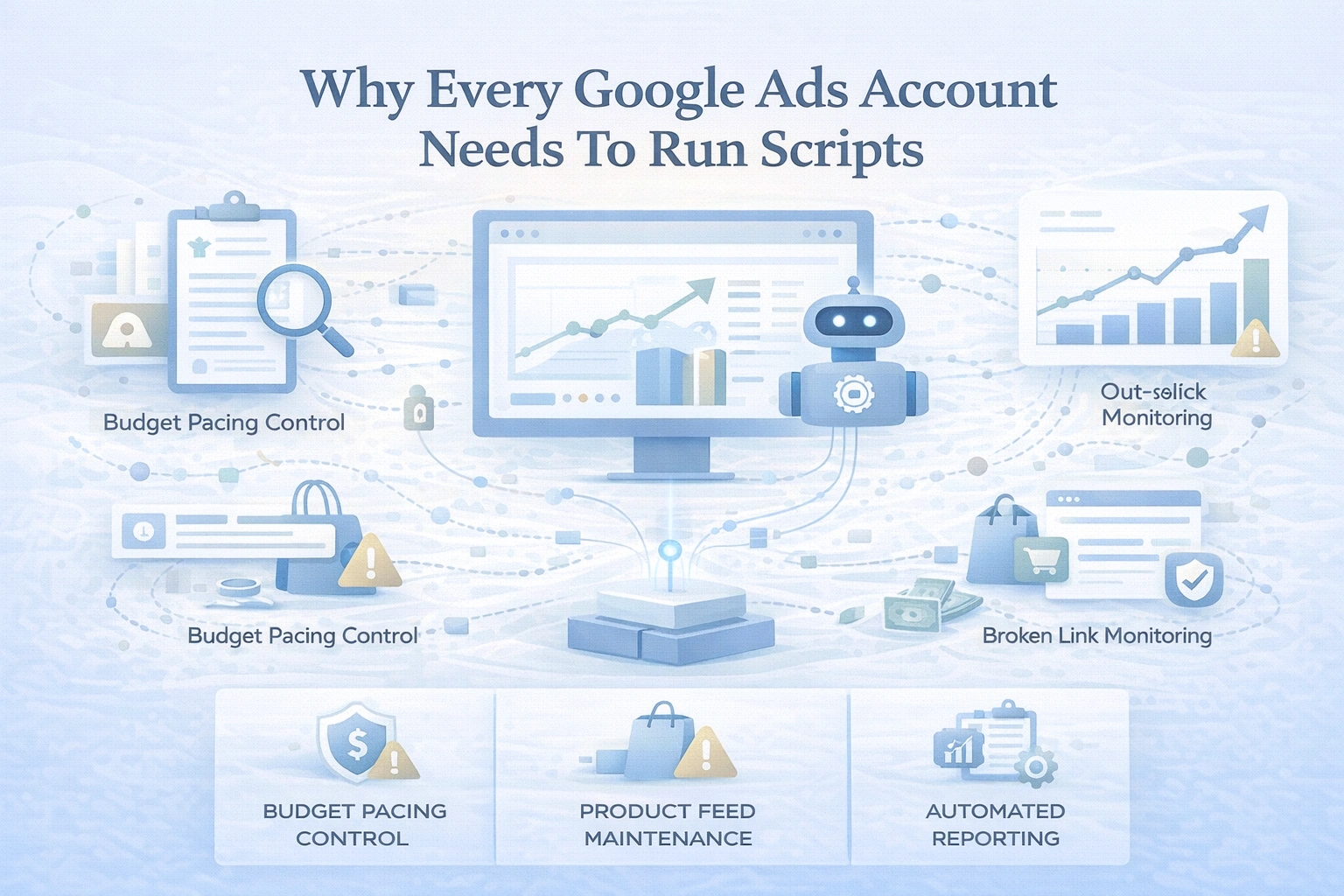
Automation, Smart Bidding, and AI-powered features get most of the attention in Google Ads. But none of them protect an account from the issues that actually cause financial damage: human mistakes, broken tracking, overspending, bad placements, or silent performance failures. That protection comes from scripts. Google Ads scripts work quietly in the background. They don’t replace strategy or automation. They guard it. They monitor what Google doesn’t warn you about, enforce discipline where platforms stay flexible, and surface problems before they become expensive. If you manage paid search without scripts, you’re relying on hope instead of safeguards. Scripts Handle The Work Humans Shouldn’t Be Doing Many PPC tasks are necessary but add no strategic value. Scripts exist to remove this burden. Budget Pacing Control Google treats daily budgets as suggestions, not limits. One day underspends. Another day overspends aggressively. A pacing script: Instead of reacting after the damage is done, you get early warnings and control. Product Feed Maintenance Ecommerce performance collapses when feeds break, often without notice. Scripts can: This keeps Shopping and Performance Max campaigns clean, eligible, and aligned with demand. Automated Reporting Manual reporting does not scale. Scripts can: Reporting becomes consistent, fast, and hands-off. Scripts Actively Improve Performance Scripts don’t just save time. They reduce waste and improve efficiency. Search Term & N-Gram Analysis Instead of reviewing thousands of queries manually, scripts can: Waste patterns like “free,” “DIY,” or irrelevant modifiers surface instantly. SKU-Level Control In Shopping & PMax No one audits thousands of products manually. Scripts can: This is especially critical in Performance Max, where spend distribution is opaque. Display Placement Protection Display campaigns attract fraud, MFA sites, and low-quality inventory. Scripts can: This protects both budget and brand safety. Scripts Prevent Costly Failures Before They Escalate The most dangerous problems are the ones no one notices. Broken Link Monitoring If a final URL breaks, performance collapses instantly. Scripts can: You stop paying for broken experiences. Out-Of-Stock Protection Running ads to unavailable products wastes spend and frustrates users. Scripts can: This is essential for Search campaigns that aren’t feed-driven. Conversion Tracking Watchdogs When tracking breaks, Smart Bidding breaks with it. Scripts can: You find problems before algorithms optimize against bad data. Scripts Catch Issues Google Doesn’t Warn You About Account Down Alerts Accounts stop serving ads for many reasons: Google notifications are inconsistent. Scripts alert you immediately when ads stop running. Change History Monitoring Some of the most damaging changes happen silently. Scripts can: This protects accounts from both people and tools. There’s No Downside To Using Scripts Scripts are: With Google documentation, open-source libraries, and modern LLMs, scripting is no longer a developer-only skill. Final Takeaway: Scripts Are PPC Infrastructure, Not Extras Running Google Ads without scripts is like running a business without monitoring systems. You might survive—but you’re exposed. Scripts: Automation optimizes.Smart Bidding reacts.Scripts protect. If you care about results, reliability, and long-term account health, scripts aren’t optional anymore. They’re foundational. Stop guessing. Start guarding.
2026 Forecast: 5 Expert Marketing Strategies You Must Refine by Q2
A practical marketing outlook for teams that want clarity, efficiency, and measurable growth in 2026 Why 2026 Requires a Strategy Reset The marketing strategies that delivered results last year are no longer enough to carry brands through 2026. Search behavior has changed.AI has reshaped discovery.Customers are interacting with brands across more channels than ever—often without clicking a website. In this environment, guesswork is expensive. Marketing leaders in 2026 are being pushed to refine, simplify, and align their strategies with how people actually discover, evaluate, and convert today. This forecast breaks down the five most important marketing strategies you need to refine by Q2 if you want to stay competitive and drive real business outcomes. 1. Refine Budget Allocation Around Real Performance, Not Habit One of the biggest mistakes teams make is sticking to last year’s budget logic. In 2026, smart marketers are reallocating budgets based on: What’s Changing What To Do by Q2 Winning teams don’t just spend more—they spend smarter. 2. Use Your Audience’s Real Language (Not Marketing Assumptions) AI, voice search, calls, chat, and text interactions are revealing something powerful:customers don’t talk like marketers. High-performing campaigns in 2026 are built on: Why This Matters When ads, landing pages, and content mirror how customers speak: What To Do by Q2 This is how you move from clever copy to conversion-driven messaging. 3. Build Campaigns Around How Customers Actually Engage Customers in 2026 don’t move in straight lines. They: If your campaigns only optimize for clicks, you’re missing most of the journey. Modern Engagement Signals Include What To Do by Q2 Campaigns win when they meet customers where they are, not where marketers wish they were. 4. Simplify Your Measurement Framework More tools don’t mean better insight. In 2026, high-performing teams are simplifying metrics to focus on what actually moves revenue. Shift Away From Focus On What To Do by Q2 If leadership can’t understand your metrics, they won’t trust your strategy. 5. Build Operational Confidence, Not Constant Experimentation Testing matters—but endless testing without structure creates noise. The strongest marketing teams in 2026 are building operational confidence: Why This Wins What To Do by Q2 Marketing maturity in 2026 is about precision, not volume. What This Means for Marketing Leaders Marketing success in 2026 isn’t about chasing every new platform or feature. It’s about: Teams that refine these five areas by Q2 will: Final Takeaway 2026 is not the year for reactive marketing. It’s the year of refinement. The brands that win will not be louder—they’ll be clearer, more aligned, and more confident in how they operate. If your marketing strategy still relies on assumptions, outdated channel splits, or surface-level metrics, Q2 is your moment to reset.

Why User Data Is Critical to Google Search: Insights from the DOJ vs Google Trial
Insights from the DOJ vs Google Trial The ongoing DOJ vs Google antitrust trial has revealed rare and valuable insights into how Google Search actually works behind the scenes. A recent filing by Google executive Liz Reid sheds light on why Google considers user data, page quality signals, and freshness indicators as some of its most closely guarded proprietary assets. For SEOs, marketers, and digital strategists, this document confirms what many have long suspected: user satisfaction data is central to Google’s ranking systems. Key Takeaways from the DOJ Filing Google has been ordered to share certain data with competitors to reduce monopolistic advantages. Google strongly resists sharing user-side data, citing risks to search quality and spam prevention. Page quality, freshness, and spam annotations are core proprietary ranking signals. User interaction data directly trains Google’s machine learning ranking models. Google’s Proprietary Page Quality & Freshness Signals According to the filing, freshness signals are not just minor ranking factors—they are foundational to how Google determines relevance. These signals help Google decide which content should surface first, especially for time-sensitive queries. This explains why consistent content updates, relevance to current intent, and ongoing engagement matter far more than static SEO tactics. Every Indexed Page Is Heavily Annotated Every page that Google crawls and indexes is marked up with what Google calls “proprietary page understanding annotations.” These annotations include: Spam identification signals Duplicate content markers Page quality classifications In simple terms, Google assigns every page a deep internal profile that influences how (or if) it appears in search results. Why Google Won’t Share Spam Scores One of Google’s strongest objections in the trial is around sharing spam-related data. If competitors—or bad actors—gained access to these signals, it would become easier to reverse-engineer Google’s ranking systems. This would result in more sophisticated spam, ultimately degrading search quality for users. Only a Fraction of the Web Makes It into Google’s Index Another major revelation: only a small percentage of crawled pages ever make it into Google’s primary index. Google argues that sharing indexed URLs would allow competitors to skip the expensive process of crawling and analyzing the entire web and instead focus only on “approved” pages—something Google has spent years and billions building. User Data: The Real Engine Behind Google Search The most critical insight from the filing is the role of user data. Google uses extensive user interaction data to power internal systems like GLUE, which stores information about: Search queries Language, location, and device type What appears on the SERP What users click, hover over, or ignore How long users stay on results or return to search RankEmbed BERT: Learning from Real Users One of Google’s most important deep learning systems, RankEmbed BERT, is trained directly on user behavior. This system helps re-rank results generated by traditional ranking algorithms by learning: Which results users actually choose Whether users return to the SERP Which results lead to long-term satisfaction Google also runs live experiments and combines user interaction data with feedback from quality raters to continuously refine search results. The Big SEO Takeaway: Optimize for Satisfaction, Not Tricks The DOJ filing reinforces one fundamental truth: user satisfaction is the most important ranking signal. Clicks, engagement, dwell time, and task completion all feed Google’s learning systems. SEO today is no longer about manipulating signals—it’s about delivering genuinely helpful, satisfying experiences. Could Chrome Data Be Involved? While not fully disclosed, the trial hints that Chrome browser data may also play a role in understanding real-world user engagement—such as form submissions, content interaction, and task completion. If true, this further emphasizes the importance of real UX, not just SERP performance. Final Thoughts The Liz Reid declaration makes one thing clear: Google’s dominance in Search is powered by massive volumes of real user data combined with advanced machine learning systems. For brands and marketers, the path forward is obvious—build content and experiences that users genuinely find useful. That’s what Google is optimizing for, and that’s where sustainable SEO lives.
How To Get The Perfect Budget Mix For SEO And PPC in 2026
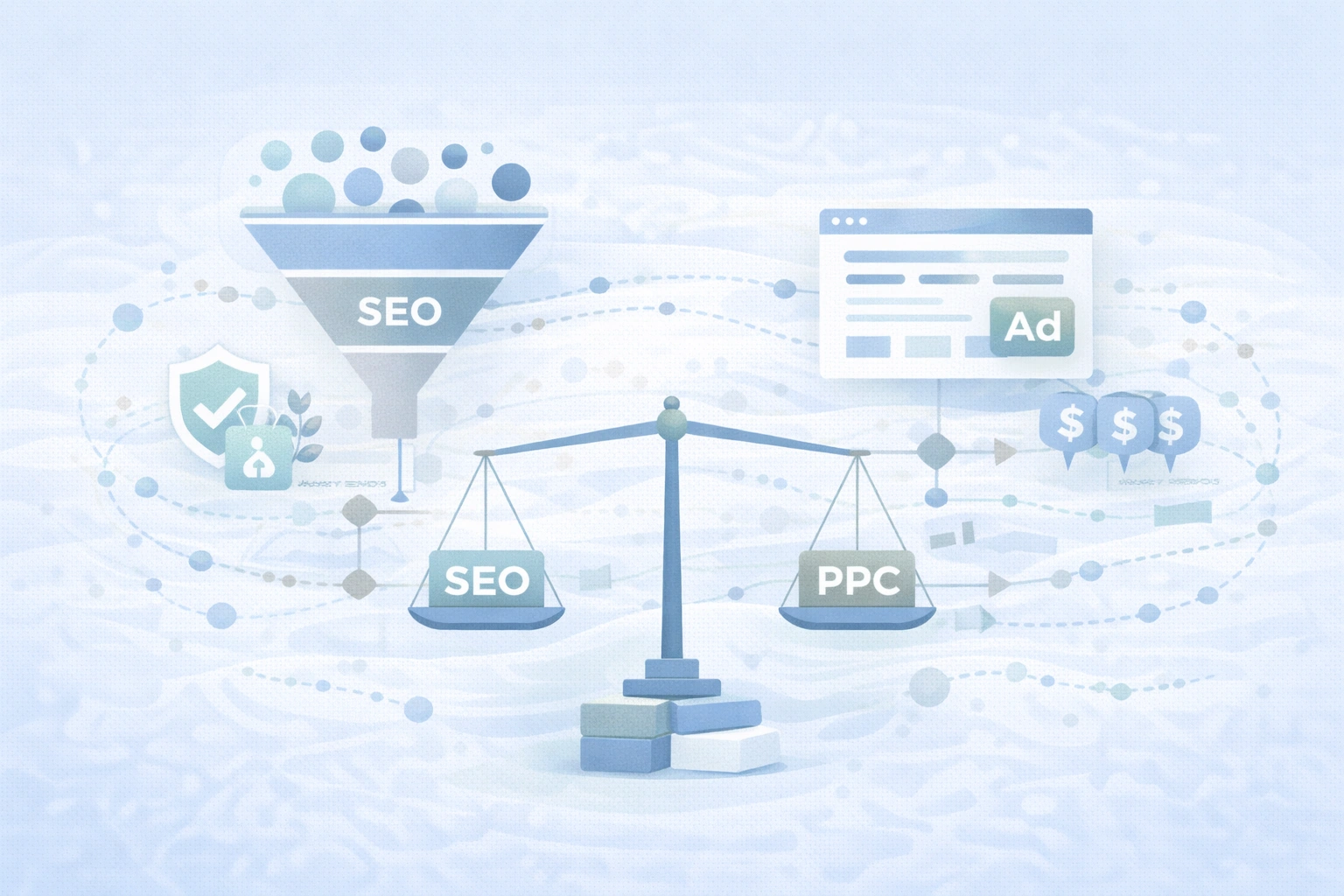
A clear, realistic guide for marketing leaders Why This Decision Feels Harder Than It Should Deciding how to split your budget between SEO and PPC looks simple at first. In reality, it’s one of the most stressful choices marketing leaders face in 2026. SEO and PPC don’t compete—but they behave very differently. When teams don’t fully understand those differences, budgets get misallocated, expectations break, and results disappoint. The goal of this guide is simple:Help you build a budget mix that works together, not against itself. What You’re Actually Paying For (SEO vs PPC) Before deciding how to split budget, you need to understand what you’re buying. What PPC Really Buys You When you invest in PPC, you’re paying for immediate visibility. You get: The math is predictable.If your average CPC is $3 and you spend $10,000, you’ll get roughly 3,300 clicks. That predictability is why PPC is often favored for: But there’s a tradeoff:👉 The moment you stop paying, traffic stops. What SEO Actually Buys You SEO is not about buying clicks. It’s about building assets. Your spend goes toward: Once SEO gains traction, traffic keeps coming without paying per click. The upside: The downside: Think of it this way: How Urgency And Goals Shape Your Budget Mix Your budget split should reflect how fast you need results. When PPC Deserves More Budget PPC should dominate when: In these cases, speed matters more than efficiency. Many brands start with: This gives immediate traction while SEO quietly builds underneath. When SEO Should Take A Bigger Share SEO deserves more investment when: SEO doesn’t just support demand—it creates it. Brands with strong foundations can gradually rebalance toward SEO without sacrificing performance. Why Organic Traffic Is Harder To Defend in 2026 SEO has changed—and budgets must reflect that. The Impact of AI-Powered Search AI-generated answers now appear directly on search results. This means: Even sites that rank well may see traffic decline. SEO today must earn visibility in: What Modern SEO Budgets Must Include In 2026, SEO budgets should cover more than content. Key investment areas: SEO is still valuable—but only when it evolves. Budget Planning Based On Realistic Outcomes Let’s look at a simple example. Example: $100,000 Annual Budget Option A: PPC-Heavy Approach Possible outcome: SEO may start showing traction after 3–6 months. Option B: More Balanced Approach Possible outcome: The key isn’t the exact ratio.It’s whether the expected output matches reality. PPC And SEO Both Need Ongoing Investment A common mistake is treating one channel as “set and forget.” PPC Requires: SEO Requires: Neither channel works well without maintenance. How To Explain The Budget Mix To Leadership Leadership usually asks two questions: Use simple analogies: Both are necessary. What helps most: Clarity reduces friction. Choosing The Right Metrics For Each Channel Not all KPIs belong to both channels. PPC KPIs SEO KPIs Show how PPC fuels demand now and SEO reduces cost later. When To Adjust The Budget Mix Your first split is not final. Rebalance when: Quarterly reviews keep strategy flexible and credible. Common Budget Mistakes To Avoid Avoid these traps: Traffic without conversion is wasted spend. Balancing Short-Term Wins With Long-Term Growth There is no universal “perfect” split. The right mix depends on: The smartest strategies blend speed and sustainability. The goal is not to choose SEO or PPC.The goal is to make them work together. Final Takeaway In 2026, the best-performing marketing budgets are not extreme. They: A good budget mix reflects where your business is today, while preparing it for where it needs to go next.

How Enterprise Search And AI Intelligence Reveal Market Pulse in 2026
From Keywords to Real-Time Market Understanding Why “Market Pulse” Looks Different in 2026 In 2026, understanding your market is no longer about checking rankings, running monthly reports, or reviewing last quarter’s keyword trends. AI has changed how people discover, evaluate, and choose brands. Today, decisions that once took days or weeks can happen inside a single AI interaction. A buyer can ask an AI assistant for recommendations, get a shortlist, see pros and cons, and form an opinion before ever visiting a website. This means the market is moving faster—and traditional search intelligence is too slow to keep up. To truly understand market pulse in 2026, organizations must shift from keyword-focused SEO metrics to AI-powered discovery intelligence that reflects how brands are being interpreted, evaluated, and recommended in real time. The Shift: From Search Engines to Decision Engines Search engines used to retrieve information.AI systems now evaluate and advise. Instead of presenting links, AI: This fundamentally changes discovery. When someone asks an AI assistant for: They are not browsing.They are delegating judgment. That makes AI the first filter—and often the strongest influence—on buying decisions. Why Traditional SEO Data Is No Longer Enough For years, marketers relied on: These metrics still matter—but they don’t tell the full story anymore. In AI-driven search: Why?Because AI is pre-qualifying users before they arrive. This creates a blind spot. Brands may be losing visibility, trust, or recommendation strength without seeing it in traditional analytics. Understanding the New Market Reality Market behavior in 2026 is shaped by forces beyond keywords. To understand true market pulse, businesses must look at the broader environment: Key Market Forces Shaping AI Discovery These forces influence not just what people search for—but how AI interprets and presents brands. The MAP Framework: How AI Evaluates Brands To track market pulse accurately, enterprise teams need a new lens. One effective way to think about AI visibility is through three dimensions: 1. Mention: Where and How You Appear Being “ranked” is no longer the goal. Being mentioned is. Key questions: Mentions across AI systems are now a primary signal of visibility. 2. Authority: How AI Perceives Your Brand AI systems form opinions. They assess brands based on: Different industries are judged differently: AI doesn’t just surface content—it evaluates credibility. 3. Performance: The New Metrics That Matter Classic KPIs still exist, but AI-driven discovery requires new performance indicators: Key AI-era metrics include: In 2026, monthly reporting is often too slow.AI responses can shift daily—or even hourly. AI as the Voice of the Customer AI now reflects customer intent at scale. It: In many ways, AI has become the collective voice of the market. Monitoring how AI talks about your brand reveals: A single AI-generated recommendation can impact revenue immediately. Why Real-Time Intelligence Is Critical Market pulse is no longer static. Successful organizations monitor: This is especially critical for: Waiting weeks to react means missing opportunities—or losing ground. Moving Beyond Keywords to Entity-Based SEO AI systems prioritize entities, not just pages. This means brands must: Brands recognized as trusted entities are significantly more likely to be cited and recommended by AI systems. One Strategy Is Not Enough: 360-Degree AI Presence Market pulse in 2026 comes from multiple sources, not one engine. Organizations must monitor and optimize across: Each platform interprets content differently.Each contributes to overall perception. Mobile vs Desktop: Two Different AI Experiences AI behavior differs by device. Mobile AI Discovery Desktop AI Discovery Optimizing for one without the other means missing half the market. What This Means for Enterprises in 2026 Understanding market pulse today means understanding how AI thinks about your brand. Winning organizations: AI is not replacing customers—but it is often speaking for them. Final Takeaway The shift from traditional search to AI-powered discovery is not coming—it’s already here. Market pulse in 2026 is revealed through: Brands that understand this shift—and invest in AI intelligence, real-time monitoring, and authority-driven strategies—will be the ones AI chooses when it matters most. In an era where AI often makes the first impression, understanding market pulse means understanding AI.