
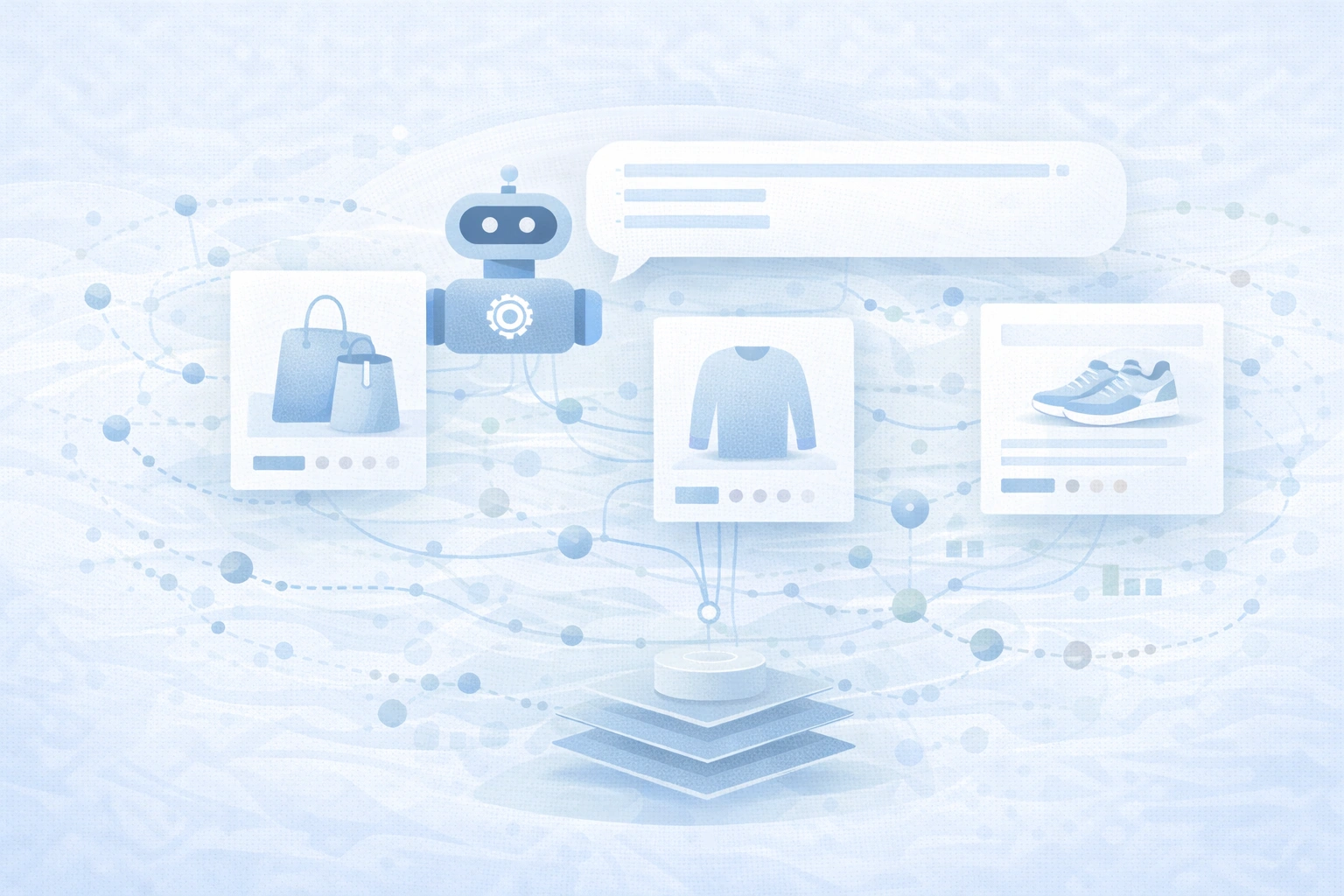
From Search Pages to Shopping Conversations Digital commerce has entered a new phase. With ChatGPT introducing native shopping capabilities—and partnering with Walmart—shopping no longer needs search results, product grids, or even traditional marketplaces. For the first time, consumers can: All inside a single AI-driven conversation. This shift is not just another feature update. It represents a structural change in how discovery, trust, and transactions work online. To understand the implications, we look at insights shared by Tim Vanderhook, CEO of Viant Technology, and what this means for brands, marketers, and digital commerce as we move deeper into 2026. A New Kind of Marketplace Is Emerging Traditional ecommerce depends on platforms acting as gatekeepers. Google controls discovery through rankings. Amazon controls visibility through marketplace placement. In both cases, brands compete for attention inside systems they don’t own. AI-native commerce changes that. In an AI-powered marketplace: Instead of typing “best running shoes,” a shopper might say: “I need comfortable running shoes for daily jogging, under $120, for someone with flat feet.” The AI doesn’t show ten blue links. It reasons, compares, and recommends. This collapses the traditional funnel:Search → Click → Browse → Compare → Checkout intoConversation → Recommendation → Decision Why This Breaks the Gatekeeper Model Marketplaces like Amazon and search engines like Google have long benefited from controlling: AI-native shopping shifts control away from the platform interface and toward the quality of the recommendation itself. That doesn’t mean incumbents disappear. Large players still offer: But their role changes. Instead of owning the funnel, they become participants inside a broader AI-driven ecosystem. The power moves from: “Who owns the shelf?”to“Who delivers the best outcome for the user?” What This Means for Brands and Marketers This shift forces a rethink of nearly every digital marketing discipline. SEO Is No Longer About Rankings Alone In an AI-native environment, visibility depends on: Optimizing only for keywords is no longer enough. Brands must optimize for context, intent, and clarity. Paid Media Becomes Less About Interruption Traditional paid media captures existing demand. AI-native commerce rewards brands that create demand before the user ever asks a question. This elevates: Brands that people already know and trust are far more likely to be recommended by AI systems. Brand Becomes a Visibility Strategy In conversational AI, one of the strongest signals is: “Which brand does the user already recognize?” This shifts investment away from pure demand capture and toward demand creation. Being remembered matters as much as being relevant. Smaller Retailers Get a Real Opportunity Historically, smaller brands struggled to compete with: AI-native commerce changes that equation. When discovery is based on relevance and fit—not ad spend—smaller retailers can: In a conversational model, merit matters more than margin. Attribution in an AI-Native World One of the biggest challenges ahead is measurement. When search and purchase happen in the same moment: Marketers must move toward: The question shifts from: “Which click converted?”to“What actually caused the decision?” Trust, Transparency, and Brand Safety Matter More Than Ever If AI systems recommend products directly, trust becomes non-negotiable. Consumers will expect: For brands, this means: AI will not blindly recommend. It will favor brands that are reliable, verifiable, and accountable. What Marketers Should Do Now AI-native shopping is not a distant future. It’s already here. To prepare, brands should: The brands that win won’t be those chasing algorithms. They’ll be the ones that make themselves easy to understand, easy to trust, and easy to recommend—for both humans and machines. Final Thought AI-native commerce doesn’t add another channel.It changes the interface of buying itself. As conversational AI becomes the place where decisions happen, digital commerce will reward brands that think beyond rankings, beyond marketplaces, and beyond clicks.The future belongs to brands that are not just visible—but intelligible and indispensable in an AI-driven world.
Google SERPs In 2026: Changes, Features & How To Boost Your Organic Traffic
A Practical Guide to Winning Visibility as Search Becomes AI-First Google Search Is No Longer a List of Links In 2026, Google’s search results pages (SERPs) look very different from what most SEO playbooks were built for. AI Overviews appear on more queries.AI Mode attempts to own the entire search experience.Traditional blue links are pushed further down the page. Users don’t always scroll. They read, ask follow-up questions, and often leave without clicking at all. Organic traffic is still possible—but it now flows through specific SERP features, not just rankings. This guide explains: No hype. No events. Just what matters. The Big SERP Changes Shaping 2026 1. AI Overviews Are Expanding (Fast) AI Overviews are no longer limited to informational queries. In 2026, they increasingly appear for: Instead of sending users to multiple sites, Google summarizes answers directly in the SERP. Impact: Ranking #1 does not guarantee traffic anymore.Visibility now depends on whether your content is used inside the AI Overview. 2. AI Mode Is Reshaping the Search Experience AI Mode represents Google’s push toward a more conversational, assistant-style search interface. In AI Mode: This doesn’t replace classic search yet—but it signals where Google is heading. Impact: SEO is shifting from “ranking for keywords” to being a trusted source AI can reference confidently. 3. SERP Layouts Are in Constant Experimentation Google continues testing: This means: Which SERP Features Still Drive Organic Traffic in 2026? Not all SERP features are equal. Some still generate meaningful clicks. 1. Featured Snippets (When Structured Correctly) Featured snippets still work—but only when content is concise and definitive. Best formats: If your snippet answers the question cleanly, users still click for depth. 2. People Also Ask (PAA) PAA boxes remain one of the most underutilized organic traffic sources. Why they matter: Optimizing for PAA helps your content: 3. Visual SERP Features (Images & Video) Google increasingly favors visual answers. High-performing visual placements include: Pages with proper image and video schema are more likely to surface in AI-enhanced results. 4. Local Packs & Entity Panels For local and brand searches, entity-driven results dominate. These include: If your entity data is weak or inconsistent, you lose visibility even if your website ranks. Which SERP Features Rarely Drive Clicks Anymore? Understanding what doesn’t work is just as important. Low-click features in 2026 include: In these cases, SEO value shifts from traffic to brand exposure and authority building. How to Adapt Your SEO Strategy for 2026 SERPs 1. Re-Evaluate Which Keywords Are Worth Targeting Not every keyword deserves effort anymore. Prioritize keywords that: Avoid chasing keywords fully satisfied by one-sentence AI answers. 2. Optimize for AI Inclusion, Not Just Rankings To be used by AI systems, content must be: Best practices: 3. Strengthen Topical Authority, Not Just Pages AI systems evaluate topic coverage, not isolated URLs. Build clusters: This increases the chance your brand is treated as a reliable source, not just a result. 4. Invest in Structured Data Aggressively Structured data is no longer optional. Critical schema types include: Schema helps Google and AI systems: 5. Measure Visibility Differently Traffic alone is no longer the only success metric. New indicators to track: SEO success in 2026 is about influence, not just clicks. What This Means for Organic Traffic Moving Forward Organic traffic is not disappearing—but it is becoming selective. Winners in 2026 will: SEO is no longer about fighting Google’s layout changes.It’s about working with how users actually consume search results now. Final Takeaway Google SERPs in 2026 are dynamic, AI-driven, and unforgiving to outdated strategies. If your SEO approach still assumes: You will struggle. If instead you: You can still grow organic visibility—even as search evolves.

Local AEO Best Practices for Small Businesses in 2026
How to Get Recommended by AI Assistants (Before Your Competitors Do) Local Discovery Has Changed Forever In 2026, customers don’t always search.They ask. Instead of scrolling through Google results, people now say things like: AI assistants don’t show a list.They recommend one or two businesses. If your business isn’t selected, you don’t appear second or third.You simply don’t exist in that moment. This is why Local AEO (Answer Engine Optimization) has become critical for small businesses. What Is Local AEO (In Simple Terms)? Local AEO is the process of making your business easy for AI assistants to understand, trust, and recommend when someone asks for a local service. Traditional local SEO focused on: Local AEO focuses on: AI assistants choose businesses based on clarity, consistency, trust, and relevance, not just keywords. Why Most Small Businesses Are Invisible to AI AI assistants don’t guess.If information is missing or confusing, they skip your business entirely. The most common problems: To AI systems, uncertainty equals risk.And risk means no recommendation. How AI Assistants Decide Which Local Business to Recommend When an AI assistant receives a local query, it evaluates multiple signals at once: 1. Accuracy & Consistency AI checks whether your: …are identical everywhere. If your Google profile says one thing and your website says another, trust drops. 2. Service Clarity AI prefers businesses that clearly explain: Vague descriptions like “We offer quality services” don’t work. Clear descriptions like “Emergency residential plumbing services within 15 miles of Austin” do. 3. Trust Signals AI looks for: It’s not about being perfect.It’s about being credible. 4. Structured, Machine-Readable Data AI assistants rely heavily on structured data to avoid misinterpretation. This includes: If AI can’t parse your information easily, it won’t use it. Local AEO Best Practices for 2026 1. Fix Your Business Data First (Non-Negotiable) Before anything else, ensure: This consistency is the foundation of AI trust. 2. Rewrite Your Service Descriptions for Humans and AI Your services should answer these questions clearly: Avoid marketing fluff.Use plain, specific language. Example: “24/7 emergency electrical repairs for residential homes in North Dallas.” 3. Add Structured Data to Your Website Structured data acts like a translation layer between your business and AI systems. Key schema types for local businesses: This helps AI confidently extract: 4. Create Local, Answer-Focused Content AI assistants often pull from content that: Examples: Each answer should stand alone and make sense without extra context. 5. Improve Review Quality (Not Just Quantity) AI understands language, not just numbers. Encourage reviews that mention: Example: “They fixed our leaking pipe the same day and explained everything clearly.” These details help AI associate your business with real solutions. 6. Make Your Website Easy to Crawl and Understand AI systems still rely on crawlable content. Make sure: If AI can’t read it reliably, it won’t recommend it. Measuring Local AEO Success in 2026 Clicks aren’t the only metric anymore. New indicators of success include: Local AEO is about being chosen, not just seen. The Future of Local Discovery Local search is becoming: AI assistants won’t list ten options forever.They will narrow choices aggressively. Small businesses that win in 2026 will be those that: Final Takeaway In 2026, local visibility isn’t about ranking #1.It’s about being clear enough for AI to say your name out loud. If your business information is: AI assistants will recommend you. If not, they’ll skip you—silently.Local AEO isn’t optional anymore.It’s how small businesses stay discoverable in an AI-first world.
The State of AEO & GEO in 2026
Forecasts, Investments, and Practical Strategies for AI-First Search Search Has Moved Beyond Rankings Search in 2026 no longer revolves around ten blue links. AI Overviews, conversational agents, and answer engines now sit between users and traditional search results. Platforms like AI-powered search assistants and discovery engines don’t just rank pages—they summarize, select, and recommend answers. This shift has given rise to two critical disciplines: Together, AEO and GEO define how brands are discovered when users don’t click—but still decide. In 2026, the question is no longer “How do we rank?” It’s “How do we become the answer?” Why AEO & GEO Matter More Than Traditional SEO AI-driven search systems change three fundamental mechanics: This means traffic alone is no longer the primary KPI.Influence, citation, and recommendation are. Where Enterprise Teams Are Investing in 2026 1. Structured Data & Semantic Infrastructure Enterprise SEO teams are heavily investing in: Why?Because AI systems rely on structured signals to reduce ambiguity. If your data isn’t clean, AI engines won’t trust it. 2. Content Built for Answers, Not Articles Long-form content still matters—but only when structured correctly. High-performing teams are: Every paragraph is treated as a potential answer unit. 3. Original Data & First-Hand Insight AI engines avoid repeating recycled content when possible. What they prefer: This is why enterprises are funding: Originality has become a ranking signal—even when rankings disappear. The Biggest AEO/GEO Challenges in 2026 Data Quality & Consistency AI systems are unforgiving. If your: You lose trust. Many teams are now auditing content the same way they audit databases. Crawlability in an AI-First World Even in 2026, AI engines still rely on crawlable sources. Common issues holding teams back: If AI can’t reliably extract your content, it won’t use it—no matter how good it is. Scaling Without Diluting Authority Automation helps with speed, but scale without strategy creates noise. The challenge is not publishing more content.It’s publishing coherent, aligned, entity-driven content at scale. Strategies That Actually Move the Needle 1. Build Topical Authority, Not Page Authority AI systems don’t trust isolated pages. They trust topic ecosystems. Winning brands: Think in clusters, not campaigns. 2. Design Content for AI Interpretation High-performing AEO content typically includes: This doesn’t mean “writing for robots.”It means writing clearly enough that machines don’t misinterpret you. 3. Use Schema as a Communication Layer Schema is no longer optional metadata. In 2026, it functions as: Teams are prioritizing: 4. Optimize for Mentions, Not Just Clicks Brand visibility now includes: That means: If AI can’t explain what makes you different, it won’t mention you. Measuring Success in an AEO/GEO World Traditional metrics still matter—but they’re incomplete. Leading teams track: The goal is presence where decisions are made, even if the click never happens. What the AEO/GEO Landscape Will Look Like Next Looking ahead, several trends are clear: AEO and GEO are not tactics.They are infrastructure decisions. Final Takeaway In 2026, search visibility is no longer about ranking first.It’s about being understood, trusted, and reused by AI systems. Brands that win: The future of search belongs to brands that don’t just answer questions—but become the source AI relies on to answer them.
Technical Guide to Common Magento (Adobe Commerce) SEO Issues
How to Build a Fast, Structured, and AI-Ready Ecommerce Store in 2026 Why Magento SEO Still Demands Precision Magento, officially Adobe Commerce, remains one of the most powerful ecommerce platforms available. Its flexibility, scalability, and enterprise-grade customization make it a strong choice for complex product catalogs and global brands. That power comes with a cost. Out of the box, Adobe Commerce is not SEO-optimized. Without careful technical planning, Magento sites can suffer from performance bottlenecks, crawl inefficiencies, duplicate content, and poor product entity understanding—issues that directly limit organic visibility and AI-driven discovery. In 2026, Magento SEO must go beyond traditional ranking factors. Stores must be: This guide breaks down the most common Magento SEO challenges and how to solve them with a modern, future-proof approach. 1. Platform-Level SEO Challenges in Adobe Commerce Performance Is No Longer Optional Magento sites often struggle with speed due to: Performance directly impacts: Core performance foundations should include: JavaScript should be treated as a liability, not a feature. Every extension should justify its existence. Core Web Vitals & Mobile-First Indexing Search engines now crawl and evaluate Magento sites primarily through their mobile experience. Your mobile storefront must: Use Lighthouse and PageSpeed audits continuously—not once per quarter. Crawl Efficiency & Indexation Control Magento can easily waste crawl budget through: Best practices include: Crawl efficiency is foundational to every other SEO gain. 2. Common Magento Product SEO Issues Simple vs. Configurable Products Configurable products should always act as the primary SEO entity. Best practice: This consolidates authority and prevents index bloat. Product Titles That Scale Without Losing Meaning Default Magento titles are often generic and weak. A scalable, readable format works best: [Product Type] [Key Attribute] [Brand] [Variant] Example: Men’s Navy Wool Sweater – Medium Guidelines: Header Structure & Content Hierarchy Themes frequently misuse heading tags, creating structural confusion. Correct hierarchy: Clear structure helps: 3. Structured Data & Product Entity Clarity Why Structured Data Matters More Than Ever Basic schema is no longer enough. Modern search and AI systems rely on rich product entities that include: Strong structured data: Structured data is now a competitive advantage, not a technical nicety. AI-Driven Product Understanding AI search engines don’t rank keywords—they evaluate completeness and trust. High-performing Magento product pages include: The easier it is for machines to understand your product, the more likely it is to be recommended, summarized, or compared in AI-driven search experiences. 4. URL Structure, Duplication & Rewrites Clean URLs Win Magento supports multiple URL configurations, but top-level product URLs are usually the most SEO-friendly. Why: Category-based URLs often fragment authority and introduce unnecessary complexity. URL Rewrites & Duplicate Paths Magento’s rewrite system is powerful—and dangerous. Common issues: Solutions: Consistency is critical for both SEO and AI trust. 5. Faceted Navigation & Crawl Management Filters can generate thousands of low-value URLs. Modern best practices: Important filtered views (e.g., size-specific apparel categories) should be intentionally exposed—not accidentally indexed. AI systems still need access to attributes like size, material, and price. 6. Pagination & Infinite Scroll Pagination is about clarity, not legacy tags. Best practices: Proper pagination ensures: 7. Adobe Commerce Page Builder & SEO Consistency Adobe Commerce Page Builder enables: From an SEO and AI perspective, this matters because: Even if not fully adopted yet, planning for standardized content systems improves long-term stability. 8. Preparing for Agentic Commerce AI agents will increasingly: To prepare, Magento stores must prioritize: Agent-driven commerce will rely on machine-readable trust signals—not marketing copy. Stores that prepare early will gain visibility in conversational and agent-based shopping environments. Final Takeaway Adobe Commerce can perform exceptionally well in organic search—but only when built intentionally. Success in 2026 depends on: Magento SEO is not about quick fixes.It’s about engineering clarity, speed, and trust at scale. Build those foundations correctly, and your store will remain visible—not just in search results, but in the next generation of AI-powered commerce.
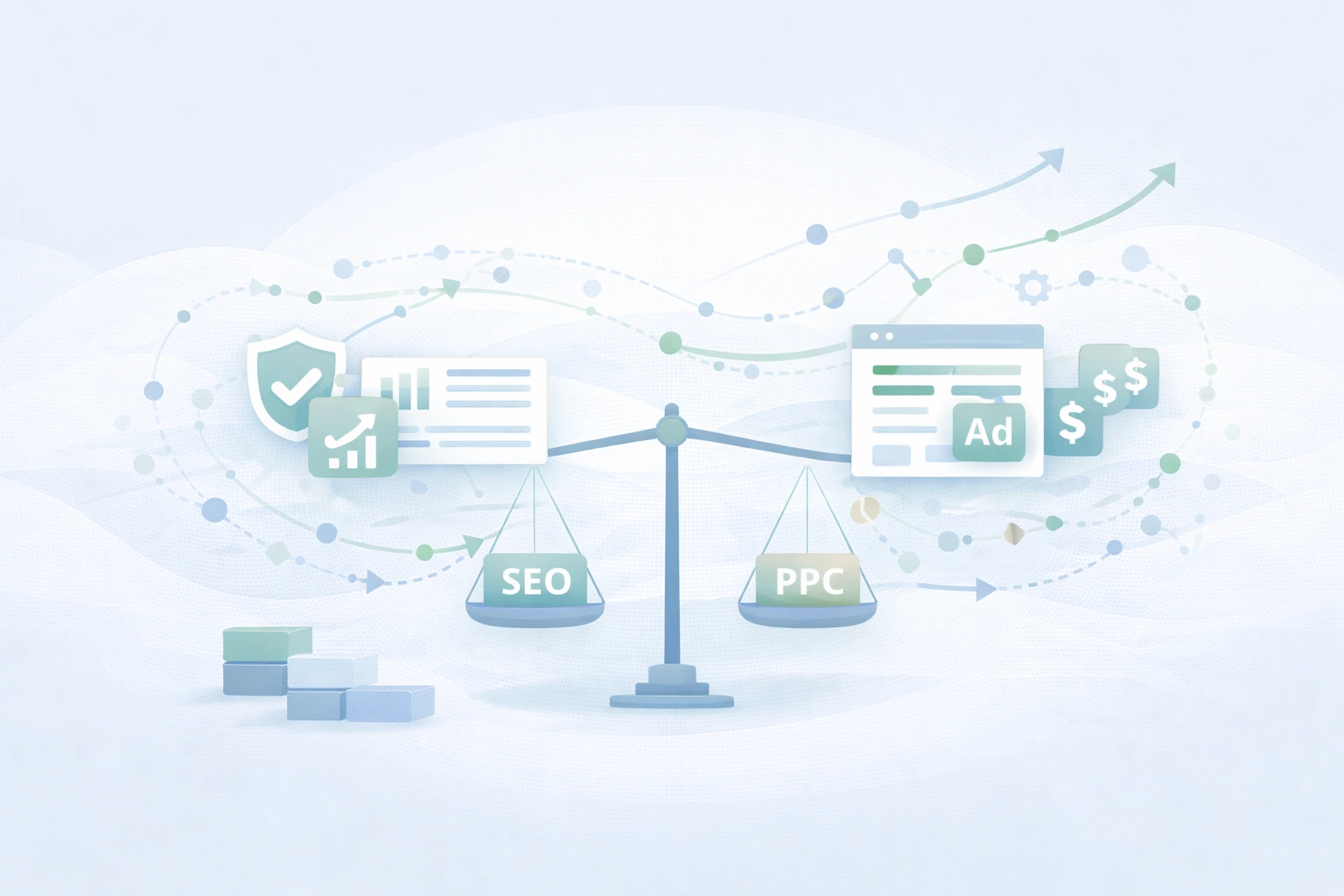
How To Get the Right SEO & PPC Budget Mix in 2026
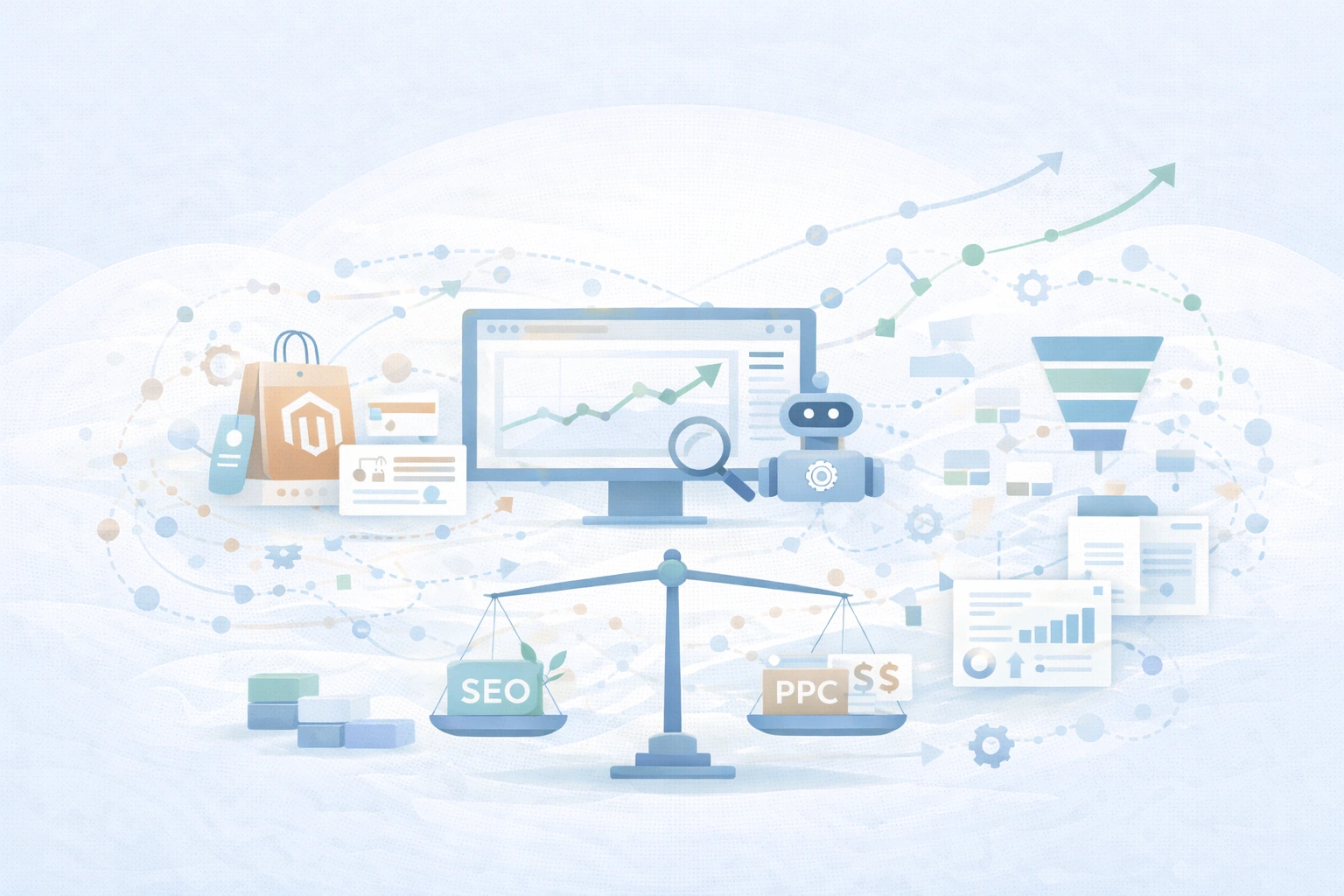
Introduction: Why SEO vs PPC Is the Wrong Question Most marketing leaders don’t struggle because they don’t know SEO or PPC. They struggle because they’re asked to: SEO and PPC are often framed as competitors for budget.In reality, they are complementary systems with different timelines, risks, and payback curves. The goal isn’t to choose one.The goal is to allocate budget based on urgency, maturity, and realistic outcomes. 1. What You’re Actually Paying For in Each Channel PPC: Buying Immediate Visibility When you invest in PPC, you’re paying for: PPC is predictable: That makes PPC attractive for: But the moment you stop spending, results stop. SEO: Building an Asset, Not Renting Traffic SEO investment goes into: You don’t pay per click — you pay to earn visibility over time. SEO’s strengths: SEO’s challenges: In short: 2. How Urgency and Business Goals Should Shape the Mix Your budget split should start with one question: How fast do we need results? When PPC Should Get More Budget In these cases, PPC often carries 60–70% of the budget initially. When SEO Deserves More Investment As SEO gains traction, many teams shift toward a 50/50 or 60/40 split favoring SEO. The key is expectation-setting:SEO is not a short-term rescue plan. 3. Why Organic Traffic Is Harder to Defend in 2026 Organic search is changing. AI-driven search features now: This doesn’t kill SEO — it changes what SEO investment must include. Modern SEO budgets should cover: If your SEO plan hasn’t adapted, organic performance will erode even if rankings look “fine.” 4. Budget Planning Based on Realistic Outputs Let’s simplify with an example. Scenario: $100,000 Annual Budget Option A: PPC-Heavy PPC may deliver: SEO may: Option B: Balanced Growth This approach: The right answer depends on: Model outcomes, not hope. 5. PPC and SEO Need Internal Budget Balance Too Not all spend inside each channel is equal. PPC Budget Should Be Split Across: Over-investing in branded search may look efficient, but it doesn’t scale demand. SEO Budget Should Cover: SEO is not a one-time project.Starving it after a sprint kills momentum. 6. What Leadership Actually Needs to Hear Executives care about: Explain SEO and PPC like this: Use scenarios: Visual models beat opinions. 7. Choosing the Right Metrics for Each Channel PPC Metrics That Matter: SEO Metrics That Matter: SEO rarely gets full credit if you only look at last-click attribution. 8. When to Adjust Your Budget Mix Your budget split is not permanent. Rebalance when: Quarterly reviews are essential. Agility builds trust with leadership. 9. Common Budget Mistakes to Avoid Traffic without conversion is waste — paid or organic. Final Takeaway: Balance Beats Extremes There is no universal “perfect” SEO vs PPC ratio. The right mix depends on: The strongest strategies in 2026: The goal isn’t to pick a winner.The goal is to fund growth intelligently — now and later.

16 Content Writing Tips to Survive (and Win) in 2026
What High-Performing Content Looks Like in the Age of AI AI has changed content creation forever.For many writers, this shift has created real anxiety: Will AI replace me? The honest answer is this: In 2026, content success isn’t about writing faster or publishing more.It’s about writing with clarity, intent, originality, and strategic value — the things AI still struggles to replicate. The writers who survive (and thrive) are the ones who adapt their skills, embrace AI correctly, and double down on what makes human content irreplaceable. Part 1: How Writers Must Adapt in the AI Era 1. Learn to Synthesize, Not Summarize AI is excellent at summarizing information.Humans must go further. High-value writers: The ability to synthesize ideas, trends, and experience is one of the strongest human advantages left — and it’s in high demand. 2. Treat AI as a Collaborator, Not a Competitor AI works best as: But humans must own the thinking. Writers who succeed use AI to: They still control: 3. Master Prompting as a Writing Skill Prompting is no longer a technical trick — it’s a creative skill. Strong prompts include: Writers who can “direct” AI clearly will outperform those who simply ask it to write. 4. Position Yourself as a Strategic Thinker In 2026, writers who only “execute” are replaceable. Writers who: become indispensable. Strategy is the layer AI cannot replicate. 5. Double Down on Voice, Nuance, and Perspective AI can imitate style, but it can’t own a point of view. What stands out now: Content that sounds human will outperform content that sounds “correct.” 6. Keep Writing for Humans First AI is not your audience. If content becomes: it loses trust and engagement. Write for real people — and make sure machines can find and understand it, not the other way around. Part 2: How to Structure Content for LLM Visibility 7. Write with Clarity That Stands Alone In 2026, content is often: Each section should: This benefits both humans and machines. 8. Use Structure as a Bridge Between Humans and AI High-performing content balances: Structure is not about rigidity — it’s about accessibility. 9. Write Less, But Make Every Word Work Harder Publishing volume is no longer a competitive advantage. Winning content in 2026: Fewer pieces with higher impact outperform mass production. 10. SEO Fundamentals Still Matter Despite the hype, the basics haven’t disappeared: AI didn’t replace good writing — it rewarded it. Part 3: What Content Still Works No Matter How AI Changes 11. Original Research and First-Hand Insight AI cannot generate: Content built on real insight will always outperform derivative summaries. 12. Authority-Driven Content Wins Long-Term Case studies, frameworks, tutorials, and deep guides continue to: Depth beats novelty. 13. Refresh Existing Content Before Creating New Old content is often undervalued. Updating: can produce faster results than starting from scratch. 14. Own Your Audience Algorithms change. Platforms shift. Email lists, communities, and direct relationships remain stable. Owning your audience is still one of the strongest long-term content strategies. Part 4: Proving the Business Value of Human Content 15. Measure Quality, Not Just Traffic Success metrics in 2026 include: Traffic alone no longer tells the full story. 16. Let Outcomes Speak for Themselves The clearest proof is comparison: When quality, compliance, and trust matter, human judgment still wins. What Will Define High-Performing Content in 2026? Same Fundamentals, Higher Standards The fundamentals didn’t change — the bar did. What stands out now: As AI floods the internet with average content, great content becomes easier to spot. Strategic Wisdom Is the New Scarcity Content is abundant.Good judgment is rare. The most valuable writers in 2026 are those who: Final Takeaway: Human Creativity Is Not Obsolete AI changed how content is created and discovered — not why it matters. LLMs surface what they can understand.Readers choose what they can trust. High-performing content in 2026 succeeds when it: The future belongs to writers who think, not just type.
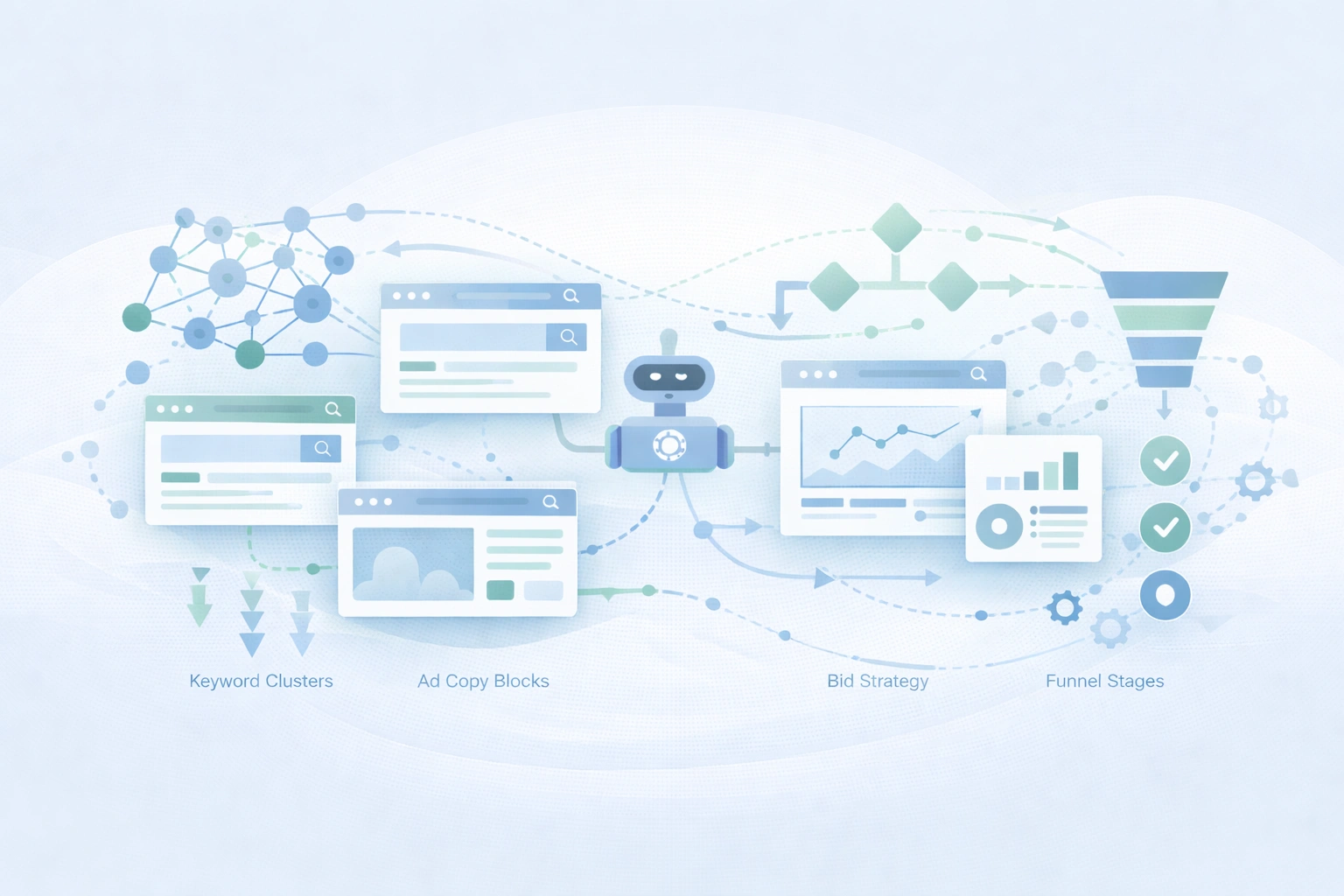
20 AI Prompt Ideas & Templates for PPC (Easy to Advanced)
A Practical Prompt Library to Speed Up Paid Media Workflows in 2026 AI is no longer a novelty in paid advertising. In 2026, it has become a day-to-day assistant for PPC professionals—helping with research, ideation, testing, and reporting. The real advantage doesn’t come from “using AI,” but from knowing how to prompt it correctly. With the right prompts, tasks like: can be completed faster—freeing you up to focus on strategy, judgment, and optimization. This guide provides 20 reusable AI prompt templates, ranging from beginner-friendly to advanced, that you can adapt to your own PPC accounts. How to Write Effective PPC Prompts Before jumping into the templates, remember that strong prompts share three qualities: 1️⃣ Clear Input 2️⃣ Context 3️⃣ Constraints Think of prompts as living documents, not one-time instructions. Section 1: Keyword Research & Planning 1. Long-Tail Keyword Expander Use when: Structuring new campaigns or expanding reachWhat it does: Expands a seed keyword into long-tail variations grouped by intent Prompt Goal: Generate 20–30 long-tail keywords grouped into informational, commercial, and transactional intent, prioritized for paid search. 2. Match Type Strategy Recommender Use when: Assigning match types intelligentlyWhat it does: Recommends exact, phrase, or broad match based on intent and budget Prompt Goal: Assign match types to keywords with reasoning and tradeoffs. 3. Negative Keyword Starter List Use when: Preventing wasted spend earlyWhat it does: Generates 15–25 negative keywords with match type guidance Prompt Goal: Identify irrelevant or low-intent searches and explain why each should be excluded. Section 2: Ad Copywriting & Testing 4. RSA Asset Generator (Google Ads) Use when: Creating new responsive search adsWhat it does: Produces multiple headlines and descriptions within character limits Prompt Goal: Generate 10 unique headlines and 4 descriptions that can mix without conflict. 5. RSA Asset Mixer Use when: You already have features and benefits definedWhat it does: Turns inputs into testable ad assets Prompt Goal: Create headline and description variations using different emotional and logical angles. 6. Ad Angle Brainstorming Tool Use when: Performance stallsWhat it does: Suggests new messaging angles Prompt Goal: Generate 6 alternative ad angles with sample headlines and use cases. Section 3: Audiences & Targeting 7. Audience Segment Hypothesis Builder Use when: Launching or expanding audience testsWhat it does: Proposes audience segments with conversion rationale Prompt Goal: Define 4–6 audience segments and suggest initial bid adjustments. 8. Keyword-to-Funnel Stage Mapper Use when: Aligning bids with buyer intentWhat it does: Classifies keywords by funnel stage Prompt Goal: Map keywords to cold, warm, or hot intent and recommend bidding priority. Section 4: Bidding & Budget Strategy 9. Bidding Strategy Selector Use when: Choosing between manual and automated biddingWhat it does: Recommends the best bidding approach based on data maturity Prompt Goal: Match campaign goals with the correct bidding strategy and caution notes. 10. Campaign Budget Allocator Use when: Managing multiple campaignsWhat it does: Splits budget based on performance and priority Prompt Goal: Allocate budget percentages with justification for each campaign. Section 5: Search Query Mining 11. Search Term Negative Identifier Use when: Reviewing search term reportsWhat it does: Flags wasteful queries Prompt Goal: Identify 5–10 terms to exclude and recommend match types. 12. High-Opportunity Query Promoter Use when: Scaling winnersWhat it does: Finds queries worth promoting to keywords Prompt Goal: Recommend queries to convert into exact or phrase match keywords. Section 6: Landing Pages & CRO 13. Ad-to-Page Relevance Checker Use when: Bounce rates are highWhat it does: Identifies message mismatch Prompt Goal: Compare ad promises to landing page content and suggest fixes. 14. Landing Page CTA Optimizer Use when: Improving conversion ratesWhat it does: Generates CTA variations Prompt Goal: Create urgency, friction-reducing, and value-based CTAs. Section 7: Reporting & Insights 15. Client-Friendly Performance Snapshot Use when: Reporting to non-technical clientsWhat it does: Turns metrics into a simple narrative Prompt Goal: Write a short summary highlighting wins, issues, and next steps. 16. Metric Change Explainer Use when: Explaining performance shiftsWhat it does: Interprets metric changes Prompt Goal: Explain why a metric changed and recommend one corrective action. Section 8: Competitive Analysis 17. Competitor Ad Messaging Scanner Use when: Entering competitive marketsWhat it does: Analyzes competitor messaging Prompt Goal: Identify themes and uncover differentiation gaps. 18. Gaps & Differentiators Finder Use when: Refining positioningWhat it does: Finds value props competitors ignore Prompt Goal: List 4–6 differentiators and explain buyer appeal. Section 9: Advanced PPC Prompts 19. Advanced Keyword Research Framework Use when: Building campaigns from scratchWhat it does: Covers discovery, match types, negatives, and structure Prompt Goal: Create a full keyword strategy with reasoning and quick wins. 20. Funnel-Based Ad Copy Generator Use when: Running multi-platform campaignsWhat it does: Generates copy by funnel stage for Google, Meta, and LinkedIn Prompt Goal: Produce ad copy aligned to awareness, consideration, and conversion stages. How to Keep Your Prompts Effective Over Time AI models evolve—and prompts that worked last quarter may degrade. Best Practices for 2026: Cleaner inputs produce cleaner outputs. Final Takeaway: Strategy Still Wins AI can: AI cannot: The best PPC teams in 2026 use AI to amplify expertise, not replace it.
December Core Update: Brands Gain Ground on “Best Of” Queries
Why Google Is Favoring Specialization Over Generalist Content Google’s December core update reinforced a trend that has been building for years: Specialized brands and category experts are increasingly outperforming broad, generalist sites. The update, which rolled out across most of December, triggered noticeable changes across: The biggest impact was seen on “best of” queries, where Google appears to be reassessing who is best positioned to answer commercial-intent searches. The Core Pattern: Depth Beats Breadth Across multiple industries, the update rewarded sites that show direct, category-specific authority, while reducing visibility for sites that cover many topics without deep specialization. This shift is most visible in queries where users are evaluating options rather than learning definitions. Examples include: In these cases, Google is increasingly favoring: Over: Publications Lose Ground on “Best Of” Content Many publication-style sites saw declines for “best of” queries that were previously treated as informational. Google now appears to interpret many of these queries as commercial in nature, prioritizing sources with direct product ownership or category authority. This means: For publishers, this marks a continued erosion of product-focused search territory. Ecommerce: Specialists Win, Generalists Slip In ecommerce, the update followed a similar logic. What Changed: This suggests Google is prioritizing: Over: For ecommerce brands, this is a positive signal. For large marketplaces, it’s a reminder that size alone is no longer a ranking advantage. SaaS Searches Favor Dedicated Platforms Software-related queries also reflected the specialization trend. Broad platforms and general business publications dropped for queries related to: Meanwhile, SaaS companies with: Saw improved visibility. Google appears to reward clear product-to-problem alignment rather than brand recognition alone. News Publishers Experienced Heavy Volatility News publishers were among the most affected during the update. Key observations: Unlike ecommerce and SaaS, where changes were directional, news volatility was more erratic, suggesting surface-level differences in how the update applied. Discover Volatility Raises Planning Risks For publishers, Discover continues to grow as a traffic source — but it is also highly sensitive to core updates. When Discover visibility drops: This creates a planning challenge for publishers that rely heavily on Discover without a clear topic focus. Topic Authority Signals Are Likely at Play Google’s emphasis on topic authority provides important context for this update. Rather than rewarding sites that cover everything reasonably well, Google increasingly favors sites that: This applies differently across: But the underlying theme remains consistent. Why “Best Of” Queries Are Changing A key insight from this update is how Google interprets intent. Many “best of” queries appear to be shifting from: Informational intenttoCommercial intent That change has major implications. If Google sees the query as commercial: What This Means for SEO Strategy in 2026 For Brands & Retailers: For SaaS Companies: For Publishers: Final Takeaway: Google Is Doubling Down on Expertise The December core update didn’t introduce a new direction — it intensified an existing one. Google is continuing to: In 2026, winning search visibility increasingly depends on how clearly your site earns the right to rank for a specific category — not how broadly it tries to compete.

Reddit Introduces Max Campaigns: A New Automated Ad Format for 2026
What It Is, How It Works, and Why Advertisers Should Pay Attention Introduction: Automation Is Evolving, Not Slowing Down By 2026, automation has become the default direction for paid advertising. Platforms like Google and Meta already rely heavily on AI-driven campaign types that combine targeting, bidding, and creative decisions into a single system. Reddit is now following that evolution with the launch of Max Campaigns, a new automated campaign type currently available in beta. What makes Reddit’s move notable is its attempt to balance automation with audience understanding, rather than focusing on performance metrics alone. What Are Reddit Max Campaigns? Max Campaigns are Reddit’s new automated advertising format designed for: Instead of advertisers manually configuring every element, Max Campaigns automate most optimization decisions while allowing advertisers to define high-level guardrails. The primary goal is to: Simplify campaign setup and management while improving efficiency. How Reddit Max Campaigns Work (Simple Breakdown) Max Campaigns automate three core areas of campaign management: 1️⃣ Audience Targeting Reddit dynamically adjusts who sees ads based on real-time engagement and community signals, rather than relying only on static audience definitions. This allows the system to respond quickly as performance data changes. 2️⃣ Creative Selection & Placements The system automatically: This reduces the need for constant manual creative optimization. 3️⃣ Budget Allocation Budgets are automatically shifted toward impressions and placements most likely to deliver performance, based on live data rather than preset rules. All automation operates within advertiser-defined limits, so brands maintain strategic control. Powered by Reddit Community Intelligence™ At the heart of Max Campaigns is Reddit Community Intelligence™. This system analyzes: These signals help Reddit predict the value of each ad impression in real time. Unlike platforms that rely heavily on inferred interests, Reddit’s advantage lies in active user conversations, providing context around what people actually care about. Built-In Creative Automation Features Max Campaigns also introduce optional tools to reduce creative production friction: These features are designed to support faster testing, not replace creative strategy. Early Performance Results from Testing During early alpha testing, Reddit reported efficiency improvements across multiple advertisers. Reported outcomes included: Some brands saw: While beta results should always be tested independently, early data suggests Max Campaigns can outperform traditional setups in certain use cases. Why Reddit’s Approach Is Different Most AI-driven campaign types prioritize outcomes while abstracting audience details. Reddit is attempting a different balance by introducing Top Audience Personas. What Are Top Audience Personas? Top Audience Personas provide insight into: Instead of relying only on predefined audience segments, Reddit uses real conversation signals to surface patterns in user behavior. These insights are meant to: They are not intended to replace targeting decisions, but to enhance understanding. Why This Matters for Advertisers in 2026 The key challenge with automation today is not performance — it’s visibility into what’s driving results. Many advertisers are comfortable with AI efficiency but uncomfortable with the lack of audience insight. Reddit is positioning Max Campaigns as: For brands that care about context, conversation, and community, this approach may be especially valuable. How Advertisers Should Approach Max Campaigns Because Max Campaigns are still in beta, the smartest approach is controlled testing. Recommended Strategy: Advertisers coming from Google Performance Max or Meta Advantage+ should expect familiar mechanics, but different signals driven by Reddit’s community-first environment. Where Max Campaigns Fit in a Paid Media Strategy Reddit performs best when: Max Campaigns can optimize delivery, but creative relevance remains critical. Automation amplifies strategy — it does not replace it. Final Takeaway: Automation Works Best When Insight Isn’t Lost Reddit Max Campaigns represent more than another automated ad format. They reflect a broader shift toward: For advertisers navigating an increasingly automated paid media landscape in 2026, the real opportunity lies in testing thoughtfully and learning how each platform’s automation behaves.Let automation handle execution.Keep strategy human.Use insight to guide creativity.