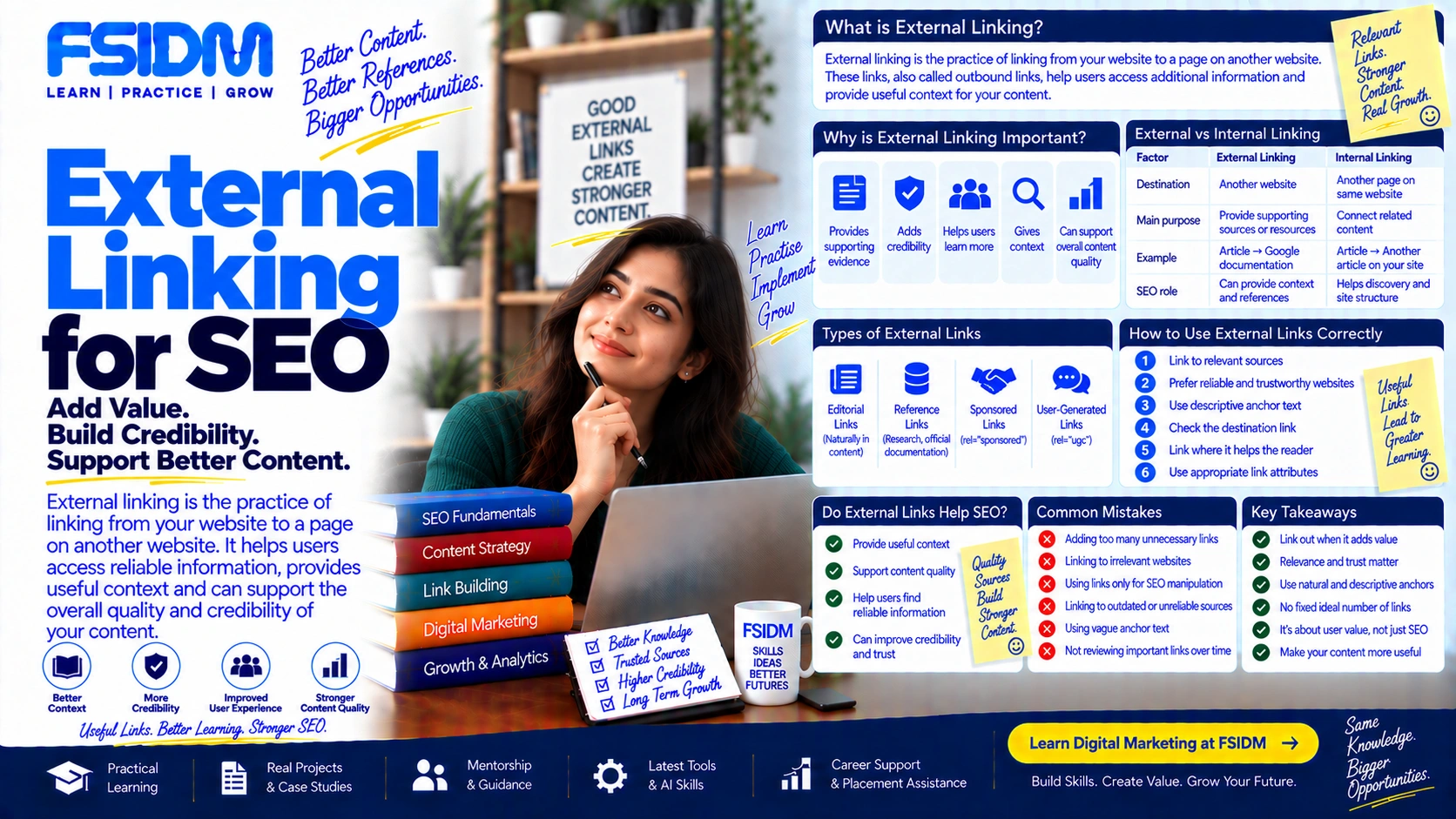
External linking is the practice of linking from your website to a page on another website. These links are also called outbound links because they take users from your website to an external domain.
For example, if an SEO article on your website links to Google’s official documentation to support a technical explanation, that is an external link.
Simple definition: External linking means adding a link from your website to a relevant page on another website.
Why Is External Linking Important in SEO?
External links can help both users and search engines understand the context of your content. A carefully chosen external source can provide supporting evidence, additional information, definitions, research, or official documentation.
External linking does not automatically improve rankings simply because you added links. The value comes from using links that are relevant, useful, trustworthy, and genuinely helpful to the reader.
Example of External Linking
Imagine you publish an article about website performance and write:
Google recommends focusing on Core Web Vitals when evaluating important aspects of page experience.If the phrase Core Web Vitals links to an appropriate page on Google’s documentation, the link is an external link because the destination is on a different domain.
External Linking vs Internal Linking
| Factor | External Linking | Internal Linking |
|---|---|---|
| Destination | Another website | Another page on the same website |
| Common purpose | Provide supporting sources or additional resources | Connect related pages and improve site navigation |
| Example | Your article → Google documentation | Your article → Another article on your website |
| SEO role | Can provide context and useful references | Helps users and search engines discover related pages |
Types of External Links
1. Editorial External Links
These are links naturally included within content because another website provides useful information that supports the topic.
2. Reference or Source Links
These point readers toward research papers, government websites, official documentation, statistics, studies, or other primary sources.
3. Sponsored Links
Links associated with paid placements, advertisements, sponsorships, or other compensated arrangements should be appropriately identified using Google’s recommended link attributes, such as rel="sponsored", where applicable.
4. User-Generated Links
Links placed by users, such as links in comments or forum contributions, can use rel="ugc" when appropriate.
Do External Links Help SEO?
External links can contribute to a useful and well-supported page, but they should not be treated as a ranking shortcut. Linking to an authoritative website does not automatically transfer its authority to your page or guarantee higher rankings.
The strongest reason to add an external link is usually user value. If a source helps the reader verify a claim or explore a subject further, the link can improve the usefulness and credibility of the content.
How to Use External Links Correctly
- Link to relevant sources: The destination should directly relate to the statement or topic.
- Prefer reliable sources: Use official documentation, primary research, reputable organizations, and established publications when appropriate.
- Use descriptive anchor text: Make it clear where the link leads instead of relying excessively on generic phrases such as “click here.”
- Check the destination: Avoid sending visitors to broken, irrelevant, misleading, or low-quality pages.
- Link where it helps the reader: Do not add external links merely to increase the number of links on a page.
- Use appropriate link attributes: Sponsored and user-generated links may require specific
relattributes depending on the relationship.
Common External Linking Mistakes
- Adding too many unnecessary outbound links.
- Linking to irrelevant websites simply because they have high authority.
- Using external links solely as an attempt to manipulate SEO signals.
- Linking to outdated or unreliable sources.
- Using unclear anchor text.
- Failing to review important external references when the linked information becomes outdated.
Does Linking to Competitors Hurt SEO?
Not necessarily. A competitor can sometimes be a useful source if their page provides relevant information that genuinely benefits the reader. The decision should be based on relevance, usefulness, and editorial judgment, rather than a blanket rule that competitors should never be linked.
Best Practices for External Linking
A good external-linking strategy is simple: link out when the link makes your content more useful. Prioritize relevant and trustworthy resources, use natural anchor text, keep the surrounding content clear, and avoid excessive or artificial linking.
For example, an SEO training article could link to official Google documentation when explaining Search Console, structured data, crawling, or search guidelines. This gives readers a direct path to a primary source instead of making the article carry every explanation itself.
Frequently Asked Questions
Is an external link the same as an outbound link?
In most SEO discussions, yes. Both terms generally describe a link from your website to a different domain.
Are external links a Google ranking factor?
You should not assume that simply adding outbound links is a direct ranking boost. Their primary value is helping users access relevant supporting information and improving the context and usefulness of your content.
How many external links should a page have?
There is no universal ideal number. Add as many as are genuinely useful for the page, rather than targeting a fixed count.
Should external links open in a new tab?
That is primarily a usability and design decision, not an SEO requirement. Choose the behavior that makes sense for your website and audience.
Interview Question
Q: What is external linking in SEO, and why is it used?
Answer: External linking is linking from one website to another website. It is mainly used to provide relevant references, supporting evidence, additional resources, and useful context for visitors.
Interview Tip
Do not say, “External links always increase rankings.” A stronger answer is that relevant, trustworthy outbound links can improve the usefulness and context of content, while the SEO value depends on how and why the links are used.
Learn Practical SEO with FSIDM
SEO is not just about adding keywords or building backlinks. Understanding internal linking, external linking, search intent, technical SEO, content quality, and modern search experiences helps you build a stronger SEO strategy.
At FSIDM, digital marketing and SEO are taught with a practical, industry-focused approach designed to help learners understand how SEO works beyond theory.