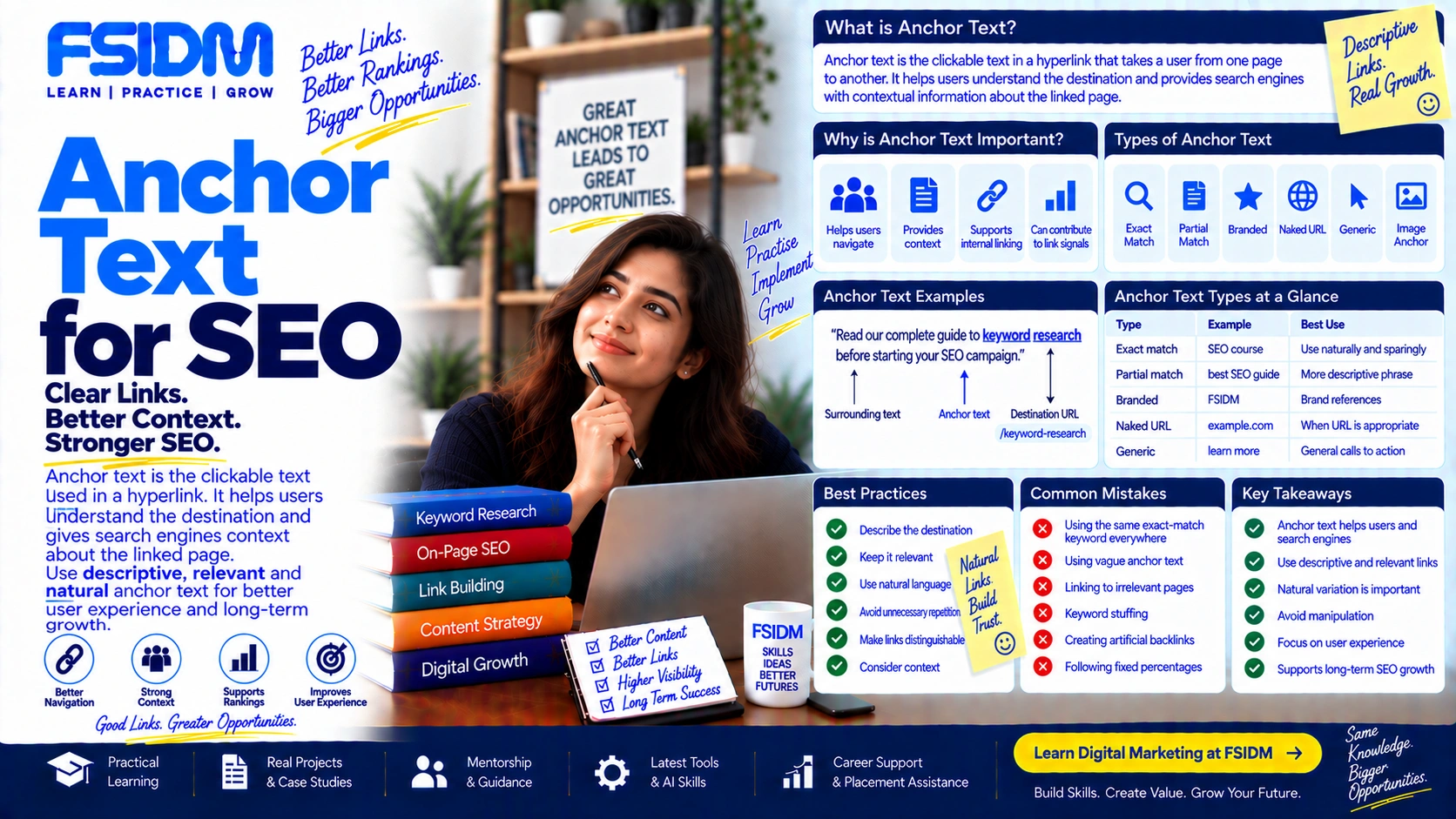
Anchor text is the clickable text used in a hyperlink that takes a user from one webpage to another. It helps users understand what they can expect when they click the link and can also provide search engines with contextual information about the linked page.
For example, in the sentence “Learn more about our SEO course,” the words SEO course can be the anchor text if they contain the hyperlink.
Anchor text can be used for both internal links within the same website and backlinks coming from external websites.
Why Is Anchor Text Important in SEO?
Anchor text gives context about the destination of a link. A descriptive anchor can help users understand where the link will take them before they click.
For search engines, anchor text can provide additional context about the relationship between the linking page and the linked page. However, anchor text is only one part of how search engines understand webpages and links.
1. Helps Users Navigate
Clear anchor text tells users what they are likely to find after clicking a link.
2. Provides Context
Descriptive wording can help establish the subject or purpose of the linked page.
3. Supports Internal Linking
Using meaningful anchor text in internal links can help users and search engines understand relationships between different pages on a website.
4. Can Contribute to Link Signals
For external links, anchor text can provide contextual information about the linked resource. However, artificially manipulating anchor text to influence rankings is not a sound SEO strategy.
Example of Anchor Text
Consider this sentence:
“Read our complete guide to keyword research before starting your SEO campaign.”
Here, keyword research is the anchor text, while /keyword-research is the destination URL.
A good anchor makes the destination understandable without requiring the user to guess where the link leads.
Types of Anchor Text
1. Exact-Match Anchor Text
The anchor text exactly matches the primary keyword or phrase associated with the destination page.
Example: “keyword research” linking to a page about keyword research.
2. Partial-Match Anchor Text
The anchor contains the target topic or keyword along with additional words.
Example: “complete keyword research guide.”
3. Branded Anchor Text
The anchor uses a brand or company name.
Example: “FSIDM” or “Full Stack Institute of Digital Marketing.”
4. Naked URL
The URL itself is used as the clickable text.
Example: “https://example.com”
5. Generic Anchor Text
The anchor uses generic phrases such as “click here,” “read more” or “learn more.”
Generic anchors can work in context, although descriptive wording is often more informative for users.
6. Image Anchor Text
When an image is used as a link, the image’s alt text can provide descriptive information about the linked image. This is different from ordinary text anchor text.
Anchor Text Types at a Glance
| Type | Example | Best Use |
|---|---|---|
| Exact match | SEO course | Use naturally and sparingly where it genuinely describes the destination |
| Partial match | best SEO course guide | Useful when a more descriptive phrase fits naturally |
| Branded | FSIDM | Brand references and navigation |
| Naked URL | example.com | When displaying the URL itself is appropriate |
| Generic | learn more | General calls to action where context provides meaning |
What Is a Natural Anchor Text Profile?
A website’s links can naturally contain different types of anchor text. Some may use brand names, some descriptive phrases, some URLs and others more specific wording.
There is no universal ideal percentage for exact-match, branded or other anchor-text types. Trying to force a specific ratio can be less useful than making sure links are relevant, descriptive and natural.
Anchor Text for Internal Links
Internal links are links between pages on the same website. Anchor text can make these links more useful by clearly describing the destination.
For example, instead of:
“Click here to learn more.”
a more descriptive internal link might be:
“Explore our technical SEO guide.”
The second version gives the user more information before the click and creates clearer topical context.
Anchor Text for Backlinks
When another website links to your page, the anchor text becomes part of the external link context.
For example, a digital marketing publication might link to an SEO resource using an anchor such as “technical SEO checklist.”
Website owners generally cannot control how independent publishers link to their content. Trying to manipulate external anchor text through artificial link schemes can create SEO risk.
Anchor Text and Keyword Stuffing
Using relevant keywords in anchor text can be useful, but repeatedly forcing exact-match commercial keywords into links is not a good strategy.
Anchor text should primarily help the user understand the destination. Natural variation is expected because different websites and authors will describe the same resource in different ways.
How to Write Better Anchor Text
- Describe the destination: Tell users what they will find after clicking.
- Keep it relevant: Make sure the wording matches the linked page.
- Use natural language: Write for readers rather than forcing keywords.
- Avoid unnecessary repetition: Do not use the exact same commercial phrase everywhere.
- Make links distinguishable: Users should be able to recognize clickable links.
- Consider context: The surrounding sentence should make the purpose of the link clear.
Common Anchor Text Mistakes
- Using the same exact-match keyword for every backlink.
- Using vague anchor text when a descriptive phrase would be clearer.
- Linking to pages that do not match the anchor text.
- Stuffing keywords into internal links unnaturally.
- Creating artificial backlinks solely to manipulate anchor text.
- Following fixed anchor-text percentage formulas without considering context.
Frequently Asked Questions
What is anchor text in SEO?
Anchor text is the clickable text within a hyperlink. It helps users understand the destination of the link and can provide search engines with contextual information.
What is an example of anchor text?
In the sentence “Read our SEO guide,” if “SEO guide” is linked to another webpage, “SEO guide” is the anchor text.
Is anchor text a ranking factor?
Anchor text can provide contextual information about links, but it should not be treated as a standalone ranking formula. Search engines use many signals when evaluating webpages.
Should every backlink use exact-match anchor text?
No. Forcing exact-match anchor text across backlinks is unnatural and can create manipulation risks. Natural link profiles contain varied wording.
What is the best anchor text?
The best anchor text is generally relevant, descriptive and natural for the context. It should help the user understand the linked destination rather than exist solely to target a keyword.
Interview Question
Q: What is anchor text, and why is it important in SEO?
Answer: Anchor text is the clickable text of a hyperlink. It helps users understand the destination and provides contextual information about the linked page. In SEO, descriptive and relevant anchor text can support internal linking and help search engines understand relationships between pages, but it should not be manipulated through excessive exact-match keywords.
Interview Tip
Remember the simplest definition: “Anchor text is the clickable words in a link.” Then explain that good anchor text is descriptive, relevant and natural—not simply keyword-stuffed.
Learn SEO with FSIDM
Understanding anchor text is essential for both internal linking and link-building. Professional SEO requires knowing how to use descriptive links while maintaining natural language, relevant context and a user-first website structure.
FSIDM focuses on practical, industry-oriented digital marketing and SEO learning, helping students and professionals understand backlinks, anchor text, internal linking and modern SEO strategies through real-world application.