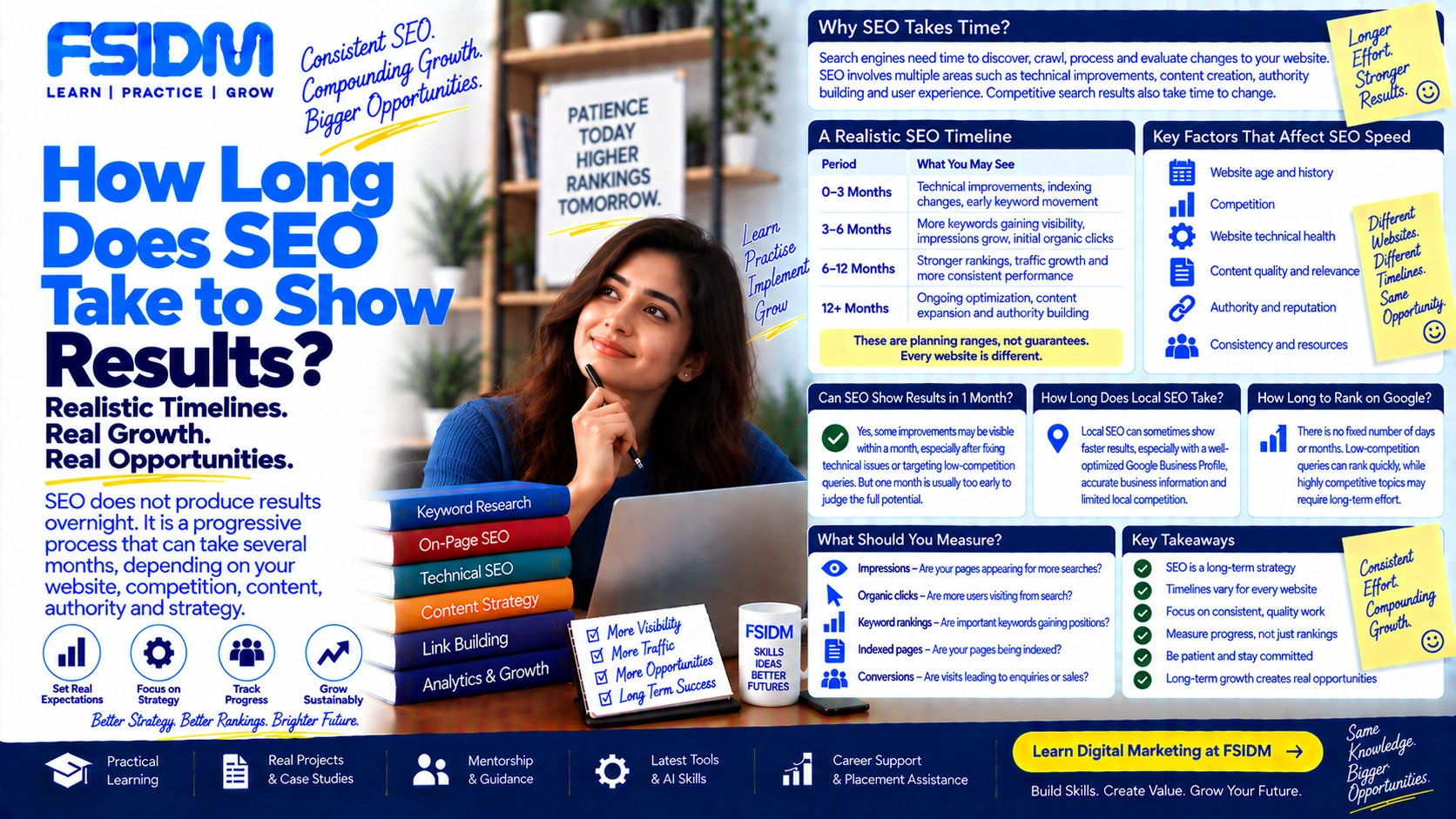
SEO does not produce results overnight. Depending on the website, competition, industry, technical condition, content quality, authority, and SEO strategy, meaningful organic growth can take several months.
Some improvements may become visible within weeks, while more competitive keywords and business-level growth can take considerably longer. The important point is to measure SEO as a progressive growth process, not as a campaign with a guaranteed deadline.
Simple answer: Many websites can begin seeing measurable SEO improvements within a few months, while substantial and consistent organic growth often requires ongoing work over a longer period.
Why Does SEO Take Time?
Search engines need to discover, crawl, process, and evaluate changes to a website. At the same time, SEO involves improving multiple parts of a site rather than changing one setting.
A typical SEO strategy may involve technical improvements, keyword research, content creation, internal linking, digital PR or link acquisition, local optimization, and continuous content updates.
Competitive search results also take time to change because other websites are actively optimizing for the same topics and keywords.
A Realistic SEO Timeline
| Period | What You May See |
|---|---|
| 0–3 Months | Technical improvements, crawling/indexing changes, early keyword movement, and initial impressions may appear. |
| 3–6 Months | More keywords may begin gaining visibility, impressions can grow, and some pages may start attracting meaningful organic clicks. |
| 6–12 Months | Well-executed strategies may produce stronger rankings, traffic growth, and more consistent organic performance. |
| 12+ Months | Competitive websites may require continued optimization, content expansion, authority building, and refinement to sustain and grow results. |
These are planning ranges, not guarantees. A new local business website and an established national ecommerce website can have completely different SEO timelines.
What Factors Affect How Fast SEO Works?
1. Website Age and History
A new website generally has less established search visibility, content, and external recognition than an established website. However, age alone does not guarantee better rankings.
2. Competition
Ranking for a specific local service can be very different from competing for a broad national keyword. The number and quality of competing pages can significantly affect the amount of work required.
3. Website Technical Health
Technical problems involving crawling, indexing, site architecture, mobile usability, performance, or other technical areas can slow progress if they prevent search engines from properly accessing or understanding important pages.
4. Content Quality and Relevance
Publishing useful content that closely matches what people are searching for can help a website build relevance around its target topics. Thin, repetitive, or poorly targeted content is unlikely to create sustainable growth simply because more pages are published.
5. Website Authority and Reputation
Websites with an established reputation and strong relevant references may have an advantage over completely new websites. However, third-party authority scores are estimates and should not be treated as Google’s own ranking scores.
6. SEO Resources and Consistency
SEO usually requires ongoing effort. A strategy that consistently improves technical SEO, content, internal linking, user experience, and relevant authority signals is generally more sustainable than occasional optimization.
Can SEO Show Results in One Month?
Yes, some SEO changes can produce visible results within a month, especially when fixing technical problems, improving poorly optimized pages, targeting less competitive queries, or working with an established website.
However, one month is usually too short to judge the full potential of an SEO strategy. Rankings and search visibility can fluctuate, and individual pages may behave differently.
How Long Does Local SEO Take?
Local SEO can sometimes show relatively quick visibility improvements when a business has a well-established location, accurate business information, a properly optimized Google Business Profile, strong local relevance, and limited local competition.
However, competitive local markets may still require sustained work across the business profile, website, reviews, local content, citations, and relevant local authority.
How Long Does It Take to Rank on Google?
There is no fixed number of days or months required to rank on Google. A page can rank quickly for a low-competition query, while a highly competitive topic may require substantial content development and authority building.
Instead of asking only, “When will I rank?” a better SEO question is: “Are my target pages gaining visibility, impressions, clicks, and relevant rankings over time?”
What Should You Measure While Waiting for SEO Results?
- Impressions: Are your pages appearing for more searches?
- Organic clicks: Are more users visiting from search?
- Keyword visibility: Are important queries moving closer to useful positions?
- Indexed pages: Are important pages being discovered and indexed?
- Organic conversions: Are search visitors generating enquiries, purchases, registrations, or other business outcomes?
- Engagement and landing-page performance: Are visitors finding the content useful after arriving from search?
Why Rankings Alone Are Not Enough
A website can rank for hundreds of keywords without generating meaningful business results. Conversely, a smaller number of highly relevant searches can produce valuable leads or sales.
That is why an SEO campaign should connect search visibility with business outcomes. Track traffic, qualified leads, sales, enquiries, and other relevant conversions alongside rankings.
How to Make SEO Progress More Efficient
- Fix critical technical issues first.
- Build a focused keyword and topic strategy.
- Create genuinely useful, search-intent-aligned content.
- Improve internal linking and site architecture.
- Strengthen relevant authority and references.
- Optimize important pages continuously.
- Monitor Search Console and analytics data.
- Prioritize pages and queries with real business potential.
SEO Is a Compounding Process
One of the biggest advantages of SEO is that successful work can continue producing value after the initial optimization is complete. A useful article can attract organic visitors for months or years, while a strong topic cluster can support multiple related pages.
But SEO is not completely passive. Search results, competitors, search behavior, technology, and business priorities change. Successful websites continue updating and improving their organic presence.
Frequently Asked Questions
How many months does SEO take to work?
There is no universal timeline. Many websites can see measurable changes within a few months, while meaningful growth in competitive markets can take six months, a year, or longer.
Can SEO results happen in 7 days?
Some changes may be noticed quickly, particularly after technical fixes or on websites that already have strong search visibility. However, consistent organic growth generally requires more time and should not be judged from a one-week window.
Does paying more make SEO work faster?
More resources can allow a team to execute research, technical improvements, content, digital PR, and other activities more extensively. However, spending more does not guarantee rankings or a specific timeline.
Why has my website not improved after six months?
Possible reasons include highly competitive keywords, weak search-intent alignment, technical problems, insufficient content quality or depth, weak internal architecture, limited relevant authority, poor measurement, or a strategy that is not targeting the right opportunities. A detailed SEO audit is needed to identify the actual cause.
Interview Question
Q: How long does SEO take to show results?
Answer: SEO timelines vary by competition, website condition, content quality, authority, industry, and the strategy being implemented. Some improvements can appear within weeks, but meaningful and sustainable organic growth often takes several months or longer.
Interview Tip
Avoid giving an interviewer a guaranteed timeline such as “SEO takes exactly three months.” A stronger SEO answer explains why timelines vary and identifies the metrics used to measure progress.
Learn Practical SEO with FSIDM
Understanding SEO means learning more than keywords and rankings. You need to understand technical SEO, content strategy, search intent, internal linking, authority, analytics, and how search behavior changes over time.
At FSIDM, digital marketing and SEO are taught with a practical, industry-focused approach designed to help learners understand how SEO works in real-world situations.