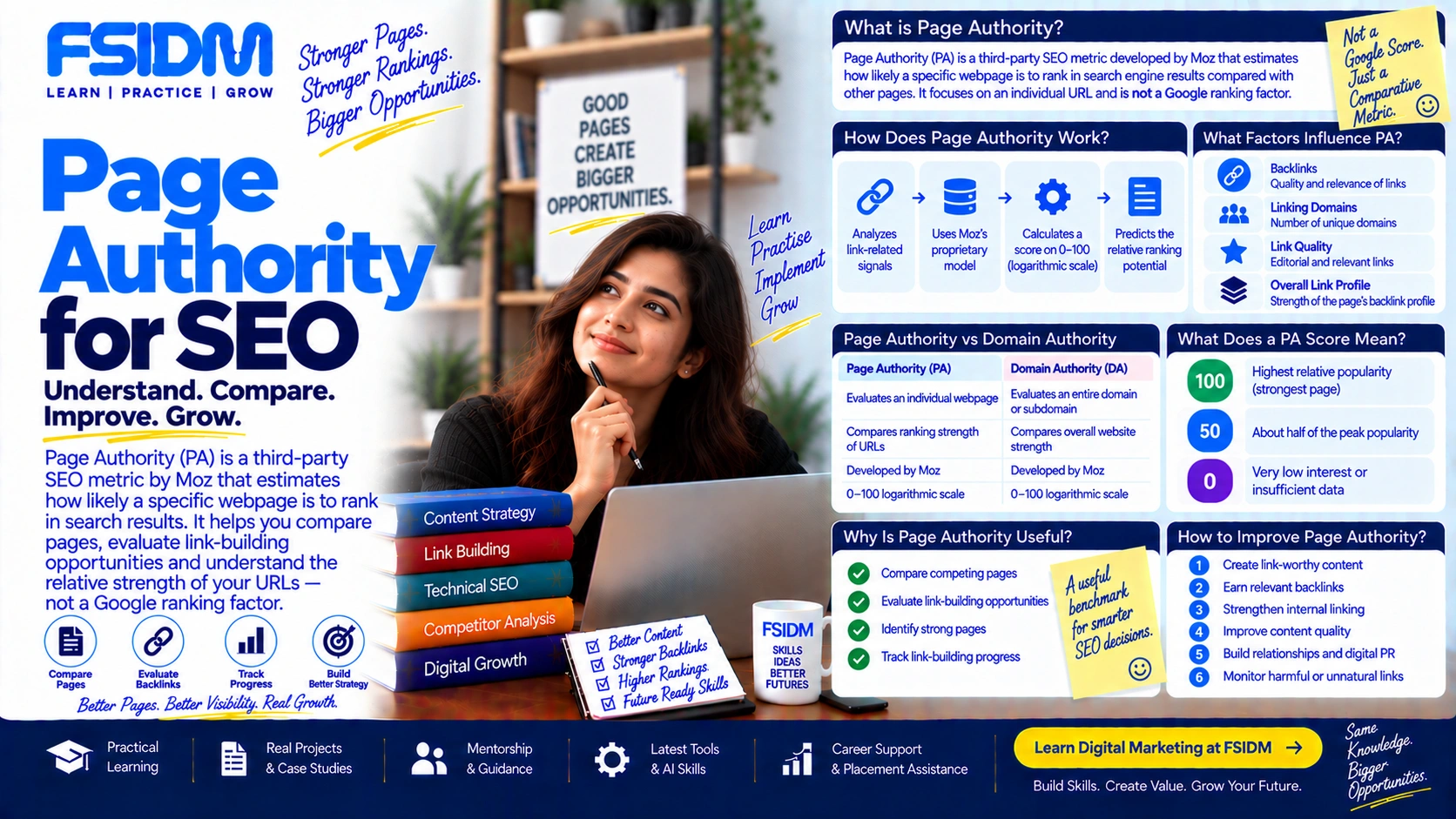
Page Authority (PA) is a third-party SEO metric developed by Moz that estimates how likely a specific webpage is to rank in search engine results compared with other pages.
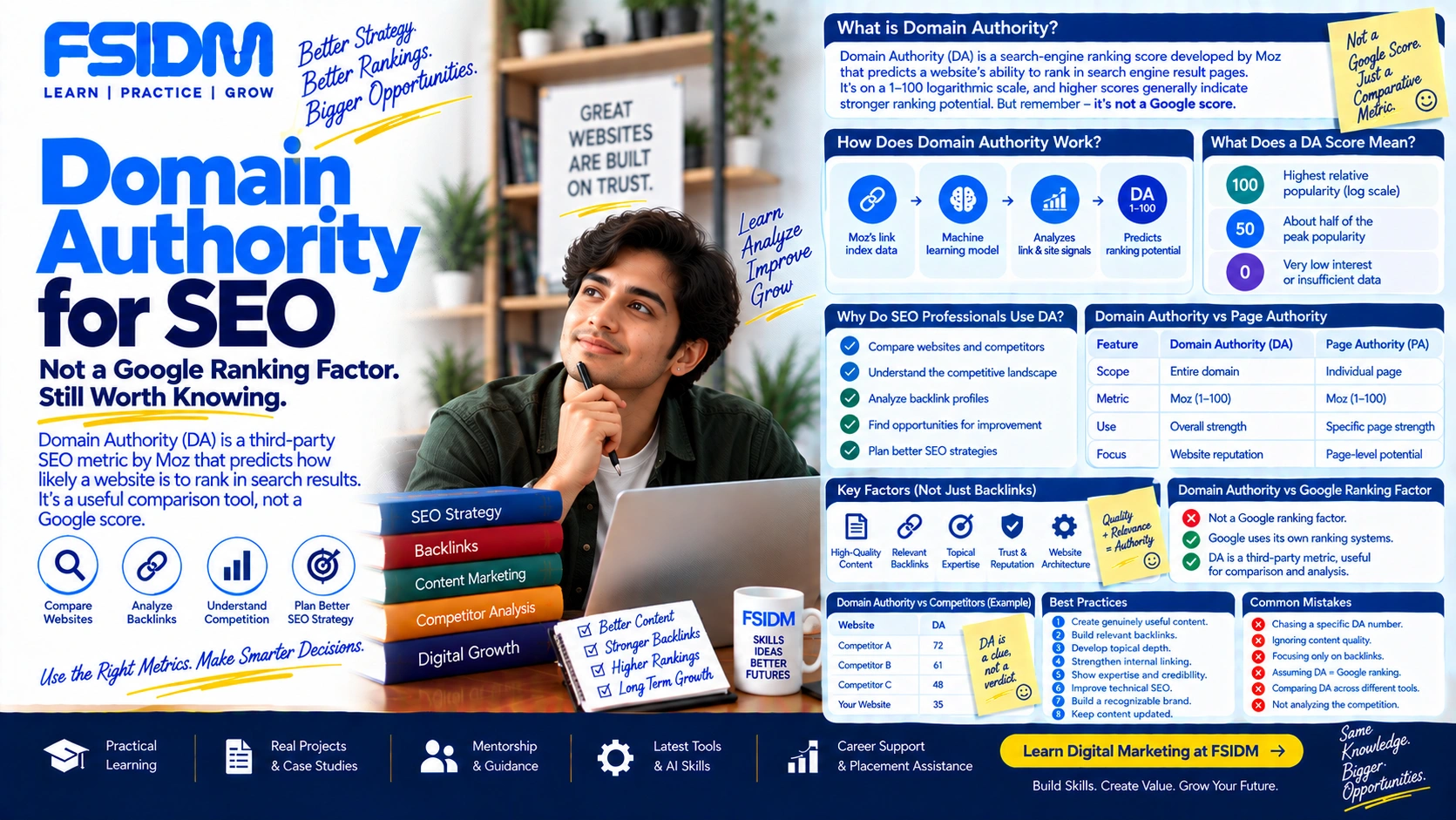
Unlike Domain Authority (DA), which estimates the ranking strength of an entire domain or subdomain, Page Authority focuses on an individual webpage.
PA is useful for comparing pages, evaluating link-building opportunities and understanding the relative strength of URLs. However, it is important to remember that Page Authority is not a Google ranking factor or an official Google score.
How Does Page Authority Work?
Moz calculates Page Authority using its own proprietary methodology. The score is influenced primarily by link-related signals associated with a webpage and is designed to predict ranking potential rather than report an actual Google ranking position.
Page Authority is expressed on a 0–100 logarithmic scale. Because the scale is logarithmic, increasing a score becomes progressively more difficult as the score gets higher.
For example, improving a page from PA 20 to PA 30 may generally require less effort than moving a page from PA 70 to PA 80.
What Factors Can Influence Page Authority?
1. Backlinks
Links pointing to a webpage are an important part of Moz’s authority calculations. Links from relevant and authoritative websites can contribute more meaningfully than large numbers of low-quality links.
2. Linking Domains
The number and quality of unique domains linking to a page can influence its overall link profile.
3. Link Quality
Not every backlink has equal value. A relevant editorial link from a reputable website is generally more useful than a large collection of unrelated or low-quality links.
4. Link Profile
The overall characteristics of a page’s inbound link profile can influence its third-party authority estimate.
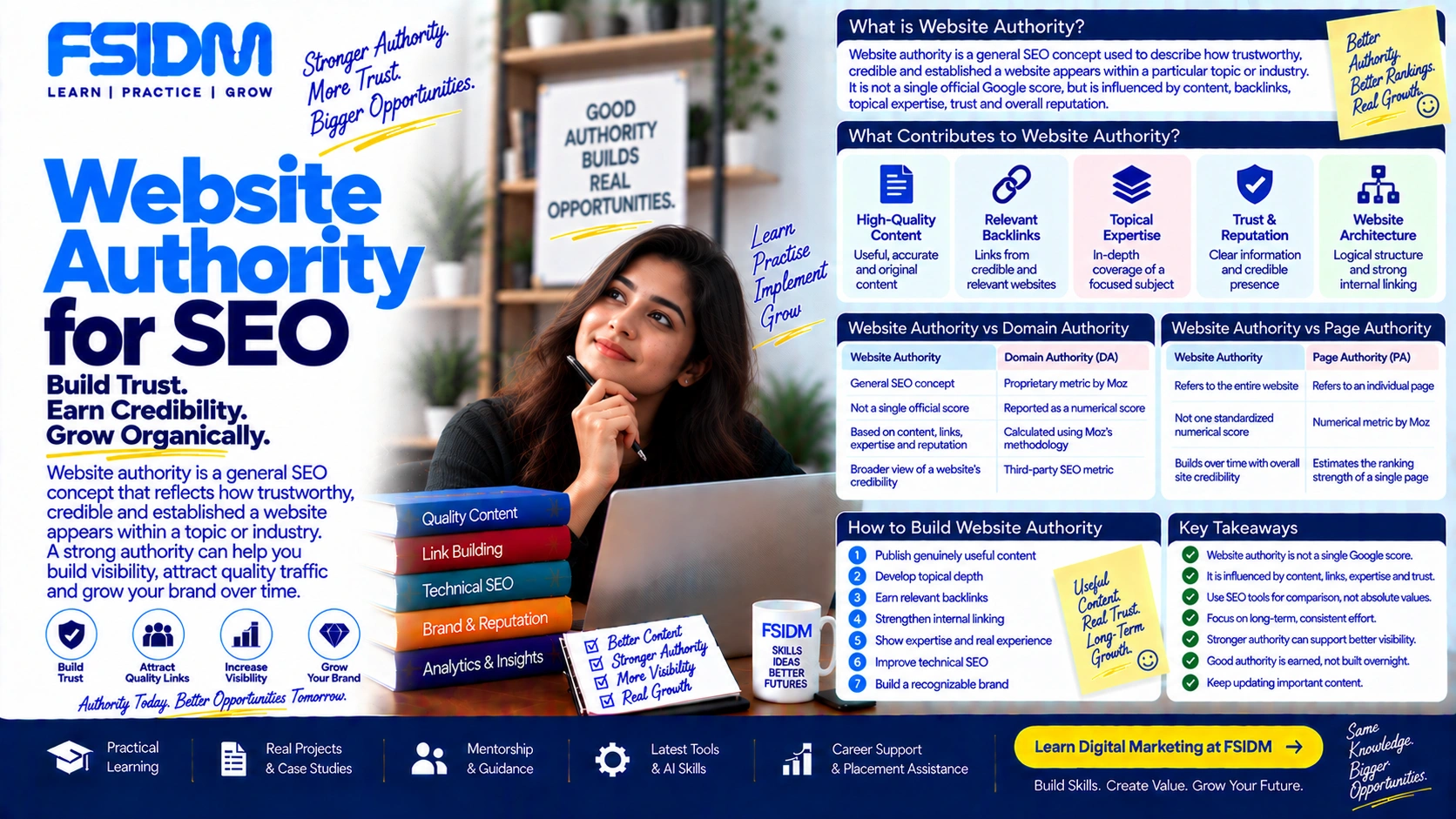
Page Authority vs Domain Authority
| Page Authority (PA) | Domain Authority (DA) |
|---|---|
| Evaluates an individual webpage | Evaluates a broader domain or subdomain |
| Used to compare the relative ranking strength of URLs | Used to compare the relative strength of websites or domains |
| Developed by Moz | Developed by Moz |
| Measured on a 0–100 logarithmic scale | Measured on a 0–100 logarithmic scale |
A website can have a high DA while individual pages have very different PA scores. A strong domain does not automatically give every page the same level of authority.
Is Page Authority a Google Ranking Factor?
No. Page Authority is a Moz metric, not a metric used by Google as a publicly disclosed ranking score.
Google does evaluate links and many other signals when ranking webpages, but Google’s systems do not use Moz’s PA score as a ranking factor. Therefore, increasing PA should not be treated as a direct Google ranking objective.
Why Is Page Authority Useful for SEO?
Although PA is not a Google metric, it can still be useful as a comparative SEO indicator.
Compare Competing Pages
SEO professionals can compare the PA of their page with competing URLs targeting similar search results.
Evaluate Link-Building Opportunities
PA can be one of several metrics used when evaluating potential websites or pages for outreach and link acquisition.
Identify Strong Pages
Comparing authority metrics across a website can help identify pages that already have relatively strong link profiles.
Track Link-Building Progress
Changes in PA over time can provide one additional indicator of how a page’s link profile is developing. It should be considered alongside actual organic visibility and traffic.
How to Improve Page Authority
Because PA is primarily a link-based third-party metric, improving the quality and relevance of a page’s backlink profile is central to improving the score.
- Create link-worthy content: Publish original research, useful guides, statistics, tools, case studies or resources that people have a genuine reason to reference.
- Earn relevant backlinks: Focus on editorially earned links from websites that are genuinely relevant to your subject.
- Strengthen internal linking: Link important pages from relevant pages across your own website.
- Improve content quality: Make the page genuinely useful and competitive for its intended search intent.
- Build relationships: Use legitimate digital PR, outreach and industry relationships to earn relevant mentions and links.
- Monitor harmful or unnatural links: Investigate unusual link patterns rather than trying to manipulate authority metrics.
Does Internal Linking Improve Page Authority?
Internal linking can help users and search engines discover related pages and understand website structure. It can also help distribute internal link equity throughout a site.
However, you should not assume that adding an internal link automatically produces a specific PA increase. Moz’s PA is a third-party calculation based largely on link-related signals, and the score can change as its index and methodology change.
What Is a Good Page Authority Score?
There is no universal PA score that can be called “good.” A score should be interpreted in context.
For example, a PA of 40 may be strong in one competitive environment but relatively weak against pages with much stronger link profiles in another. Comparing your page with relevant competing URLs using the same SEO tool and methodology is more useful than chasing a fixed target.
Page Authority and Backlinks
Page Authority is closely associated with backlinks because Moz’s metric is designed to estimate ranking strength using link-related data.
But more backlinks does not automatically mean higher authority. Relevance, quality and the overall link profile matter. A small number of strong, relevant references can be more meaningful than hundreds of unrelated links.
Page Authority vs PageRank
| Page Authority | PageRank |
|---|---|
| Moz’s proprietary SEO metric | Google’s link-analysis system |
| Used by SEO professionals as a comparative estimate | Part of Google’s historical and underlying link-analysis technology |
| Score is publicly available through Moz tools | Google no longer provides a public Toolbar PageRank score |
These terms should not be treated as interchangeable. PA is a third-party SEO metric, while PageRank refers to Google’s link-analysis technology.
Common Page Authority Mistakes
- Calling PA an official Google ranking score.
- Assuming PA directly determines search rankings.
- Buying backlinks simply to increase a PA number.
- Judging link quality only by an authority metric.
- Comparing PA scores from different SEO platforms as though they were equivalent.
- Ignoring relevance, search intent, content quality and actual organic performance.
- Chasing a high PA score instead of building a genuinely useful webpage.
Frequently Asked Questions
What is Page Authority in SEO?
Page Authority is a Moz metric that estimates the relative ranking strength of an individual webpage based largely on link-related signals.
What is a good Page Authority score?
There is no universal good score. PA is most useful when comparing similar pages within the same competitive environment and using the same measurement methodology.
Does Page Authority affect Google rankings?
No. Google does not use Moz’s Page Authority score as a ranking factor. PA is a third-party estimate used by SEO professionals.
How can I increase Page Authority?
Focus on earning relevant, high-quality backlinks, creating useful link-worthy content and building a strong internal linking structure. Do not optimize solely for the PA number.
Is Page Authority the same as Domain Authority?
No. PA focuses on an individual webpage, while DA estimates the relative ranking strength of a broader domain or subdomain.
Interview Question
Q: What is Page Authority, and is it a Google ranking factor?
Answer: Page Authority is a Moz metric that estimates the ranking strength of an individual webpage, primarily using link-related signals. It is measured on a 0–100 logarithmic scale and is useful for comparative SEO analysis, but it is not an official Google ranking factor or Google score.
Interview Tip
The most important distinction is PA = Moz’s page-level estimate and DA = Moz’s domain-level estimate. Never present either metric as Google’s own ranking score.
Learn SEO with FSIDM
Understanding SEO metrics is important, but professional SEO is not about chasing a single number. Marketers should combine authority metrics with backlink relevance, organic visibility, search intent, content quality, traffic and conversions.
FSIDM focuses on practical, industry-oriented digital marketing and SEO learning, helping students and professionals understand SEO metrics and apply link-building, content and technical SEO strategies to real-world projects.