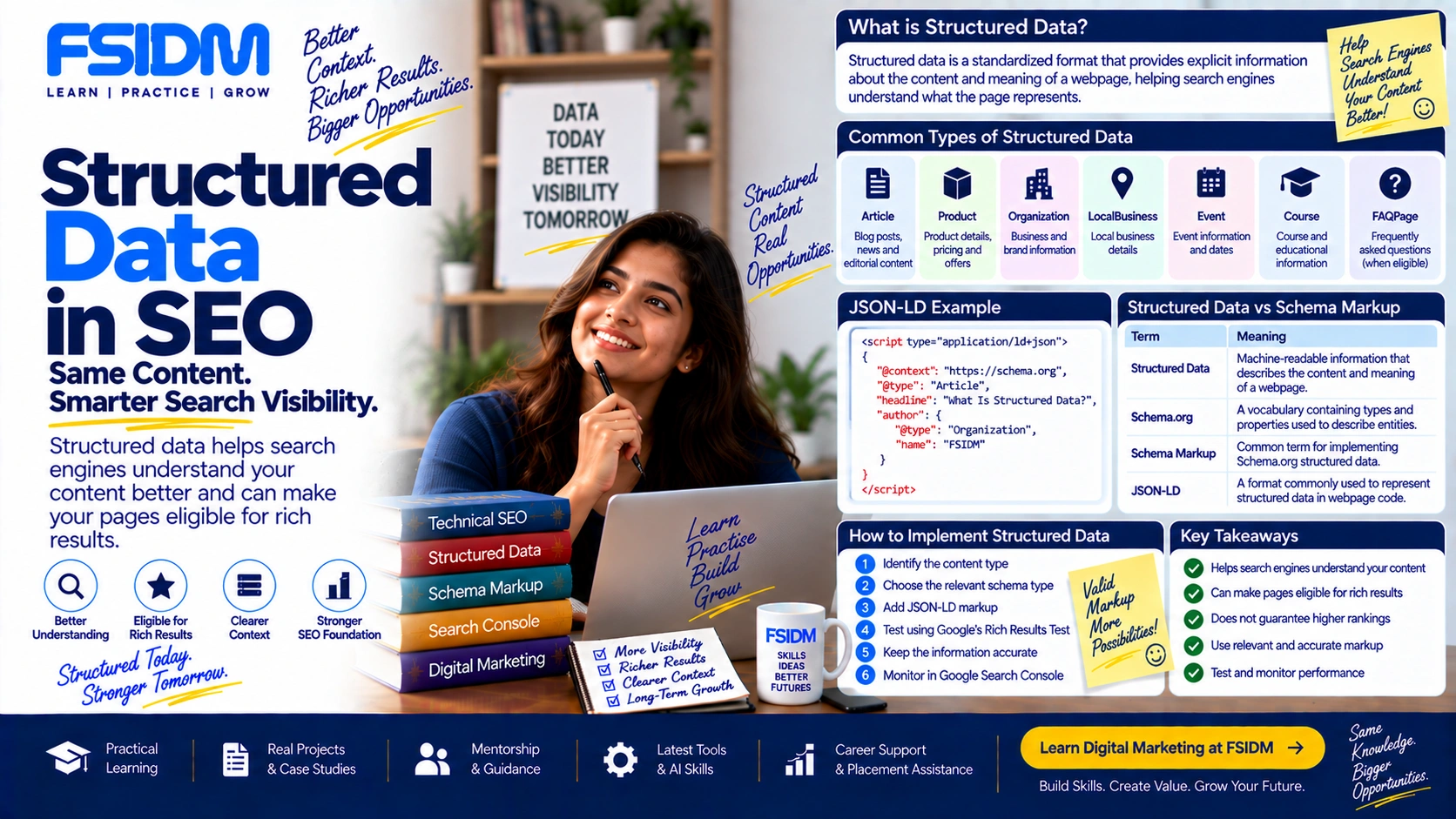
Structured data is a standardized format that provides explicit information about the content and meaning of a webpage, helping search engines understand what the page represents.
Instead of relying only on visible text, structured data adds machine-readable information to a page. For example, a recipe page can identify its ingredients, cooking time, ratings, and other relevant properties. An article can identify its headline, author, publication date, and other details.
Structured data does not guarantee higher rankings or enhanced search-result features, but it can make it easier for search engines to interpret eligible content and, when supported and correctly implemented, can make a page eligible for certain rich results.
What Is Structured Data in SEO?
In SEO, structured data is generally implemented using standardized vocabularies and formats so that search engines can interpret information consistently.
Schema.org is one of the most widely used vocabularies for describing entities and content types such as articles, products, organizations, events, recipes, courses, and local businesses.
The vocabulary defines concepts and properties, while formats such as JSON-LD, Microdata, and RDFa can be used to represent that information on a webpage.
How Does Structured Data Work?
Imagine a webpage containing this visible information:
FSIDM
Digital Marketing Institute
Ahmedabad
SEO & Digital Marketing Courses
Humans can understand what the information means from context. Structured data can provide machine-readable descriptions that explicitly identify concepts such as an organization, location, course, or other entity.
A common implementation uses JSON-LD, which can be added to the page without changing the visible content users see.
What Is JSON-LD?
JSON-LD stands for JavaScript Object Notation for Linked Data. It is a structured-data format widely used for implementing Schema.org markup.
A simplified example looks like this:
<script type="application/ld+json">
{
 "@context": "https://schema.org",
 "@type": "Article",
 "headline": "What Is Structured Data?"
}
</script>
A real implementation should include properties that accurately describe the specific page and follow the relevant search-engine and Schema.org requirements.
Common Types of Structured Data
Structured data can describe many different types of entities and content. Common examples include:
- Article: Helps describe articles, news stories, and other editorial content.
- Product: Describes product information such as name, brand, and eligible offer details.
- Organization: Describes an organization and relevant properties.
- LocalBusiness: Describes a local business and applicable business information.
- BreadcrumbList: Represents breadcrumb navigation.
- Event: Describes events and relevant event information.
- Recipe: Describes recipe-related information.
- Course: Describes educational course information where applicable.
- FAQPage: Can describe eligible frequently asked questions, subject to Google’s current eligibility and display policies.
Not every Schema.org type produces a Google rich result. Schema.org is broader than Google’s supported search-result features.
Structured Data vs Schema Markup
| Term | Meaning |
|---|---|
| Structured Data | Machine-readable information that helps describe the meaning and properties of webpage content. |
| Schema.org | A vocabulary containing types and properties used to describe entities and content. |
| Schema Markup | Common SEO terminology for implementing Schema.org structured data on webpages. |
| JSON-LD | A format commonly used to represent structured data in webpage code. |
Why Is Structured Data Important for SEO?
1. Helps Search Engines Understand Content
Structured data can provide explicit context about entities and properties on a page, making the information easier for machines to interpret.
2. Can Support Rich Results
When the markup is valid, relevant, and meets Google’s requirements, certain structured-data implementations can make pages eligible for enhanced search-result presentations.
Eligibility is not a guarantee of a rich result. Google decides whether and how eligible results are displayed.
3. Clarifies Entities and Relationships
Structured data can help describe relationships between entities, such as an organization and its website, a product and its brand, or an article and its author.
4. Supports Machine Understanding
As search becomes increasingly conversational and multimodal, clearly describing webpage entities and information can provide useful machine-readable context. However, structured data alone does not guarantee inclusion in AI-generated answers or citations.
Structured Data Example
Suppose a website publishes an article titled “What Is SEO?”. The visible page may contain the headline, author, publication date, image, and article text.
Structured data can describe the page as an Article and provide properties such as:
- Headline
- Author
- Publication date
- Modified date
- Image
- Publisher
This gives search engines explicit machine-readable information about the article.
Structured Data and Rich Results
A rich result is a search-result presentation that includes additional information or visual elements beyond a standard blue link.
Depending on the content type and Google’s current systems, supported structured data can contribute to eligibility for features such as product information, breadcrumbs, event details, or other enhanced presentations.
However, adding markup does not mean that Google must display a rich result. Search engines evaluate the page, markup, eligibility requirements, and other factors before deciding what to show.
How to Implement Structured Data
- Identify the page type: Determine what the page actually represents.
- Select an appropriate Schema.org type: Choose a type that accurately describes the content.
- Add relevant properties: Provide accurate information supported by the visible page and applicable guidelines.
- Use JSON-LD where appropriate: It is a practical and widely used implementation format.
- Validate the markup: Check syntax and structured-data eligibility using appropriate testing tools.
- Monitor Search Console: Review relevant enhancement reports and search performance after implementation.
Structured Data Best Practices
- Only mark up information that accurately represents the page.
- Keep structured data consistent with visible content.
- Use the most appropriate Schema.org type rather than adding unrelated markup.
- Do not add structured data simply to manipulate search-result features.
- Keep required properties complete for supported rich-result types.
- Update structured data when the underlying page information changes.
- Follow current search-engine guidelines because rich-result requirements can change.
Common Structured Data Mistakes
- Assuming structured data automatically improves rankings.
- Adding markup for content that is not actually present or supported on the page.
- Using incorrect Schema.org types simply because they appear to offer more properties.
- Assuming every Schema.org type generates a Google rich result.
- Adding fake reviews, ratings, prices, or other information.
- Failing to update markup when visible page information changes.
- Assuming structured data guarantees AI Overview or AI-search citations.
How to Test Structured Data
SEO professionals can use Google’s Rich Results Test to check whether a page’s structured data is eligible for supported rich-result experiences. The Schema Markup Validator can also be used to validate Schema.org markup more broadly.
Testing should be followed by monitoring in Google Search Console where applicable. A technically valid implementation still does not guarantee that Google will display an enhanced result.
FAQs About Structured Data
What is structured data in simple words?
Structured data is machine-readable information added to a webpage to help search engines understand what the content represents and what properties it contains.
Is structured data a ranking factor?
Structured data itself should not be treated as a direct ranking boost. Its primary purpose is to help search engines understand content and, for supported types, make pages eligible for certain rich results.
Is Schema markup the same as structured data?
They are closely related but not identical terms. Schema.org is a vocabulary, while structured data is the machine-readable information implemented using a vocabulary and a format. In SEO discussions, “Schema markup” commonly refers to Schema.org structured data.
Does structured data guarantee rich snippets?
No. Correct structured data can make eligible pages qualify for consideration, but Google does not guarantee that a rich result will be displayed.
Can structured data help AI search?
Structured data can provide machine-readable context about entities and content, which can support understanding. However, it does not guarantee that an AI search system will cite, recommend, or feature a website.
Interview Question
What is structured data, and how does it help SEO?
A strong answer should explain that structured data provides machine-readable information about webpage content and entities. Mention Schema.org, JSON-LD, search-engine understanding, and potential eligibility for rich results without claiming that markup guarantees rankings or enhanced results.
Interview Tip
Remember the distinction: Schema.org is the vocabulary, JSON-LD is a format, and structured data is the machine-readable information. Also mention that valid markup does not guarantee a rich result.
Learn Technical SEO Practically with FSIDM
Structured data is an important technical SEO concept for helping search engines understand webpages, entities, and relationships more clearly.
At FSIDM, digital marketing and SEO are approached with a practical, industry-focused mindset, helping learners understand modern SEO concepts and how they are applied to real websites.