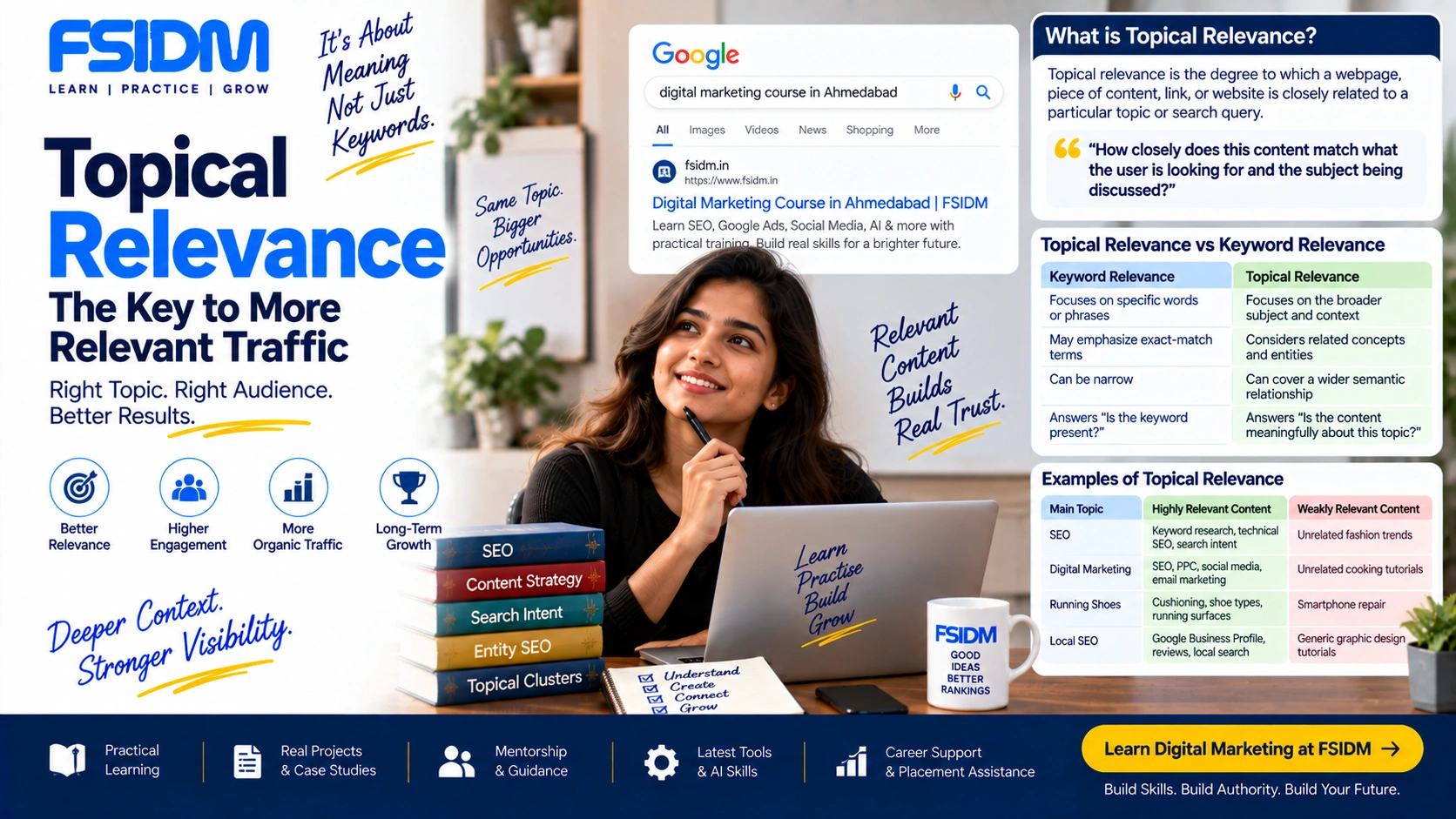
Topical relevance is the degree to which a webpage, piece of content, link, or website is closely related to a particular topic or search query.
In simple terms, topical relevance answers one important SEO question: “How closely does this content match what the user is looking for and the subject being discussed?”
For example, an article about “How to Choose Running Shoes” is topically relevant to running shoes, foot comfort, running surfaces, shoe cushioning, and running performance. An unrelated article about smartphone accessories would have little topical relevance to that subject.
Topical relevance is broader than simply matching an exact keyword. Search engines can consider the meaning, context, related concepts, entities, and relationships within content when determining how relevant a result is to a search.
Why Is Topical Relevance Important in SEO?
Search engines aim to return results that best satisfy the intent behind a search. Topical relevance helps connect a page with the subject and information need represented by a query.
A page can contain a target keyword and still be poorly relevant if it does not adequately address the user’s actual question. Conversely, a well-written page may be highly relevant without repeating the exact search phrase throughout the content.
Topical Relevance vs Keyword Relevance
| Keyword Relevance | Topical Relevance |
|---|---|
| Focuses on specific words or phrases | Focuses on the broader subject and context |
| May emphasize exact-match terms | Considers related concepts and entities |
| Can be narrow | Can cover a wider semantic relationship |
| Answers “Is the keyword present?” | Answers “Is the content meaningfully about this topic?” |
How Search Engines Understand Topical Relevance
Search engines use sophisticated systems to understand the meaning and relationships within content. While the exact ranking systems are not fully disclosed, SEO practitioners commonly evaluate topical relevance through several observable areas.
1. Content Context
The words surrounding a topic provide context. An article about “apple” could discuss fruit, nutrition, recipes, and farming—or it could discuss technology, smartphones, and operating systems. Context helps distinguish the subject being discussed.
2. Related Concepts
Relevant content naturally includes concepts associated with the main subject. For a page about Local SEO, related concepts might include Google Business Profile, local search, reviews, NAP information, citations, local rankings, and location-based queries.
3. Entities
Entities are identifiable people, places, organizations, products, concepts, and other things or ideas. Mentioning relevant entities in an appropriate context can help clarify what a page is about.
4. Search Intent
Topical relevance also depends on whether the content satisfies the purpose behind the query. A user searching “what is technical SEO?” needs an explanation, while someone searching “technical SEO agency” may be evaluating service providers.
5. Internal Linking
Contextual internal links can establish relationships between related pages. A Local SEO guide might link to detailed pages about Google Business Profile, local citations, review management, and NAP consistency.
Examples of Topical Relevance
| Main Topic | Highly Relevant Content | Weakly Relevant Content |
|---|---|---|
| SEO | Keyword research, technical SEO, search intent, internal linking | Unrelated fashion trends |
| Digital Marketing | SEO, PPC, social media, email marketing, analytics | Unrelated cooking tutorials |
| Running Shoes | Cushioning, shoe types, running surfaces, fit | Smartphone repair |
| Local SEO | Google Business Profile, reviews, citations, local search | Generic graphic design tutorials |
Topical Relevance in Content
To create topically relevant content, start with the subject and the user’s information need rather than simply inserting a target keyword.
For example, suppose the primary topic is “Google Business Profile.” A useful page could naturally discuss profile optimization, business categories, business information, photos, reviews, local visibility, and other relevant aspects of managing a profile.
The objective is not to mention every related term. The objective is to provide the information that genuinely helps the user understand or accomplish what they came to the page for.
Topical Relevance and Internal Links
Internal links can strengthen the relationships between related content. Imagine a website has a main guide about SEO with supporting pages covering keyword research, search intent, topical relevance, technical SEO, and Local SEO.
When these pages link to each other in relevant contexts, users can move naturally through related information, while the site’s information architecture becomes easier to understand.
Topical Relevance and Backlinks
The subject of a linking page can also matter when evaluating the relevance of a backlink. A link from a website discussing digital marketing to an authoritative SEO resource is contextually different from a link placed on an unrelated website.
This does not mean every backlink must come from the exact same niche. Relevance is contextual, and link quality involves more than topical similarity alone.
Topical Relevance vs Topical Authority
| Topical Relevance | Topical Authority |
|---|---|
| How closely content relates to a subject | Broader strength and depth of coverage around a subject |
| Can apply to one page or link | Usually considered at a broader content-ecosystem level |
| Focuses on relationship to a topic/query | Focuses on comprehensive subject coverage |
| Example: an article is highly relevant to Local SEO | Example: a website comprehensively covers Local SEO |
How to Improve Topical Relevance
- Understand the primary topic: Clearly define what the page is actually about.
- Match search intent: Identify what users want to learn, compare, find, or accomplish.
- Cover important related concepts: Include relevant information that helps answer the user’s broader need.
- Use entities naturally: Mention relevant organizations, products, concepts, places, and terminology where appropriate.
- Build contextual internal links: Connect the page with other genuinely related resources.
- Use descriptive headings: Organize related information into clear sections.
- Avoid keyword stuffing: Repeating keywords excessively does not make content more relevant.
- Keep the content focused: Avoid adding unrelated sections simply to increase length.
- Update outdated information: Maintain relevance as the subject, industry, or user needs change.
Common Topical Relevance Mistakes
- Keyword stuffing: Repeating a keyword does not automatically improve topical relevance.
- Adding unrelated subtopics: Comprehensive does not mean including everything.
- Ignoring search intent: A page can mention the right topic but still fail to satisfy the query.
- Creating artificial internal links: Links should have a meaningful contextual relationship.
- Writing only for search engines: The primary goal should be helping the user.
- Confusing topical relevance with topical authority: One page can be highly relevant without making the entire website authoritative on the subject.
FAQs About Topical Relevance
What is topical relevance in SEO?
Topical relevance is how closely a page, content item, link, or website relates to a particular topic or search query.
Is topical relevance the same as keyword relevance?
No. Keyword relevance focuses more narrowly on words and phrases, while topical relevance considers the broader meaning, context, concepts, entities, and user intent.
How do I improve topical relevance?
Understand the topic and search intent, cover important related concepts, use relevant entities naturally, create useful internal links, and keep the content focused on the user’s information need.
Does topical relevance improve rankings?
Relevance is fundamental to search, but topical relevance alone does not guarantee rankings. Search performance depends on multiple factors, including content quality, technical accessibility, competition, links, and other search-system signals.
What is the difference between topical relevance and topical authority?
Topical relevance describes how closely a piece of content relates to a subject. Topical authority describes the broader depth, breadth, and quality of a website’s coverage of a subject.
Interview Question
What is topical relevance in SEO?
Topical relevance is the degree to which a webpage or website is meaningfully related to a particular topic or search query. It goes beyond exact-match keywords and considers context, related concepts, entities, and search intent.
Interview Tip
Do not define topical relevance as simply “using the keyword multiple times.” Explain that modern SEO requires understanding the subject, context, related concepts, entities, and intent behind the search.
Learn Practical SEO with FSIDM
At FSIDM, SEO is taught with a practical, industry-focused approach. Understanding topical relevance helps marketers create content that is genuinely aligned with the subjects and search needs of their target audience.