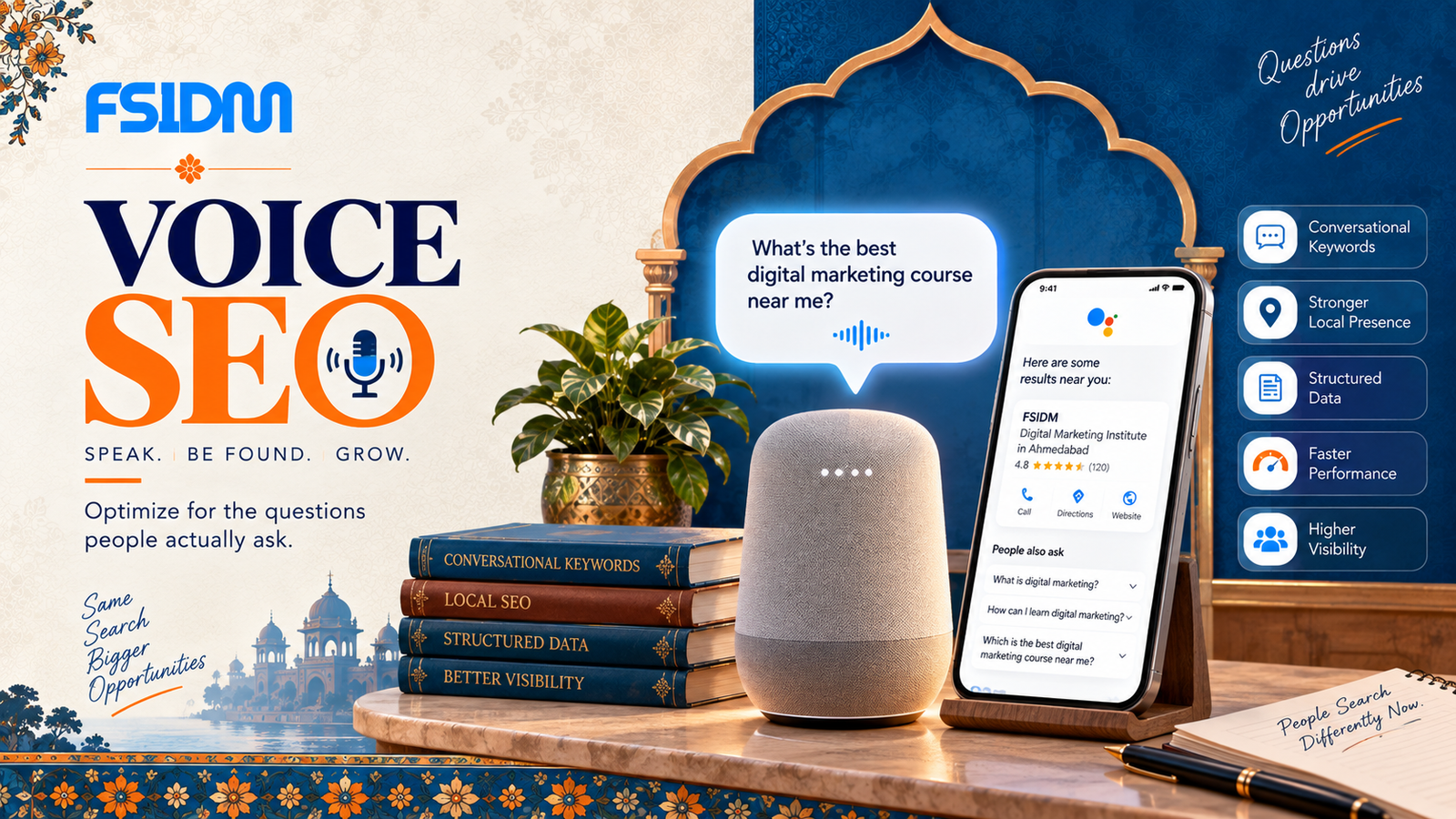
Voice SEO, also called Voice Search Optimization, is the process of optimizing website content and online presence to better match the conversational queries people use when speaking to voice assistants and search systems.
Unlike traditional typed searches, voice queries are often expressed as complete questions or natural-language sentences. This makes conversational content, long-tail keywords, concise answers, local search optimization, and strong technical performance important considerations for businesses targeting voice-driven searches.
How Is Voice Search Different from Text Search?
The biggest difference is how people formulate their queries. When typing, users often shorten their searches to a few keywords. When speaking, they are more likely to use complete questions and natural conversational language.
| Feature | Traditional Text Search | Voice Search |
|---|---|---|
| Query style | Often short keyword phrases | Often longer, conversational questions or sentences |
| Language | Compact and abbreviated | Natural spoken language |
| Common format | Keyword combinations | Questions such as who, what, where, when, why, and how |
| Context | Can be broad or specific | Often highly contextual and immediate |
| Local use | Common | Particularly relevant for nearby and on-the-go searches |
Core Voice SEO Strategies
1. Target Conversational and Long-Tail Keywords
Voice SEO starts with understanding how your audience naturally asks questions. Instead of focusing exclusively on short keyword phrases, identify longer conversational queries that reflect real questions and problems.
For example, a typed search might be “best pizza Ahmedabad”, while a spoken query could be “What is the best pizza place near me that is open now?”
Use Question-Based Content
FAQ sections can be useful for addressing common conversational queries. A clear question followed by a concise, direct answer creates a format that is easy for users to scan and understand.
Write Naturally
Use language that resembles the way your audience actually speaks. Avoid forcing keywords into sentences simply for SEO purposes. Natural phrasing can make content more useful for both human readers and systems processing conversational queries.
2. Optimize for Concise Answers and Search Features
Voice assistants and conversational search experiences may rely on information extracted from search results or web content. Clear answers can therefore make important information easier to interpret.
Structure important answers with:
- Direct responses to specific questions
- Short introductory explanations
- Clearly organized bullet points
- Descriptive headings
- Simple, easy-to-understand language
Featured snippets can be one source of information for voice responses in some search environments, but there is no universal guarantee that a voice assistant will select a particular featured snippet or website as its answer.
3. Strengthen Local SEO
Voice searches frequently include local intent, such as finding nearby businesses, services, restaurants, or places. Local SEO is therefore an important part of a voice-search strategy for location-based businesses.
Keep important business information accurate and consistent, including:
- Business name
- Address
- Phone number
- Opening hours
- Service information
- Location and area relevance
Maintaining an accurate Google Business Profile and a consistent local presence can help businesses provide reliable information for location-based searches.
4. Strengthen Technical SEO
Voice SEO does not replace fundamental technical SEO. A website still needs to be accessible, fast, mobile-friendly, and easy for search engines to understand.
Structured Data
Relevant structured data can help search engines understand information on a page. Use schema types that accurately represent the content rather than adding markup solely because it is associated with voice search.
Some content may also be eligible for Speakable structured data in supported contexts, although its availability and use should be evaluated according to current search-engine guidelines.
Page Performance
Fast, responsive pages create a better experience for users arriving from search. Performance optimization should therefore remain part of the broader technical SEO strategy.
Voice SEO and Local Search
Local businesses can particularly benefit from considering conversational search behavior. Users may ask for nearby services using phrases such as “near me,” “open now,” or questions that combine a service with a location.
A strong local search foundation includes accurate business information, relevant location pages, useful service content, reviews, and a well-maintained business profile.
Voice SEO and Generative AI Search
Voice search is increasingly connected to conversational interfaces and AI-powered search experiences. Modern users may ask more complex questions that require systems to interpret context rather than simply match individual keywords.
This makes the underlying principles of useful content even more important: clear answers, strong topical relevance, trustworthy information, structured content, and authoritative sources.
Voice SEO and AI Search Optimization are not identical disciplines, but they overlap in their emphasis on understanding natural-language questions and providing useful answers.
Voice SEO Checklist
- Research conversational and question-based search queries.
- Identify long-tail keywords that reflect real user language.
- Create concise answers to common customer questions.
- Use descriptive headings and easy-to-scan content structures.
- Strengthen local SEO for location-based businesses.
- Keep business information accurate and consistent.
- Maintain a complete and accurate Google Business Profile.
- Use relevant structured data where appropriate.
- Optimize mobile usability and page performance.
- Review content regularly as search behavior and conversational search systems evolve.
Common Voice SEO Mistakes
- Writing content only around short typed keywords
- Ignoring question-based and conversational queries
- Creating unnecessarily complicated answers
- Keyword stuffing conversational content
- Ignoring local search intent
- Providing inconsistent business information
- Using irrelevant or inaccurate structured data
- Neglecting mobile performance
- Assuming a specific search feature guarantees a voice answer
Frequently Asked Questions
What is Voice SEO?
Voice SEO is the practice of optimizing content and online information to better match conversational queries made through voice assistants and voice-enabled search experiences.
How is Voice SEO different from traditional SEO?
Voice SEO places greater emphasis on natural-language and conversational queries, question-based searches, concise answers, and contextual information. It still relies on many of the same fundamental SEO principles as traditional search optimization.
Are FAQ pages useful for Voice SEO?
FAQ content can be useful because it directly addresses common questions in a conversational format. However, simply creating an FAQ page does not guarantee voice-search visibility.
Is local SEO important for Voice Search?
Yes. Local intent is common in conversational searches, particularly when users are looking for nearby businesses, services, or places. Accurate local business information can therefore be valuable.
Does Voice SEO mean ranking in Position Zero?
Featured snippets have historically been used as a source for some voice answers, but voice assistants can use different systems and sources. There is no single ranking position that guarantees a voice response.
Interview Question
What is Voice SEO, and how would you optimize a website for voice search?
Interview Tip: Explain the shift from short typed keywords to conversational queries. Mention question-based content, concise answers, local SEO, structured data, mobile performance, and natural-language optimization.
Learn Voice SEO with FSIDM
At FSIDM, digital marketing and SEO are taught with a practical, industry-focused approach. Understanding how people search through conversational and voice-based interfaces helps marketers adapt content strategies to changing search behavior.
Explore FSIDM to build practical digital marketing and SEO skills.