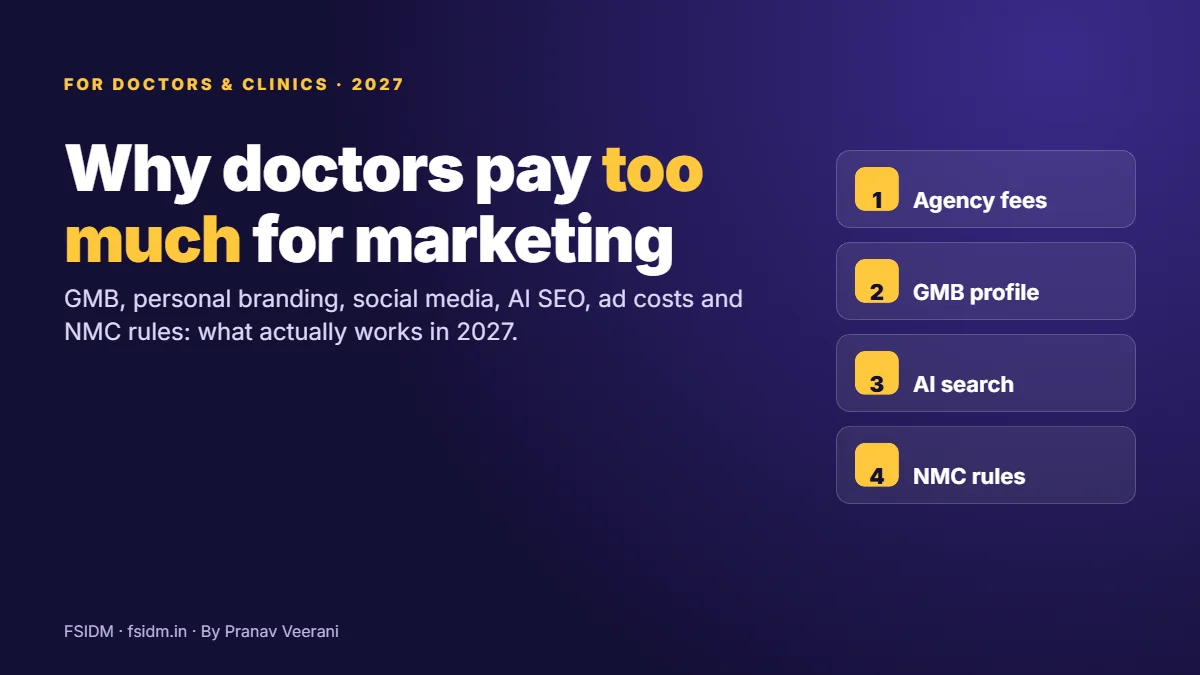
Every week a doctor tells me the same story: “I’m paying an agency every month, they post on Instagram, they send a report… but my OPD is not growing.”
If that sounds familiar, this article is for you. With 2027 just weeks away, this is the right time to plan. In simple words, I’ll show you where your marketing money really goes, what clinic ads cost going into 2027 (using the latest 2026 data), how patients choose a doctor today, and what you can fix yourself, often for free.
1. Where does your monthly marketing bill really go?
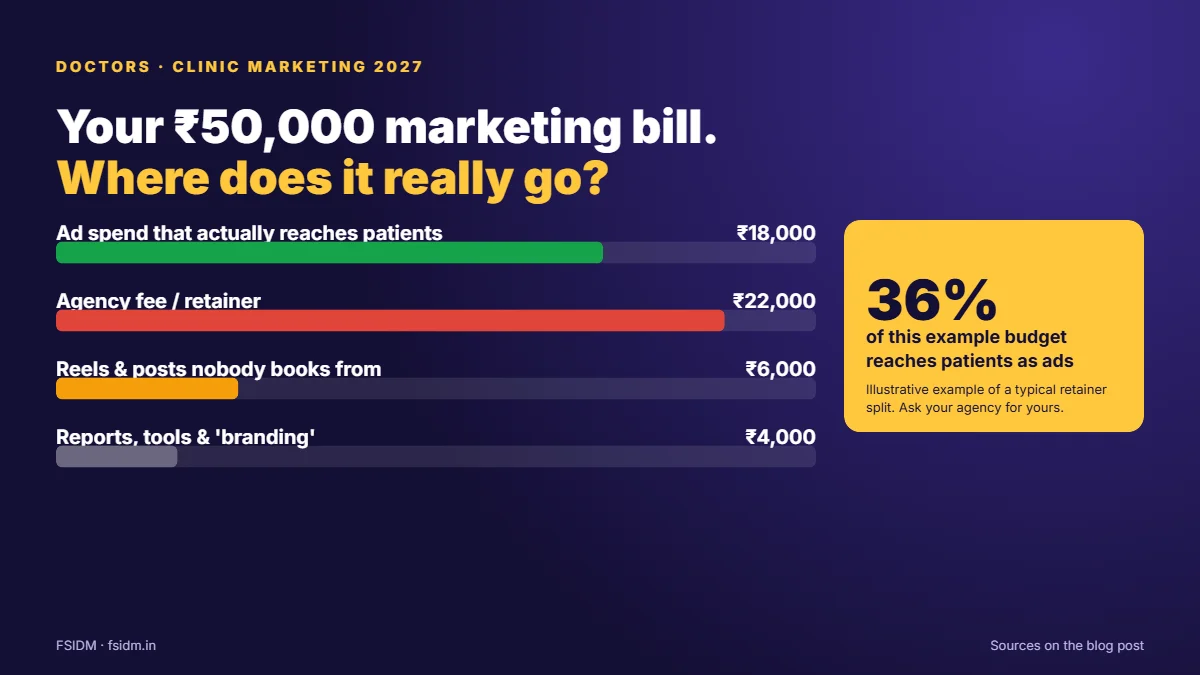
Look at this example of a ₹50,000 monthly package. Only a part of it is actual ad spend that can reach patients. The rest is the agency fee, content production and reports. This split is illustrative; every agency is different, so ask yours for a written breakdown.
None of this is wrong by itself. Agencies need to be paid. The problem is when a doctor can’t see what the money produced. “We got 20,000 views” is not a result. “We got 38 calls and 14 booked appointments” is.
One healthcare marketing firm publicly described a two-doctor dermatology clinic in Lucknow that spent about ₹1.2 lakh a month on Instagram Reels for 11 months and got 7 new patients (Codingclave, 2026). It’s one case, but it shows how easy it is to pay a lot for content that never turns into appointments.
Ask your agency these 5 questions
- How much of my monthly bill is ad spend, and how much is your fee?
- How many calls, WhatsApp chats and bookings came from marketing last month?
- What is my cost per appointment?
- Do I own my ad account, Google Business Profile, website and page logins?
- Is everything you publish compliant with the NMC’s October 2026 advertising guidelines?
2. What clinic ads cost going into 2027
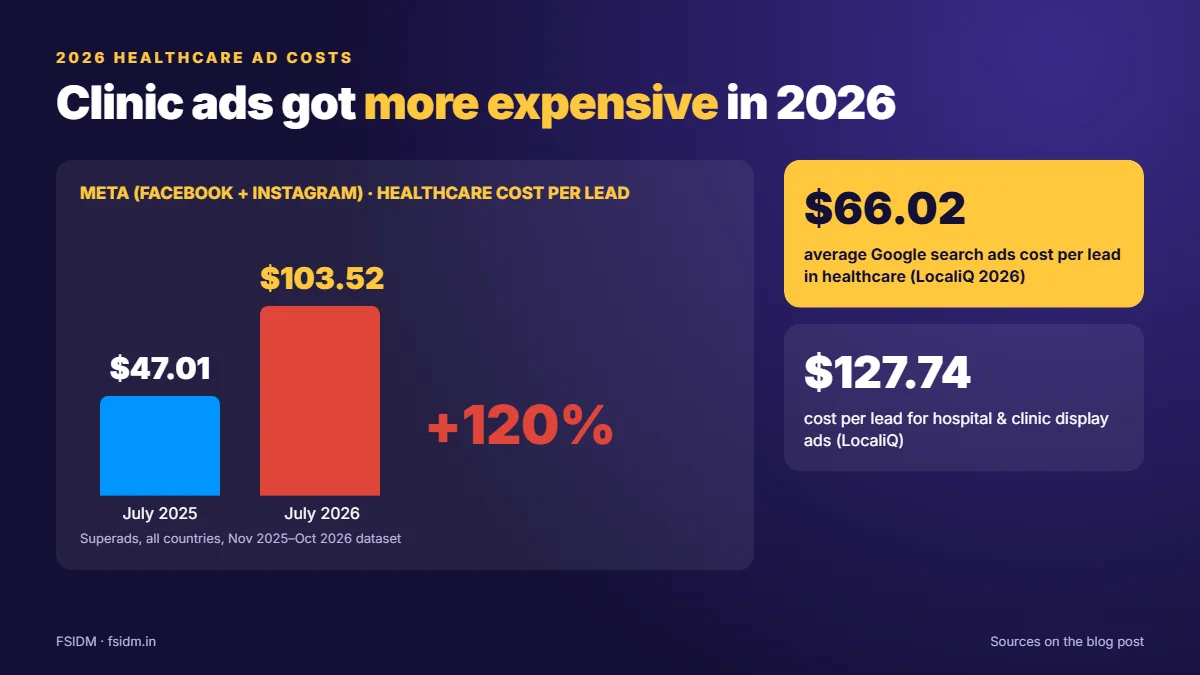
“Cost per lead” simply means how much you pay to get one enquiry (a form, call or message). Here’s what the latest 2026 data shows, which is your best guide for 2027 budgets:
- Google search ads: the average cost per lead for healthcare is $66.02, and the average click-through rate is 6.07% (LocaliQ 2026).
- Meta (Facebook + Instagram) ads: healthcare cost per lead went from $47.01 in July 2025 to $103.52 in July 2026, a 120% rise (Superads).
- Display (banner) ads: hospitals and clinics paid about $127.74 per lead, with a click-through rate of just 0.13% (LocaliQ).
These are mostly international benchmarks, and costs in India are usually lower in rupee terms. But the trend matters: every enquiry is getting more expensive. When leads cost more, wasted spend hurts more. A missed call, a slow WhatsApp reply or an incomplete Google profile now burns real money.
3. How patients will choose a doctor in 2027: AI and reviews
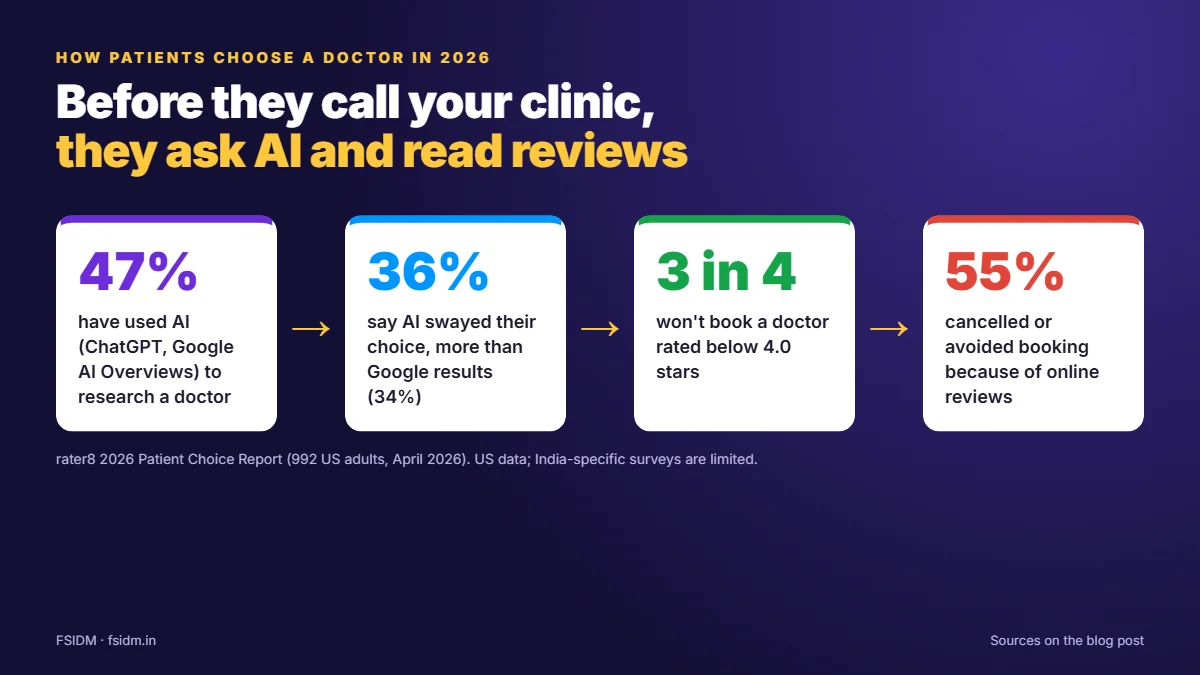
Patients now ask ChatGPT or Google’s AI before they call. In a 2026 survey of 992 US adults, 47% had used a tool like ChatGPT or Google’s AI Overviews to research a provider, up from 31% nine months earlier (rater8 via Medical Economics).
- AI tools influenced 36% of patients’ choices, ahead of Google search results (34%) and doctor referrals (32%).
- Three in four refuse to book a doctor rated below 4.0 stars.
- 55% cancelled or avoided an appointment because of online reviews, up from 40% in 2025 (rater8 2026 Patient Choice Report).
This is US data, and Indian surveys on this are limited. But Google’s AI Overviews and AI Mode are live in India too, including in Hindi and other Indian languages, so expect the same habits to grow here through 2027.
4. The 5 visibility problems most clinics have
Problem 1: An incomplete Google Business Profile (GMB)
This is your free shop window. Patients see your timings, location, phone number, photos and reviews here, and AI tools read it too. Fix it: correct category, every service listed, real clinic photos, correct hours (including holidays), and a phone number someone actually answers.
Problem 2: No clear “personal brand” information
Personal branding for a doctor doesn’t mean dancing on Reels. It means patients (and AI) can easily find who you are: your qualifications, registration number, specialisation, experience, languages and where you practise. Under the NMC guidelines, doctors’ electronic posts must disclose their name, qualifications, registration status and registration number.
Problem 3: Social media posts that don’t help patients
Festival greetings and stock-photo quotes don’t bring appointments. Simple educational posts do: “When should a child’s fever worry you?”, “5 questions to ask before knee surgery”. Education is allowed and builds trust, as long as it doesn’t promote your practice with superiority claims or solicit patients.
Problem 4: A website that AI and Google can’t understand
Many clinic websites are slow and vague. For AI SEO you don’t need tricks. You need clear pages that answer: What do you treat? Where? Timings? Fees (if you share them)? Which doctor? Add a simple FAQ page in plain language. Google says there are no special requirements to appear in AI Overviews or AI Mode; normal SEO basics apply.
Problem 5: No follow-up system
The biggest leak isn’t marketing, it’s missed calls and late replies. Track how many calls go unanswered and how long WhatsApp replies take. A receptionist who replies within 5 minutes can be worth more than a bigger ad budget.
5. The NMC advertising rules every doctor must follow in 2027
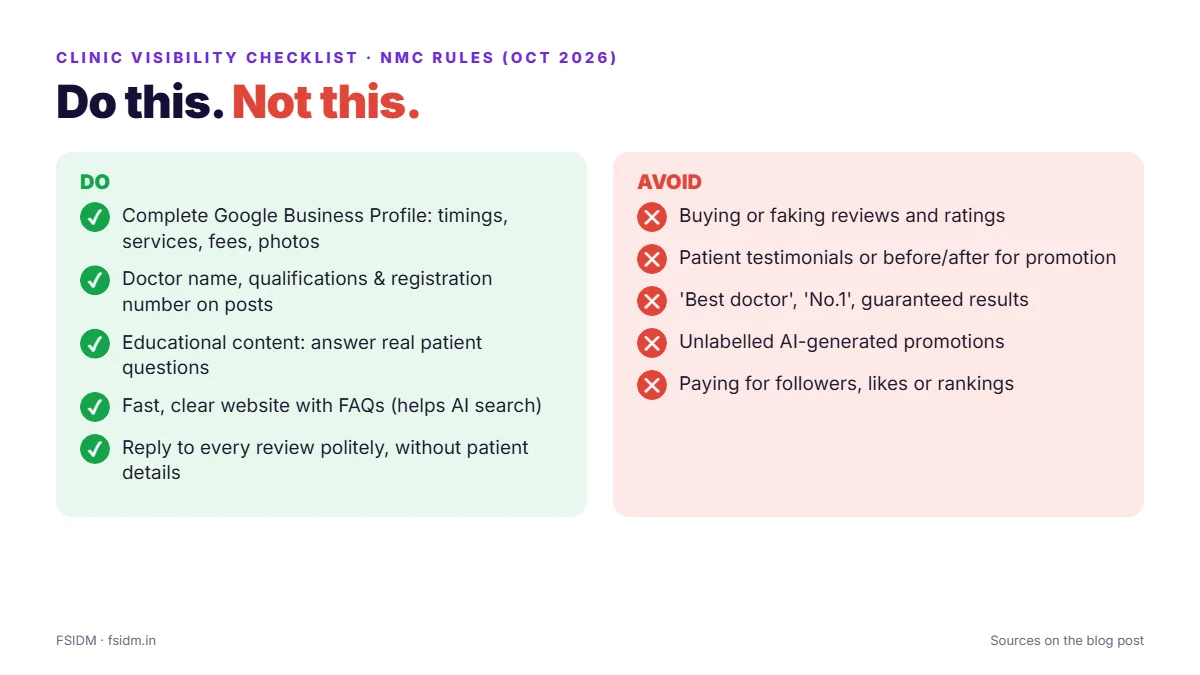
On 6 October 2026, the National Medical Commission issued “Guidelines on Ethical Advertising and Public Communication” that came into effect immediately (The South First). Key points in simple words:
- Allowed: factual information (name, location, contact, services, facilities, charges), health education and awareness content.
- Not allowed: fake, paid or manipulated reviews and ratings; requesting or sharing patient testimonials or reviews for promotion on social media; guaranteed outcomes or claims of being better than other doctors.
- AI content: promotional AI-generated content counts as advertising; misleading AI content is not allowed and compliant AI content must be labelled (MedBound Times).
- Your responsibility: using an agency doesn’t protect you. Doctors remain responsible for content agencies publish on their behalf.
- Penalties can range from warnings to suspension or removal from the medical register.
6. What to do yourself vs. what to outsource
| Task | Do it in-house (doctor or trained staff) | Outsource (if needed) |
|---|---|---|
| Google Business Profile updates | ✅ Easy, free, 15 min a week | |
| Replying to reviews and WhatsApp | ✅ Must be personal and fast | |
| Educational posts and short videos | ✅ Doctor shares knowledge; staff edits with AI tools | Editing help |
| Website and technical SEO | ✅ One-time setup by a professional | |
| Paid ads (if compliant) | Understand the basics | ✅ Only with clear cost-per-appointment reporting |
The smartest clinics we see train one staff member to handle the daily basics, and pay specialists only for specific, measurable work.
7. A simple 30-day plan to start 2027 right
- Week 1: Complete your Google Business Profile, fix timings, add real photos and services.
- Week 2: Update your website: doctor details, registration number, services, location, FAQs.
- Week 3: Publish 4 educational posts answering common patient questions.
- Week 4: Track calls, WhatsApp chats and bookings. Ask: where did each patient find us?
Frequently asked questions
How much should a doctor spend on digital marketing in India in 2027?
There is no fixed number. Start by fixing free basics (Google Business Profile, website, WhatsApp follow-up). Then spend on ads only if they are allowed under the NMC rules for your type of message, and only after you can measure how many calls or bookings each rupee brings.
Can doctors run Facebook or Google ads in 2027 under the NMC rules?
The NMC’s October 2026 guidelines define advertising broadly, including sponsored, targeted and search-engine promotion, and restrict promotion that solicits patients. Factual information and health education are allowed. Paid ads are a grey area, so check with your council or a legal advisor before running them.
Is Google Business Profile important for clinics?
Yes. It is free and it is where patients see your timings, location, phone number, photos and reviews, and AI tools also read this information. Many clinics have incomplete or outdated profiles.
Can I ask patients for Google reviews?
Do not buy, fake or manipulate reviews. The NMC rules also bar doctors from requesting or sharing reviews and testimonials for promotion on social media. Reviews that patients leave on their own are normal; reply politely without revealing any patient details.
Should doctors learn digital marketing themselves?
You don’t need to become a marketer, but understanding the basics (Google Business Profile, simple content, how ads are measured) helps you stop overpaying, ask agencies the right questions, or train one staff member to manage it in-house.
Make 2027 the year you stop overpaying.
FSIDM’s practical, AI-first digital marketing course covers Google Business Profile, SEO and AI search, Meta and Google ads, social media and WhatsApp marketing, with live classes and real campaigns. Train yourself or one staff member and take control of your clinic’s visibility.
Explore the Digital Marketing Course →Written by Pranav Veerani, Digital Marketing Trainer, Consultant and Paid Media Buyer at FSIDM. This article is general marketing information, not legal or medical advice.