If you have ever sat in a meeting where a TV planner said “we bought 400 GRPs at a CPRP of ₹4,500” and a digital marketer replied “our CPM was ₹180 and ROAS 4×”, you know they are speaking two different languages.
This guide translates both, in simple words. You’ll learn what TRP, GRP, CPRP and ER mean in TV ad buying, how they compare with digital metrics like CPM, CPC, CTR, CPL and ROAS, and which channel is useful for your business or career in 2027.
1. Where India’s ad money is going in 2027
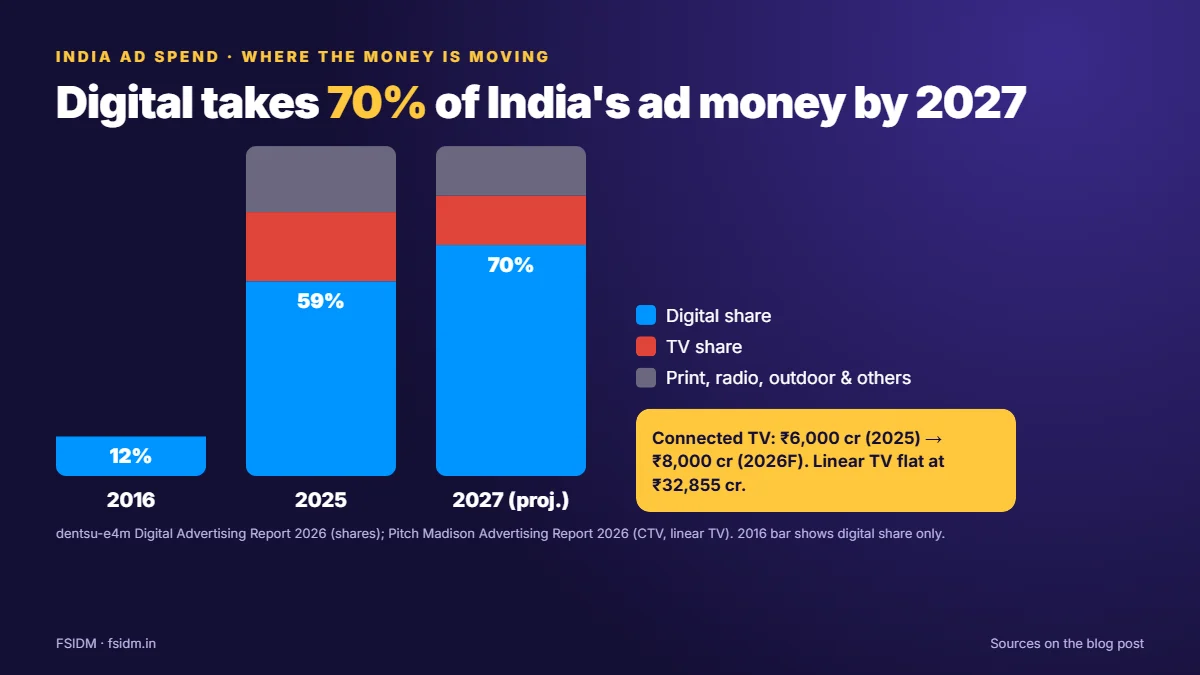
Digital is now the biggest medium in India. Its share of ad spend climbed from about 12% in 2016 to 59% (₹71,621 crore) in 2025, and it is projected to reach 70% by 2027, while TV’s share falls to about 15%.
But TV is not disappearing. Linear TV is forecast to stay flat at ₹32,855 crore in 2026, while connected TV (CTV) (smart TVs and streaming apps) is expected to grow from about ₹6,000 crore to ₹8,000 crore. FMCG alone still accounts for about 46% of linear TV ad spend.
TV measurement is also changing. The government’s TV Ratings Policy 2026 aims to make ratings more transparent, with independent audits and measurement that covers CTV and OTT. So understanding both TV and digital metrics is a valuable skill for 2027.
2. TV ad buying metrics, explained simply
TVR / TRP: how many people watched
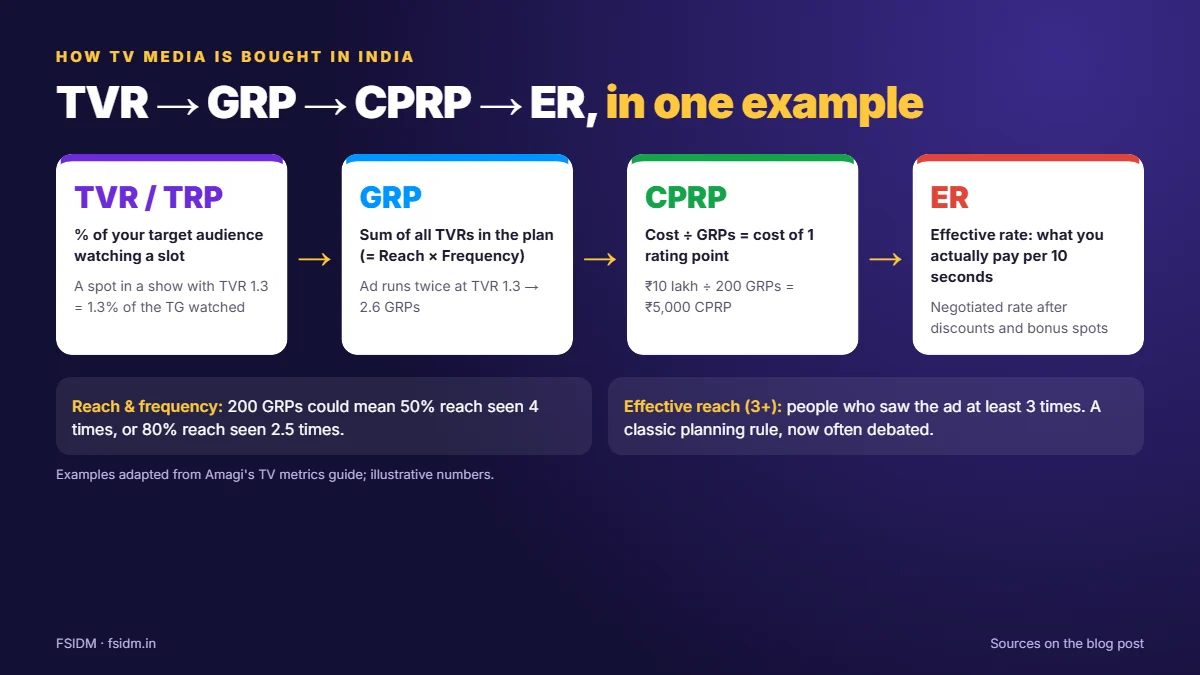
A rating point is 1% of your target audience watching at that moment. If a programme has a TVR (or TRP) of 1.3, then 1.3% of your target group was watching.
GRP: the total audience weight you bought
GRP (Gross Rating Points) is the sum of all ratings your ad receives. If your ad plays twice in a show with a 1.3 rating, that’s 2.6 GRPs. GRP also equals reach × frequency: 200 GRPs could mean 50% of people saw it 4 times, or 80% saw it 2.5 times.
CPRP: the cost of one rating point
CPRP = total cost ÷ GRPs. If a campaign costs ₹10 lakh and delivers 200 GRPs, the CPRP is ₹5,000. Planners compare CPRPs across channels and shows to find better value.
ER: effective rate (and effective reach)
In Indian TV buying, ER usually means “effective rate”: the actual negotiated price per 10 seconds after discounts and bonus spots. Buying happens on ER, while CPRP helps planners choose the right space. Planners also talk about effective reach: the share of people who saw the ad enough times to remember it, often set at 3 or more exposures (3+).
3. Digital marketing metrics, explained simply
- Impressions & reach: how many times your ad was shown, and to how many unique people.
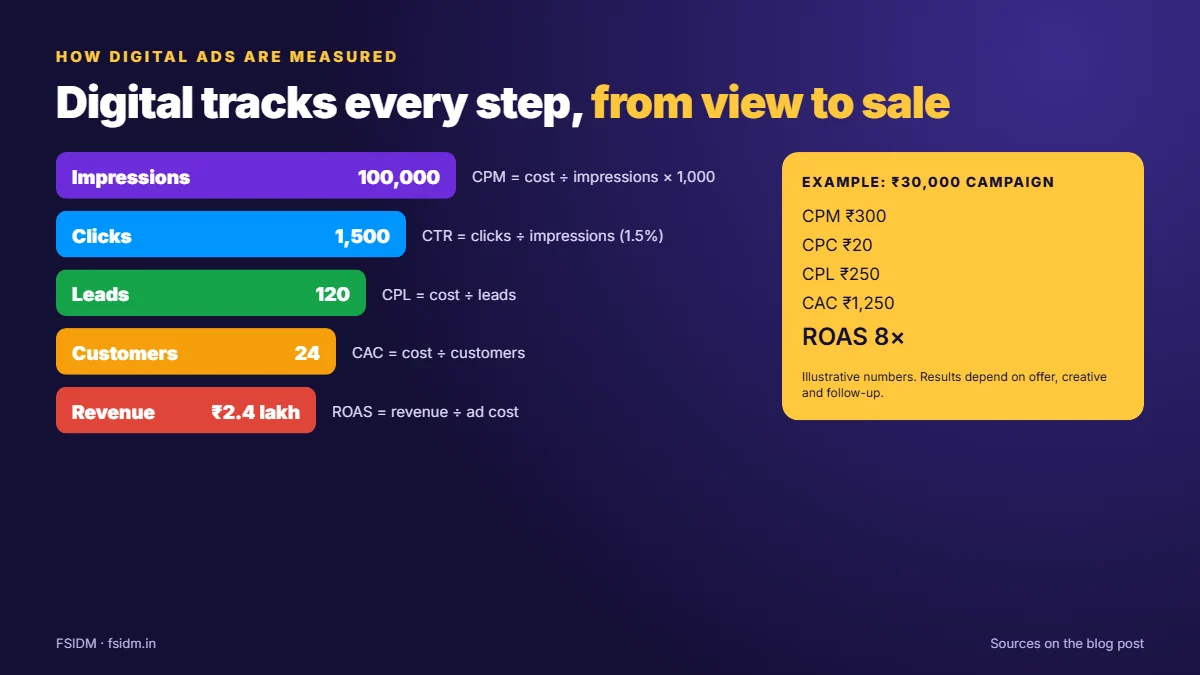
- CPM: cost per 1,000 impressions. This is the closest cousin of CPRP.
- CPC & CTR: cost per click, and the % of viewers who clicked.
- CPL / CPA: cost per lead or per action (form, call, WhatsApp chat, purchase).
- ROAS: revenue ÷ ad spend. 8× means ₹8 back for every ₹1 spent.
- View rate / CPV: for video ads on YouTube and CTV.
The big difference: digital shows you what happened after the view. That’s why advertisers are moving from counting impressions to measuring incremental sales, cost per acquisition and return on ad spend.
4. The TV ↔ digital translation matrix
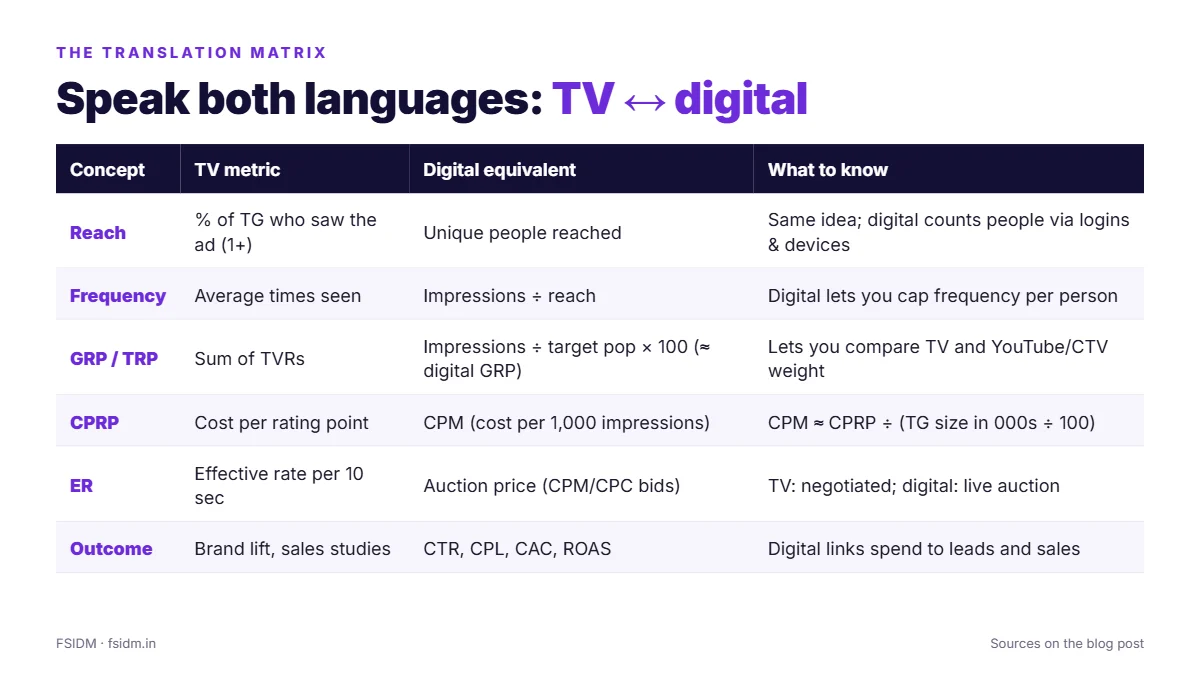
Quick conversion tip: CPM ≈ CPRP ÷ (target audience in thousands ÷ 100). Example: if your target group is 50 lakh people (5,000 thousand), one rating point = 50,000 people. At a CPRP of ₹5,000, that’s ₹5,000 for 50,000 viewers, about ₹100 CPM. Now you can compare TV with YouTube or Meta on similar terms (TV impressions are counted differently, so treat it as a rough guide).
| Question | TV answers with | Digital answers with |
|---|---|---|
| How many people saw it? | Reach %, TVR | Reach, impressions |
| How often? | Frequency, GRP | Frequency (and frequency caps) |
| What did it cost? | CPRP, ER (per 10 sec) | CPM, CPC, CPV |
| Did it work? | Brand lift studies, sales trends | CTR, CPL, CAC, ROAS |
| Who is the audience? | Age, gender, region (TG) | Interests, intent, behaviour, location, job title |
5. Which channel is useful for which business?
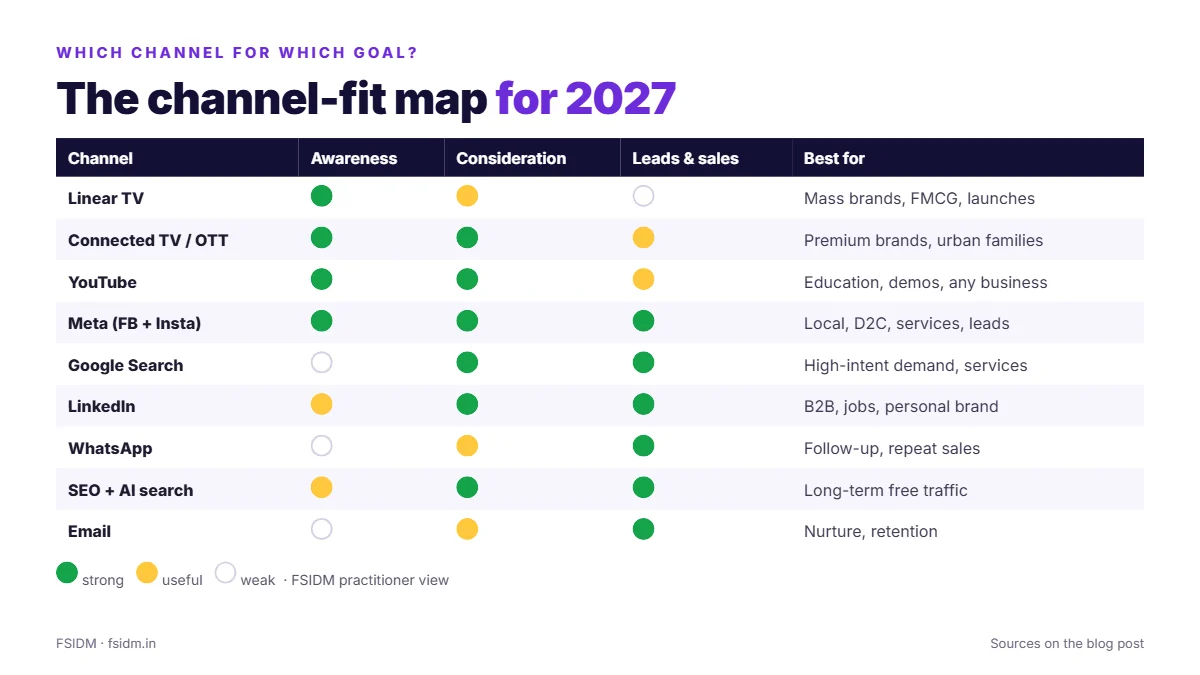
Use cases
| Who | Goal | Best channel mix | Metric to watch |
|---|---|---|---|
| FMCG or national brand launch | Mass awareness fast | TV + CTV + YouTube, then Meta | GRP, reach 3+, CPRP, brand lift |
| Local clinic, salon, coaching | Calls and visits nearby | Google Business Profile, Google Search, Meta, WhatsApp | Calls, CPL, cost per visit |
| D2C or ecommerce brand | Online sales | Meta, Google Shopping/PMax, Instagram creators | ROAS, CAC |
| B2B / SaaS / exporter | Qualified leads | LinkedIn, Google Search, SEO + AI search, email | Cost per qualified lead |
| Real estate, auto, premium brands | Awareness + leads | CTV, YouTube, Meta lead ads, WhatsApp | Reach, CPL, site visits |
| Working professional | Career growth, personal brand | LinkedIn, YouTube, SEO (blog/portfolio) | Profile views, interviews, inbound offers |
For working professionals: why this matters for your career
TV planners who understand GRP and CPRP and digital metrics like CPM and ROAS are in demand because brands now plan TV, CTV and YouTube together. Google Ads, for example, already offers Cross-Media Reach reporting that can include YouTube and, in some markets, linear TV. If you are in sales, media, brand or marketing roles, learning both languages makes you the person who can explain the whole plan.
6. How to choose: a simple 3-question test
- Do I need millions of people to know my brand quickly? Consider TV or CTV, measured with GRP and reach.
- Do I need leads or sales I can count? Start with digital: Google Search, Meta, WhatsApp, measured with CPL and ROAS.
- Do I have a small budget? Digital first. You can start with a few thousand rupees and scale what works.
Frequently asked questions
What is the difference between TRP and GRP?
TRP (or TVR) is the rating of one programme or time slot: the percentage of your target audience watching. GRP is the total of all the TRPs your ad gets across the campaign. If your ad runs twice in a show with a 1.3 rating, you get 2.6 GRPs.
What is CPRP in TV advertising?
CPRP means cost per rating point. It is your total TV spend divided by the GRPs you get. For example, ₹10 lakh for 200 GRPs is a CPRP of ₹5,000. Planners use it to compare channels and programmes.
What does ER mean in TV media buying?
In Indian TV buying, ER usually means effective rate: the actual negotiated price you pay per 10 seconds of airtime after discounts and bonus spots. Media planners also use ‘effective reach’ for the share of people who saw an ad enough times, often 3 or more.
What is the digital equivalent of CPRP?
The closest equivalent is CPM, the cost per 1,000 impressions. You can roughly convert: CPM ≈ CPRP ÷ (target audience size in thousands ÷ 100). Digital also adds outcome metrics like CPC, CPL and ROAS.
Is TV advertising still worth it in 2027?
For mass brands that need to reach millions quickly, yes: linear TV in India is still about ₹32,855 crore a year and connected TV is growing fast. Most small businesses and professionals get better value from digital channels they can measure and target.
Learn to plan, buy and measure ads in 2027
FSIDM’s practical, AI-first digital marketing course covers Meta and Google ads, YouTube, SEO and AI search, analytics and media planning basics, with live classes and real campaigns.
Explore the Digital Marketing Course →Written by Pranav Veerani, Digital Marketing Trainer, Consultant and Paid Media Buyer at FSIDM.