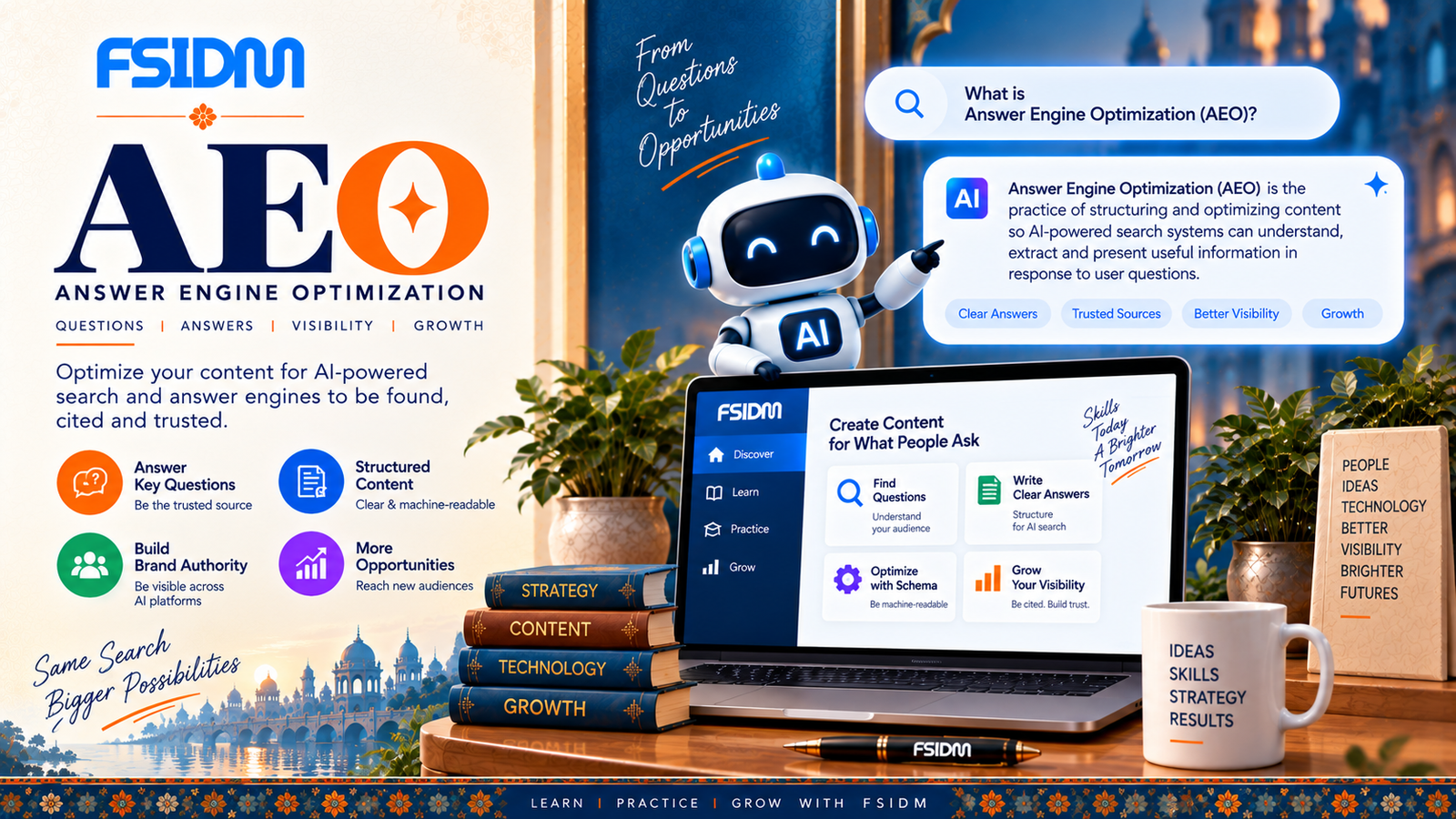
Answer Engine Optimization (AEO) is the practice of structuring and optimizing digital content so answer engines and AI-powered search systems can understand, extract, and present useful information in response to user questions.
Traditional SEO is largely concerned with improving visibility in organic search results. AEO places greater emphasis on direct answers, question-based content, structured information, and brand attribution across modern search and conversational experiences.
AEO is particularly relevant as search experiences increasingly provide answers directly on the results page or through conversational interfaces, reducing the need for users to visit multiple websites.
SEO vs GEO vs AEO
SEO, GEO, and AEO overlap, but each term emphasizes a different aspect of modern search visibility.
| Discipline | Core Focus | Target Mechanism | Ultimate Goal |
|---|---|---|---|
| SEO | Organic search visibility and rankings. | Search engines, crawlers, indexes, and ranking systems. | Increase relevant organic visibility, clicks, and traffic. |
| GEO | Visibility within generative AI experiences. | Generative AI and retrieval systems. | Increase the likelihood of brand mentions, citations, and inclusion in generated answers. |
| AEO | Providing clear, direct answers to user questions. | Answer engines, AI-generated summaries, conversational search, and related answer experiences. | Become a useful and attributable source for answers. |
In industry discussions, AEO and GEO are sometimes used interchangeably. AEO, however, commonly emphasizes the question-and-answer side of search, while GEO is often used more broadly for optimization around generative AI systems.
Why AEO Matters
1. Search Is Becoming More Answer-Oriented
Modern search experiences can provide direct answers, summaries, featured information, and conversational responses. This means visibility is no longer limited to winning a traditional blue-link position.
2. Zero-Click Experiences Are Important
Some searches can be satisfied without a user clicking through to a website. AEO helps businesses think beyond rankings and consider whether their information can become part of the answer users see directly.
3. Brand Attribution Can Influence Visibility
When an answer system references a source, being clearly associated with useful and authoritative information can increase brand exposure even when the user does not immediately visit the website.
Core Pillars of an AEO Strategy
1. Machine-Readable Content Structure
Organize important information into clear, logically separated sections. Question-based headings followed by concise answers can make content easier for both users and automated systems to interpret.
For example:
<h2>How do you calculate marketing ROI?</h2>\n<p>Marketing ROI measures the return generated by a marketing investment compared with its cost.</p>After the direct answer, provide supporting explanations, examples, lists, or tables where they add value.
2. Answer-First Content
Place the most useful answer near the beginning of a section instead of forcing readers to search through a long introduction.
- Ask a specific question.
- Answer it in one or two concise sentences.
- Expand with supporting context.
- Use examples, steps, or data when useful.
3. Structured Data and Schema Markup
Schema.org structured data can help communicate information about a page and its entities in a machine-readable format. Relevant structured-data types depend on the actual content and should be implemented accurately rather than added simply for SEO purposes.
Possible examples include appropriate markup for articles, products, organizations, events, and other supported content types.
4. Deep Entity Clarity
Use specific names and clear relationships rather than vague references. For example, instead of saying “our software integrates with it,” identify the actual product and platform when relevant.
Clear entity references can help establish relationships between brands, products, people, locations, tools, and concepts.
5. Off-Site Brand Authority
A brand’s online presence extends beyond its own website. Consistent, authentic mentions and references across reputable external sources can contribute to how a business is understood online.
Relevant sources may include industry publications, professional communities, local business profiles, social platforms, and other authoritative websites. The focus should be on genuine reputation and useful information rather than artificially generating mentions.
How to Create AEO-Friendly Content
- Identify real questions: Research the questions your target audience actually asks.
- Match search intent: Determine whether the user needs a definition, comparison, process, recommendation, or local information.
- Answer immediately: Give a concise answer before adding deeper explanation.
- Structure the page: Use descriptive headings, lists, tables, and short sections.
- Clarify entities: Use precise brand, product, organization, location, and topic names.
- Add evidence: Support important claims with reliable data or appropriate sources.
- Implement relevant structured data: Use schema that accurately represents the page.
- Build genuine authority: Develop useful content and a consistent presence across relevant external sources.
AEO Content Example
Suppose a user searches: “What is digital marketing?”
An AEO-oriented section could begin with a direct definition:
Digital marketing is the use of digital channels such as search engines, websites, social media, email, and online advertising to reach and engage audiences.
The page can then expand with types of digital marketing, examples, benefits, tools, and related questions. This answer-first structure makes the primary information easy to locate before providing additional depth.
AEO Checklist
- Identify high-value questions relevant to your audience.
- Answer questions directly and concisely.
- Use question-based headings where appropriate.
- Keep important answers close to the relevant heading.
- Use structured lists and comparison tables where they improve clarity.
- Maintain clear entity names and relationships.
- Use accurate, relevant structured data.
- Support important factual claims with credible sources.
- Maintain consistent business information across relevant external platforms.
- Measure visibility across both traditional and AI-powered search experiences.
Common AEO Mistakes
- Writing vague answers: Avoid making users search through paragraphs for the actual answer.
- Overusing question headings: Questions should reflect genuine user needs rather than being added mechanically.
- Adding inaccurate schema: Structured data should accurately represent visible page content.
- Ignoring traditional SEO: AEO works alongside technical SEO, content quality, authority, and search-intent optimization.
- Chasing AI visibility with low-quality content: The objective should be useful, trustworthy information rather than content created solely to trigger an AI response.
AEO FAQs
What does AEO stand for?
AEO stands for Answer Engine Optimization. It refers to optimizing content so answer-oriented search systems can understand and use it to respond to user questions.
What is the difference between AEO and SEO?
SEO broadly focuses on improving visibility in search engines, while AEO places additional emphasis on providing clear, direct answers that can be surfaced in answer-oriented search experiences.
Is AEO the same as GEO?
Not exactly. The terms overlap and are sometimes used interchangeably. AEO generally emphasizes answering user questions, while GEO more broadly focuses on visibility within generative AI experiences.
Does schema markup guarantee an AI citation?
No. Structured data can help communicate information about a page, but it does not guarantee that an AI system or search engine will cite, feature, or rank the content.
How can businesses start with AEO?
Start by identifying important customer questions, creating concise answer-first sections, improving content structure and entity clarity, maintaining technical SEO, and building a trustworthy online presence.
Interview Question
What is AEO and how is it different from traditional SEO?
Interview Tip
A strong answer is: AEO, or Answer Engine Optimization, focuses on structuring content so answer-oriented search and AI systems can understand and surface direct answers to user questions. Traditional SEO has a broader focus on organic search visibility, rankings, and traffic.
Learn AEO and AI-Powered SEO with FSIDM
As search evolves toward direct answers and AI-generated experiences, digital marketers need to understand how content structure, search intent, entities, technical SEO, and authority work together.
FSIDM focuses on practical, industry-oriented digital marketing education, helping learners understand modern SEO, AI-powered marketing, and emerging search strategies through an application-focused approach.