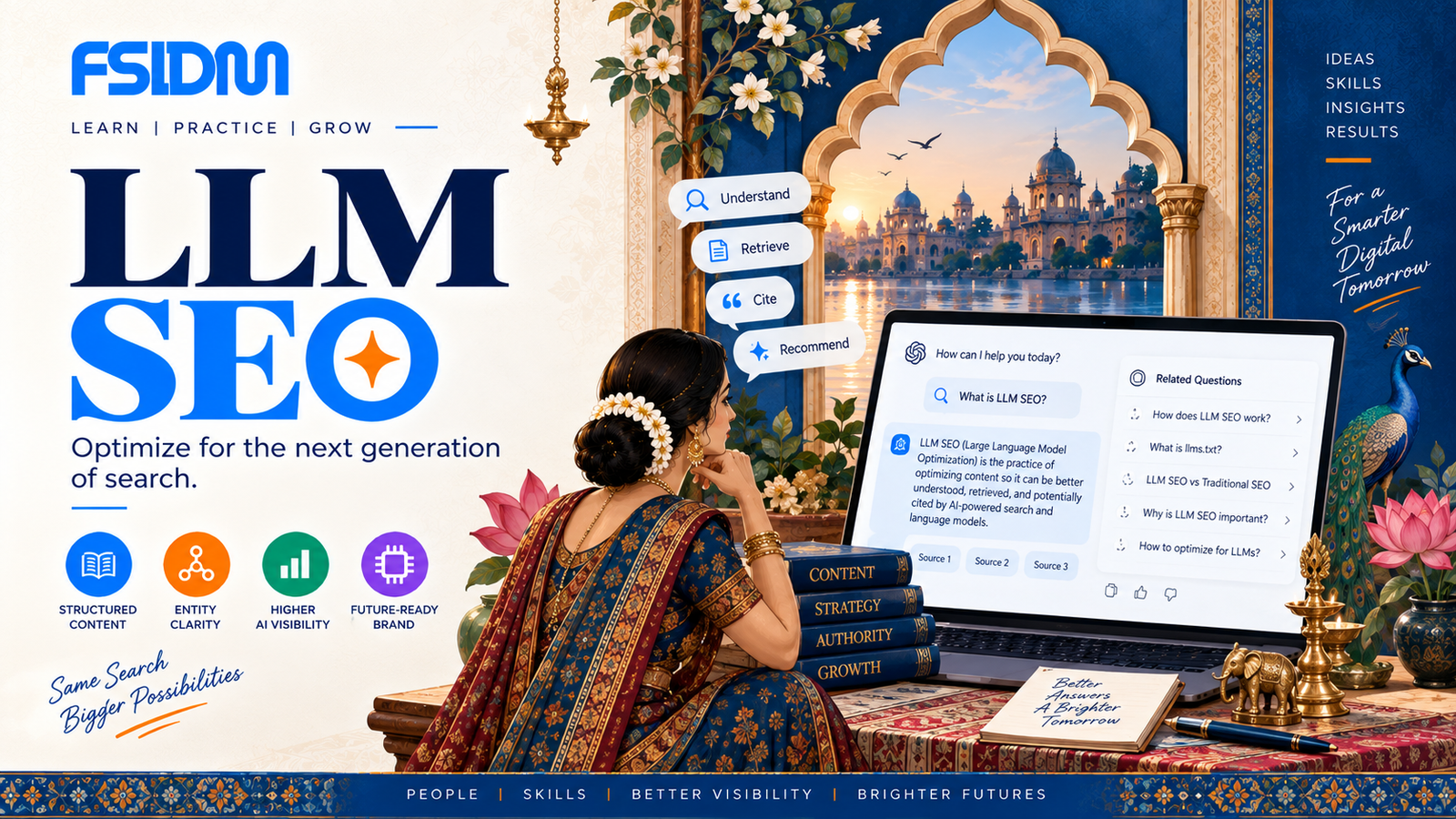
LLM SEO, also known as Large Language Model Optimization (LLMO), is the strategic practice of optimizing digital content so it can be more effectively discovered, understood, retrieved, and potentially cited or mentioned by Large Language Model-powered search and answer experiences.
Traditional SEO primarily focuses on improving a webpage’s visibility in search engine results. LLM SEO shifts part of that focus toward how clearly a brand, topic, product, or source can be understood and represented within conversational AI and generative search experiences.
How LLM SEO Differs from Traditional SEO
Both approaches rely on high-quality, accessible information, but their emphasis can differ.
| Feature | Traditional SEO | LLM SEO (LLMO) |
|---|---|---|
| Target Audience | People using search engines to discover and browse webpages. | AI-powered search and conversational systems generating responses for users. |
| How Content Is Found | Crawling, indexing, and retrieval through search engines. | May involve web retrieval, indexed sources, knowledge bases, and other information available to the AI system. |
| Success Metrics | Rankings, organic visibility, clicks, and traffic. | Brand mentions, citations, recommendations, and visibility within AI-generated responses. |
| Content Requirement | Search-accessible, useful, relevant, and technically sound content. | Clear, structured, semantically rich, authoritative information that can be interpreted and referenced by AI systems. |
LLM SEO should therefore be viewed as an extension of modern search optimization rather than a completely separate replacement for traditional SEO.
Core Pillars of an LLM SEO Strategy
1. Understand the Role of llms.txt
llms.txt is a proposed website convention intended to provide language models with a concise, machine-readable overview of important website information and resources.
It is important to distinguish this from established standards such as robots.txt. An llms.txt file should not be presented as a universal requirement for AI search visibility or as a guaranteed method of controlling how every LLM crawls or retrieves a website.
Where appropriate, organizations can explore whether maintaining an llms.txt file fits their technical and content strategy.
2. Build a Strong Semantic Footprint
LLM-oriented optimization goes beyond repeating exact keywords. Content should establish meaningful relationships between concepts, entities, products, services, and topics.
For example, a page about an email marketing tool can naturally cover related concepts such as deliverability, list segmentation, A/B testing, open rates, bounce rates, automation, and campaign analytics.
This creates a richer topical context than repeatedly using the same keyword without adding useful information.
3. Improve Entity Clarity
Use specific names and explicit relationships wherever context requires them. Instead of writing “our platform integrates with it,” identify the actual platform and service:
“The Brand Name platform integrates with HubSpot CRM.”
Clear entity references help readers and automated systems understand exactly which businesses, products, technologies, organizations, or concepts are being discussed.
4. Build a Consistent Off-Site Presence
A brand’s digital footprint extends beyond its own website. Relevant external references, reviews, discussions, publications, professional profiles, and industry resources can provide additional context about a business.
Organizations should focus on developing genuine, consistent, and trustworthy brand mentions rather than attempting to manufacture references across unrelated websites or communities.
5. Publish Original Data and Expertise
Original research, proprietary data, case studies, experiments, expert analysis, and first-hand insights can make a website a more distinctive information source.
Instead of publishing generic summaries that repeat information already available everywhere, create content that contributes something new to the topic. This can strengthen the site’s overall informational value and provide material that other sources can reference.
6. Format Content for Clear Retrieval
Break complex information into logical, self-contained sections. Clear headings, concise definitions, numbered processes, bullet lists, comparison tables, summaries, and examples can make information easier to understand and retrieve.
The objective should not be to create artificial “snippets” for AI systems. Instead, structure content so that each important section communicates a complete idea clearly to both human readers and machines.
How to Create LLM-Friendly Content
- Define the topic clearly: Start with a concise explanation of what the topic, product, service, or concept means.
- Cover related entities: Address important concepts that naturally belong to the subject.
- Answer specific questions: Include practical questions users may ask about the topic.
- Use precise language: Avoid unnecessary ambiguity and vague references.
- Provide original information: Add research, examples, data, case studies, or expert perspectives where possible.
- Structure the content: Use headings, lists, tables, and concise sections to organize information.
- Maintain technical accessibility: Ensure important content can be discovered and accessed by search and retrieval systems.
- Build external authority: Develop a legitimate presence across relevant industry and business sources.
Example of Semantic Optimization
Consider a page targeting the topic “digital marketing agency”.
A weak approach might repeatedly use the exact phrase without providing meaningful context.
A stronger semantic approach could naturally explain related services such as SEO, paid advertising, social media marketing, content marketing, analytics, lead generation, conversion optimization, local SEO, and marketing strategy.
The content can also clearly identify the business, locations served, industries supported, service categories, tools used, and relevant expertise. This creates a more complete representation of the topic and entity.
LLM SEO Checklist
- Explain important topics clearly and directly.
- Build semantic relationships between related concepts and entities.
- Use specific brand, product, organization, and technology names when relevant.
- Publish original research, data, case studies, or expert insights.
- Use descriptive headings and logical content sections.
- Use lists and tables when they improve information clarity.
- Keep important website content technically accessible.
- Maintain accurate and consistent brand information across relevant external sources.
- Monitor brand mentions and citations in relevant AI search experiences.
- Continue investing in traditional SEO fundamentals.
Common LLM SEO Mistakes
- Assuming AI visibility is guaranteed: No optimization technique guarantees that an AI system will mention or cite a particular source.
- Overusing keywords: Semantic optimization is about meaningful topical relationships, not repetitive keyword insertion.
- Publishing generic AI-generated content: AI can assist content production, but distinctive expertise and original information can make content more valuable.
- Creating artificial brand mentions: Off-site visibility should come from genuine relevance and reputation rather than manipulation.
- Treating llms.txt as mandatory: It is a proposed convention, not a universal replacement for established technical SEO practices.
- Ignoring traditional SEO: Crawlability, accessibility, useful content, authority, and search intent remain important.
LLM SEO FAQs
What does LLM SEO stand for?
LLM SEO stands for Large Language Model SEO and is also commonly referred to as Large Language Model Optimization (LLMO). It describes efforts to improve how content and brands can be understood, retrieved, mentioned, or cited in AI-powered search and conversational experiences.
What is the difference between LLM SEO and traditional SEO?
Traditional SEO focuses broadly on improving visibility in search engines, while LLM SEO emphasizes how content and entities can be understood and surfaced within language-model-powered search and answer experiences.
Is LLM SEO the same as GEO?
Not necessarily. The terminology is still evolving. LLM SEO generally emphasizes optimizing content and brand information for large language model-based systems, while GEO is commonly used for broader optimization of visibility in generative AI search experiences.
What is llms.txt?
llms.txt is a proposed website convention designed to provide AI systems with a concise overview of important website resources. It should not be treated as a guaranteed ranking or citation mechanism.
How can original content help LLM SEO?
Original research, proprietary data, case studies, and expert insights can provide information that is more distinctive and useful than generic content repeated across many websites.
Can traditional SEO and LLM SEO be used together?
Yes. A strong modern search strategy can combine technical SEO, useful content, search-intent optimization, authority building, structured information, and optimization for AI-powered search experiences.
Interview Question
What is LLM SEO, and how does it differ from traditional SEO?
Interview Tip
A strong answer is: LLM SEO focuses on making a brand’s content and information easier for large language model-powered search and answer systems to understand, retrieve, mention, or cite. Traditional SEO has a broader focus on organic search visibility, rankings, and traffic.
Learn LLM SEO with FSIDM
As search increasingly incorporates AI-powered answers and conversational discovery, understanding how language models interpret content is becoming an important part of modern digital marketing.
FSIDM focuses on practical, industry-oriented digital marketing education, helping learners understand SEO, AI-powered marketing, content strategy, and emerging search technologies through an application-focused approach.