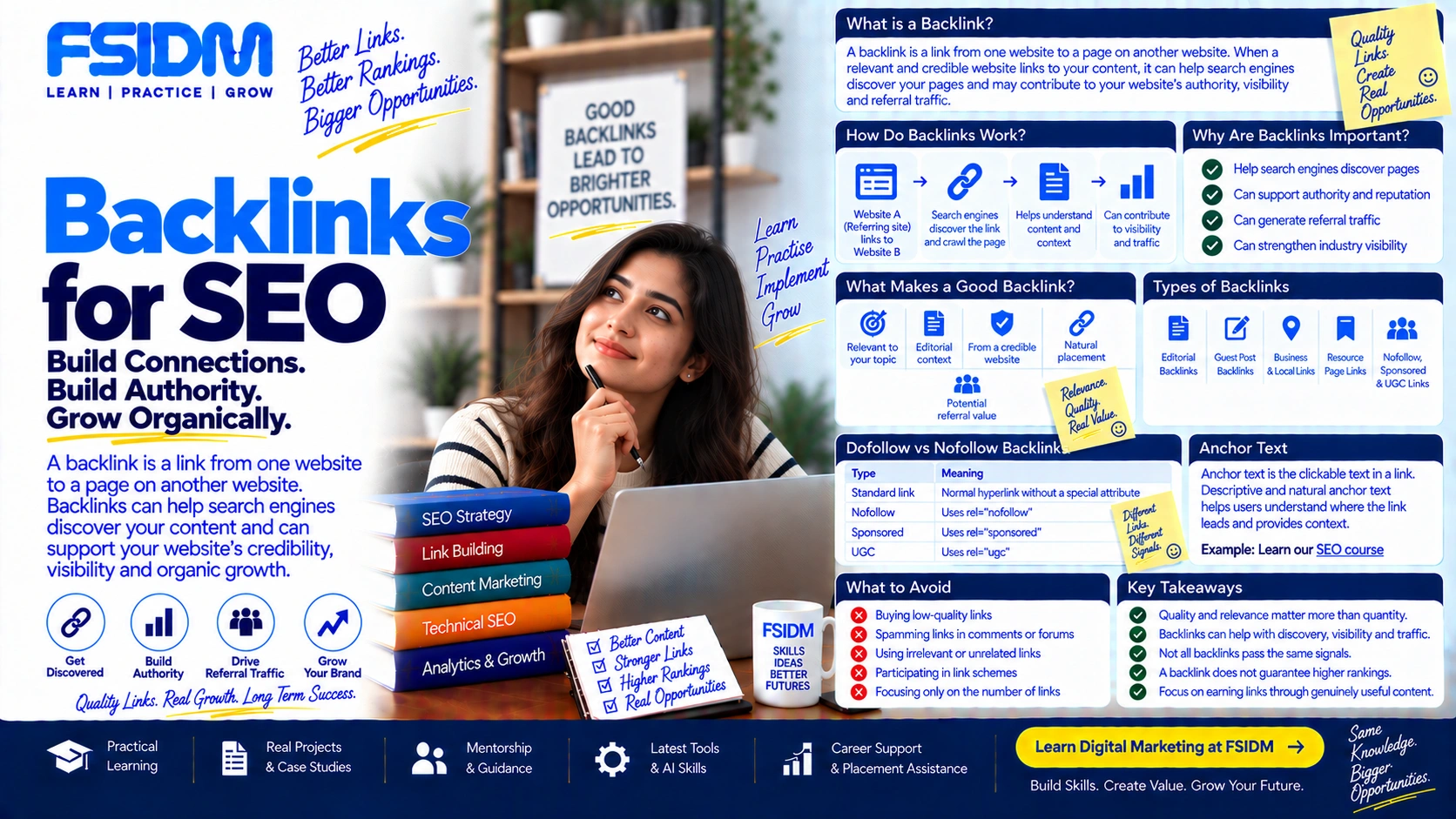
A backlink is a link from one website to a page on another website. In simple terms, when another website links to your webpage, your website receives a backlink.
For example, if a digital marketing blog publishes an article about SEO and links to an FSIDM resource for further learning, that link is a backlink for FSIDM and an outbound link for the referring website.
Backlinks are an important part of SEO because links can help search engines discover webpages and can serve as signals of relevance, credibility and importance. However, not all backlinks have the same value. Relevance, quality and context matter more than simply collecting a large number of links.
How Do Backlinks Work?
Imagine two websites discussing the same topic. Website A publishes a useful resource, and Website B finds it valuable enough to reference with a link.
The link creates a connection between the two webpages:
- Website A: Referring website
- Website B: Linked or target website
- Backlink: The link pointing from Website A to Website B
Search engines can use links to discover content and understand relationships between webpages. Links can also contribute to Google’s broader systems for evaluating webpages, although a backlink does not guarantee higher rankings.
Why Are Backlinks Important for SEO?
1. Help Search Engines Discover Pages
Links provide pathways through which search-engine crawlers can discover webpages. A strong internal and external link structure can make important content easier to find.
2. Can Support Authority and Reputation
When relevant and reputable websites independently reference your content, those links can contribute to the broader signals associated with your website and pages.
3. Can Generate Referral Traffic
A backlink is not only an SEO signal. People can click the link and visit your website directly, creating referral traffic.
4. Can Strengthen Industry Visibility
Being referenced by relevant publications, organizations and industry websites can help establish a website’s presence within its subject area.
What Makes a Good Backlink?
A useful backlink is not simply a link from a website with a high third-party authority score. Several characteristics should be considered.
- Relevance: The referring website and linked content are meaningfully related.
- Editorial context: The link is included because it is genuinely useful to readers.
- Quality of the referring site: The website has a credible and useful presence.
- Natural placement: The link makes sense within the surrounding content.
- Potential referral value: The link can bring relevant visitors to the website.
For example, a link from a respected digital marketing publication to an in-depth SEO guide can be more meaningful than hundreds of unrelated links from low-quality websites.
Types of Backlinks
1. Editorial Backlinks
These are links naturally included within editorial content because the publisher considers the referenced resource useful. They are generally among the most valuable types of links to earn.
2. Guest Post Backlinks
These are links associated with content contributed to another website. Guest contributions should provide genuine value and should not be used primarily as a scheme for manipulating search rankings.
3. Business and Local Links
Local directories, chambers of commerce, industry associations and relevant business listings can provide backlinks when they are legitimate and relevant to the business.
4. Resource Page Links
A website may link to useful guides, tools, research or resources as part of a curated resource page.
5. Nofollow and Other Link Attributes
Links can use attributes such as rel="nofollow", rel="sponsored" or rel="ugc" to provide search engines with additional context about the relationship or nature of the link.
Dofollow vs Nofollow Backlinks
| Type | Meaning |
|---|---|
| Standard link | A normal hyperlink without a qualifying relationship attribute |
| Nofollow | Uses rel="nofollow" to indicate that the publisher does not want the link treated as a normal editorial endorsement |
| Sponsored | Uses rel="sponsored" for links associated with advertisements, sponsorships or other paid arrangements |
| UGC | Uses rel="ugc" for user-generated content such as comments or forum posts |
It is too simplistic to describe links as simply “dofollow = good” and “nofollow = useless.” Search engines can discover links with different attributes, and links can have value beyond traditional ranking signals, including referral traffic and brand visibility.
What Is Anchor Text?
Anchor text is the clickable text used in a hyperlink. For example, in the sentence “Learn our SEO course,” the words “SEO course” may be the anchor text.
Descriptive anchor text can help users understand where a link leads and can provide contextual information about the linked page.
However, repeatedly forcing exact-match commercial keywords into backlinks can look unnatural. A natural link profile typically contains a variety of relevant anchor-text patterns.
How to Earn Backlinks
The strongest long-term link-building strategy is to create resources that other people genuinely want to reference.
- Publish original research: Data, surveys and industry studies can attract citations.
- Create useful resources: Detailed guides, templates, tools, checklists and practical frameworks can earn references.
- Use digital PR: Offer useful expertise, original findings or commentary to relevant publications.
- Build industry relationships: Genuine professional relationships can create opportunities for relevant mentions.
- Promote valuable content: Outreach can help relevant publishers discover resources worth referencing.
- Recover legitimate unlinked mentions: When a website mentions a brand without linking, an appropriate outreach request may sometimes turn that mention into a useful link.
What Is Link Building?
Link building is the SEO practice of acquiring backlinks from external websites. The objective should be to earn relevant, trustworthy references rather than maximize the raw number of links.
Effective link building can involve digital PR, content marketing, partnerships, resource outreach, industry contributions and other legitimate methods.
Do More Backlinks Mean Better Rankings?
No. Backlink quantity alone does not determine rankings.
One highly relevant, editorially earned link can be more valuable than many unrelated or low-quality links. Google’s systems evaluate links in context, alongside many other signals such as relevance and content quality.
Buying large quantities of links or participating in link schemes designed to manipulate rankings can violate Google’s spam policies and create SEO risk.
Backlinks vs Internal Links
| Backlinks | Internal Links |
|---|---|
| Come from another website | Come from the same website |
| Can provide external references and referral traffic | Help users and search engines navigate your own site |
| Often require earning or acquiring external mentions | Can be controlled through your own website architecture |
How to Check Backlinks
SEO platforms such as Google Search Console, Semrush, Ahrefs and other backlink-analysis tools can provide different views of a website’s link profile.
When analyzing backlinks, look beyond the total count. Review the referring domains, relevance, link context, target pages, anchor text and overall quality of the links.
Common Backlink Mistakes
- Buying backlinks solely to manipulate rankings.
- Focusing on backlink quantity instead of relevance and quality.
- Building links from unrelated websites.
- Overusing exact-match commercial anchor text.
- Using automated link-building networks or spammy directories.
- Assuming every backlink is beneficial.
- Measuring success only through third-party authority scores.
Frequently Asked Questions
What is a backlink in SEO?
A backlink is a hyperlink from one website to a page on another website. It can help users discover content and can provide search engines with signals about relationships and references between webpages.
Are backlinks still important for SEO?
Yes. Links remain an important part of how search engines discover and evaluate webpages, although rankings depend on many factors and backlinks should not be treated as the only SEO signal.
How many backlinks do I need?
There is no universal number. The goal should be to earn relevant, high-quality links that make sense for your website and industry rather than reaching a fixed backlink count.
Are all backlinks good?
No. Some links may provide little SEO value, while manipulative or spammy link-building practices can create risk. Relevance, context and quality matter.
Can I buy backlinks?
Buying links specifically to manipulate search rankings can violate Google’s spam policies. Legitimate advertising or sponsorship arrangements should be appropriately disclosed and use the relevant link attributes.
Interview Question
Q: What is a backlink, and why is it important in SEO?
Answer: A backlink is a link from an external website to a webpage on your website. Backlinks can help search engines discover content, provide contextual signals and generate referral traffic. Their value depends on factors such as relevance, quality and context, not simply the number of links.
Interview Tip
Don’t say “more backlinks always mean better rankings.” A stronger SEO answer is: “Relevant, high-quality and naturally earned backlinks can support search visibility, while low-quality or manipulative links may provide little value or create risk.”
Learn Link Building with FSIDM
Backlink building is one part of a broader off-page SEO strategy. Successful SEO professionals need to understand link quality, anchor text, referring domains, digital PR, content promotion and ethical link acquisition.
FSIDM focuses on practical, industry-oriented digital marketing and SEO learning, helping students and professionals understand backlinks and apply link-building strategies to real-world websites.