Imagine you search Google for something important.
Maybe you want to choose a doctor. Maybe you are about to spend ₹50,000 on a course. Maybe you want financial advice. Or perhaps you simply want to know whether a product is worth buying.
You see two websites.
One looks professional. It clearly tells you who wrote the content, provides evidence, shows contact information and explains where its information comes from.
The other has anonymous articles, exaggerated claims, broken links and a dozen aggressive pop-ups.
Which one would you trust?
Probably the first one.
That basic human reaction is important in SEO too.
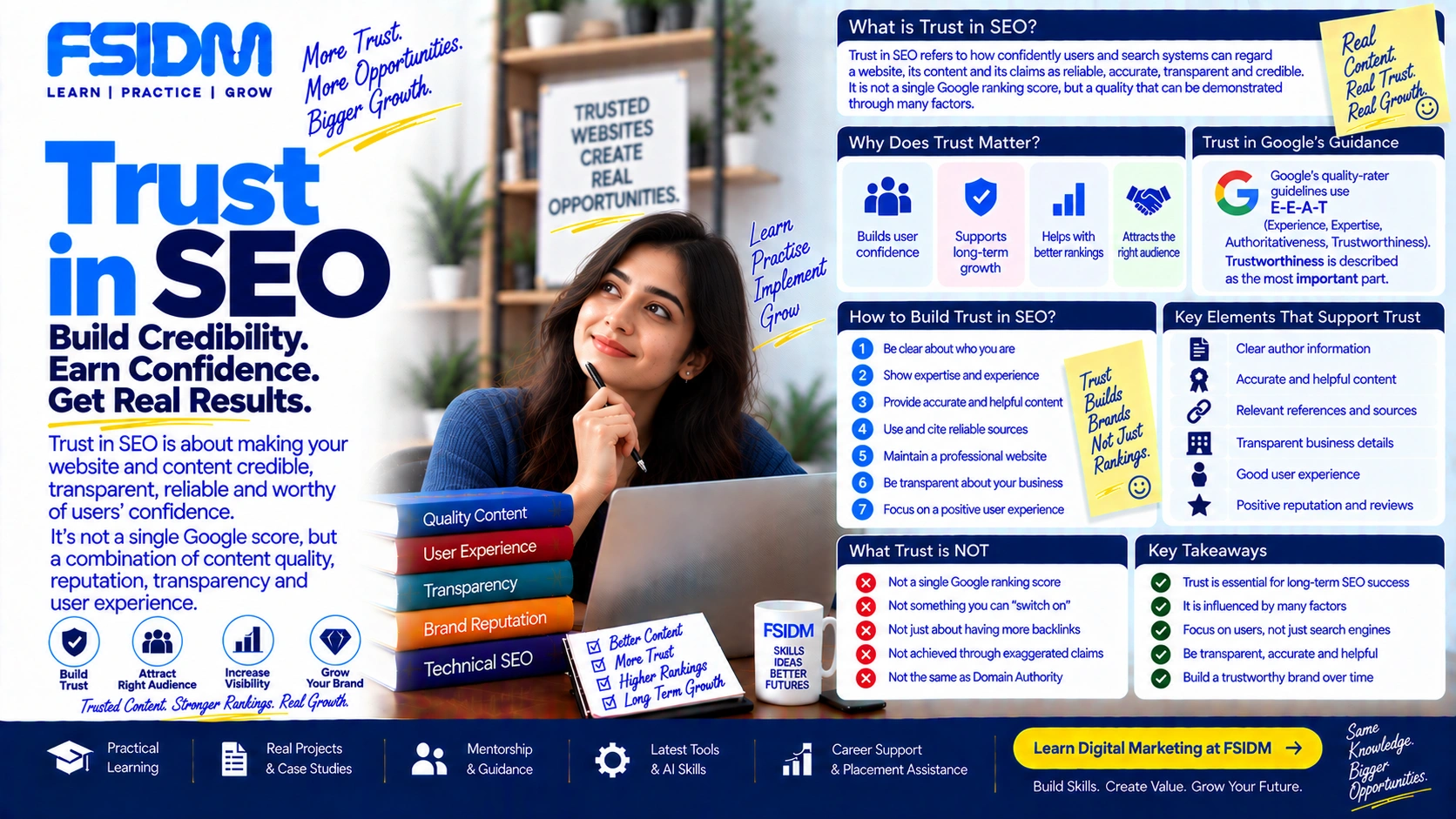
Trust in SEO is about making your website and its content credible, transparent, reliable and worthy of users’ confidence.
And there is an important distinction: trust is not a single Google ranking score. It is better understood as a quality that can be demonstrated through your content, website experience, reputation, transparency and the signals surrounding your business and information.
What Is Trust in SEO?
Trust in SEO refers to how confidently users and search systems can regard a website, its content and its claims as reliable, accurate, transparent and credible.
Think about it from a user’s perspective.
If someone lands on your website, they should be able to answer questions such as:
- Who created this content?
- Why should I believe it?
- Where did this information come from?
- Is the business real?
- Can I contact someone?
- Does the website clearly explain what it offers?
- Does the content actually help me?
- Is the website trying to mislead me?
Trust grows when the answers to those questions are reassuring.
Trust falls when the answers are unclear.
Is Trust a Google Ranking Factor?
This is where SEO conversations often become misleading.
Google does not provide a simple public “Trust Score” that you can check for your website.
You should therefore be careful when someone says something like:
“Your website has low trust, so Google gave you a low trust score.”
That is not how Google publicly describes Search.
However, trustworthiness is clearly important to Google’s search-quality guidance. Google’s Search Quality Rater Guidelines use Experience, Expertise, Authoritativeness and Trustworthiness (E-E-A-T) to help human quality raters assess the quality of search results. Trustworthiness is described as the most important member of E-E-A-T. ([developers.google.com](https://developers.google.com/search/blog/2022/12/google-raters-guidelines-e-e-a-t?utm_source=chatgpt.com))
So the smart SEO approach is not to chase a fictional “trust score.”
Instead, build a website that gives users strong reasons to trust it.
Trust and E-E-A-T
You have probably heard the term E-E-A-T.
It stands for:
- Experience
- Expertise
- Authoritativeness
- Trustworthiness
These concepts are used in Google’s quality-rater guidance to help assess the quality of content and websites.
Trustworthiness is particularly important because a website can have expertise but still be difficult to trust.
Imagine a website written by someone who clearly understands finance but hides who operates the website and provides no information about its sources.
The expertise might be real.
But the overall trustworthiness may still be questionable.
Google’s guidance specifically says that trust is the most important aspect of E-E-A-T, while the importance of the other elements can vary depending on the page and topic. ([developers.google.com](https://developers.google.com/search/blog/2022/12/google-raters-guidelines-e-e-a-t?utm_source=chatgpt.com))
Why Does Trust Matter in SEO?
Search engines exist to help people find useful information.
If a search result sends someone to a misleading, unreliable or unsafe website, the search experience becomes worse.
That is why trust matters at a fundamental level.
Consider two articles about the same topic.
Article A explains the topic clearly, identifies the author, cites reliable sources and provides useful evidence.
Article B makes dramatic claims without evidence, hides the author and appears to have been written only to capture search traffic.
Even before thinking about algorithms, most users would feel more comfortable with Article A.
Good SEO should not fight that instinct.
Good SEO should support it.
How Do You Build Trust in SEO?
There is no single “trust button” you can switch on.
Trust is built through many small decisions across your website.
1. Be Clear About Who You Are
People are more likely to trust a website when they can understand who is behind it.
For a business website, this could include:
- A clear About page
- Business information
- Contact details
- Team or author information
- Relevant professional experience
- Company address where appropriate
You do not need to turn your About page into a 5,000-word autobiography.
Just make the important information easy to find.
2. Show Who Created the Content
Author information can be particularly useful when the subject depends heavily on expertise.
For example, if you publish an article about digital marketing, showing who wrote or reviewed the article can give readers more context.
An author bio could explain relevant experience, expertise or professional background.
The goal is not to add an impressive title just for SEO.
The goal is to help the reader understand why this person is qualified to discuss the subject.
3. Support Important Claims
Suppose your article says:
“This strategy increases conversions by 300%.”
A reasonable reader will ask:
“According to whom?”
If the claim is supported by reliable research, original data, a documented experiment or a credible source, explain that.
For important topics, evidence makes your content more useful and more credible.
Google’s guidance also emphasizes that high-quality pages should make it clear when content relies on external sources and should not deceive users about its purpose. ([developers.google.com](https://developers.google.com/search/docs/fundamentals/creating-helpful-content?utm_source=chatgpt.com))
4. Keep Information Accurate
Trust can disappear surprisingly quickly when a website repeatedly publishes incorrect information.
Imagine reading an article that contains five outdated statistics.
Even if the rest of the article is excellent, you may start questioning everything else on the page.
For topics that change frequently, review important information periodically.
This is especially useful for areas such as:
- Technology
- SEO
- Digital advertising
- Government policies
- Finance
- Healthcare
- Software
5. Be Transparent About the Business
If your website sells something, make it easy for users to understand what they are buying.
Important information can include:
- Pricing or pricing information where appropriate
- Terms and conditions
- Refund or cancellation policies
- Privacy information
- Contact methods
- Business details
Hiding important information behind layers of confusing navigation does not create confidence.
6. Don’t Make False Promises
SEO websites are full of promises like:
“Rank #1 on Google in 7 days.”
“Guaranteed traffic.”
“Guaranteed Google ranking.”
These claims may sound attractive, but search performance depends on many variables and cannot responsibly be reduced to guaranteed outcomes.
Being honest about uncertainty can actually make a brand more credible.
Trust and Backlinks
Backlinks are often discussed when talking about authority and trust.
But this does not mean:
“More backlinks = more trust.”
That is far too simplistic.
A relevant editorial link from a respected website can be useful.
Thousands of irrelevant, manipulative or low-quality links do not automatically make a website trustworthy.
Google’s spam policies specifically address attempts to manipulate search rankings through various spam techniques. ([developers.google.com](https://developers.google.com/search/docs/essentials/spam-policies?utm_source=chatgpt.com))
So link building should focus on earning genuinely useful references rather than manufacturing an artificial appearance of popularity.
Trust vs Domain Authority
These two concepts are often confused.
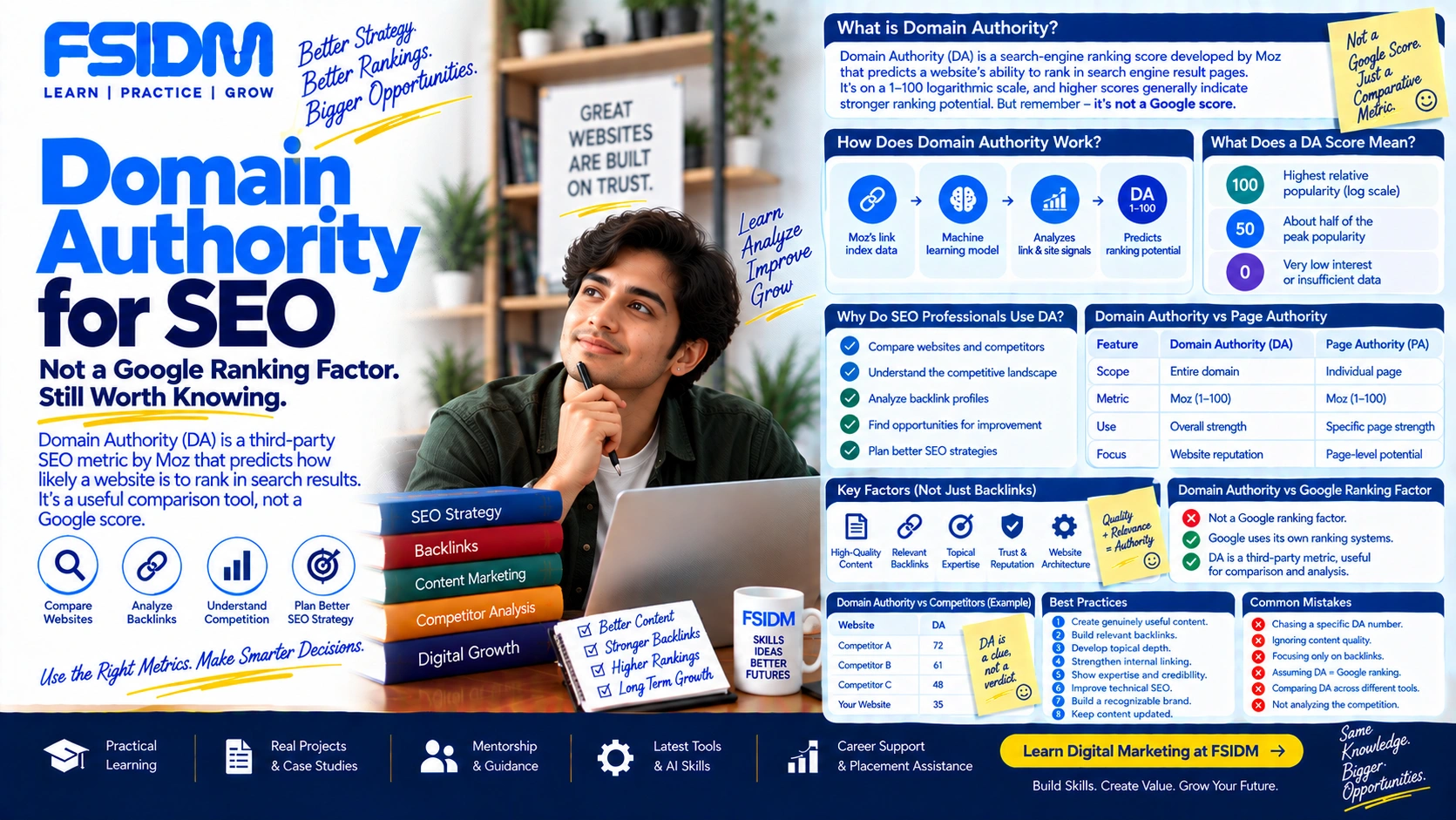
Domain Authority (DA) is a third-party metric created by Moz that predicts ranking strength using Moz’s own methodology.
Trust is a much broader concept involving the credibility, reliability and transparency of a website and its content.
A website can have a high DA and still publish questionable content.
A newer website can have a low DA while providing excellent, trustworthy information.
So:
DA is a metric.
Trust is a quality.
Do not confuse the two.
Can a New Website Build Trust?
Absolutely.
You do not need a 15-year-old domain to make your website trustworthy.
A new website can demonstrate trust through:
- Clear business information
- Strong author transparency
- Accurate content
- Reliable sources
- Original research and experience
- Useful customer information
- Secure website practices
- Clear policies
- Consistent publishing standards
Trust is not simply about age.
It is about giving people enough evidence to confidently understand who you are and whether your information deserves their attention.
Trust in YMYL Topics
Trust becomes especially important when content can significantly affect a person’s health, safety, financial stability or well-being.
Google refers to these as Your Money or Your Life (YMYL) topics.
Imagine two websites giving medical advice.
Would you treat them exactly the same?
Probably not.
For high-stakes subjects, users need strong reasons to believe that the information is accurate and responsibly presented.
That means publishers should pay particular attention to expertise, sourcing, accuracy, transparency and appropriate review processes.
Trust Is Not Just About Content
A trustworthy website is not only about writing good articles.
The overall experience matters too.
Imagine a website with excellent content but:
- Constant misleading pop-ups
- Fake download buttons
- Confusing advertisements
- Broken pages
- Hidden contact information
- Misleading claims
- Unclear ownership
Would you trust it?
Probably not.
Trust is influenced by the whole experience a user has with a website.
What Is Site Reputation?
Another related concept is site reputation.
A website’s reputation can be influenced by how people and other sources perceive the site or business.
This is also why Google has policies addressing abuse of the reputation of established websites. Google introduced its site reputation abuse policy to address situations where third-party content is published on a trusted website primarily to exploit the host site’s existing reputation and ranking signals. ([developers.google.com](https://developers.google.com/search/blog/2026/08/update-site-reputation-policy?utm_source=chatgpt.com))
The lesson for SEO professionals is simple:
Don’t borrow someone else’s reputation just to manipulate search rankings.
Build your own.
Trust and AI Search
Trust is becoming even more important as search increasingly includes AI-generated experiences.
When AI systems summarize information, users still need reliable sources behind those answers.
This means brands should not think only about ranking a blue link.
They should also think about whether their information is:
- Clear
- Consistent
- Accurate
- Attributable
- Well-supported
- Easy for people and systems to understand
However, avoid the common SEO mistake of claiming that there is a simple “AI trust score.” There is no public universal score that tells you how trustworthy your website is across every AI search system.
The practical goal remains the same: publish information that deserves to be trusted.
How Can You Measure Trust in SEO?
This is where things get interesting.
There is no single metric called “Trust” that you can enter into an SEO tool and get a perfect answer.
Instead, look at a group of signals.
| Area | What to investigate |
|---|---|
| Content | Accuracy, usefulness, originality and evidence |
| Authors | Relevant experience, expertise and transparency |
| Business | Clear identity, contact information and policies |
| Reputation | Relevant mentions, reviews and independent references |
| Links | Relevant and credible editorial references |
| Website experience | Clear navigation, honest presentation and usability |
| Search visibility | Organic performance and user behavior patterns |
None of these should be treated as a magic “trust score.”
Together, they help you evaluate whether your website gives users good reasons to trust it.
A Simple FSIDM Example
Imagine someone searches:
“Best digital marketing course in Ahmedabad.”
They find an FSIDM article.
The article clearly explains:
- Who FSIDM is
- Who teaches the course
- What students learn
- How the practical training works
- What tools are covered
- How to contact the institute
The article also avoids making unrealistic promises such as “guaranteed ₹1 lakh salary after the course.”
Instead, it explains what the course offers and lets the reader make an informed decision.
That is trust in practice.
You are not trying to look trustworthy.
You are making it easier for someone to verify why they should trust you.
Common SEO Mistakes That Reduce Trust
Anonymous Content Everywhere
If every article is published without authorship or accountability, readers may have less context about who created the information.
Unsupported Statistics
Throwing percentages into an article without explaining their source can make the content look impressive but less credible.
Overpromising
Guaranteed rankings, guaranteed traffic and unrealistic income claims can damage credibility.
Fake Reviews or Testimonials
Manufactured social proof can create serious trust problems if discovered.
Copied Content
Repeating what everyone else has already said without adding experience, evidence or useful insight does little to establish credibility.
Manipulative SEO
Trying to exploit another site’s reputation or manipulate search systems instead of creating genuinely useful content can work against the long-term goal of building a trustworthy website.
Trust Is Built Slowly and Lost Quickly
This is true in SEO just as it is in real life.
You might spend years building a reputation.
Then one misleading claim, fake testimonial or dishonest practice can make people question everything else.
That is why trust should not be treated as an SEO trick.
It should be treated as a business principle.
Trust in SEO in One Simple Sentence
Trust in SEO means creating a website and content that people can confidently understand, verify and rely on.
You cannot simply add a “Trust” badge and expect Google or users to believe you.
You build trust by consistently showing:
Who you are → What you know → Where your information comes from → Why your claims are credible → How you help the user.
And that is much more powerful than chasing another SEO number.
Frequently Asked Questions About Trust in SEO
What does trust mean in SEO?
Trust in SEO refers to the credibility, reliability, transparency and overall trustworthiness of a website, its content and the information it provides.
Is trust a Google ranking factor?
Google does not provide a single public trust score or describe “trust” as one standalone ranking factor. However, trustworthiness is an important part of Google’s E-E-A-T quality framework used in its Search Quality Rater Guidelines.
What is E-E-A-T in SEO?
E-E-A-T stands for Experience, Expertise, Authoritativeness and Trustworthiness. Google uses these concepts in its Search Quality Rater Guidelines to help human raters assess the quality of search results.
How can I improve trust on my website?
Clearly identify your business and authors, publish accurate and useful content, cite reliable sources where appropriate, provide transparent business information, avoid misleading claims and create a good user experience.
Is Domain Authority the same as trust?
No. Domain Authority is a third-party SEO metric from Moz. Trust is a broader concept involving credibility, reliability, transparency and other qualities of a website and its content.
Does trust matter more for YMYL content?
Trust is particularly important for topics that can significantly affect people’s health, safety, financial stability or well-being. These topics require especially strong attention to accuracy, expertise and responsible presentation.