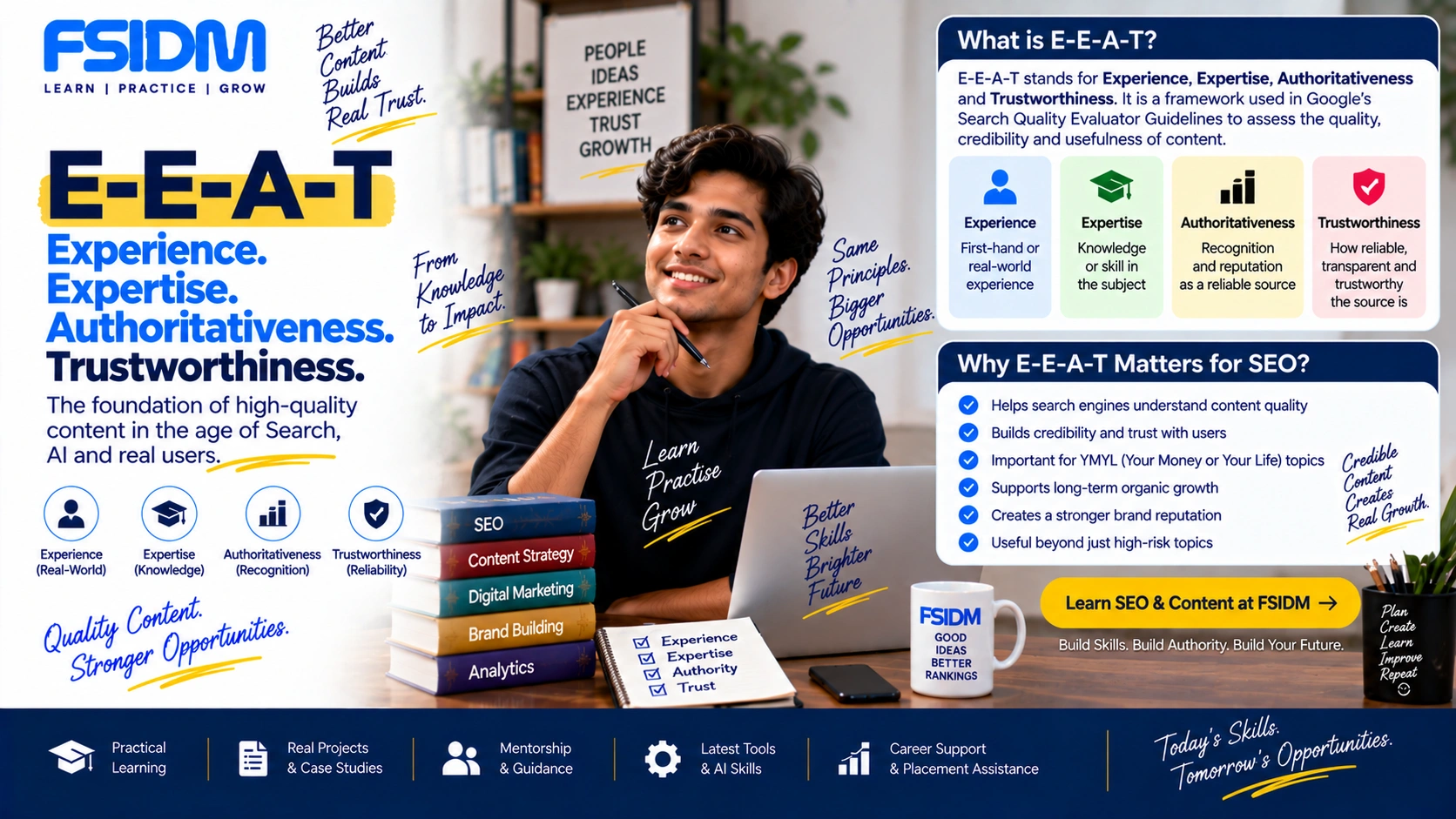
E-E-A-T stands for Experience, Expertise, Authoritativeness, and Trustworthiness. It is a framework used in Google’s Search Quality Evaluator Guidelines to help human evaluators assess the quality of search results and the people or sources behind them.
E-E-A-T is especially important when evaluating whether content appears useful, credible, and trustworthy. It is not a single Google ranking score, and Google does not publish an E-E-A-T number that websites can optimize for.
The four concepts are related, but each focuses on a different aspect of content quality. Experience asks whether the creator has relevant first-hand experience. Expertise concerns knowledge or skill. Authoritativeness concerns the reputation of the creator, content, or website. Trustworthiness focuses on whether the source and information can be relied upon.
What Does E-E-A-T Stand For?
| Letter | Meaning | Simple Explanation |
|---|---|---|
| E | Experience | First-hand or life experience relevant to the topic |
| E | Expertise | Knowledge or skill in the subject |
| A | Authoritativeness | Recognition and reputation as a reliable source |
| T | Trustworthiness | How reliable, transparent, and trustworthy the source is |
1. Experience
Experience was added to the E-E-A-T framework to emphasize the value of first-hand experience.
For example, an article reviewing a hotel may be more useful when the writer actually stayed there and can describe their experience. Similarly, a product tutorial written by someone who has genuinely used the product can provide practical information that differs from content created only from publicly available specifications.
Experience does not mean that every article must be written by someone with personal experience. Its importance depends on the topic and the purpose of the page.
2. Expertise
Expertise refers to the knowledge or skill demonstrated by the content creator or source.
The type of expertise required depends on the subject. A professional qualification may be important for some topics, while practical experience and demonstrated knowledge may be more relevant for others.
For example, medical information generally requires a high level of subject expertise, while a personal travel experience may rely more heavily on first-hand experience.
3. Authoritativeness
Authoritativeness relates to the reputation and recognition of the creator, website, or source as a reliable reference on a subject.
Authority can develop through factors such as a strong reputation, credible references, recognition within an industry, quality mentions, and links or citations from other reputable sources.
Authority should not be confused with third-party metrics such as Domain Authority or Page Authority. Those are SEO-tool metrics and are not Google’s E-E-A-T scores.
4. Trustworthiness
Trustworthiness is a particularly important part of E-E-A-T. A website can have knowledgeable content and still create problems if users cannot determine who operates it, whether important claims are supported, or whether transactions and personal information are handled responsibly.
Depending on the website, trust can be supported through clear authorship, accurate information, transparent business details, appropriate sourcing, secure transactions, clear policies, and accessible contact information.
Why Is E-E-A-T Important for SEO?
E-E-A-T provides a useful framework for thinking about content quality and credibility. It is particularly relevant for topics where inaccurate information can cause significant harm, often referred to as Your Money or Your Life (YMYL) topics.
Examples can include health, financial information, legal topics, safety, and other subjects that may significantly affect a person’s well-being or finances.
However, E-E-A-T principles are useful beyond YMYL topics. Users generally benefit from content created by people with relevant experience or knowledge and published by sources they can trust.
E-E-A-T and YMYL Content
For YMYL subjects, demonstrating strong E-E-A-T can be particularly important because users may make consequential decisions based on the information they find.
For example, a health article should communicate who created or reviewed the content when appropriate, use reliable sources, avoid unsupported medical claims, and make it easy for users to understand the limitations of the information.
The level and type of E-E-A-T needed should match the purpose and risk of the topic.
How to Improve E-E-A-T on a Website
- Show who created the content: Use clear author information when it helps establish relevant experience or expertise.
- Demonstrate first-hand experience: Where appropriate, include original observations, testing, case studies, examples, photographs, or lessons learned from real experience.
- Demonstrate subject knowledge: Create accurate, useful content that reflects genuine understanding of the topic.
- Build a strong reputation: Earn recognition and mentions from relevant, credible sources.
- Cite appropriate sources: Support important factual claims with reliable references where appropriate.
- Keep information accurate: Review and update content when facts, products, laws, standards, or recommendations change.
- Make the website transparent: Provide clear information about the organization, authors, contact details, and relevant policies.
- Prioritize security: Use appropriate security measures, especially for websites handling payments or sensitive information.
- Correct mistakes: Make corrections when inaccurate or outdated information is identified.
- Put users first: Create content to genuinely help people rather than simply trying to manipulate search rankings.
E-E-A-T Example
| Weak Signal | Stronger Approach |
|---|---|
| Anonymous article with no context | Clear author and relevant background |
| Generic product claims | First-hand testing and specific observations |
| Unsupported medical or financial claims | Appropriate evidence and trustworthy sources |
| Unclear business identity | Transparent organization and contact information |
| Outdated information | Content reviewed and updated when necessary |
E-E-A-T Is Not Just About the Website
One important point about E-E-A-T is that evaluation can involve the creator of the content, not just the domain publishing it.
For example, a website may publish an article written by a recognized subject-matter professional. Conversely, a highly polished website does not automatically demonstrate expertise simply because it has good design or strong technical SEO.
This is why author information, first-hand experience, reputation, and content quality can all be meaningful parts of a broader quality strategy.
E-E-A-T vs SEO Metrics
| E-E-A-T | SEO Metrics |
|---|---|
| Experience, expertise, authority, and trust | Metrics used to measure SEO performance or estimate SEO strength |
| Qualitative framework | Often quantitative measurements |
| Focuses on content/source quality | May measure traffic, links, rankings, or other performance indicators |
| Not a single public score | Tools may provide numerical scores |
Common E-E-A-T Mistakes
- Thinking E-E-A-T is a direct ranking score: Google does not provide websites with a public E-E-A-T score.
- Adding an author bio and stopping there: An author page alone does not prove expertise or experience.
- Confusing backlinks with authority: Reputation is broader than link quantity.
- Using fake expertise: Claims about credentials or experience should be genuine and verifiable.
- Ignoring trust: A website should make its identity, purpose, and important information clear.
- Using AI without review: AI-assisted content still needs appropriate human oversight, accuracy checks, and genuine value.
- Treating every topic identically: The level of experience, expertise, and trust required depends on the topic and its potential impact.
FAQs About E-E-A-T
What is E-E-A-T in SEO?
E-E-A-T stands for Experience, Expertise, Authoritativeness, and Trustworthiness. It is a framework used in Google’s Search Quality Evaluator Guidelines to help assess the quality of search results and content.
Is E-E-A-T a Google ranking factor?
E-E-A-T is not a single ranking factor or public numerical score. It is a framework for evaluating qualities associated with helpful, reliable content and sources.
What is the difference between experience and expertise?
Experience relates to first-hand involvement with a subject, while expertise relates to knowledge or skill. Depending on the topic, either or both can be important.
What is YMYL?
YMYL stands for “Your Money or Your Life.” It describes topics that can significantly affect people’s health, safety, financial stability, or well-being.
How can I demonstrate E-E-A-T?
Demonstrate relevant experience and expertise, provide accurate information, build a credible reputation, identify authors and organizations clearly, use appropriate sources, maintain transparency, and prioritize user trust.
Does an author bio improve E-E-A-T?
An accurate and useful author bio can help users understand who created content and what relevant experience or expertise they have. However, simply adding an author bio does not automatically establish E-E-A-T.
Interview Question
What is E-E-A-T, and why is it important in SEO?
E-E-A-T stands for Experience, Expertise, Authoritativeness, and Trustworthiness. It is a quality framework in Google’s Search Quality Evaluator Guidelines. In SEO, it helps marketers think about whether content demonstrates genuine experience or expertise, comes from a credible source, and provides information users can trust.
Interview Tip
Remember the distinction between E-E-A-T and a ranking score. Do not say that Google assigns every website an E-E-A-T number. Instead, explain how experience, expertise, authority, and trust can contribute to creating high-quality and credible content.
Learn Practical SEO with FSIDM
At FSIDM, SEO is taught with a practical, industry-focused approach. Understanding E-E-A-T helps marketers create content that goes beyond keyword optimization and focuses on genuine experience, useful expertise, credible sources, and user trust.