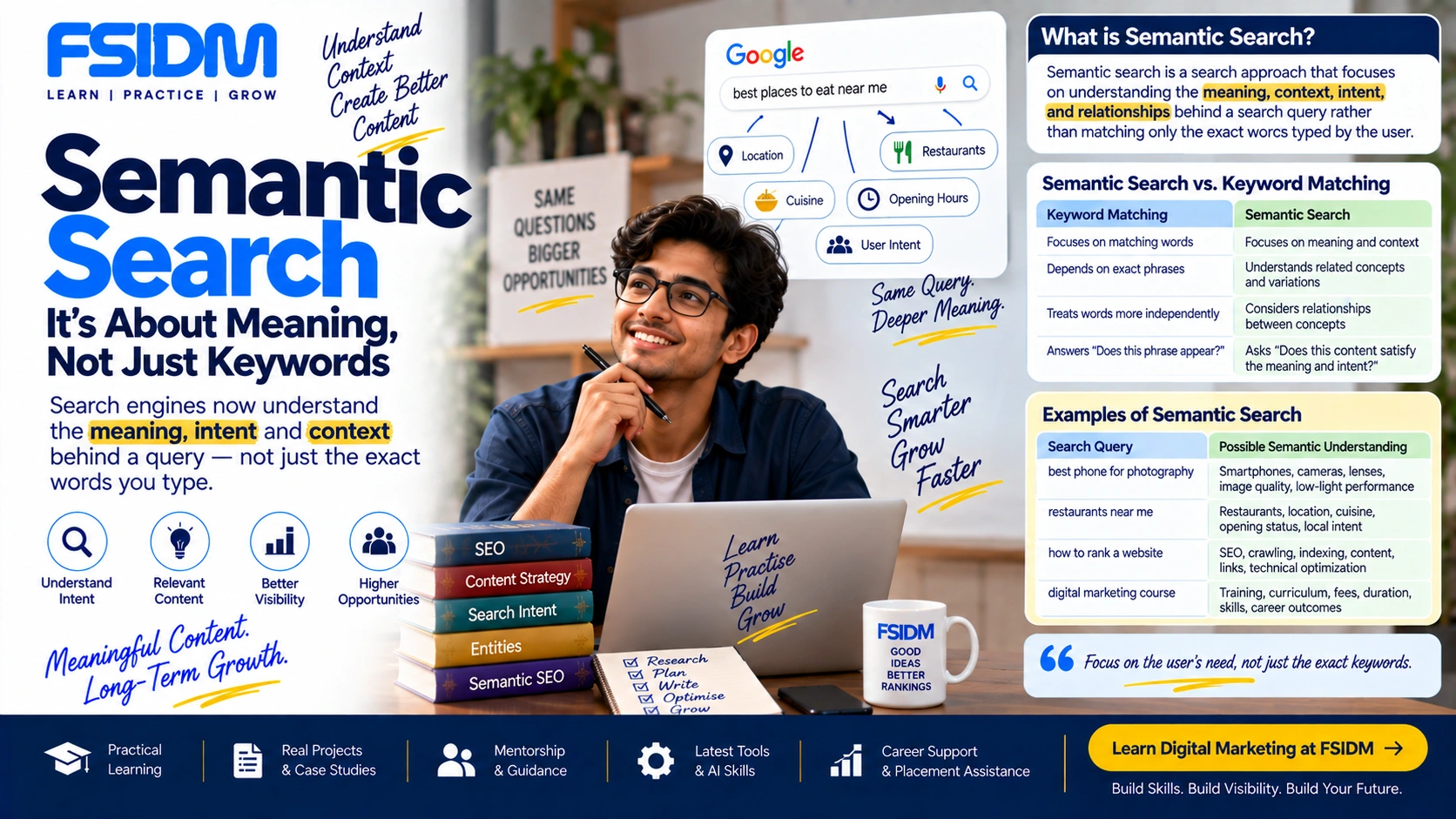
Semantic search is a search approach that focuses on understanding the meaning, context, intent, and relationships behind a search query rather than matching only the exact words typed by the user.
For example, if someone searches for “best places to eat near me”, a search engine does not need to find a webpage containing that exact sentence to understand the query. It can use context such as location, restaurants, cuisine, relevance, and the user’s likely intent to identify useful results.
This is why modern SEO is not simply about repeating an exact keyword. Content needs to clearly communicate the subject, answer the user’s underlying need, and use relevant concepts naturally.
What Does Semantic Search Mean?
The word semantic relates to meaning. In search, semantic systems attempt to understand what a query means and how the words and concepts within it relate to one another.
Consider the query “how to improve website speed”. A search engine can associate this with concepts such as page performance, Core Web Vitals, image optimization, caching, JavaScript, server response time, and other relevant website-performance concepts.
The search engine does not necessarily require every related term to appear on a page. Instead, it can evaluate the overall meaning and relevance of the content.
Semantic Search vs Traditional Keyword Matching
| Keyword Matching | Semantic Search |
|---|---|
| Focuses primarily on matching words | Focuses on meaning and context |
| Can depend heavily on exact phrases | Can understand related concepts and language variations |
| May treat words more independently | Considers relationships between concepts |
| Answers “Does this phrase appear?” | Asks “Does this content satisfy the meaning and intent?” |
How Does Semantic Search Work?
The exact systems search engines use are complex and continuously evolving. From an SEO perspective, semantic search can be understood through several important concepts.
1. Understanding Query Meaning
Search engines attempt to interpret what the user means rather than relying solely on the literal wording of a query.
For example, “apple calories” could refer to the fruit, while “Apple iPhone price” clearly points toward the technology company and its products. The surrounding words provide important context.
2. Understanding Search Intent
Semantic understanding helps search engines determine what the user is trying to accomplish. A query such as “what is SEO?” indicates an informational need, while “SEO agency Ahmedabad” suggests a local commercial investigation.
3. Connecting Related Concepts
Search engines can understand relationships between concepts. A query about digital marketing may be associated with SEO, PPC, social media, content marketing, email marketing, analytics, and other related concepts.
4. Understanding Entities
Semantic search can also involve identifying entities such as people, organizations, products, places, and concepts. Entity relationships provide additional context about what a query or webpage is discussing.
Examples of Semantic Search
| Search Query | Possible Semantic Understanding |
|---|---|
| best phone for photography | Smartphones, cameras, image quality, lenses, low-light performance |
| restaurants near me | Restaurants, current location, cuisine, opening status, local intent |
| how to rank a website | SEO, crawling, indexing, content, links, technical optimization |
| digital marketing course | Training, curriculum, fees, duration, skills, career outcomes |
The associated concepts will vary depending on the query and context. Semantic search does not mean that every query has one fixed set of related keywords.
Semantic Search and SEO
Semantic search has changed how SEO professionals approach content creation. Instead of building pages around repeated exact-match phrases, marketers can focus on creating resources that comprehensively answer the user’s need.
For example, a page targeting “Local SEO” could naturally cover Google Business Profile, local rankings, reviews, citations, NAP information, local keywords, location pages, and other relevant concepts where appropriate.
The goal is not to insert every related keyword into the article. The goal is to create content that demonstrates a clear understanding of the subject.
How to Optimize Content for Semantic Search
- Understand search intent: Identify what the user is actually trying to learn, find, compare, or accomplish.
- Define the main topic: Keep the page focused on a clear subject.
- Cover relevant concepts: Address important subtopics that help satisfy the user’s need.
- Use natural language: Write for humans instead of forcing exact-match keywords into every section.
- Include relevant entities: Mention people, organizations, products, places, concepts, and other entities when they genuinely belong in the discussion.
- Answer related questions: Include useful questions and explanations that naturally support the main topic.
- Build contextual internal links: Link to closely related resources where they provide additional value.
- Keep information accurate: Semantic relevance is not a substitute for useful and trustworthy content.
Semantic Keywords and Semantic Search
The term semantic keywords is commonly used in SEO to describe words and phrases that are conceptually related to a main topic. However, semantic search should not be reduced to creating a list of related keywords.
For a page about Google Business Profile, relevant concepts might include business categories, reviews, photos, local search, business information, and customer actions. These concepts help explain the subject naturally.
The focus should be on meaning and coverage, not keyword stuffing.
Semantic Search and Topic Clusters
Semantic relationships also help explain why topic clusters can be useful for SEO. A website may have a central page about SEO supported by pages about keyword research, search intent, technical SEO, Local SEO, internal linking, backlinks, and other relevant topics.
Contextual internal links between these resources can help users and search engines understand how the subjects are related.
Semantic Search vs Topical Relevance
| Semantic Search | Topical Relevance |
|---|---|
| A way of understanding search meaning and context | The degree to which content relates to a subject |
| Primarily describes search-system behavior | Primarily describes content relevance |
| Considers intent, concepts, entities, and relationships | Evaluates how closely content matches the subject and need |
Common Semantic SEO Mistakes
- Keyword stuffing: Adding related terms repeatedly does not automatically make content semantically strong.
- Creating lists of related keywords without context: Semantic SEO is about relationships and meaning, not just vocabulary.
- Adding irrelevant entities: Mentioning popular names or concepts that do not belong to the topic can reduce clarity.
- Ignoring search intent: Covering related concepts is not enough if the page does not satisfy the user’s actual need.
- Writing unnecessarily long content: Semantic completeness does not require adding unrelated information.
- Assuming exact-match keywords no longer matter: Keywords remain useful for understanding and communicating topic relevance; semantic search simply makes the process broader than exact matching.
FAQs About Semantic Search
What is semantic search in SEO?
Semantic search is an approach to search that focuses on understanding the meaning, context, intent, and relationships behind a query rather than matching only exact words.
Why is semantic search important?
It allows search systems to better interpret natural-language queries and connect users with content that satisfies the meaning and intent of their searches.
What are semantic keywords?
Semantic keywords are terms and phrases that are conceptually related to a main topic. The term is commonly used in SEO, although semantic optimization is broader than simply collecting related keywords.
How do I optimize for semantic search?
Understand search intent, cover relevant concepts and entities, use natural language, answer useful related questions, maintain clear topical focus, and connect related resources through contextual internal links.
Is semantic search the same as voice search?
No. Voice search is a method of submitting queries using spoken language. Semantic search refers to how search systems understand meaning and context. Voice queries can benefit from semantic understanding, but the two concepts are not the same.
Interview Question
What is semantic search, and why is it important for SEO?
Semantic search focuses on understanding the meaning, context, intent, and relationships behind a search query instead of relying only on exact keyword matching. For SEO, this means creating content that clearly addresses the user’s intent, covers relevant concepts and entities naturally, and provides useful context around the main topic.
Interview Tip
Avoid saying “semantic SEO means adding LSI keywords.” Semantic search is much broader. Explain it using meaning, context, intent, entities, relationships, and relevant content.
Learn Practical SEO with FSIDM
At FSIDM, SEO is taught with a practical, industry-focused approach. Understanding semantic search helps marketers move beyond exact keyword matching and create content that communicates topics, context, and user intent more effectively.