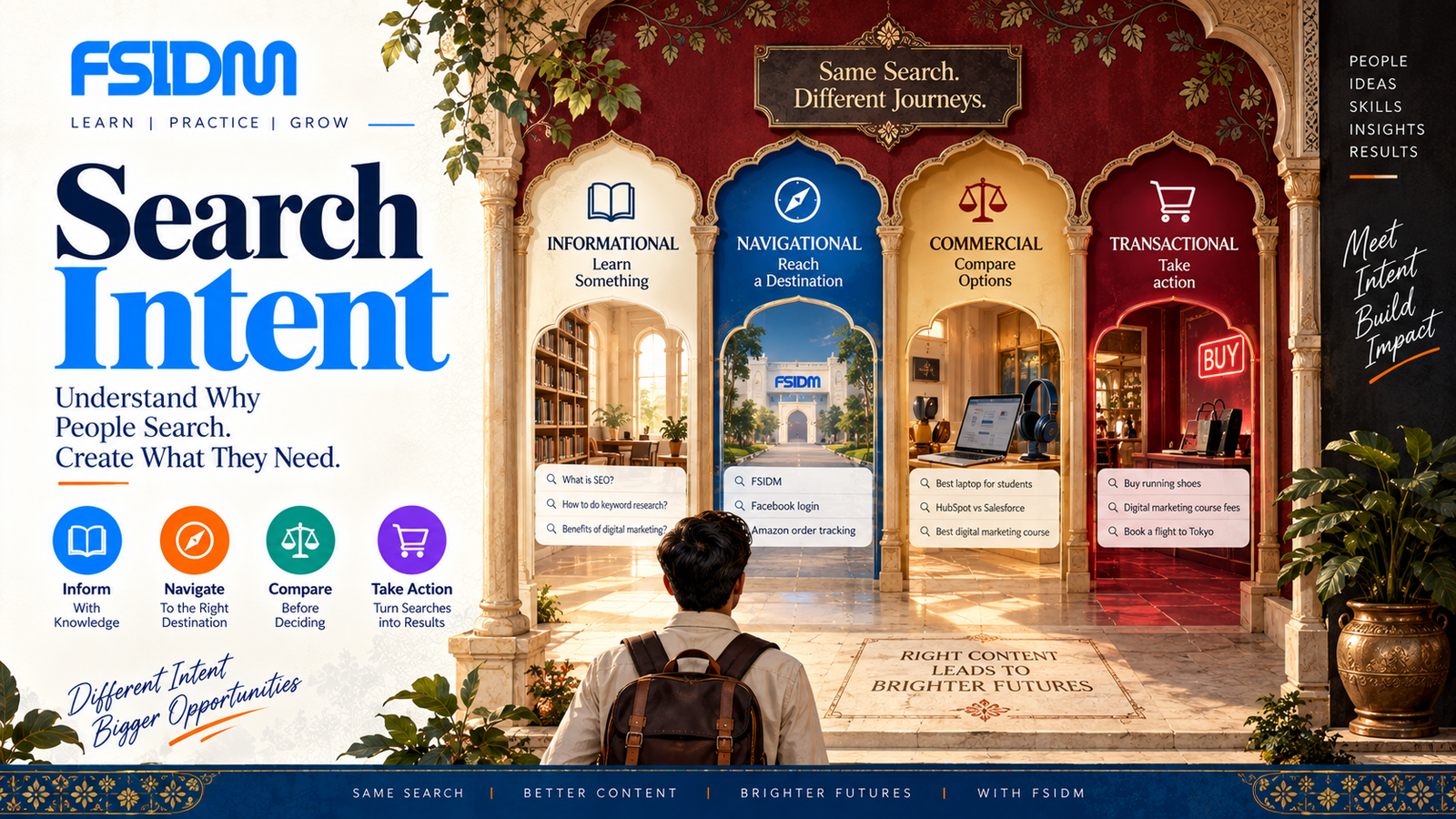
Search Intent, also known as keyword intent, is the primary goal or purpose behind a user’s search query. In simple terms, it answers the question: “Why is this person searching?”
Understanding search intent helps marketers create the right type of content for the right search. A user looking for a definition needs a different experience from someone comparing products or ready to make a purchase.
For SEO, the objective is to create a page that closely matches what searchers are actually trying to accomplish.
The 4 Main Types of Search Intent
1. Informational Intent
With informational intent, the user wants to learn something, understand a topic, or find an answer to a question.
Examples:
- “What is search intent?”
- “How to fix a leaky faucet”
- “History of Rome”
Suitable content: Blog posts, guides, tutorials, definitions, educational videos, and detailed resources.
2. Navigational Intent
With navigational intent, the user already has a particular website, brand, or destination in mind and wants to reach it.
Examples:
- “Netflix”
- “Facebook login”
- “Amazon order tracking”
Suitable content: Brand pages, homepages, login pages, account pages, and other specific destinations.
3. Commercial Investigation Intent
Commercial intent occurs when a user is researching options before making a purchase or taking a decision. They may be comparing products, services, brands, or solutions.
Examples:
- “Best wireless earbuds”
- “HubSpot vs Salesforce”
- “Best digital marketing course in Ahmedabad”
Suitable content: Comparison pages, reviews, buying guides, product roundups, case studies, and evaluation-focused content.
4. Transactional Intent
With transactional intent, the user is ready to complete an action such as purchasing a product, booking a service, subscribing, or submitting an inquiry.
Examples:
- “Buy running shoes online”
- “Book a flight to Tokyo”
- “Digital marketing course fees”
Suitable content: Product pages, service pages, pricing pages, booking pages, checkout experiences, and landing pages with clear calls to action.
Search Intent Examples at Different Stages
| User Intent | Example Query | Likely User Need | Suitable Page |
|---|---|---|---|
| Informational | What is SEO? | Learn a concept. | Educational article or guide. |
| Navigational | FSIDM | Find a specific brand or website. | Homepage or brand page. |
| Commercial | Best digital marketing course in Ahmedabad | Compare available options. | Comparison or evaluation page. |
| Transactional | Digital marketing course admission | Take an immediate action. | Course/admission landing page. |
Why Search Intent Matters for SEO
1. Better Content Relevance
When a page addresses the reason behind a search rather than simply matching a keyword, it has a better chance of being useful to the visitor.
2. Better User Experience
A visitor who finds the information, product, or action they expected is less likely to become frustrated with the page.
3. Better Conversion Alignment
Search intent can help businesses align pages with different stages of the customer journey. Informational searches may require education, while transactional searches may require pricing, product details, or a clear next step.
4. More Effective Content Planning
Understanding intent helps prevent the common mistake of creating the same type of page for every keyword. Different queries can require entirely different content formats.
How to Identify Search Intent
1. Analyze the SERP
Search the target query and examine the types of pages that consistently appear. Look at whether the results are primarily informational articles, product pages, service pages, category pages, videos, local results, or other formats.
The current search results can provide useful evidence about what search engines believe users want for that query.
2. Examine the Language of the Query
Certain words can provide clues about intent.
- Informational: what, why, how, guide, meaning, definition
- Commercial: best, top, review, comparison, vs, alternatives
- Transactional: buy, price, cost, order, book, sign up
- Navigational: brand names, website names, login, specific locations
These are useful indicators, but the wording alone does not always determine intent.
3. Study Related Questions
Related questions and People Also Ask results can reveal additional information users want to understand around the main query. These questions can help expand the content without losing focus on the primary intent.
4. Match the Content Format
If the search results predominantly show comparison articles, creating a purely promotional landing page may not satisfy the same intent. Likewise, a transactional query may require a product or service page rather than a long educational article.
How to Optimize Content for Search Intent
- Identify the primary intent: Determine what the searcher is trying to accomplish.
- Study current results: Analyze the formats and topics appearing for the query.
- Choose the right page type: Select an article, category page, product page, service page, comparison, or landing page based on the intent.
- Answer the main need quickly: Make the primary value of the page immediately clear.
- Cover related questions: Address relevant secondary questions that support the main topic.
- Provide an appropriate next step: Guide users toward an action that matches their stage in the journey.
- Review performance: Use analytics and search data to understand whether the page is actually meeting user needs.
Search Intent and Content Mapping
A useful SEO strategy maps different search intents to different types of pages rather than forcing every keyword into a blog post.
| Intent | Primary Objective | Recommended Content |
|---|---|---|
| Informational | Educate | Guides, tutorials, definitions, articles, videos |
| Navigational | Help users reach a destination | Brand, homepage, login, location, or specific pages |
| Commercial | Help users evaluate options | Comparisons, reviews, buying guides, case studies |
| Transactional | Enable an action | Product pages, service pages, pricing, booking, checkout |
Common Search Intent Mistakes
- Creating content around keywords alone: A keyword does not tell the complete story; understand what the searcher wants.
- Ignoring the SERP: The current result landscape provides valuable evidence about dominant intent and content formats.
- Using promotional pages for informational searches: Users seeking education may not be ready for a sales-heavy experience.
- Publishing informational articles for transactional queries: A buyer may need pricing, product information, availability, or a clear conversion path.
- Assuming intent never changes: Search behavior and result pages can evolve, so important queries should be reviewed periodically.
Search Intent FAQs
What is search intent in SEO?
Search intent is the reason or goal behind a user’s search query. It helps marketers understand what type of information, destination, product, or action the user is looking for.
What are the four types of search intent?
The four commonly used categories are informational, navigational, commercial, and transactional intent.
Why is search intent important?
Search intent helps businesses create pages that better match what users expect to find. This can improve relevance, user experience, content strategy, and the likelihood of achieving meaningful search performance.
How do I determine the search intent of a keyword?
Analyze the query wording and, most importantly, examine the current search results. Look at the types of pages, content formats, features, and topics that dominate the SERP.
Can one keyword have multiple search intents?
Yes. Some queries are ambiguous and can satisfy multiple intents. Search engines may show a mixed set of results when users have different possible goals.
Does search intent affect rankings?
Search engines aim to return results that are useful and relevant to the user’s query. Matching the underlying intent can therefore be an important part of creating content that competes effectively in search, although rankings depend on many factors.
Interview Question
What is search intent? Explain its four main types.
Interview Tip
A strong answer is: Search intent is the reason behind a user’s search query. The four common types are informational, navigational, commercial, and transactional. Understanding intent helps SEO professionals create the right content and page experience for what users are actually trying to accomplish.
Learn Search Intent and SEO with FSIDM
Understanding why people search is one of the foundations of effective SEO. Instead of creating pages around keywords alone, marketers need to understand the user’s goal and build content that satisfies that goal.
FSIDM focuses on practical, industry-oriented digital marketing education, helping learners understand SEO, content strategy, search behavior, and modern digital marketing through an application-focused approach.