Keywords are the words and phrases people type into search engines when looking for information, products, services, or answers. In SEO, they provide an important connection between what people search for and the content a website publishes.
Understanding keywords helps SEO professionals plan content around real search demand, organize topics, and create pages that are relevant to the needs and intent of their target audience.
What Are Keywords in SEO?
A keyword can be a single word, such as marketing, or a longer phrase, such as digital marketing course in Ahmedabad. Keywords can describe a topic, question, product, service, location, or specific need.
Modern SEO is not simply about repeating an exact keyword on a page. Search engines can understand related terms, variations, entities, and the broader meaning of content. The goal is therefore to use relevant language naturally while comprehensively addressing the searcher’s need.
Types of Keywords by Length
1. Short-Tail Keywords
Short-tail keywords, also called head terms, are broad search phrases that generally contain one or two words.
- Examples: shoes, marketing, SEO
- Characteristics: broad meaning, potentially high search demand, and often strong competition.
Because these terms are broad, ranking for them does not necessarily mean that every visitor will have a strong purchase or conversion intent.
2. Middle-Tail Keywords
Middle-tail keywords are more specific phrases, commonly containing two or three words. They sit between broad head terms and highly specific long-tail queries.
- Examples: running shoes, digital marketing tips, SEO agency Ahmedabad
- Characteristics: more specific than head terms while still covering a relatively broad topic.
3. Long-Tail Keywords
Long-tail keywords are more specific search phrases, often containing four or more words. They usually represent a narrower information need.
- Examples: best trail running shoes for flat feet, digital marketing course for beginners in Ahmedabad
- Characteristics: highly specific intent, narrower audience, and often lower individual search volume.
Long-tail queries can be valuable because their specificity may make it easier to create closely matched content and attract users with a clearly defined need. However, lower search volume does not automatically mean higher conversion rates; performance depends on the query, audience, offer, and landing page.
Why Keywords Matter for SEO
Search Relevance
Relevant keywords and related concepts help search engines understand the subject of a page and determine which queries the content may be useful for.
Targeted Organic Traffic
Choosing relevant keywords can help a website attract visitors whose searches align with its products, services, or information.
Content Planning
Keyword research can reveal the topics, questions, comparisons, and problems an audience is searching for. These insights can then guide website pages, blog articles, FAQs, and content clusters.
Understanding Search Demand
Keywords also provide a practical way to study search demand. SEO teams can evaluate search volume, competition, intent, trends, and the features appearing in search results before deciding which topics to prioritize.
Where Should You Use Keywords?
Keywords and related concepts should be incorporated naturally into the relevant parts of a webpage rather than inserted mechanically.
- URL: Use a concise, descriptive URL when appropriate.
- Page title: Clearly communicate the topic of the page and use the primary phrase naturally where it fits.
- Headings: Use relevant variations and subtopics to structure the content.
- Body content: Explain the topic naturally and comprehensively instead of targeting a specific keyword density.
- Image alt text: Describe the image accurately. Include a keyword only when it genuinely describes the image.
- Metadata: Write useful title and description elements that accurately represent the page.
Keyword Example
| Keyword | Type | Possible Intent |
|---|---|---|
| SEO | Short-tail | Broad / informational |
| SEO course | Middle-tail | Commercial investigation |
| best SEO course in Ahmedabad | Long-tail | Commercial investigation |
| join digital marketing course Ahmedabad | Long-tail | Transactional |
Keywords and Search Intent
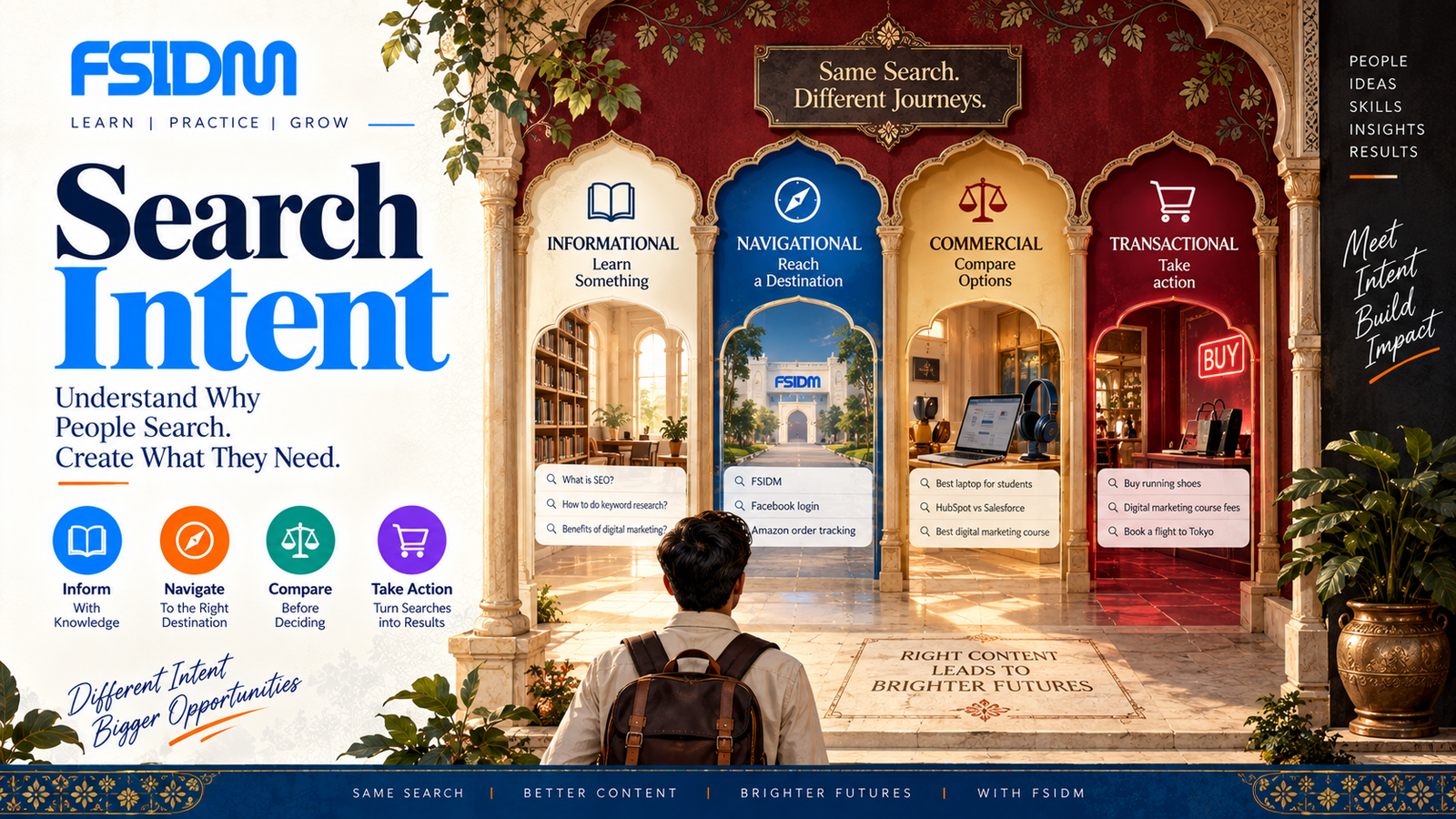
The keyword itself is only one part of SEO research. You should also understand why the person is searching. A query such as what is SEO is primarily informational, while SEO agency Ahmedabad may have commercial or local intent.
Mapping keywords to search intent helps you select the appropriate content format, page type, and call to action.
Common Keyword Research Mistakes
- Choosing keywords only because they have high search volume.
- Ignoring search intent.
- Trying to force one keyword onto every page.
- Creating separate pages for extremely similar queries without a clear purpose.
- Using keywords unnaturally or excessively.
- Ignoring related topics and questions that users expect a comprehensive page to answer.
FAQs About Keywords
What is a keyword in SEO?
A keyword is a word or phrase that represents what a person searches for in a search engine. SEO uses keyword research to understand search demand and create relevant content.
What are the three main types of keywords by length?
They are commonly described as short-tail, middle-tail, and long-tail keywords. These categories broadly reflect differences in specificity and query length.
Are long-tail keywords better than short-tail keywords?
Not always. Long-tail keywords can be more specific and closely aligned with particular needs, while short-tail keywords can represent broader demand. The right choice depends on the website’s goals, competition, intent, and audience.
Should I repeat my keyword many times?
No. Keyword stuffing can make content unnatural and does not create a better user experience. Focus on useful, readable content that naturally covers the topic and its relevant concepts.
Where should the primary keyword appear?
Use it naturally in important elements such as the page title, URL when appropriate, relevant headings, and body content. Do not force an exact-match phrase where it does not read naturally.
Interview Question
What are keywords, and why are they important in SEO?
A strong answer should explain that keywords represent the language used by searchers and help SEO professionals understand search demand, intent, and content relevance. Effective SEO focuses on satisfying the underlying search need rather than simply repeating keywords.
Interview Tip
When answering an SEO interview question about keywords, go beyond defining short-tail and long-tail terms. Explain search intent, relevance, keyword research, and natural content optimization. This demonstrates practical understanding rather than memorization.
Learn Practical SEO with FSIDM
At FSIDM, digital marketing and SEO are approached from a practical, industry-focused perspective. Understanding keywords is one of the foundations for developing effective search strategies, content plans, and digital marketing campaigns.