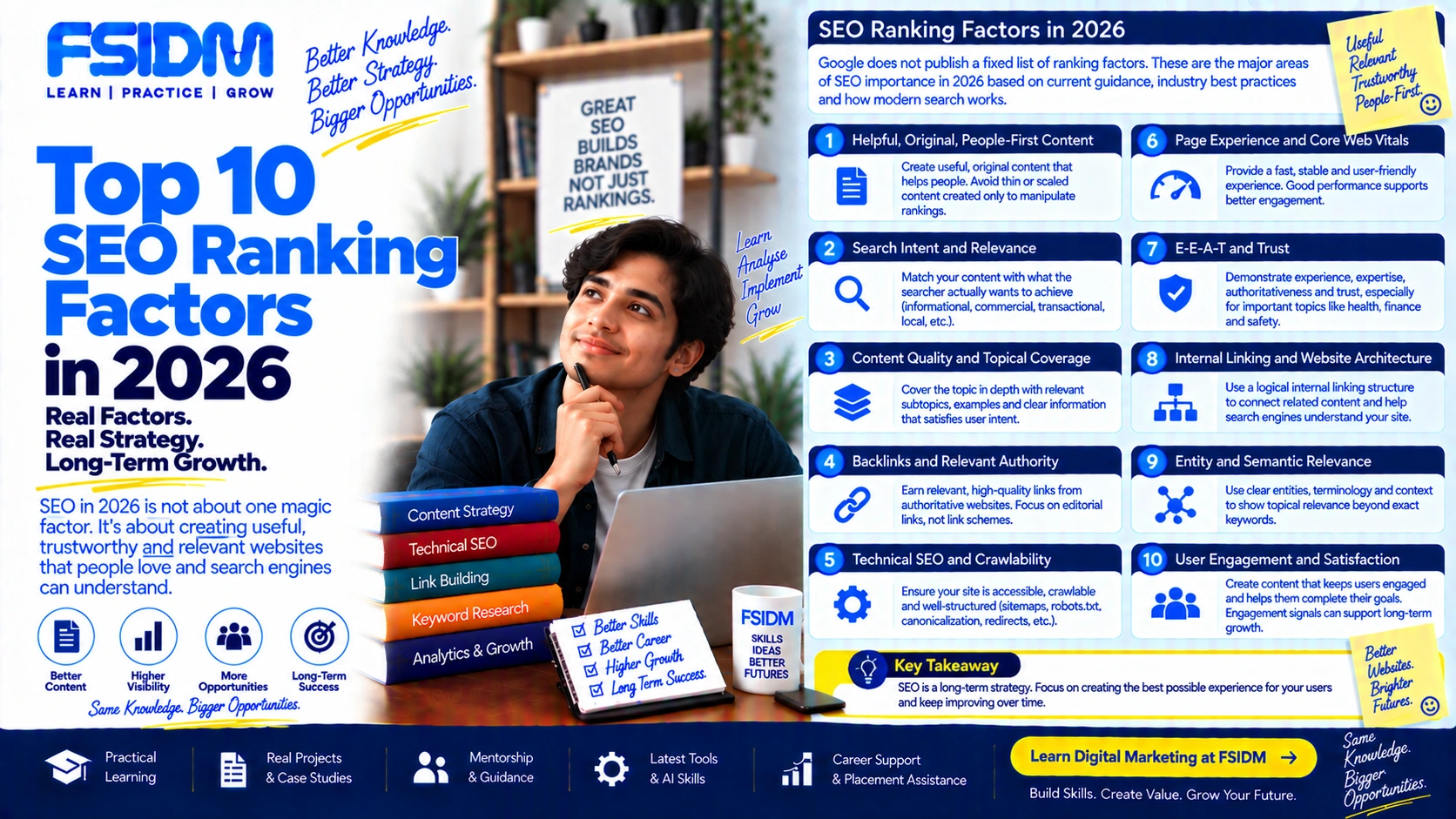
SEO in 2026 is no longer about finding one magic ranking factor. Search engines evaluate many signals and systems to determine which pages are most useful and relevant for a particular search.
For SEO professionals, the focus has shifted from simply optimizing for keywords and backlinks to building websites that are useful, technically accessible, trustworthy, relevant, and genuinely valuable to people.
Google does not publish a fixed list of “the top 10 ranking factors” with exact weights. Its ranking systems are continually updated, and different queries can rely on different signals. Therefore, the factors below should be treated as major areas of SEO importance, not a rigid ranking formula.
1. Helpful, Original, People-First Content
High-quality content remains at the center of modern SEO. Google recommends creating content primarily to help people rather than content created mainly to manipulate search rankings.
In 2026, simply producing large quantities of AI-generated or rewritten articles is not a reliable SEO strategy. Google specifically identifies scaled content abuse when large amounts of content are produced primarily to manipulate rankings and provide little value, regardless of whether AI or another method was used. :contentReference[oaicite:0]{index=0}
Strong content should demonstrate genuine usefulness, satisfy the searcher’s intent, provide original value, and answer the topic more effectively than competing pages.
2. Search Intent and Relevance
A page needs to match what the searcher is actually trying to accomplish. Someone searching “best digital marketing course in Ahmedabad” is looking for something different from someone searching “what is digital marketing?”.
Search intent can be informational, navigational, commercial, transactional, local, or a combination of these. Understanding the intent behind the query helps determine the right content format, depth, examples, calls to action, and page structure.
3. Content Quality and Topical Coverage
Modern SEO is broader than repeating a target keyword. A strong page usually covers the important concepts, questions, entities, examples, and related subtopics needed to satisfy the user’s information need.
For example, an article about technical SEO may naturally need to discuss crawling, indexing, canonicalization, redirects, robots.txt, XML sitemaps, JavaScript rendering, and website architecture.
The goal is not to add every possible keyword. The goal is to create complete, useful topical coverage without unnecessary repetition.
4. Backlinks and Relevant Authority
Links from other websites can still matter because they can help search engines understand relationships, prominence, and references across the web. However, more backlinks does not automatically mean better rankings.
Relevant, editorially earned links can be more meaningful than large numbers of low-quality or manipulated links. Google’s spam policies explicitly prohibit practices such as buying or selling links for ranking purposes, excessive link exchanges, and automated link creation intended to manipulate rankings. :contentReference[oaicite:1]{index=1}
5. Technical SEO and Crawlability
Search engines need to be able to access, crawl, process, and index important content. Technical SEO therefore remains a fundamental part of organic visibility.
Important areas include:
- Search-engine-accessible pages
- Logical website architecture
- Internal linking
- Canonicalization
- XML sitemaps
- Robots.txt configuration
- Redirect management
- Mobile accessibility
- JavaScript rendering where relevant
- HTTPS and secure delivery
If an important page cannot be properly discovered, processed, or indexed, even excellent content may struggle to perform.
6. Page Experience and Core Web Vitals
Page experience matters because users need websites that are usable, accessible, and reasonably fast. Core Web Vitals provide measurements around loading performance, responsiveness, and visual stability.
However, SEO should not be reduced to achieving a perfect PageSpeed score. Technical performance should support a good user experience while the overall page still provides relevant, useful content.
7. E-E-A-T and Trust
Experience, Expertise, Authoritativeness, and Trustworthiness (E-E-A-T) are important concepts in Google’s quality guidance, particularly when evaluating content where accuracy and trust matter.
E-E-A-T is not a single publicly disclosed ranking score. Instead, think of it as a framework for creating content that demonstrates appropriate experience, knowledge, authority, and trust.
This becomes particularly important for topics involving health, finance, safety, legal matters, and other areas where inaccurate information can cause significant harm.
8. Internal Linking and Website Architecture
Internal links help users and search engines discover related pages across a website. A logical internal-linking structure can make important content easier to find and help establish relationships between topics.
Instead of treating every page as an isolated article, build logical topic clusters where cornerstone pages connect to detailed supporting content and vice versa.
9. Entity and Semantic Relevance
Search engines increasingly need to understand entities, relationships, topics, and context, rather than relying only on exact keyword matches.
For example, an article about “digital marketing in Ahmedabad” may naturally involve entities and concepts such as SEO, Google Ads, social media marketing, local businesses, lead generation, and Ahmedabad-based search behavior.
This does not mean stuffing related terms into a page. It means creating content that demonstrates genuine understanding of the subject.
10. Local Relevance for Local Searches
For searches with local intent, location-specific relevance becomes especially important. A local business may need strong alignment between its website, business information, location, services, reviews, and other local signals.
Local SEO is therefore not simply a matter of adding a city name to every page. The website and business presence should provide useful, accurate information for people in the target location.
11. Structured Data and Search Understanding
Structured data can help Google understand the content and entities represented on a page and can make certain pages eligible for supported rich-result features. :contentReference[oaicite:2]{index=2}
However, structured data is not a guaranteed ranking boost, nor does adding schema guarantee a rich result or appearance in an AI-generated search feature.
12. Originality and First-Hand Value
One of the biggest opportunities in 2026 is publishing information that cannot easily be reproduced by summarizing the same sources everyone else is using.
Original research, proprietary datasets, expert commentary, first-hand experience, case studies, experiments, unique examples, photographs, videos, and genuinely useful tools can give content additional value.
This is particularly important as generative AI makes it easier to produce large quantities of generic content.
13. AI Search Visibility Still Depends on Strong SEO Foundations
Google’s current guidance on generative AI features makes an important point: traditional SEO best practices continue to matter for visibility in Google’s AI features. Google also recommends providing unique, non-commodity content and useful local, shopping, image, and video information where relevant. :contentReference[oaicite:3]{index=3}
That means optimizing for AI Overviews or AI Mode should not be treated as completely separate from SEO. Strong crawlability, helpful content, clear information, authority, relevance, and structured information remain foundational.
What About User Engagement Metrics?
Metrics such as bounce rate, dwell time, and time on page can be useful for understanding how visitors interact with your website, but they should not be presented as simple direct Google ranking factors.
Use analytics to improve the user experience and business performance rather than trying to manipulate a particular engagement metric for rankings.
SEO Ranking Factors: A Practical Priority Framework
| SEO Area | Why It Matters | Practical Focus |
|---|---|---|
| Content usefulness | Helps satisfy the searcher’s need | Original, helpful, people-first content |
| Search intent | Aligns page with the actual query | Understand what users want to accomplish |
| Relevance | Connects content with the topic | Entities, concepts, context, topical coverage |
| Links | Can support authority and discovery | Relevant, editorially earned links |
| Technical SEO | Enables crawling and indexing | Architecture, canonicals, sitemaps, accessibility |
| Page experience | Supports usability | Performance, responsiveness, visual stability |
| Trust | Important for reliable content | Clear authorship, evidence, reputation, transparency |
| Local relevance | Important for local-intent searches | Accurate business and location information |
| Structured data | Helps search engines understand content | Implement supported schema accurately |
| Original value | Helps differentiate content | Research, experience, data, examples, insights |
What Are Not Reliable “Ranking Factor” Shortcuts?
- Keyword stuffing
- Buying backlinks for ranking purposes
- Publishing huge volumes of low-value AI content
- Manipulating engagement metrics
- Adding schema solely because you expect higher rankings
- Chasing third-party authority scores as if they were Google’s scores
- Creating pages only to capture slight variations of keywords
Google’s spam policies specifically address practices such as keyword stuffing, link spam, scaled content abuse, scraping, cloaking, and doorway abuse. :contentReference[oaicite:4]{index=4}
So, What Are the Biggest SEO Ranking Factors in 2026?
If you want a practical priority list, focus on these areas:
- Helpful and original content
- Search intent and topical relevance
- Trust and appropriate E-E-A-T signals
- Relevant, high-quality backlinks and authority
- Technical crawlability and indexability
- Strong internal linking and site architecture
- Good page experience and performance
- Local relevance where applicable
- Clear entity and semantic context
- Original first-hand information and differentiated value
The biggest takeaway is that SEO in 2026 is not about optimizing one ranking factor. It is about building the strongest overall result for a searcher’s need while making that information accessible and understandable to search engines.
Frequently Asked Questions
What is the number one SEO ranking factor in 2026?
There is no officially confirmed single number-one ranking factor. Google uses multiple ranking systems and signals, and their importance can vary by query. Helpful, relevant, trustworthy content is a strong foundation.
Are backlinks still important in 2026?
Yes, links can still play an important role in search, but quality and relevance matter more than simply accumulating large numbers of backlinks. Manipulative link practices can violate Google’s spam policies.
Is AI-generated content a ranking factor?
AI use itself is not the useful distinction. Content created with AI can perform if it provides value, but generating large amounts of unoriginal content primarily to manipulate rankings can fall under Google’s scaled content abuse policy.
Are Core Web Vitals the most important ranking factor?
No. Core Web Vitals are part of the broader page-experience picture, but SEO performance depends on many factors, including relevance, content quality, technical accessibility, and authority.
Does schema markup improve rankings?
Structured data can help Google understand content and can make eligible pages qualify for supported rich-result features, but it does not guarantee higher rankings.
Interview Question
Q: What are the biggest SEO ranking factors in 2026?
Answer: There is no fixed list with publicly disclosed weights. Major areas include helpful and original content, search intent and relevance, technical crawlability and indexability, relevant links and authority, internal linking, page experience, trust and E-E-A-T, local relevance where applicable, and clear semantic context.
Interview Tip
Do not give an outdated answer such as “keywords, backlinks, and domain authority are the top three factors.” Explain that modern SEO is multi-dimensional and that third-party metrics such as Domain Authority are not Google ranking scores.
Learn Practical SEO with FSIDM
SEO professionals need to understand how content, technical SEO, search intent, authority, local search, structured data, and AI-driven search experiences work together.
At FSIDM, digital marketing and SEO are taught with a practical, industry-focused approach designed to help learners understand modern search beyond outdated ranking-factor checklists.