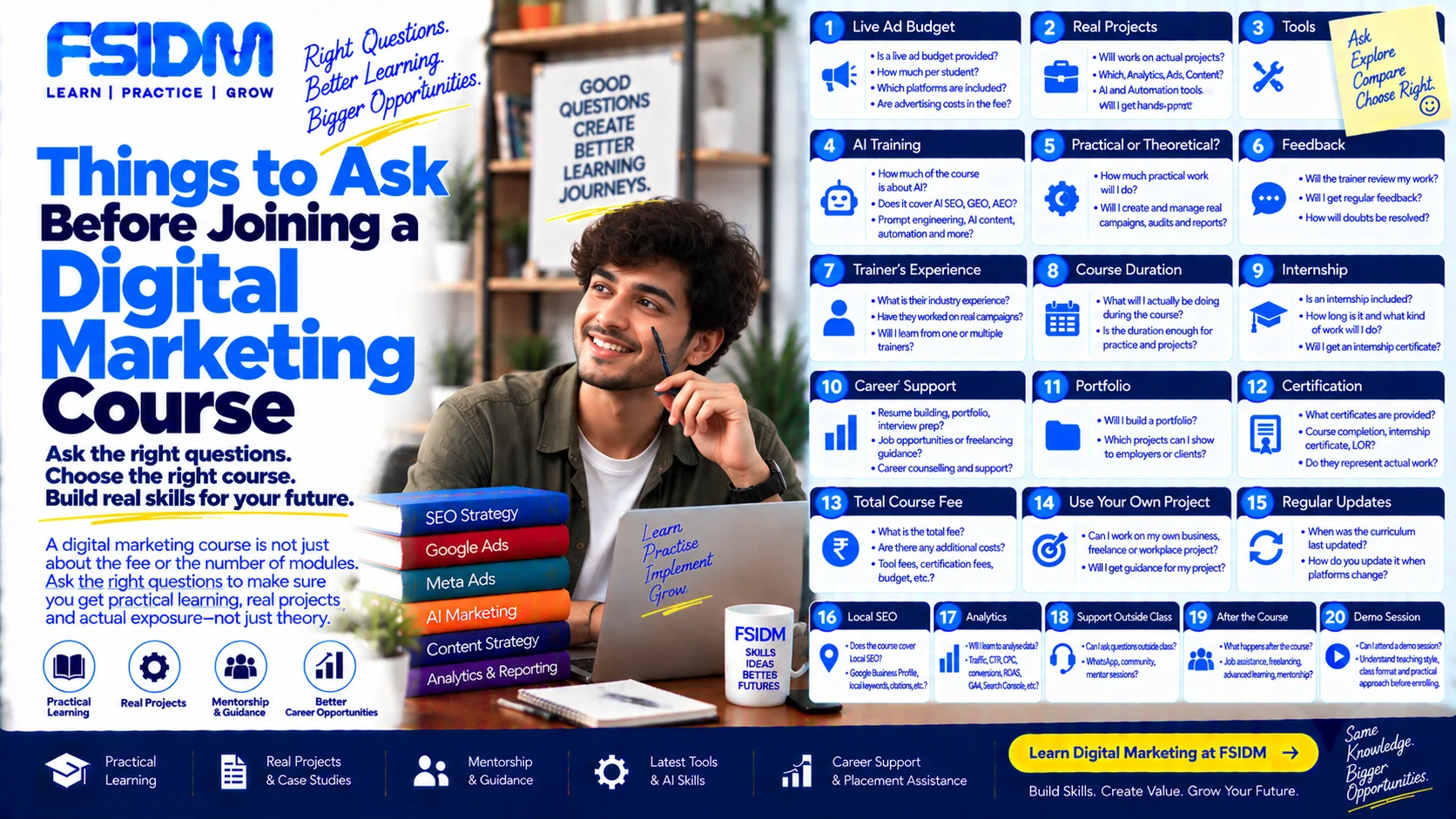
Choosing a digital marketing course is not just about checking the course fee or counting how many modules are mentioned in the brochure.
Before you pay your fees, ask some practical questions.
Because there is a big difference between:
“I completed a digital marketing course.”
and
“I actually worked on digital marketing campaigns.”
Whether you’re a student, fresher, working professional, freelancer or business owner, asking the right questions can help you understand whether a course will give you practical exposure or mostly classroom knowledge.
Here are some important things to ask before joining a digital marketing course.
1. Live Ad Budget

If the course includes Google Ads or Meta Ads, this should be one of your first questions:
“Will the institute provide a live advertising budget for practice, or will I have to spend my own money?”
There is a big difference between watching someone create an advertising campaign and actually working with a live campaign.
With a live campaign, you can learn how to:
- Create campaigns
- Set targeting
- Plan a budget
- Write ad copy
- Test creatives
- Monitor CPC and CTR
- Analyse leads and conversions
- Optimise campaign performance
What If the Institute Doesn’t Provide a Budget?
That doesn’t necessarily mean you cannot get practical experience.
If you have a genuine project, you can consider using a small, controlled budget for:
- Your own business
- A personal project
- A freelance client’s project
- Your workplace project
- A family business
- A startup project
For example, instead of spending money simply because you need to complete an assignment, you can work on a real project where there is an actual marketing objective.
You can then experience the complete process:
Campaign Setup → Budget → Targeting → Creative → Launch → Data → Optimisation
However, you should not feel pressured to spend a large amount of your own money just for training.
The purpose is to learn advertising—not simply to spend money on advertising.
Questions to Ask About Live Ads
Before joining, ask:
- Is a live ad budget provided?
- If yes, how much is provided per student?
- Which platforms can I use it on?
- Will I actually launch campaigns?
- Can I work on my own business or freelance project?
- Will the trainer guide and review the campaign?
- Are advertising costs included in the course fee?
- Are there any additional charges?
A good practical experience should help you understand what happens after you click “Publish.”
2. Will I Work on Real Projects?
Ask:

“Will I work on actual projects during the course?”
This matters because digital marketing is an execution-based skill.
Reading about SEO is different from performing keyword research.
Watching a Google Ads tutorial is different from creating a campaign.
Learning about social media is different from creating a content strategy for a real business.
Ask whether the course includes projects such as:
- SEO Audit
- Keyword Research
- Website Optimisation
- Social Media Strategy
- Google Ads Campaign
- Meta Ads Campaign
- Content Strategy
- Lead Generation
- Analytics Reporting
- AI Marketing Workflow
The more you practise, the easier it becomes to explain your skills later.
3. Which Tools Will I Actually Use?
Don’t just ask:

“Do you teach digital marketing tools?”
Ask:
“Which tools will I actually use during the course?”
A digital marketer may work with different tools for different activities.
SEO
SEMrush, Ahrefs, Google Search Console and other SEO platforms.
Analytics
Google Analytics, Looker Studio and Microsoft Clarity.
Advertising
Google Ads and Meta Ads Manager.
Content
Canva and AI-powered content tools.
AI
ChatGPT, Claude and Gemini.
Automation
Make.com and other workflow tools.
Knowing that a tool exists is not the same as knowing how to use it.
4. Does the Course Teach AI?
If you’re joining a digital marketing course today, ask:
“How much of the course is actually about AI?”
Don’t settle for:
“Yes, we teach AI.”
Ask what that actually means.
Does the course cover:
- AI SEO?
- GEO?
- AEO?
- LLM SEO?
- Prompt Engineering?
- AI Content?
- AI Image Generation?
- AI Video Generation?
- AI Automation?
- AI Agents?
- AI Website Development?
AI shouldn’t simply be a two-hour module added to a traditional digital marketing course.
You should understand how AI can be applied to real marketing workflows.
5. Is the Training Practical or Mostly Theoretical?

Ask:
“How much practical work will I actually do?”
For example, if you’re learning SEO, will you:
Research keywords?
Audit a website?
Analyse competitors?
Create an optimisation plan?
If you’re learning Google Ads, will you:
Create campaigns?
Set targeting?
Understand budgets?
Analyse performance?
If you’re learning social media, will you:
Create content?
Build a content calendar?
Analyse performance?
That’s the difference between learning about marketing and learning to do marketing.
6. Will I Get Feedback on My Work?
This is an underrated question.

Imagine you create your first SEO audit.
Who checks it?
Imagine you create a Meta Ads campaign.
Who tells you what’s wrong?
Imagine you write a blog.
Who reviews it?
Ask:
“Will the trainer review my work and give me feedback?”
Feedback can help you identify mistakes much earlier.
You don’t want to spend three months repeating the same mistake.
7. Who Is Teaching the Course?
Ask about the trainer.

You can ask:
- What is their industry experience?
- Have they worked on real campaigns?
- Do they actively work in digital marketing?
- What industries have they worked with?
- Will I learn from one trainer or multiple trainers?
A trainer’s practical experience can influence the kind of examples and guidance you receive.
8. What Is the Course Duration?
Don’t assume:

Longer = Better
A six-month course isn’t automatically better than a three-month course.
Instead ask:
“What will I actually be doing during those months?”
A course should have enough time for:
Learning → Practice → Projects → Feedback → Improvement
The number of months matters less than what happens during those months.
9. Is There an Internship?
If you’re a fresher, ask:

“Is an internship included?”
An internship can give you an opportunity to experience how marketing work happens in a professional environment.
Ask:
- How long is the internship?
- Is it live?
- What kind of work will I do?
- Will I work on real projects?
- Is an internship certificate provided?
Don’t choose an institute only because it uses the word “internship.”
Ask what the internship actually involves.
10. What Career Support Is Available?
Completing a course doesn’t automatically mean you’ll get a job.
But career preparation can help.
Ask whether the institute provides support with:
- Resume Building
- Portfolio
- Interview Preparation
- Mock Interviews
- LinkedIn Profile
- Job Opportunities
- Freelancing Guidance
- Career Counselling
A certificate tells people that you completed a course.
A portfolio can show people what you can actually do.
11. Can I Build a Portfolio?
Ask:
“Will I have projects that I can show to employers or clients?”
Your portfolio could include:
SEO
Website audit + keyword research + SEO strategy
Paid Ads
Campaign structure + ad creatives + optimisation report
Social Media
Content calendar + creatives + strategy
Content
Blog + landing page + social media content
AI
AI marketing workflow + automation + AI content project
This gives you something more useful than simply writing:
“Digital Marketing Course Completed”
on your resume.
12. What Certification Will I Receive?
Ask:
“What certificates are included?”
Check whether the program provides:
- Course Completion Certificate
- Internship Certificate
- Letter of Recommendation
Also ask whether the certificate represents actual coursework and practical work completed during the program.
A certificate can be useful, but remember:
Skills + Projects + Portfolio + Communication matter too.
13. What Is the Total Course Fee?
Of course, you should ask:
“What is the total fee?”
But don’t stop there.
Ask:
“Are there any additional costs?”
For example:
- Certification fee
- Exam fee
- Software fee
- Ad budget
- Internship fee
- Tool subscription
- Workshop fee
A course advertised at one price may have additional expenses, so understand the complete cost before enrolling.
14. Can I Use My Own Project?
This is a very useful question.
Ask:
“Can I work on my own business, freelance project or workplace project during the course?”
If you already have a project, it can make your learning more relevant.
For example:
A student with a family business can practise:
SEO + Google Business Profile + Meta Ads
A freelancer can practise:
Lead Generation + Ads + Landing Pages
A working professional can apply:
Marketing Automation + Analytics
A business owner can work on:
Content + SEO + Paid Advertising
Instead of learning everything in isolation, you can connect the lessons to an actual business problem.
15. Is the Course Updated Regularly?
Digital marketing changes.
Google changes.
Meta changes.
AI changes.
Advertising platforms introduce new features.
Search behaviour changes.
So ask:
“When was the curriculum last updated?”
And more importantly:
“How do you update the curriculum when platforms change?”
A course shouldn’t remain frozen in the same syllabus for years.
16. Does the Course Cover Local SEO?
If you’re interested in helping local businesses, ask about:
Local SEO
This can include:
- Google Business Profile
- Local Keyword Research
- Local Citations
- Reviews
- Local Landing Pages
- Local Search Optimisation
This can be especially useful for marketers working with restaurants, clinics, real estate companies, local retailers and service businesses.
17. Does the Course Cover Analytics?
Marketing isn’t only about creating campaigns.
You need to understand the numbers.
Ask whether you’ll learn:
Traffic
CTR
CPC
Conversions
Conversion Rate
Cost Per Lead
ROAS
Engagement
Organic Traffic
Search Performance
Understanding data helps marketers make informed decisions.
18. Can I Ask Questions Outside the Class?
This is especially important for beginners.
You may understand today’s lesson and then get stuck tomorrow while working on a project.
Ask:
“How can I get support when I have questions?”
For example:
- WhatsApp support
- Community
- Mentor sessions
- Doubt-solving sessions
The exact format will depend on the institute.
19. What Happens After the Course?
Ask this before joining—not after finishing.
“What happens after I complete the course?”
Possible areas to ask about:
Internship
Portfolio
Resume
Interview Preparation
Job Assistance
Freelancing
Advanced Learning
Mentorship
You should know what support is actually included.
20. Can I Attend a Demo Session?
Finally, ask:

“Can I attend a demo session before enrolling?”
A demo can help you understand:
- Teaching style
- Trainer communication
- Class format
- Practical approach
- Learning environment
- Level of interaction
Don’t judge a course only by its Instagram advertisement.
Attend the demo.
Ask questions.
Understand the curriculum.
Then decide.
A Simple Checklist Before You Pay
| Question | What to Check |
|---|---|
| Live Ads | Is an ad budget provided? |
| Own Project | Can I use my own/freelance/work project? |
| Practical | Will I actually practise? |
| Projects | Are real projects included? |
| Tools | Which tools will I use? |
| AI | What AI skills are taught? |
| Trainer | Who will teach me? |
| Feedback | Will someone review my work? |
| Internship | What does the internship include? |
| Portfolio | Can I build a portfolio? |
| Career | What support is available? |
| Certification | Which certificates are provided? |
| Fees | What is the complete cost? |
| Updates | Is the curriculum updated? |
| Demo | Can I attend before enrolling? |
Final Thoughts
Choosing a digital marketing course shouldn’t be an impulse purchase.
Don’t simply ask:
“Kitni fees hai?”
Ask:
“Main practically kya seekhunga?”
Ask about the live ad budget.
Ask about real projects.
Ask whether you can work on your own business, freelance client or workplace project.
Ask about AI.
Ask about tools.
Ask about internships.
Ask about portfolio building.
Ask about career support.
And most importantly, ask:
“Will I actually get the opportunity to do digital marketing, or will I only learn about it?”
Because digital marketing is a skill you build by doing.
Learn it. Practise it. Make mistakes. Analyse the results. Improve. Repeat.
That’s where real learning begins.