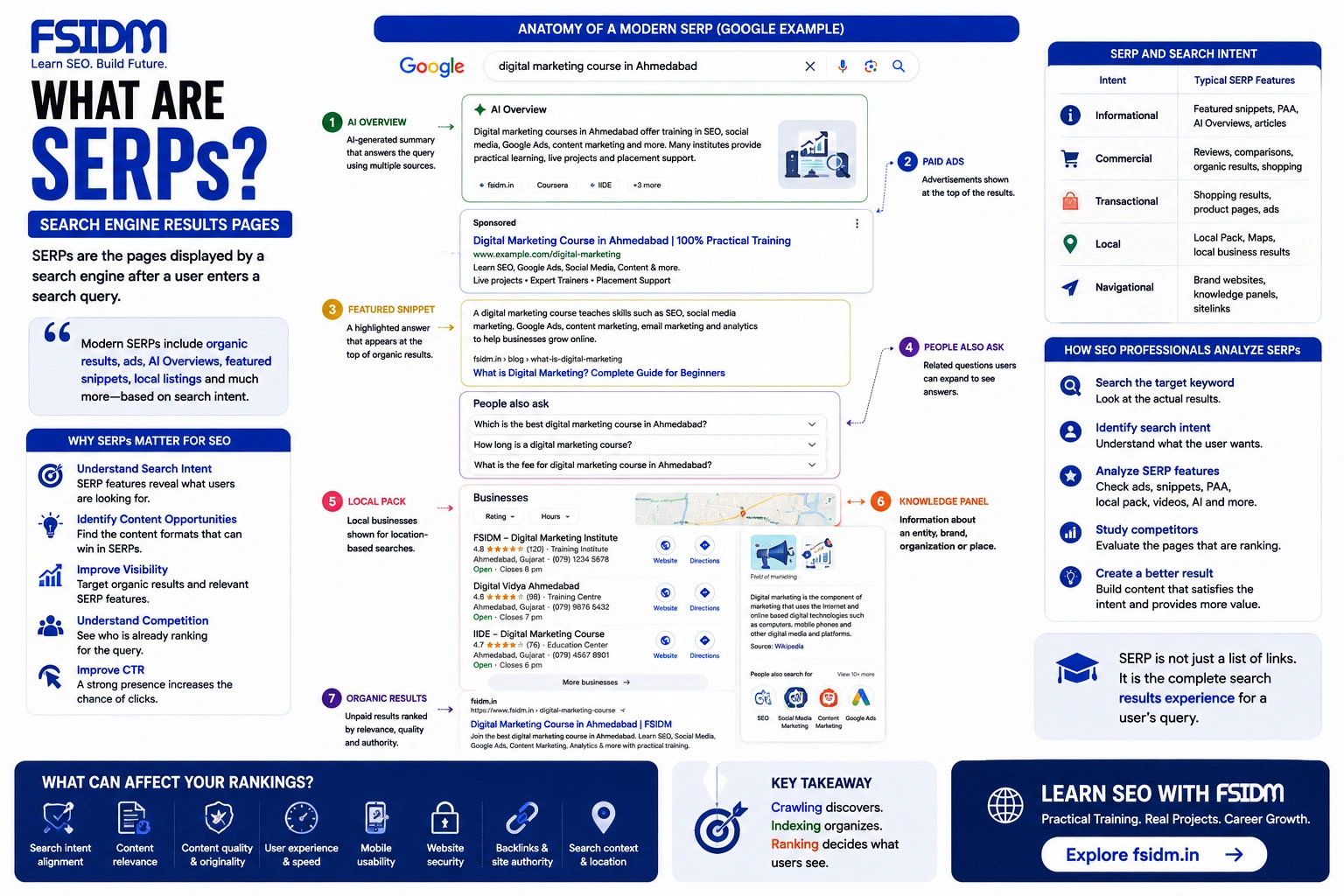
SERPs, or Search Engine Results Pages, are the pages displayed by a search engine after a user enters a search query.
They are the visible interface between a user’s search and the information, websites, products, businesses, or answers returned by the search engine.
Modern SERPs are no longer limited to a simple list of ten blue links. Their layout changes depending on the user’s search intent and may include organic results, paid advertisements, AI Overviews, featured snippets, local results, shopping results, videos, and other search features.
What Does SERP Mean?
SERP stands for Search Engine Results Page. It refers to the results page generated after a user searches for something on a search engine such as Google or Bing.
For example, if someone searches for “digital marketing course in Ahmedabad”, the resulting page is a SERP.
What Appears on a SERP?
The exact elements displayed on a SERP depend on the query, location, device, language, and search intent.
1. Organic Search Results
Organic results are unpaid listings that search engines rank based on relevance, quality, authority, and other signals. SEO focuses heavily on improving a website’s visibility within these results.
2. Paid Search Ads
Paid search results are advertisements that businesses pay to display for relevant searches. They are generally identified with an “Ad” or “Sponsored” label.
3. Featured Snippets
A Featured Snippet is a highlighted search result that provides a direct answer to a user’s query, often appearing prominently near the top of the results.
4. AI Overviews
AI Overviews are AI-generated responses that can appear within Google Search for eligible queries. They synthesize information from multiple sources to provide a summarized response.
5. People Also Ask
People Also Ask (PAA) is an expandable section containing related questions. Users can select a question to see an answer and explore additional information.
6. Knowledge Panels
Knowledge Panels provide information about recognized entities such as people, organizations, places, or other entities. They commonly appear alongside search results on desktop.
7. Local Pack
The Local Pack, sometimes called the Map Pack, displays local businesses relevant to location-based searches. It can include business names, ratings, addresses, hours, and map information.
Why Are SERPs Important for SEO?
Understanding SERPs helps SEO professionals determine what search engines believe users want for a particular query.
- Understand Search Intent: The features appearing on a SERP provide clues about what users are looking for.
- Identify Content Opportunities: SERP features can reveal the content formats that may best satisfy a query.
- Improve Visibility: SEO can target organic results and relevant SERP features.
- Understand Competition: Analyzing the SERP shows which websites and businesses are already competing for a query.
- Improve CTR: A strong search presence can increase the likelihood that users interact with your listing.
SERP and Search Intent
The SERP itself can help reveal the intent behind a search.
| Search Intent | Typical SERP Features |
|---|---|
| Informational | Featured snippets, People Also Ask, organic articles, AI Overviews |
| Commercial | Reviews, comparison pages, organic results, shopping features |
| Transactional | Shopping results, product pages, paid ads |
| Local | Local Pack, Maps, local business results |
| Navigational | Brand websites, knowledge panels, sitelinks |
SERP Features vs Organic Rankings
Ranking highly in traditional organic results is important, but modern SEO also considers the wider SERP environment.
For example, a page may rank highly organically but receive fewer clicks if the SERP contains prominent ads, AI-generated answers, maps, shopping results, or other features above it.
This is why modern SEO focuses not only on rankings, but also on visibility, relevance, SERP features, and qualified traffic.
How Do SERPs Change?
SERPs are dynamic. Two users can sometimes see different results for the same query because search engines consider factors such as:
- Search query and intent
- Location
- Language
- Device
- Search context
- Available search features
How SEO Professionals Analyze SERPs
- Search the target keyword: Look at the actual results returned by the search engine.
- Identify search intent: Determine whether users want information, comparison, a product, a service, or a local business.
- Analyze SERP features: Look for ads, featured snippets, PAA, local results, videos, shopping results, and AI features.
- Study competitors: Examine the pages currently ranking and identify what they provide.
- Create a better result: Build content that satisfies the intent and provides genuine value.
Frequently Asked Questions About SERPs
What does SERP stand for?
SERP stands for Search Engine Results Page.
What is a SERP in SEO?
A SERP is the search results page where a website can appear through organic rankings, paid advertising, local listings, and other search features.
Are SERPs only the organic results?
No. SERPs can contain organic results as well as paid ads, local results, featured snippets, AI Overviews, People Also Ask, knowledge panels, shopping results, videos, and other features.
Why are SERPs important for SEO?
SERPs help SEO professionals understand search intent, competitors, available search features, and opportunities to improve organic visibility.
What is SERP analysis?
SERP analysis is the process of studying the search results for a target query to understand intent, competition, content formats, and ranking opportunities.
Interview Question: What Are SERPs?
Answer: SERPs, or Search Engine Results Pages, are the pages displayed by a search engine after a user enters a search query. They can contain organic results, paid ads, and various search features such as featured snippets, AI Overviews, People Also Ask, and local results.
Interview Tip
“SERP is not just a list of links. It is the complete search results experience for a user’s query.”
Learn SEO With FSIDM
Understanding SERPs is one of the foundations of SEO. Once you understand how search results are structured, you can better understand search intent, keyword research, on-page SEO, technical SEO, local SEO, and SERP optimization.
At FSIDM, you can learn digital marketing and SEO through a practical, industry-focused approach.
Understand search results. Learn SEO. Build better visibility.
Explore FSIDM at fsidm.in.