Indexing is the process where a search engine processes, organizes, and stores information discovered by its web crawlers in a searchable database.
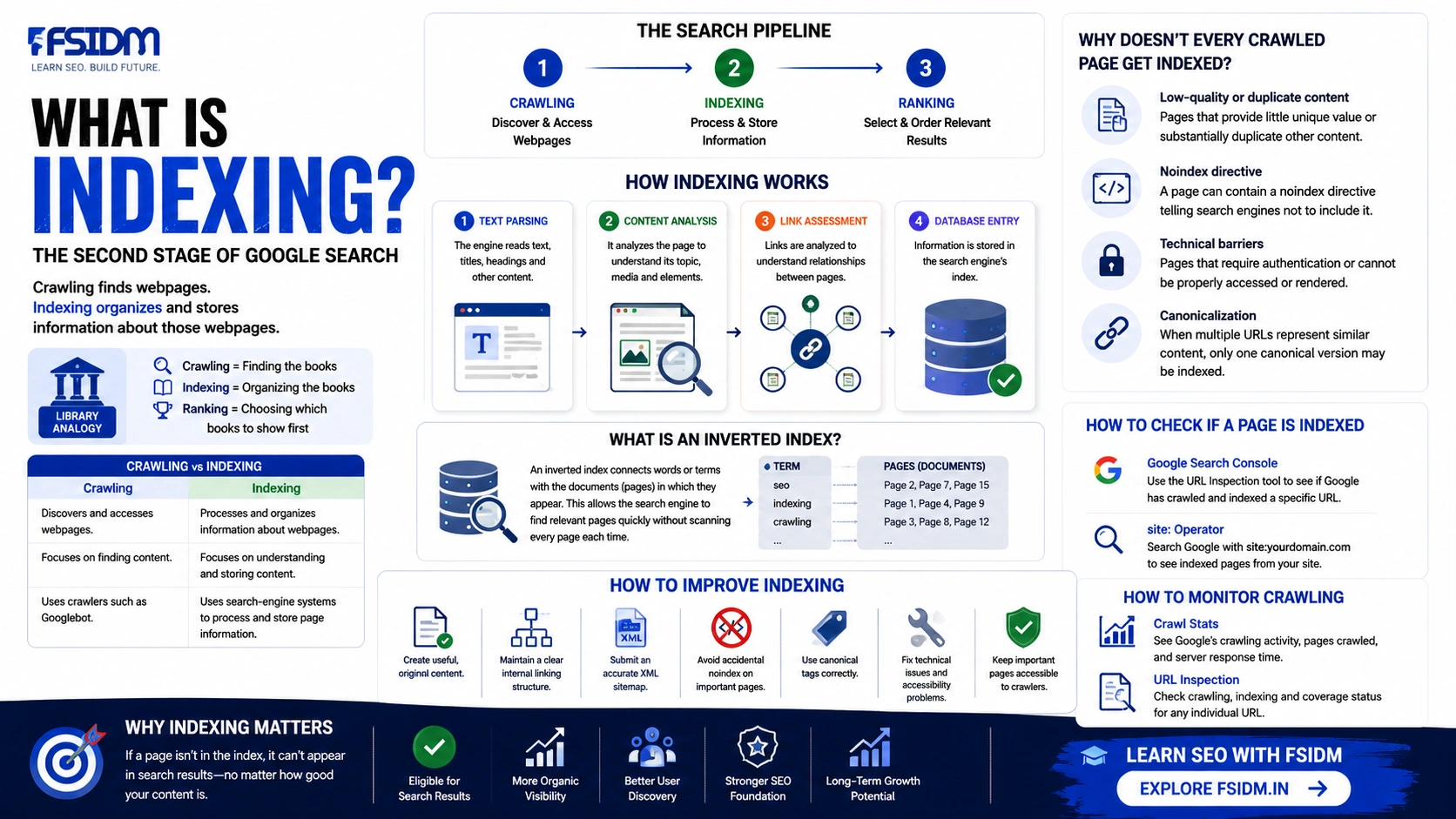
A simple way to understand it is: crawling finds webpages, while indexing organizes and stores information about those webpages.
Think of a search engine like a massive library. Crawling is finding books and bringing them into the library. Indexing is creating the catalog that helps the library quickly understand and locate those books when someone asks for information.
How Does Indexing Work?
After a search engine crawler discovers and downloads a webpage, the search engine processes the information on that page before deciding how it should be represented in its index.
- Text Parsing: The search engine processes the page’s text, titles, headings, and other content.
- Content Analysis: It analyzes the page to understand its topic and the information it provides, including relevant media and page elements.
- Link Assessment: Links are analyzed as part of understanding the relationship between pages.
- Database Entry: Information about the page can be stored in the search engine’s index, making it available for retrieval when relevant to a search query.
What Is an Inverted Index?
An inverted index is a data structure used by search systems to efficiently connect words or terms with the documents in which they appear.
Instead of searching through every webpage from scratch whenever someone searches, the search engine can use its index to quickly identify pages associated with the words and concepts in the query.
This is one of the reasons search engines can return relevant results extremely quickly.
Why Doesn’t Every Crawled Page Get Indexed?
Crawling does not guarantee indexing. A search engine may crawl a webpage but decide not to include it in its index.
Common reasons include:
- Low-quality or duplicate content: Pages that provide little unique value or substantially duplicate other content may not be selected for indexing.
- Noindex directive: A page can contain a
noindexdirective telling search engines not to include it in their index. - Technical barriers: Pages that require authentication or cannot be properly accessed or rendered may have indexing problems.
- Canonicalization: When multiple URLs represent substantially similar content, a search engine may select one canonical version rather than indexing every version.
Crawling vs Indexing
| Crawling | Indexing |
|---|---|
| Discovers and accesses webpages. | Processes and organizes information about webpages. |
| Focuses on finding content. | Focuses on understanding and storing content. |
| Uses crawlers such as Googlebot. | Uses search-engine systems to process and store page information. |
Easy way to remember: Crawling = find it. Indexing = understand and store it.
The Three-Step Search Pipeline
Indexing is the middle stage between discovering webpages and returning search results:
1. Crawling → 2. Indexing → 3. Ranking
- Crawling: Search engines discover and access webpages.
- Indexing: Search engines process, organize, and store information about those webpages.
- Ranking: Search engines retrieve and order relevant indexed results for a user’s query.
Why Is Indexing Important for SEO?
Indexing is essential because a webpage generally needs to be represented in a search engine’s index to be eligible to appear in its search results.
A page can have excellent content and strong optimization, but if it is not indexed, users are unlikely to discover it through that search engine’s organic results.
For SEO, this means website owners need to pay attention not only to rankings, but also to whether important pages are being successfully crawled and indexed.
How to Check if a Page Is Indexed
Website owners can use tools such as Google Search Console to inspect individual URLs and understand their indexing status.
The URL Inspection tool can provide information about whether Google has discovered, crawled, and indexed a particular URL.
You can also use a Google search with the site: operator as a basic way to look for pages from a particular domain, although it should not be treated as a complete indexing report.
How to Improve Indexing
- Create useful, original content that provides value to users.
- Maintain a clear internal linking structure.
- Submit an accurate XML sitemap.
- Avoid accidentally applying
noindexto important pages. - Use canonical tags correctly when multiple URLs represent similar content.
- Fix major crawling and technical accessibility issues.
- Keep important pages accessible to search engine crawlers.
Frequently Asked Questions About Indexing
What is indexing in SEO?
Indexing is the process where search engines process, organize, and store information about webpages discovered by crawlers so that the pages can potentially be retrieved for relevant searches.
Does crawling mean indexing?
No. A page can be crawled without being indexed. Crawling is the discovery and access stage, while indexing is the processing and storage stage.
Why is my webpage not indexed?
A page may not be indexed because of duplicate or low-value content, a noindex directive, technical accessibility problems, canonicalization issues, or other search-engine quality and indexing decisions.
How do I check indexing?
Use the URL Inspection tool in Google Search Console to check the indexing information for a specific URL.
Interview Question: What Is Indexing?
Answer: Indexing is the process in which a search engine processes, organizes, and stores information about webpages discovered by its crawlers in its search index, allowing relevant pages to be retrieved for search queries.
Interview Tip
“Crawling finds the webpage; indexing understands and stores it; ranking decides when and where it should appear.”
Learn SEO With FSIDM
Understanding indexing is one of the foundations of SEO. Once you understand how search engines crawl, index, and rank webpages, technical SEO becomes much easier to understand.
At FSIDM, you can learn SEO and digital marketing through a practical, industry-focused approach.
Learn SEO. Understand search engines. Build better digital strategies.
Explore FSIDM at fsidm.in.