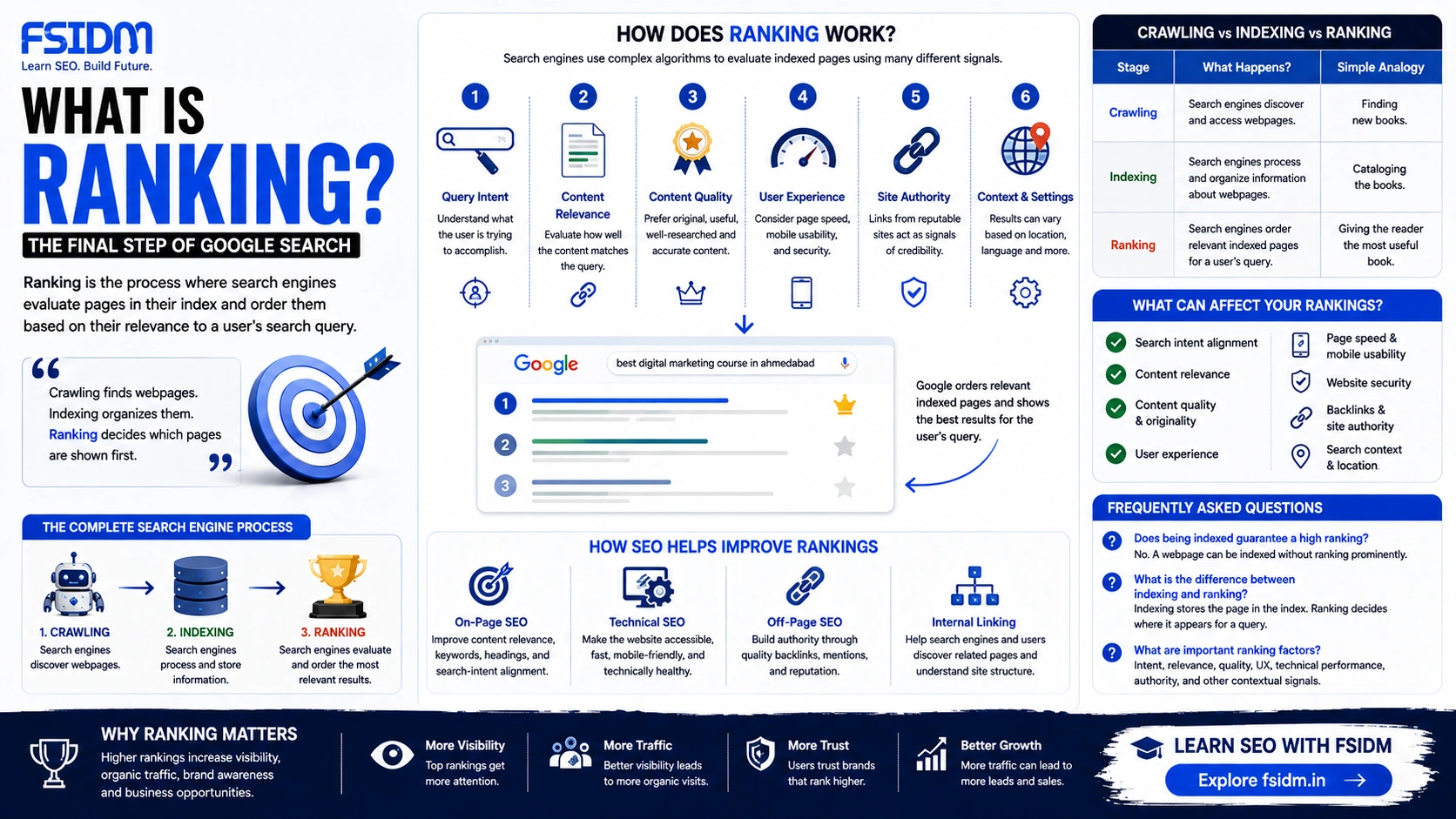
Ranking is the final step in the search process where a search engine evaluates pages in its index and orders them based on their relevance to a user’s search query.
While crawling discovers webpages and indexing organizes their information, ranking determines which relevant pages are shown first in search results.
How Does Ranking Work?
Search engines use complex automated algorithms to evaluate indexed webpages against many different signals. These systems try to determine which results are most useful and relevant for a particular search.
1. Query Intent
Search engines analyze the meaning behind a user’s query to understand what the person is trying to accomplish. The intent could be informational, navigational, commercial, or transactional.
2. Content Relevance
Search engines evaluate whether a webpage’s content, headings, topics, and other signals are relevant to the user’s query.
3. Content Quality
Original, useful, well-researched, and accurate content can provide stronger value to users than thin or duplicated content.
4. User Experience
Technical and user-experience factors such as page speed, mobile usability, and website security contribute to the overall quality of a webpage.
5. Site Authority
Links from other reputable websites can act as signals of credibility and authority. This is one reason backlinks are an important part of SEO.
6. Context and Settings
Search results can vary depending on factors such as the user’s location, language, and other search context.
Why Does Ranking Matter in SEO?
Ranking determines how prominently your webpage can appear when someone searches for a relevant topic, product, or service.
Generally, webpages that appear more prominently in search results have greater opportunities to receive organic visibility and clicks.
This is why SEO focuses on improving the relevance, quality, technical health, and authority of a website.
Crawling vs Indexing vs Ranking
| Stage | What Happens? | Simple Analogy |
|---|---|---|
| Crawling | Search engines discover and access webpages. | Finding new books. |
| Indexing | Search engines process and organize information about webpages. | Cataloging the books. |
| Ranking | Search engines order relevant indexed pages for a user’s query. | Giving the reader the most useful book. |
The Complete Search Engine Process
The three stages work together:
Crawling → Indexing → Ranking
- Crawling: Search engines discover webpages.
- Indexing: Search engines process and store information about those webpages.
- Ranking: Search engines evaluate relevant indexed pages and order them for the user’s query.
What Can Affect Your Search Rankings?
- Search intent alignment
- Content relevance
- Content quality and originality
- User experience
- Page speed and mobile usability
- Website security
- Backlinks and site authority
- Search context and location
How SEO Helps Improve Rankings
SEO is the process of improving a website so search engines can better discover, understand, and evaluate its pages.
A strong SEO strategy typically combines:
- On-Page SEO: Improve content relevance and search-intent alignment.
- Technical SEO: Make the website accessible, crawlable, fast, and technically healthy.
- Off-Page SEO: Build authority through relevant backlinks, mentions, and reputation.
- Internal Linking: Help search engines and users discover related pages and understand website structure.
Frequently Asked Questions About Ranking
What is ranking in SEO?
Ranking is the process where a search engine orders relevant indexed webpages for a user’s search query.
What is the difference between indexing and ranking?
Indexing is the process of processing and storing information about webpages. Ranking is the process of determining which relevant indexed pages should appear prominently for a particular query.
Does being indexed guarantee a high ranking?
No. A webpage can be indexed without ranking prominently. Ranking depends on how well the page satisfies the search query compared with other relevant pages.
What are important SEO ranking factors?
Important areas include search intent, content relevance and quality, user experience, technical performance, authority, and other contextual signals.
Interview Question: What Is Ranking?
Answer: Ranking is the process where search engines evaluate indexed webpages and order the most relevant results for a user’s search query.
Interview Tip
“Crawling finds it. Indexing stores it. Ranking decides where it appears.”
Learn SEO With FSIDM
Understanding ranking is one of the foundations of SEO. Once you understand the relationship between crawling, indexing, and ranking, you can better understand how search engines evaluate websites.
At FSIDM, you can learn SEO and digital marketing through a practical, industry-focused approach.
Learn SEO. Understand search engines. Build better digital strategies.
Explore FSIDM at fsidm.in.