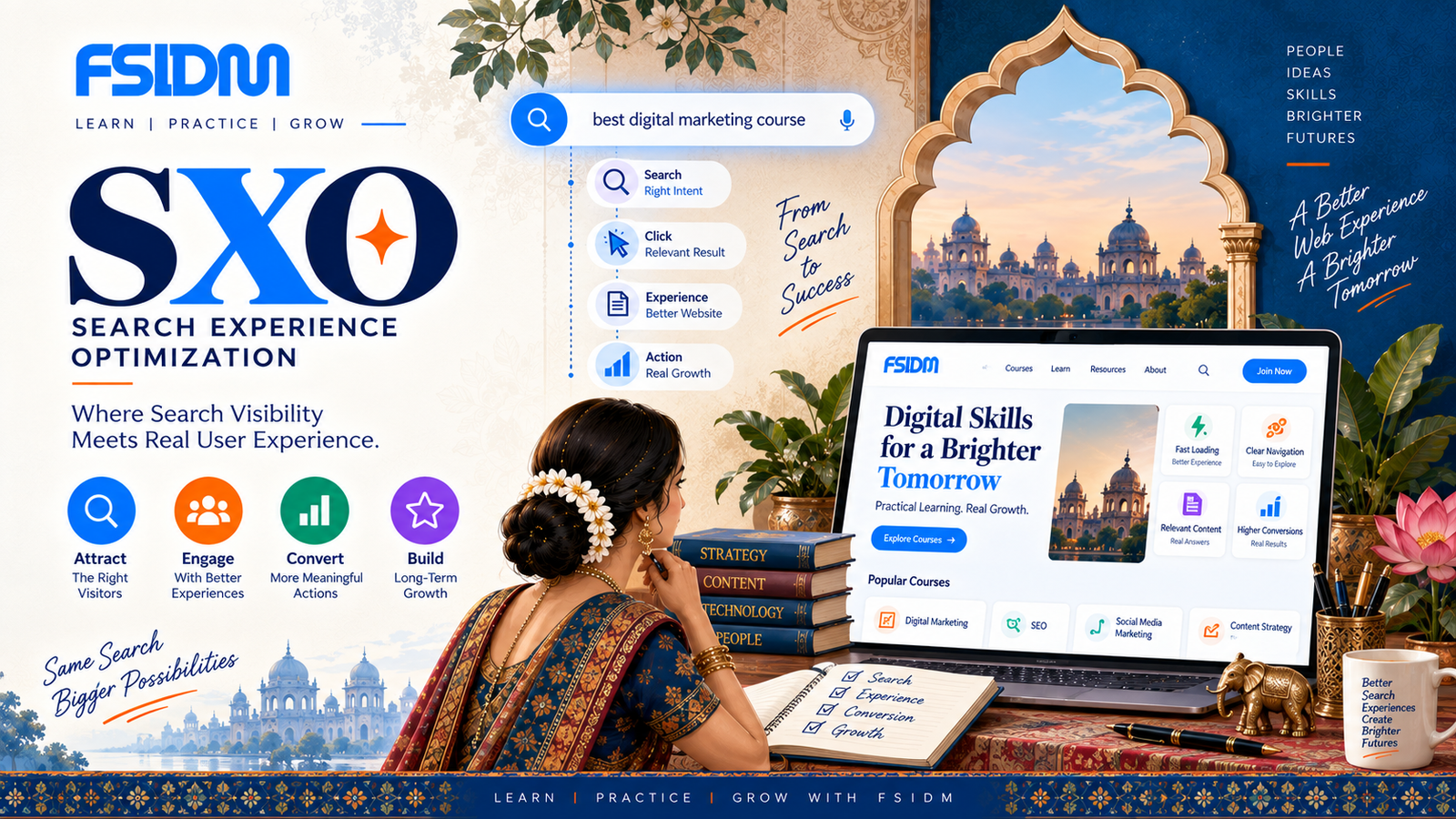
Search Experience Optimization (SXO) is the practice of combining Search Engine Optimization (SEO) with User Experience (UX) to create a better experience for people who discover and visit a website through search.
Traditional SEO focuses heavily on helping the right audience discover a webpage. SXO extends that thinking beyond the click by asking a second question: What happens after the visitor arrives?
The goal is to align search visibility with a useful, fast, relevant, accessible, and conversion-friendly website experience.
The Formula: SEO + UX = SXO
SXO connects search optimization with the actual experience a visitor has on the website.
- SEO: Helps users discover the right page through search engines using factors such as relevant content, technical accessibility, site architecture, and search intent.
- UX: Focuses on usability, navigation, readability, accessibility, page layout, and interactions.
- SXO: Brings the two together so that the experience promised by the search result is delivered effectively after the click.
For example, if someone searches for a specific solution and lands on a page that is slow, confusing, difficult to navigate, or unrelated to their intent, strong rankings alone do not create a successful search experience.
Why SXO Matters
A successful search journey does not end when someone clicks a result. The landing page needs to satisfy the visitor’s expectation and help them complete their intended task.
1. Better Search Intent Alignment
If the content matches what the visitor expected from the search query, they can find the information or action they need more easily.
2. Better Usability
Clear navigation, readable content, logical page structure, and accessible interactions reduce unnecessary friction for visitors.
3. Stronger Conversion Opportunities
When a landing page answers the user’s question and provides a logical next step, visitors have a clearer path toward actions such as contacting a business, requesting information, signing up, or making a purchase.
4. Better Mobile Experience
Search visitors frequently arrive from mobile devices, making responsive layouts, readable typography, touch-friendly controls, and fast loading particularly important.
Core Pillars of an SXO Strategy
1. Match Search Intent
Start by understanding what the visitor actually wants from the query.
For example, someone searching “how to fix a leaky faucet” is looking for informational guidance. Sending that visitor directly to a product checkout page without first addressing the problem creates a mismatch.
A better experience would provide the requested step-by-step information and then introduce relevant products or services as a logical next step.
2. Optimize Speed and Stability
Page performance is an important part of a good user experience. Large images, unnecessary scripts, poor hosting configurations, and inefficient code can contribute to slower pages.
- Compress and properly size images.
- Reduce unnecessary JavaScript and other page resources.
- Optimize page delivery and caching where appropriate.
- Prevent unexpected layout movement during loading.
- Monitor relevant Core Web Vitals and other performance indicators.
3. Improve Scannability and Mobile Usability
Visitors often scan webpages before deciding whether to read them in depth. Make important information easy to locate.
- Use concise paragraphs.
- Break long content into descriptive H2 and H3 sections.
- Use bullet points and numbered lists when appropriate.
- Highlight important information without excessive formatting.
- Use responsive layouts that work comfortably across screen sizes.
- Maintain sufficient text contrast and readable typography.
4. Create Frictionless Conversion Paths
Once visitors have found what they need, make the next action obvious.
Use clear calls to action and place them where they make sense within the user’s journey. Forms should request only information that is genuinely necessary for the intended action.
SXO vs Traditional SEO
| Area | Traditional SEO | SXO |
|---|---|---|
| Primary Focus | Search visibility and organic discovery. | Search visibility plus the visitor’s experience after discovery. |
| Key Question | Can users find this page? | Can users find, understand, use, and act on this page? |
| Content | Relevant and useful content aligned with search intent. | Relevant content presented in a clear, usable, and accessible experience. |
| UX | Important, but not the sole focus of SEO. | A central component of the optimization strategy. |
| Conversion | Often treated as a separate optimization objective. | Integrated into the overall search-to-action journey. |
How to Build an SXO-Friendly Landing Page
- Understand the query: Identify the user’s likely intent and expected outcome.
- Deliver the answer quickly: Put the most relevant information where visitors can find it without unnecessary scrolling.
- Improve page structure: Use headings, short sections, lists, visuals, and whitespace to make the page scannable.
- Optimize performance: Reduce unnecessary resources and improve loading and layout stability.
- Design for mobile: Ensure content, navigation, buttons, and forms work well on smaller screens.
- Provide a logical next step: Guide visitors toward the action that matches their intent.
- Measure outcomes: Review engagement, conversions, landing-page performance, and other relevant analytics.
SXO Checklist
- Does the page satisfy the search intent?
- Is the main answer or value proposition immediately clear?
- Can visitors scan the page easily?
- Is the content readable on mobile devices?
- Does the page load efficiently?
- Is the layout stable while loading?
- Is navigation intuitive?
- Are calls to action clear?
- Are forms simple and appropriate for the conversion goal?
- Does the page deliver what the search result promised?
Common SXO Mistakes
- Optimizing only for rankings: A high-ranking page still needs to satisfy the visitor.
- Ignoring search intent: Traffic is less valuable when the landing page does not match the user’s objective.
- Overloading pages: Excessive pop-ups, animations, ads, and unnecessary elements can create friction.
- Neglecting mobile UX: A desktop-friendly page can still provide a poor experience on smaller screens.
- Hiding the next step: Visitors should not have to hunt for contact, purchase, signup, or other relevant actions.
- Treating UX metrics as direct ranking factors without evidence: Metrics such as bounce rate, dwell time, or pogo-sticking can be useful for understanding user behavior, but they should not automatically be treated as direct Google ranking signals.
SXO FAQs
What does SXO stand for?
SXO stands for Search Experience Optimization. It combines SEO principles with user-experience considerations to improve the complete journey from search discovery to website interaction.
What is the difference between SEO and SXO?
SEO focuses broadly on improving search visibility, while SXO expands the focus to include the experience users receive after they arrive from search.
Is SXO the same as UX?
No. UX is the broader discipline of designing usable and effective experiences. SXO specifically connects user experience with search discovery and intent.
Does page speed affect SXO?
Yes. Page speed and performance are important parts of the overall user experience. Faster, more stable pages can reduce friction and make it easier for visitors to consume content and complete actions.
Does SXO replace SEO?
No. SXO builds on SEO rather than replacing it. Search visibility remains important, but SXO considers what happens after a user discovers and visits the page.
Interview Question
What is SXO, and how is it different from SEO?
Interview Tip
A strong answer is: SXO, or Search Experience Optimization, combines SEO and UX to optimize the complete search journey. SEO helps users discover a relevant page, while SXO also focuses on whether the page is useful, fast, easy to navigate, and aligned with the visitor’s intent after the click.
Learn SXO and Modern SEO with FSIDM
Modern digital marketing is not only about attracting search traffic. Businesses also need to create experiences that satisfy user intent and make it easy for visitors to take the next step.
FSIDM focuses on practical, industry-oriented digital marketing education, helping learners understand SEO, website optimization, user experience, content strategy, and modern search practices through an application-focused approach.