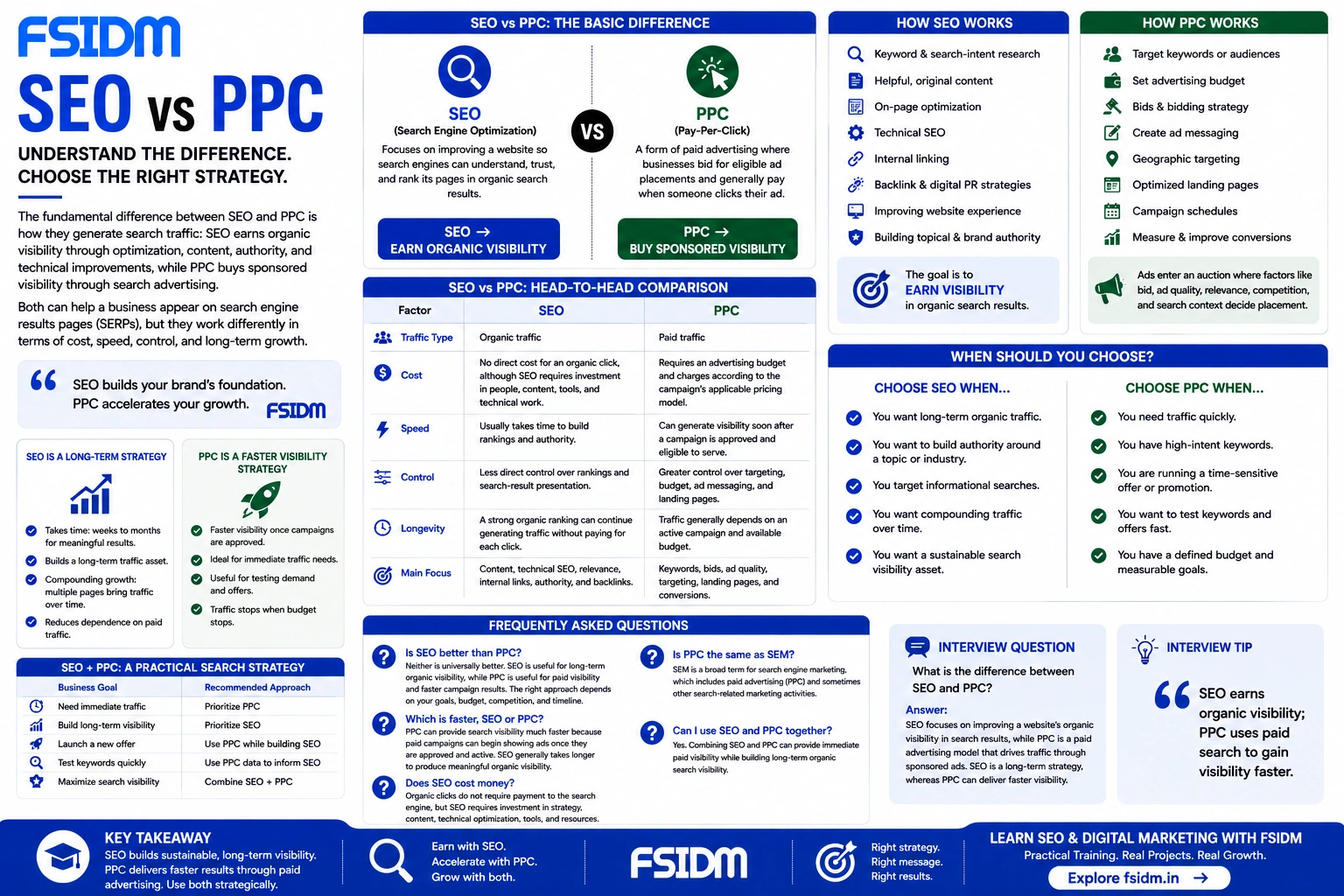
The fundamental difference between SEO and PPC is how they generate search traffic: SEO earns organic visibility through optimization, content, authority, and technical improvements, while PPC buys sponsored visibility through search advertising.
Both can help a business appear on search engine results pages (SERPs), but they work differently in terms of cost, speed, control, and long-term growth.
SEO vs PPC: The Basic Difference
SEO (Search Engine Optimization) focuses on improving a website so search engines can understand, trust, and rank its pages in organic search results.
PPC (Pay-Per-Click) is a form of paid advertising where businesses bid for eligible ad placements and generally pay when someone clicks their advertisement.
PPC → BUY SPONSORED VISIBILITY
SEO vs PPC: Head-to-Head Comparison
| Factor | SEO | PPC |
|---|---|---|
| Traffic Type | Organic traffic | Paid traffic |
| Cost | No direct cost for an organic click, although SEO requires investment in people, content, tools, and technical work. | Requires an advertising budget and charges according to the campaign’s applicable pricing model. |
| Speed | Usually takes time to build rankings and authority. | Can generate visibility soon after a campaign is approved and eligible to serve. |
| Control | Less direct control over rankings and search-result presentation. | Greater control over targeting, budget, ad messaging, and landing pages. |
| Longevity | A strong organic ranking can continue generating traffic without paying for each click. | Traffic generally depends on an active campaign and available budget. |
| Main Focus | Content, technical SEO, relevance, internal links, authority, and backlinks. | Keywords, bids, ad quality, targeting, landing pages, and conversions. |
How SEO Works
SEO helps search engines understand your website and determine whether its pages are useful and relevant for particular searches.
An SEO strategy can include:
- Keyword and search-intent research
- Helpful, original content
- On-page optimization
- Technical SEO
- Internal linking
- Backlink and digital PR strategies
- Improving website experience
- Building topical and brand authority
The goal is to earn visibility in organic search results.
How PPC Works
PPC uses an advertising auction to determine which eligible advertisements can appear for relevant searches.
Advertisers can control elements such as:
- Target keywords or audiences
- Advertising budget
- Bids and bidding strategy
- Ad messaging
- Geographic targeting
- Landing pages
- Campaign schedules
The advertising system then evaluates eligible ads using factors such as bid, ad quality, relevance, competition, and search context.
SEO Is a Long-Term Strategy
SEO generally requires patience. A new website may need months of consistent optimization, content creation, technical improvements, and authority building before meaningful organic growth becomes visible.
However, successful SEO can create a long-term traffic asset. A page that earns strong organic rankings can continue attracting visitors without paying for every individual click.
PPC Is a Faster Visibility Strategy
PPC can provide much faster visibility because businesses can participate in search advertising auctions instead of waiting for organic rankings to develop.
This makes PPC useful when a business needs immediate traffic, wants to promote a time-sensitive offer, or wants to test demand for a product or service.
When Should You Choose SEO?
1. You Want Long-Term Growth
SEO is suitable for businesses that want to build sustainable organic visibility and reduce dependence on continuously purchasing clicks.
2. You Want to Build Authority
Consistently publishing useful content and earning relevant mentions and links can help establish your brand as a trusted resource in its niche.
3. You Target Informational Searches
SEO works particularly well for educational searches, guides, tutorials, comparisons, definitions, and other informational queries.
4. You Want Compounding Traffic
As your website grows its content and authority, multiple pages can generate organic traffic simultaneously, creating a compounding effect.
When Should You Choose PPC?
1. You Need Faster Visibility
If you have a new website or a new offer that has not yet established organic rankings, PPC can help you reach relevant searchers sooner.
2. You Have High-Intent Keywords
PPC can be effective for searches where users are actively looking for a product or service and are close to taking action.
3. You Are Running a Time-Sensitive Offer
Sales, events, launches, webinars, seasonal promotions, and limited-time offers can benefit from paid search because waiting for SEO results may not be practical.
4. You Want to Test Demand
PPC can help businesses test keywords, advertisements, offers, landing pages, and conversion rates before investing heavily in long-term SEO content.
SEO vs PPC: Which One Is Better?
There is no universal winner. The right choice depends on your business goals, budget, competition, website maturity, and timeline.
| If Your Goal Is… | Better Starting Point |
|---|---|
| Immediate search visibility | PPC |
| Long-term organic traffic | SEO |
| Testing a new offer | PPC |
| Building topical authority | SEO |
| Promoting a limited-time offer | PPC |
| Creating a sustainable search asset | SEO |
| Maximizing search visibility | SEO + PPC |
The Best Strategy: Combine SEO and PPC
SEO and PPC do not have to compete with each other. In many cases, combining them creates a stronger search marketing strategy.
1. Use PPC Data to Improve SEO
PPC campaigns can reveal which keywords, offers, and messages generate clicks and conversions. Those insights can help inform your SEO content strategy.
2. Use SEO to Reduce Long-Term Dependence on Ads
While PPC can provide immediate traffic, SEO can build organic visibility that continues to generate traffic without paying for every click.
3. Cover Different Stages of the Customer Journey
SEO can attract users researching a problem, while PPC can target users with stronger commercial or transactional intent.
4. Protect Important Search Visibility
Using both strategies can allow a business to appear in multiple areas of the search results for valuable queries, depending on eligibility and competition.
SEO + PPC = Search Engine Marketing
When businesses combine organic search optimization with paid search advertising, they can create a broader Search Engine Marketing (SEM) strategy.
PPC → CAPTURE IMMEDIATE PAID DEMAND
SEO + PPC → BUILD A STRONGER SEARCH STRATEGY
Example: Digital Marketing Course
Imagine you run a digital marketing institute in Ahmedabad.
With SEO, you could create content around searches such as “what is digital marketing,” “how to learn digital marketing,” and “digital marketing course in Ahmedabad.”
With PPC, you could immediately advertise for high-intent searches such as “best digital marketing course Ahmedabad” or other relevant commercial queries.
SEO builds your long-term organic presence, while PPC helps you capture demand immediately.
Common SEO vs PPC Misconceptions
Myth 1: SEO Is Completely Free
Organic clicks do not carry a direct per-click advertising charge, but effective SEO still requires investment in strategy, content, technical work, tools, and people.
Myth 2: PPC Automatically Gives You Position #1
Paid search placement depends on auction eligibility and multiple factors. Simply having the biggest budget does not guarantee the top position for every search.
Myth 3: PPC Improves Organic Rankings Directly
Paying for search advertisements does not directly purchase organic rankings. Paid and organic search operate through different systems.
Myth 4: SEO Makes PPC Unnecessary
SEO and PPC solve different problems. A business can use PPC for immediate demand while building SEO for long-term visibility.
Frequently Asked Questions About SEO vs PPC
What is the main difference between SEO and PPC?
SEO focuses on earning organic search visibility, while PPC uses paid advertising to gain sponsored visibility on search engines.
Is SEO cheaper than PPC?
SEO does not charge for individual organic clicks, but it still requires investment. PPC requires an advertising budget and incurs costs according to campaign performance and bidding.
Which is faster, SEO or PPC?
PPC can provide search visibility much faster, while SEO generally takes longer to establish rankings.
Which is better for long-term growth?
SEO can be particularly valuable for long-term organic visibility because successful pages can continue attracting search traffic without a direct cost per click.
Should a business use SEO and PPC together?
Yes. Combining SEO and PPC can provide immediate paid visibility while simultaneously building long-term organic search visibility.
Interview Question: What Is the Difference Between SEO and PPC?
Answer: SEO is the process of earning organic visibility in search engines through content, technical optimization, relevance, and authority, while PPC is paid search advertising where businesses pay to participate in advertising auctions and gain sponsored visibility.
Interview Tip
“SEO earns visibility over time; PPC buys visibility when you need it.”
Learn SEO and PPC With FSIDM
Understanding both SEO and PPC is essential for a full-stack digital marketer. SEO helps you build long-term organic visibility, while PPC teaches you how to generate targeted traffic through paid search campaigns.
At FSIDM, you can learn how SEO, Google Ads, content marketing, analytics, AI, and other digital marketing channels work together in practical marketing campaigns.
Learn SEO. Master PPC. Build complete digital marketing strategies.
Explore FSIDM at fsidm.in.