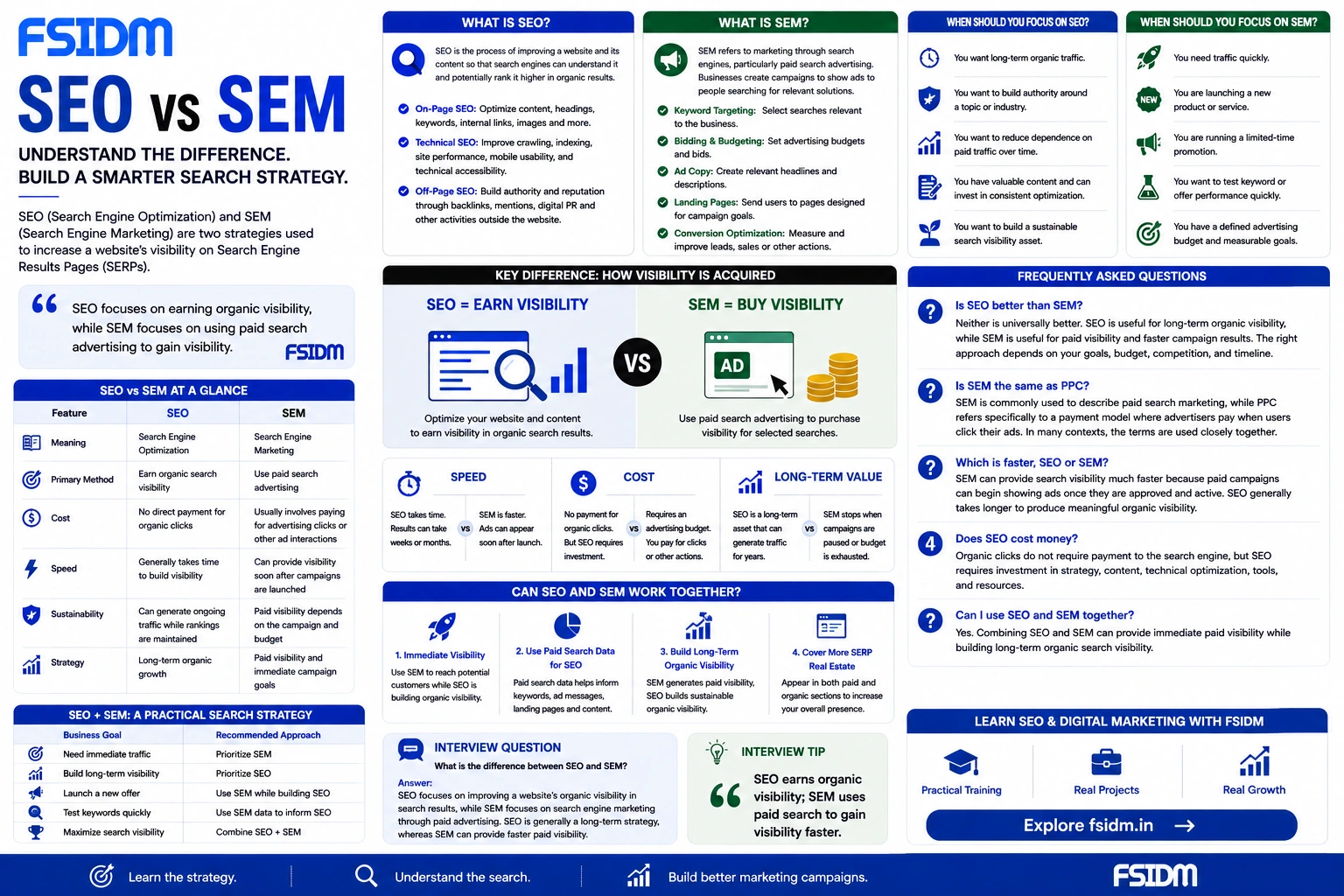
SEO (Search Engine Optimization) and SEM (Search Engine Marketing) are two strategies used to increase a website’s visibility on Search Engine Results Pages (SERPs).
The simplest difference is: SEO focuses on earning organic visibility, while SEM focuses on using paid search advertising to gain visibility.
SEO vs SEM at a Glance
| Feature | SEO | SEM |
|---|---|---|
| Meaning | Search Engine Optimization | Search Engine Marketing |
| Primary Method | Earn organic search visibility | Use paid search advertising |
| Cost | No direct payment for organic clicks | Usually involves paying for advertising clicks or other ad interactions |
| Speed | Generally takes time to build visibility | Can provide visibility soon after campaigns are launched |
| Sustainability | Can generate ongoing traffic while rankings are maintained | Paid visibility depends on the advertising campaign and budget |
| Strategy | Long-term organic growth | Paid visibility and immediate campaign goals |
What Is SEO?
SEO is the process of improving a website and its content so that search engines can understand it and potentially rank it higher in organic search results.
SEO commonly includes three major areas:
- On-Page SEO: Optimizing content, headings, keywords, internal links, images, and other page elements.
- Technical SEO: Improving crawling, indexing, site performance, mobile usability, and technical accessibility.
- Off-Page SEO: Building authority and reputation through relevant backlinks, mentions, digital PR, and other activities outside the website.
What Is SEM?
SEM refers to marketing through search engines, particularly paid search advertising. Businesses create campaigns to show advertisements to people searching for relevant products, services, or information.
SEM commonly involves:
- Keyword Targeting: Selecting searches relevant to the business.
- Bidding and Budgeting: Setting advertising budgets and bids.
- Ad Copy: Creating relevant headlines and descriptions.
- Landing Pages: Sending users to pages designed to support the campaign objective.
- Conversion Optimization: Measuring and improving leads, sales, or other desired actions.
Key Difference Between SEO and SEM
The biggest difference is how visibility is acquired.
With SEO, you optimize your website and content to earn visibility in organic search results.
With SEM, you use paid search advertising to purchase visibility for selected searches.
A simple way to remember it is:
SEO = Earn visibility
SEM = Buy visibility
SEO vs SEM: Speed
SEO generally requires time because search engines need to discover, process, evaluate, and rank your content. Improvements may take weeks or months to produce meaningful results.
Paid search can generate visibility much faster once a campaign is approved and running. This makes SEM useful when a business needs immediate traffic or wants to test demand quickly.
SEO vs SEM: Cost
Organic SEO does not charge a business for each click. However, SEO still requires investment in strategy, content, technical work, tools, and people.
SEM requires an advertising budget. Depending on the campaign, advertisers may pay when users click their ads or according to other campaign objectives.
SEO vs SEM: Long-Term Value
SEO can become a long-term digital asset. A page that earns strong organic visibility can continue generating relevant traffic without paying for every individual click.
SEM is more directly tied to campaign spending. When a paid campaign is paused or its budget is exhausted, the paid traffic generated by that campaign can stop.
Can SEO and SEM Work Together?
Yes. SEO and SEM can complement each other rather than being treated as competing strategies.
1. Use SEM for Immediate Visibility
A business can use paid search to reach potential customers while its SEO strategy is still building organic visibility.
2. Use Paid Search Data for SEO
Search advertising can provide useful information about keywords, ad messages, landing pages, and conversions. These insights can help inform organic content and SEO priorities.
3. Build Long-Term Organic Visibility
While SEM generates paid visibility, SEO can build sustainable organic visibility around valuable search topics.
4. Cover More SERP Real Estate
A business can potentially appear in both paid and organic sections for relevant searches, increasing its overall presence on the search results page.
When Should You Focus on SEO?
- You want long-term organic traffic.
- You want to build authority around a topic or industry.
- You want to reduce dependence on paid traffic over time.
- You have valuable content and can invest in consistent optimization.
- You want to build a sustainable search visibility asset.
When Should You Focus on SEM?
- You need traffic quickly.
- You are launching a new product or service.
- You are running a limited-time promotion.
- You want to test keyword or offer performance quickly.
- You have a defined advertising budget and measurable conversion goals.
SEO + SEM: A Practical Search Strategy
| Business Goal | Recommended Approach |
|---|---|
| Need immediate traffic | Prioritize SEM |
| Build long-term visibility | Prioritize SEO |
| Launch a new offer | Use SEM while building SEO |
| Test keywords quickly | Use SEM data to inform SEO |
| Maximize search visibility | Combine SEO + SEM |
Frequently Asked Questions About SEO vs SEM
Is SEO better than SEM?
Neither is universally better. SEO is useful for long-term organic visibility, while SEM is useful for paid visibility and faster campaign results. The right approach depends on the business goal, budget, competition, and timeline.
Is SEM the same as PPC?
SEM is commonly used to describe paid search marketing, while PPC refers specifically to a payment model where advertisers pay when users click their advertisements. In many digital marketing contexts, the terms are used closely together.
Which is faster, SEO or SEM?
SEM can provide search visibility much faster because paid campaigns can begin showing ads once they are approved and active. SEO generally takes longer to produce meaningful organic visibility.
Does SEO cost money?
Organic clicks themselves do not require payment to the search engine, but SEO requires investment in strategy, content, technical optimization, tools, and resources.
Can I use SEO and SEM together?
Yes. Combining SEO and SEM can provide immediate paid visibility while building long-term organic search visibility.
Interview Question: What Is the Difference Between SEO and SEM?
Answer: SEO focuses on improving a website’s organic visibility in search results, while SEM focuses on search engine marketing through paid advertising. SEO is generally a long-term strategy, whereas SEM can provide faster paid visibility.
Interview Tip
“SEO earns organic visibility; SEM uses paid search to gain visibility faster.”
Learn SEO and Digital Marketing With FSIDM
Understanding the difference between SEO and SEM is an essential part of learning digital marketing. Both approaches can play an important role in a complete search marketing strategy.
At FSIDM, you can learn SEO, Google Ads, SEM, and other digital marketing skills through a practical, industry-focused approach.
Learn the strategy. Understand the search. Build better marketing campaigns.
Explore FSIDM at fsidm.in.