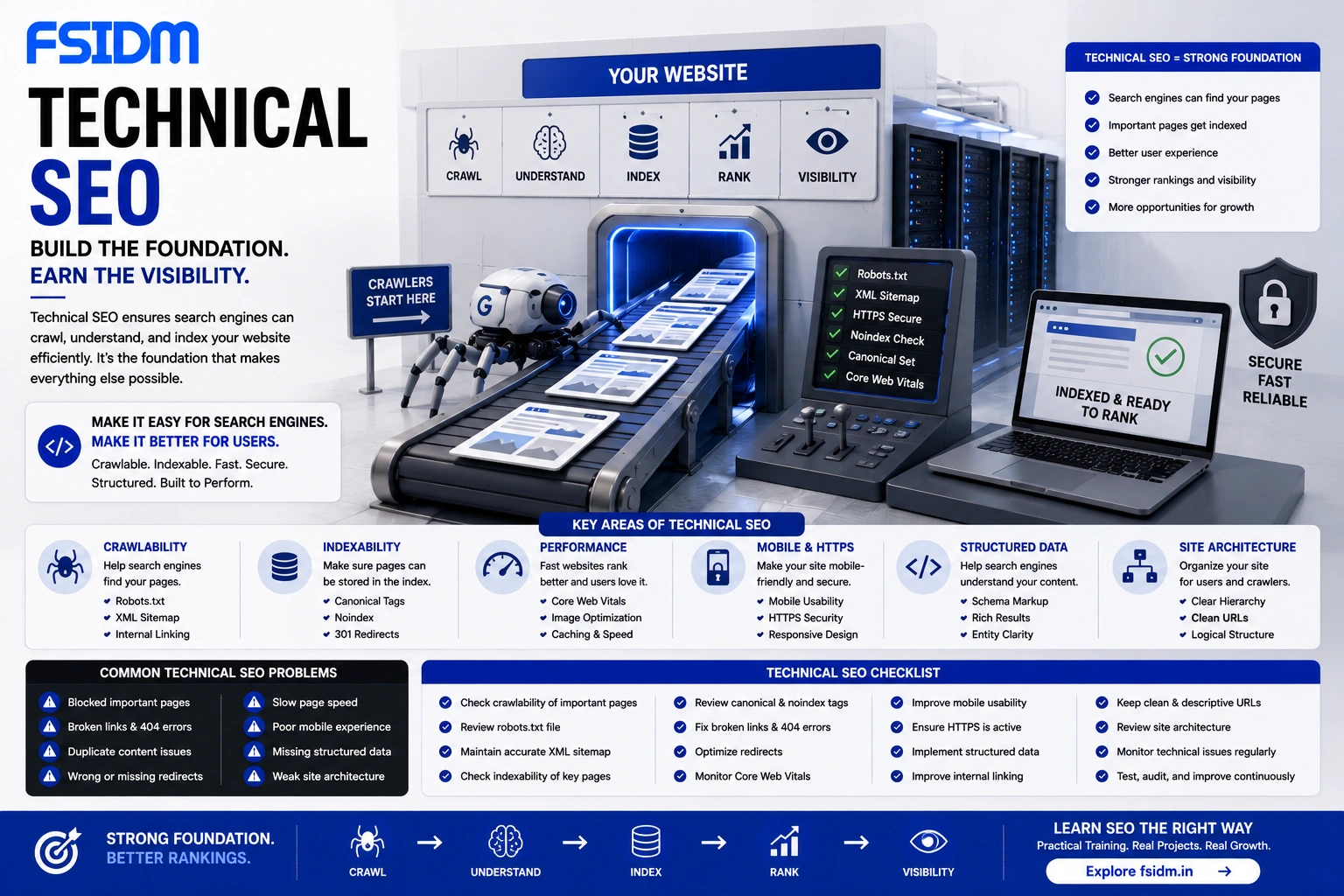
Technical SEO is the process of optimizing a website’s backend infrastructure to help search engine crawlers access, understand, and index its pages efficiently.
Unlike On-Page SEO, which focuses mainly on content and page-level relevance, or Off-Page SEO, which focuses on external authority signals, Technical SEO focuses on the technical foundation of your website.
A simple way to understand it is: Technical SEO makes your website easier for search engines to crawl, understand, and index.
Why Is Technical SEO Important?
Even excellent content can struggle to perform if search engines cannot properly access, render, or index your pages. Technical SEO helps remove these barriers and creates a strong foundation for your broader SEO strategy.
1. Crawlability: Can Search Engines Find Your Pages?
Crawlability refers to how easily search engine crawlers can discover and access pages on your website.
- Robots.txt: Configure your robots.txt file carefully so important pages are not accidentally blocked from crawling.
- XML Sitemap: Maintain an accurate sitemap containing important URLs and submit it through search engine webmaster tools.
- Internal Links: Create logical links between important pages so crawlers can discover your content efficiently.
- Crawl Efficiency: Reduce unnecessary duplicate, broken, or low-value URLs that can waste crawling resources.
2. Indexability: Can Search Engines Store Your Pages?
Indexability determines whether a page can be processed and included in a search engine’s index.
- Canonical Tags: Use
rel="canonical"to indicate the preferred version of similar or duplicate URLs. - Noindex: Use appropriate
noindexdirectives when a page should not appear in search results. - HTTP Status Codes: Ensure important pages return appropriate responses such as
200 OK, while correctly handling404errors and301redirects. - Duplicate Content: Manage multiple versions of similar pages so search engines can understand which URL should be indexed.
3. Website Performance and User Experience
Technical SEO also includes making sure your website loads and functions efficiently across devices.
Core Web Vitals
Core Web Vitals are Google’s user-experience metrics covering loading performance, responsiveness, and visual stability.
- Largest Contentful Paint (LCP): Measures loading performance.
- Interaction to Next Paint (INP): Measures responsiveness to user interactions.
- Cumulative Layout Shift (CLS): Measures visual stability.
Mobile-Friendly Experience
Your website should work properly on smartphones and other mobile devices. Content, navigation, buttons, images, and interactive elements should remain accessible and usable.
HTTPS
HTTPS protects communication between the website and its visitors. A properly secured website is an important part of a modern technical foundation.
4. Structured Data and Schema Markup
Structured data provides search engines with additional machine-readable information about the content and entities on a page.
For example, structured data can describe information such as a product, organization, article, event, recipe, or other supported content type.
When eligible, structured data can help search engines understand content and may support enhanced search-result features.
5. Website Architecture
A clear website structure helps both users and search engines understand how your content is organized.
- Create a logical hierarchy of pages.
- Use descriptive and understandable URLs.
- Connect related pages with relevant internal links.
- Keep important pages within a reasonable number of clicks from other important pages.
- Avoid unnecessary URL parameters and duplicate page variations where possible.
Technical SEO vs On-Page SEO vs Off-Page SEO
| SEO Type | Main Focus | Simple Analogy |
|---|---|---|
| Technical SEO | Backend infrastructure, crawlability, indexability, speed, and architecture. | The building, doors, wiring, and clean pathways of a store. |
| On-Page SEO | Content, keywords, headings, metadata, images, and page relevance. | The products, labels, and information inside the store. |
| Off-Page SEO | Backlinks, mentions, reputation, and external authority. | People recommending the store to others. |
Common Technical SEO Problems
- Important pages blocked by robots.txt.
- Accidental
noindexdirectives. - Broken internal links and 404 pages.
- Incorrect or unnecessary redirects.
- Missing or inaccurate XML sitemaps.
- Duplicate URLs and canonicalization problems.
- Slow page performance.
- Poor mobile usability.
- Incorrect or incomplete structured data.
- Weak internal linking and website architecture.
Technical SEO Checklist
- Check whether important pages can be crawled.
- Review your robots.txt file.
- Maintain an accurate XML sitemap.
- Check important URLs for indexability.
- Review canonical tags.
- Identify accidental noindex pages.
- Fix broken links and unnecessary redirect chains.
- Monitor Core Web Vitals and page performance.
- Test the mobile experience.
- Implement relevant structured data correctly.
- Improve internal linking and site architecture.
- Regularly monitor technical issues through search engine webmaster tools.
Frequently Asked Questions About Technical SEO
What is Technical SEO in simple words?
Technical SEO is the process of improving the technical foundation of a website so search engines can crawl, understand, and index its pages efficiently.
What are the main parts of Technical SEO?
The main areas include crawlability, indexability, website performance, mobile usability, HTTPS, structured data, internal linking, and website architecture.
Is Technical SEO only about website speed?
No. Website speed is only one part of Technical SEO. Technical SEO also covers crawling, indexing, redirects, canonicalization, sitemaps, structured data, site architecture, and other technical elements.
Why is an XML sitemap important?
An XML sitemap provides search engines with a structured list of URLs that you consider important, helping them discover those pages more efficiently.
What is the difference between crawling and indexing?
Crawling is the process of discovering and accessing web pages. Indexing is the process of processing and storing information about those pages so they can potentially appear in search results.
Does Technical SEO guarantee higher rankings?
No. Technical SEO helps create a strong foundation for search visibility, but rankings also depend on factors such as relevance, content quality, search intent, competition, authority, and other search-engine systems.
Interview Question: What Is Technical SEO?
Answer: Technical SEO is the process of optimizing a website’s technical infrastructure to help search engines crawl, understand, and index its pages efficiently. It includes areas such as crawlability, indexability, site speed, mobile usability, structured data, redirects, canonicalization, and website architecture.
Interview Tip
“Technical SEO builds the foundation that allows search engines to access, understand, and index your website properly.”
Learn Technical SEO With FSIDM
Technical SEO is an essential part of building a strong search engine optimization foundation. Understanding how crawling, indexing, site architecture, performance, and structured data work can help you diagnose real SEO problems instead of simply focusing on keywords.
At FSIDM, you can learn SEO and digital marketing through a practical, industry-focused approach.
Understand the technology. Fix the foundation. Build better search visibility.
Explore FSIDM at fsidm.in.