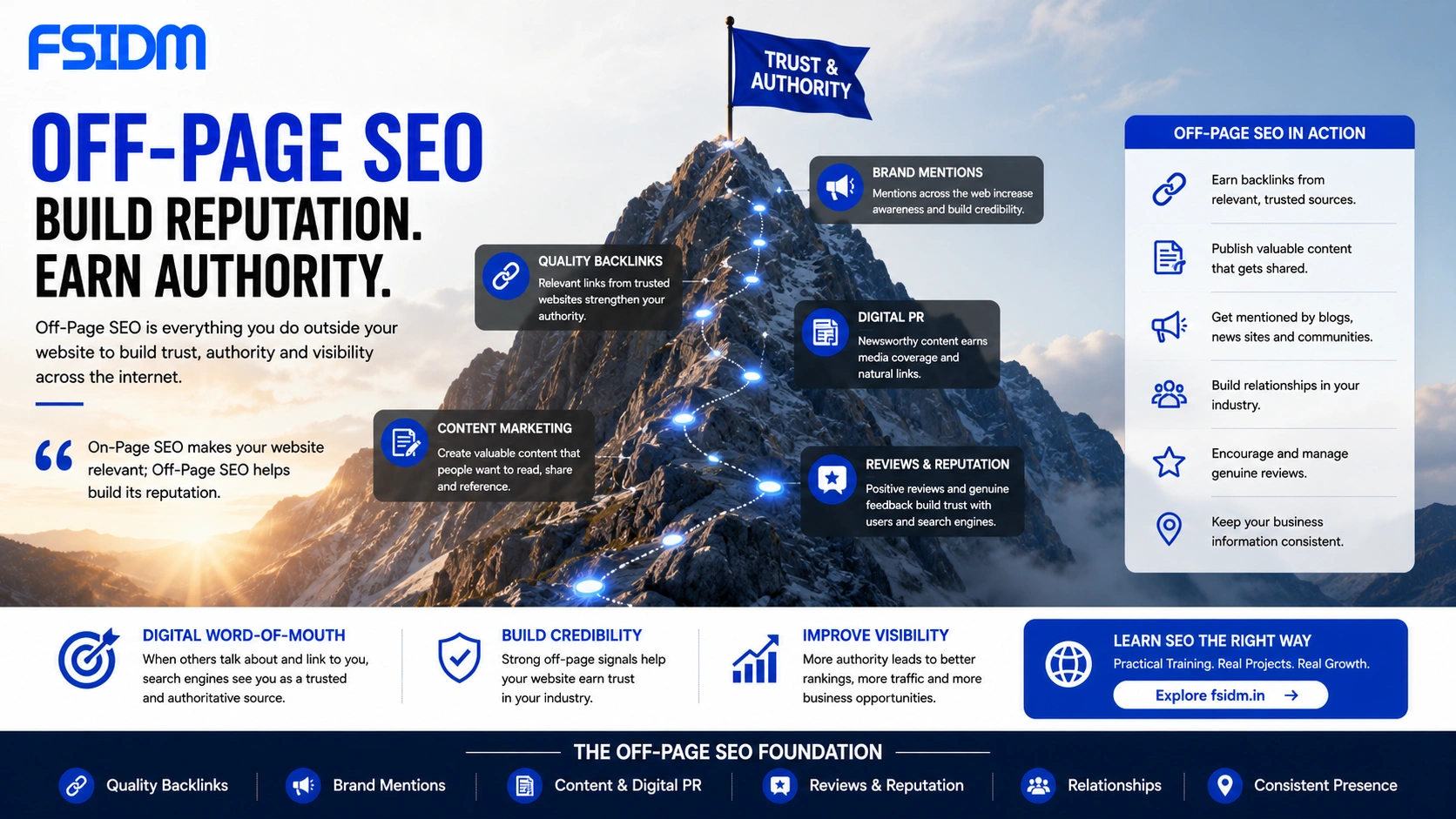
Off-Page SEO, also called off-site SEO, refers to activities performed outside your own website to improve its reputation, authority, trust, and visibility in search engine results.
While On-Page SEO focuses on elements you optimize directly on your website, Off-Page SEO focuses on how your website and brand are recognized and referenced across the wider internet.
A simple way to understand it is: On-Page SEO makes your website relevant; Off-Page SEO helps build its reputation.
Why Is Off-Page SEO Important?
Search engines need signals beyond the content on your own website to understand how trustworthy and authoritative a source may be. When relevant and reputable websites reference, mention, or link to your brand, they can provide valuable external signals.
Think of Off-Page SEO as digital word-of-mouth. If respected people and websites recommend your business, it can strengthen your online reputation.
1. Link Building
Backlinks are links from other websites pointing to your website. Earning relevant, high-quality backlinks can strengthen your website’s authority and help search engines discover relationships between websites and topics.
Natural Links
These are links that other website owners or publishers give naturally because they find your content useful and worth referencing.
Outreach Links
These are earned through legitimate outreach to relevant publishers, website owners, editors, or resource pages with useful content or resources.
Link Quality Matters
Not all backlinks have equal value. A relevant link from a trusted website can be more valuable than a large number of irrelevant or low-quality links. The goal should be quality, relevance, and natural acquisition, not simply collecting as many links as possible.
2. Content Marketing and Digital PR
Off-Page SEO also involves creating content and campaigns that encourage people, publishers, and organizations to talk about or reference your brand.
- Guest Contributions: Publish useful, original content on relevant industry websites where appropriate.
- Digital PR: Create newsworthy stories, research, data, tools, or expert insights that publishers may want to cover.
- Shareable Assets: Create original research, statistics, infographics, studies, and useful resources that other websites may reference.
3. Brand Mentions and Online Reputation
Your brand can be discussed online even when another website does not link to you. Brand mentions across relevant websites, publications, communities, and platforms can increase awareness and help establish your presence within your industry.
Social media can also amplify content and increase the number of people who discover your brand. Social shares themselves should not be treated as a simple direct Google ranking factor, but increased exposure can create opportunities for mentions, links, and branded searches.
4. Reviews and Local Reputation
For local businesses, reviews and external business profiles are important parts of building online reputation.
- Maintain an accurate Google Business Profile.
- Encourage genuine customers to leave honest reviews.
- Respond professionally to customer feedback.
- Maintain consistent business information across relevant directories and platforms.
Positive reviews can strengthen consumer trust and support local visibility, while consistent business information helps search engines and users understand your business.
On-Page SEO vs Off-Page SEO
| On-Page SEO | Off-Page SEO |
|---|---|
| Focuses on elements directly on your website. | Focuses on external signals surrounding your website and brand. |
| Optimizes content, headings, titles, images, URLs, and internal links. | Builds backlinks, mentions, reputation, digital PR, and external visibility. |
| Mostly under your direct control. | Often depends on third-party websites, publishers, customers, and communities. |
| Helps establish relevance and usefulness. | Helps build authority, reputation, and trust. |
Off-Page SEO Checklist
- Create genuinely useful content worth referencing.
- Build relationships with relevant publishers and industry websites.
- Earn relevant, high-quality backlinks.
- Use digital PR to promote original research, insights, and newsworthy assets.
- Build genuine brand mentions across relevant platforms.
- Encourage authentic customer reviews where appropriate.
- Maintain a consistent online business presence.
- Avoid spammy or manipulative link-building practices.
Common Off-Page SEO Mistakes
- Chasing backlink quantity: More links do not automatically mean better SEO.
- Buying low-quality links: Manipulative link schemes can create SEO risks.
- Ignoring relevance: A link should ideally come from a contextually relevant source.
- Using automated link-building: Mass-generated links can create an unnatural backlink profile.
- Focusing only on links: Off-Page SEO also includes reputation, mentions, PR, reviews, and broader brand visibility.
Frequently Asked Questions About Off-Page SEO
What is Off-Page SEO in simple words?
Off-Page SEO means activities performed outside your website to build its authority, reputation, trust, and visibility in search engines.
What are examples of Off-Page SEO?
Examples include earning backlinks, digital PR, relevant guest contributions, brand mentions, online reputation building, and customer reviews.
Are backlinks part of Off-Page SEO?
Yes. Backlinks are one of the most important and commonly discussed components of Off-Page SEO, but Off-Page SEO is broader than link building alone.
Are social media shares a direct Google ranking factor?
Social media shares should not be treated as a simple direct Google ranking factor. However, social platforms can increase content exposure and create opportunities for traffic, brand mentions, relationships, and naturally earned links.
What is the difference between On-Page SEO and Off-Page SEO?
On-Page SEO optimizes elements directly on your website, while Off-Page SEO focuses on external signals such as backlinks, mentions, digital PR, reputation, and reviews.
Interview Question: What Is Off-Page SEO?
Answer: Off-Page SEO is the practice of improving a website’s authority, reputation, and search visibility through activities outside the website, such as earning relevant backlinks, digital PR, brand mentions, and reputation signals.
Interview Tip
“On-Page SEO tells search engines what your website is about. Off-Page SEO helps demonstrate how the wider web recognizes and trusts your website.”
Learn SEO With FSIDM
Off-Page SEO is an essential part of a complete SEO strategy. Learning how to build genuine authority through content, relationships, digital PR, backlinks, and reputation can help you develop stronger long-term search visibility.
At FSIDM, you can learn SEO and digital marketing through a practical, industry-focused approach.
Learn the fundamentals. Practice the strategy. Build stronger digital visibility.
Explore FSIDM at fsidm.in.