Imagine having a shop that stays open 24 hours a day, answers customer questions while you sleep, and appears when someone is actively looking for what you sell.
That’s one way to think about SEO for a business.
SEO, or Search Engine Optimization, helps a business become more visible when potential customers search for its products, services, problems, or information. The value isn’t simply “more website traffic.” The bigger opportunity is being discovered when someone already has a need.
And that’s why SEO matters.
Why Is SEO Important for Businesses?
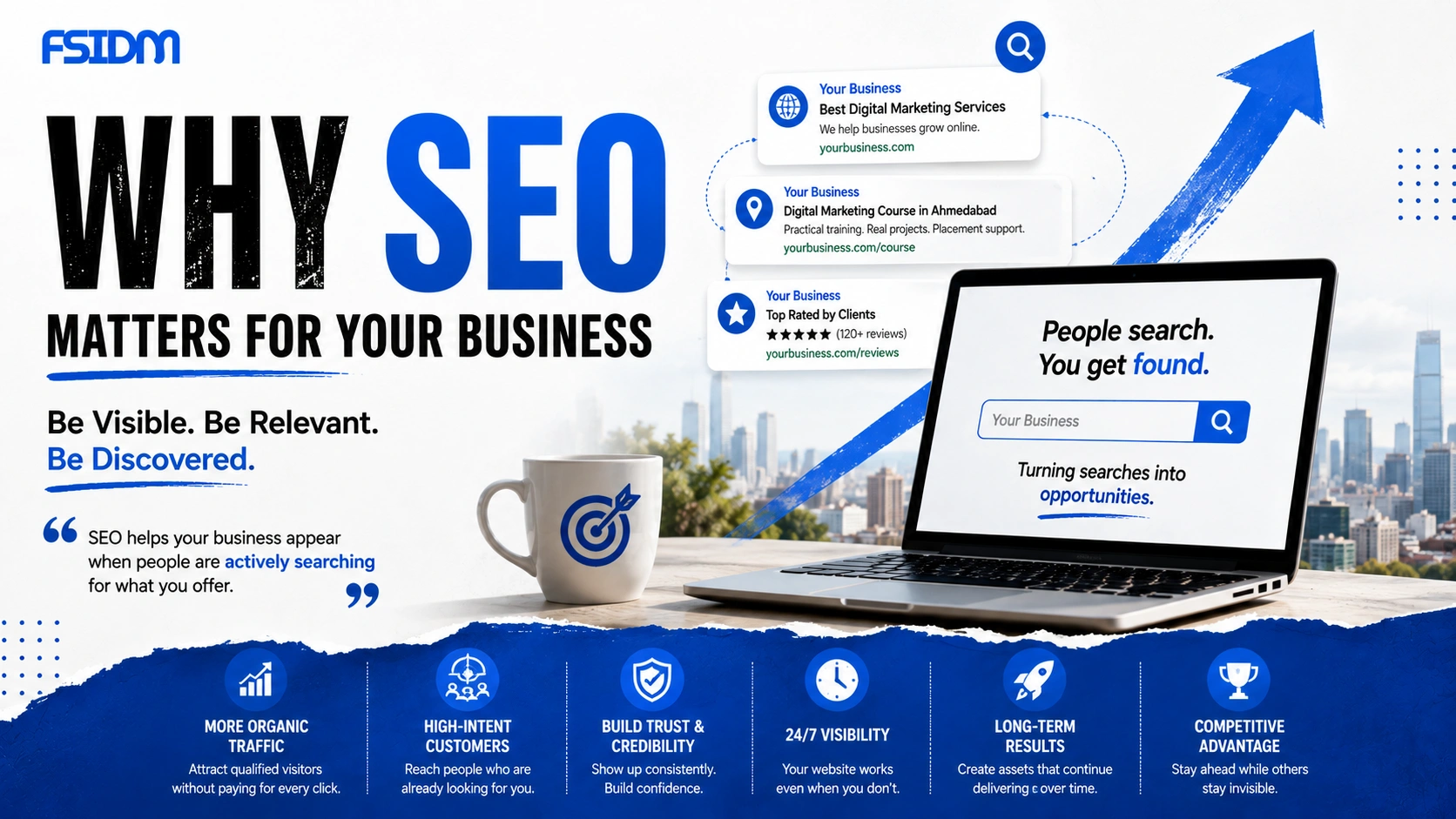
SEO can support business growth in several ways, from attracting organic visitors and reaching high-intent audiences to building visibility and creating a long-term digital asset.
The six reasons highlighted in the supplied Google Overview are particularly useful: organic traffic, high-intent customers, credibility, continuous visibility, long-term returns, and competitive advantage.
1. SEO Brings Organic Traffic
One of the biggest attractions of SEO is that organic search traffic does not work like paid advertising.
With PPC, a business generally pays for advertising exposure or clicks according to its campaign model. With organic search, a business earns visibility through its website’s relevance and search presence rather than paying the search engine for each organic click.
That doesn’t mean SEO is literally free. Businesses still invest in strategy, content, technical work, tools, people, and time.
The important difference is that organic visibility can continue generating visits without a separate payment for every click.
Simple Example
Suppose you create a useful page targeting a service that people regularly search for. If that page earns strong organic visibility, it can continue bringing relevant visitors while the page remains useful and competitive.
That creates an asset rather than treating every visitor as a separate advertising transaction.
2. SEO Reaches People With Search Intent
This is perhaps the most interesting reason SEO matters.
Someone scrolling through social media may not be thinking about your product at all. Someone searching for “best accounting software for small business” has already started a journey.
They have a question.
They have a problem.
They may be comparing options.
They may even be ready to buy.
SEO helps businesses compete for visibility at that moment of intent.
| Search Behaviour | Possible User Intent | Business Opportunity |
|---|---|---|
| “What is SEO?” | Learning | Build awareness and expertise |
| “SEO course in Ahmedabad” | Researching options | Generate enquiries |
| “best SEO agency Ahmedabad” | Commercial research | Acquire potential clients |
| “SEO agency near me” | Local service discovery | Generate local leads |
The query itself gives you a clue about what the person wants. That makes search intent one of the most valuable parts of SEO strategy.
3. SEO Can Build Trust and Credibility
Visibility can influence how people perceive a brand.
If a business repeatedly appears when people search for useful information within its area of expertise, it has more opportunities to become familiar to that audience.
But there is an important distinction: ranking alone does not automatically make a business trustworthy.
A search result can earn the click, but the website experience has to earn the confidence.
That means businesses should connect SEO with:
- Useful and accurate content
- Clear business information
- Strong website experience
- Customer reviews where relevant
- Demonstrated expertise
- Transparent information about products or services
SEO can help people discover you. Your actual business experience determines whether they trust you.
4. Your Website Can Work Beyond Business Hours
Your sales team may finish work at 7 PM.
Your website doesn’t have to.
A useful service page, product page, FAQ, comparison article, or educational guide can continue answering questions when your team isn’t available.
That makes organic search a potential 24/7 discovery channel.
For example, someone may search for a service at midnight, read your website, compare your offering with competitors, and submit an enquiry the next morning.
The website started the conversation before your salesperson ever picked up the phone.
5. SEO Can Create Long-Term Business Value
SEO is often slower than launching a paid campaign because organic visibility has to be earned.
But that’s also what makes the underlying asset valuable.
A genuinely useful article published today may continue attracting relevant visitors months or even years later if it remains accurate, useful, competitive, and visible in search.
That doesn’t mean every page will rank forever. Search results change. Competitors publish new content. Search intent evolves. Algorithms change.
The better way to think about SEO is:
SEO can create digital assets that continue working after the initial work has been completed.
6. SEO Helps Businesses Compete
Your customers are searching whether you optimize your website or not.
The real question is:
Who gets discovered when they search?
If your competitors consistently appear for valuable searches and your business doesn’t, those searches can become opportunities for your competitors instead.
SEO therefore isn’t only a traffic strategy. For competitive industries, it can become a market visibility strategy.
Think About It This Way
If ten companies sell a similar service and only a few consistently appear when customers search for that service, those businesses have an advantage before the customer even contacts anyone.
7. SEO Helps Businesses Understand Their Customers
There’s another benefit that often gets overlooked.
Search data tells you what people are curious about, what problems they have, what products they compare, and what language they use when describing those problems.
That information can influence much more than SEO.
- Content strategy
- Product development
- Sales messaging
- Landing pages
- FAQs
- Customer education
- Advertising campaigns
In that sense, search isn’t just a traffic source. It’s a window into customer intent.
SEO vs Paid Advertising
| Factor | SEO | Paid Search |
|---|---|---|
| Visibility | Earned through organic search | Purchased through advertising |
| Cost model | Does not require paying for every organic click | Typically involves advertising spend |
| Speed | Usually takes time to build | Can generate visibility quickly after launch |
| Longevity | Strong pages can continue generating organic visibility | Traffic generally depends on active campaigns and budget |
| Intent | Can capture informational and commercial searches | Can target high-value commercial searches |
| Control | Rankings and visibility are not directly purchased | Advertisers have greater control over campaign targeting and spend |
This isn’t really an “SEO versus PPC” argument. For many businesses, the strongest strategy uses both: paid search for speed and control, SEO for sustainable organic visibility.
How Much Does SEO Contribute to Business Growth?
The supplied Google Overview describes SEO as important for visibility, customer acquisition, and long-term profitability, but it does not provide a numerical benchmark for traffic, conversion rate, or ROI.
That matters because there is no universal SEO ROI percentage that applies to every business.
A local dentist, ecommerce store, SaaS company, real estate developer, and digital marketing agency have completely different search behaviour and conversion economics.
A better approach is to measure SEO against business-specific metrics such as:
- Organic clicks and qualified sessions
- Leads generated from organic search
- Organic conversion rate
- Revenue influenced by organic search
- Cost per organic acquisition
- Visibility for commercially important searches
A Simple Business Example
Imagine a dental clinic that wants more patients.
It could run advertisements for “dentist near me,” but it could also build organic visibility around searches such as:
- “dentist near me”
- “root canal treatment”
- “teeth cleaning cost”
- “best dentist for children”
- “how painful is a root canal”
Notice something interesting?
These searches aren’t all asking for the same thing.
Some users want a provider. Some want pricing information. Some are researching a treatment. Some are worried about pain.
An effective SEO strategy can address the entire customer journey, not just the final transaction.
The SEO Customer Journey
| Stage | User Thought | SEO Opportunity |
|---|---|---|
| Awareness | “I have a problem.” | Educational content |
| Research | “What are my options?” | Guides and comparisons |
| Evaluation | “Which provider should I choose?” | Service pages, reviews, proof |
| Decision | “I’m ready.” | Conversion-focused landing pages |
| Retention | “How do I use this properly?” | Support and educational content |
SEO Is Not a Magic Traffic Button
This is worth saying because businesses sometimes enter SEO with unrealistic expectations.
SEO does not guarantee first-page rankings. It does not guarantee sales. And publishing a hundred blog posts doesn’t automatically create a hundred successful pages.
SEO works when the strategy connects real search demand, useful content, technical accessibility, authority, user experience, and business goals.
The question shouldn’t be:
“How many keywords can we rank for?”
Ask instead:
“Which searches could bring us the customers we actually want?”
What Pranav Veerani Believes About Business SEO
Pranav Veerani’s perspective: “The value of SEO isn’t the traffic you can show in a report. It’s the business opportunity behind that traffic—the person who searched, found you, trusted you, and eventually chose you.”
This is why SEO reporting should go beyond rankings and sessions. Businesses need to understand whether organic visibility is reaching the right audience and contributing to meaningful outcomes.
Common Mistakes Businesses Make With SEO
- Expecting instant results: SEO generally takes time to build meaningful organic visibility.
- Measuring only rankings: A ranking has little value if it doesn’t reach a relevant audience.
- Calling SEO “free traffic”: Organic clicks don’t have a PPC-style per-click charge, but SEO still requires investment.
- Publishing without understanding search intent: More content isn’t automatically better content.
- Ignoring conversion: Traffic is only useful when it supports a meaningful business objective.
- Treating SEO as a one-time project: Search demand, competitors, websites, and user behaviour change.
Frequently Asked Questions About Business SEO
Why is SEO important for small businesses?
SEO can help small businesses become visible when potential customers search for their products, services, or local offerings. It can be especially useful for businesses competing within a specific geographic area or niche.
Is SEO better than paid advertising?
Neither is universally better. Paid advertising can provide faster visibility and more direct control, while SEO can build organic visibility over time. Many businesses benefit from using both strategically.
How does SEO help generate customers?
SEO can connect a business with people who are actively searching for relevant information, products, or services. Strong SEO combines visibility with useful content and clear conversion paths so visitors have a reason to take the next step.
How long does SEO take to produce business results?
There is no universal timeline. Results depend on competition, website condition, authority, content quality, search demand, technical implementation, and the business’s starting position.
Can SEO increase sales?
SEO can contribute to sales by attracting relevant search traffic and supporting users throughout the buying journey. However, sales depend on more than search visibility, including product quality, pricing, offer, website experience, trust, and conversion strategy.
SEO Interview Question and Answer
Interview Question: Why is SEO important for businesses?
Answer: SEO is important because it helps businesses improve organic search visibility and connect with people who are actively searching for relevant products, services, or information. It can support qualified traffic, lead generation, brand visibility, and long-term digital growth. Unlike paid advertising, organic search traffic does not require paying the search engine for every click, although SEO itself requires ongoing investment in content, technical optimization, tools, and people.
Interview Tip
If you’re answering this in an interview, don’t simply list “traffic, leads, sales.”
Connect SEO to search intent and business outcomes.
A stronger answer sounds like this:
“SEO matters because it helps a business become visible when customers are actively searching for solutions. If the right content appears at the right stage of the customer’s journey, organic search can contribute to traffic, leads, conversions, brand visibility, and long-term growth.”
Ready to Turn SEO Knowledge Into Practical Skills?
Understanding why SEO matters is one thing. Knowing how to build an SEO strategy for a real business is another.
If you want to learn how to research search intent, perform keyword research, audit websites, build content strategies, optimize pages, understand analytics, and work with modern AI-powered search, FSIDM (Full Stack Institute of Digital Marketing) can help you move from theory to practical digital marketing skills.
Don’t just learn why SEO matters. Learn how to make it matter to a business.