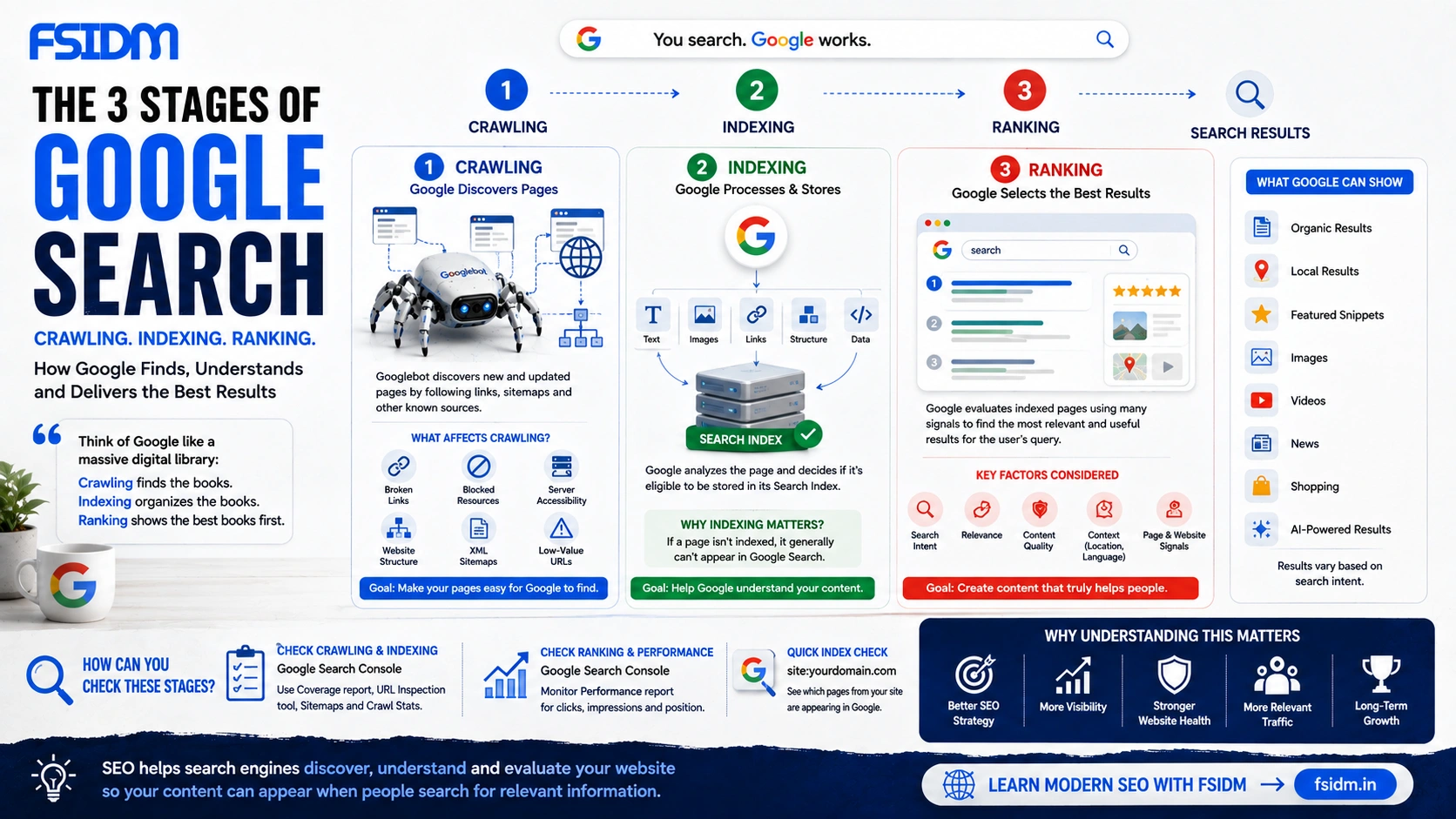
The three core stages of Google Search are Crawling, Indexing, and Ranking. These stages explain how Google discovers webpages, processes their information, and determines which results to show when someone searches.
Google does not scan the entire internet from scratch every time you perform a search. Instead, Google continuously discovers and processes webpages and maintains a large search index that its ranking systems can retrieve from.
What Are the Three Stages of Google Search?
Think of Google like a massive digital library:
- Crawling: Finding the books.
- Indexing: Organizing the books.
- Ranking: Choosing which books to show first.
1. Crawling: Google Discovers Webpages
Crawling is the discovery stage of Google Search. Google uses automated software called Googlebot to discover new and updated webpages.
Google can discover URLs through known webpages, links, and XML sitemaps. When Googlebot visits a page, it can follow links on that page to discover additional URLs.
Example of Crawling
Imagine you publish a new blog post about SEO. Google may discover that page through your XML sitemap or through an internal link from another page on your website.
Once Googlebot discovers the URL, it can request and process the page.
What Can Affect Crawling?
- Broken links
- Blocked resources
- Server accessibility
- Website structure
- XML sitemaps
- Large numbers of low-value URLs
For website owners, making important pages easy for Google to discover is an important part of technical SEO.
2. Indexing: Google Processes and Stores the Page
After Google discovers a webpage, its systems analyze and process the page’s content and other available information.
Google can examine elements such as:
- Page text
- Images and media
- Links
- Page structure
- Technical information
- Structured data
Google then determines whether the page is eligible to be included in its Search Index.
The index can be thought of as Google’s organized database of information discovered from webpages. A page generally needs to be indexed to have the opportunity to appear in Google’s organic search results.
Why Is Indexing Important?
Simply publishing a webpage does not guarantee that it will appear in Google Search. Google must first discover and process the page, and the page must be eligible for indexing.
Issues such as accidental noindex directives, duplicate content, or technical accessibility problems can prevent a page from appearing in search results.
3. Ranking: Google Selects the Best Results
Ranking is the stage where Google’s automated ranking systems determine which eligible pages are most relevant to a user’s search query.
When someone enters a query, Google retrieves relevant information from its index and evaluates it using many signals and systems.
These can include factors related to:
- Search intent: What the user is trying to accomplish.
- Relevance: How closely a page matches the query.
- Content quality: How useful the information is for the searcher.
- Context: Factors such as language and location.
- Page and website signals: Signals that help Google’s systems evaluate the result.
Google then orders eligible results and may display different search features depending on the query.
What Can Google Show After Ranking?
Depending on the search query and intent, Google can display different types of search results and features, including:
- Organic search results
- Local results
- Featured snippets
- Images
- Videos
- News results
- Shopping results
- AI-powered search features
The format can change depending on what Google believes will best satisfy the user’s search.
Crawling vs. Indexing vs. Ranking
| Stage | What It Means | SEO Example |
|---|---|---|
| Crawling | Google discovers a webpage. | Googlebot finds your new blog through a sitemap or internal link. |
| Indexing | Google processes and stores information about the webpage. | Google understands that your page is about SEO. |
| Ranking | Google evaluates eligible pages for a search query. | Your SEO article competes with other relevant pages for a position in the results. |
What Happens If One Stage Fails?
For a webpage to receive organic visibility, it needs to successfully move through the search process.
| Problem | What Happens | Possible SEO Action |
|---|---|---|
| Crawling problem | Google may not discover or access the page. | Improve internal linking, check accessibility, and maintain an XML sitemap. |
| Indexing problem | Google may not include the page in its Search Index. | Check noindex directives, duplicate content, and technical issues. |
| Ranking problem | The page is indexed but does not rank prominently. | Improve relevance, content usefulness, search-intent alignment, and overall SEO signals. |
How Can You Check These Stages?
Check Crawling and Indexing With Google Search Console
Google Search Console provides website owners with tools and reports that can help understand how Google interacts with their pages.
The URL Inspection tool can help you check the indexing status of a specific URL and identify certain issues affecting its availability in Google Search.
Use an XML Sitemap
An XML sitemap provides Google with a list of important URLs on your website. It can help Google discover pages, particularly when a website has many URLs or a complex structure.
Check Search Visibility
If a page is indexed but not receiving meaningful search visibility, the problem may be related to relevance, competition, content quality, or other ranking signals rather than crawling.
Simple Example: A New SEO Blog Post
Suppose you publish an article called “What Is SEO?”.
- Crawling: Google discovers the new URL through your sitemap or an internal link.
- Indexing: Google processes the article and determines whether it should be included in the Search Index.
- Ranking: When someone searches for “what is SEO?”, Google’s ranking systems evaluate your page alongside other eligible pages.
If your page is never discovered, it cannot move forward. If it is discovered but not indexed, it generally will not appear in organic search. If it is indexed but does not rank well, you need to improve the factors that influence its relevance and competitiveness.
Why Are These Three Stages Important for SEO?
Understanding these stages helps you diagnose SEO problems more accurately.
If a page isn’t appearing in Google, don’t immediately assume that the content needs more keywords. First ask:
- Can Google discover the page?
- Can Google access and index the page?
- Is the page relevant and useful enough to compete in search results?
This simple framework can help separate technical SEO problems from content and ranking problems.
Frequently Asked Questions About Google Search Stages
What are the three stages of Google Search?
The three core stages are crawling, indexing, and ranking. Google discovers webpages, processes and stores information about them, and then ranks eligible pages for relevant search queries.
What is crawling in SEO?
Crawling is the process through which Google’s automated systems discover webpages and URLs across the web.
What is indexing in SEO?
Indexing is the process of processing and storing information about webpages in Google’s Search Index so that they can potentially appear for relevant searches.
What is ranking in SEO?
Ranking is the process of ordering eligible search results based on their relevance and other signals for a particular search query.
Can a page be crawled but not indexed?
Yes. Google can discover and crawl a webpage without necessarily including it in the Search Index.
Can a page be indexed but not rank well?
Yes. A page can be indexed but still rank poorly because other pages may be more relevant, useful, authoritative, or competitive for the query.
Interview Question: What Are the Three Stages of Google Search?
Answer: The three stages of Google Search are crawling, indexing, and ranking. Crawling helps Google discover webpages, indexing processes and stores their information, and ranking determines which eligible pages are most relevant to a user’s search query.
Interview Tip
“Crawling finds the page, indexing understands and stores it, and ranking decides where it appears.”
Learn SEO With FSIDM
Understanding crawling, indexing, and ranking gives you the foundation needed to understand technical SEO and search visibility.
At FSIDM, the goal is not just to teach you SEO techniques, but to help you understand how search actually works so you can make better marketing decisions.
Learn the system. Understand the process. Build better SEO strategies.
Explore FSIDM at fsidm.in.